
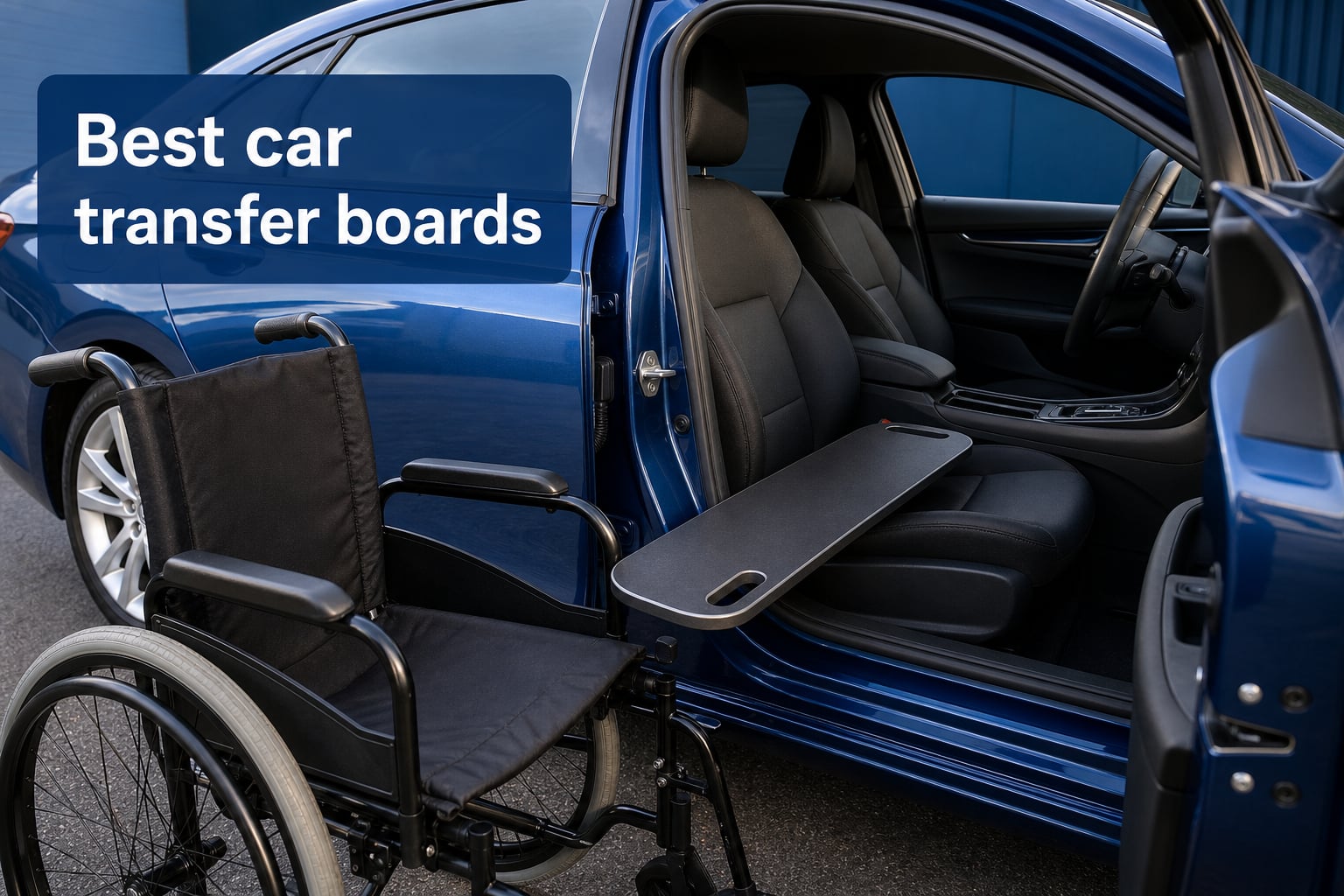
The best car transfer boards create a bridge between a wheelchair and vehicle seat, so a person can slide across instead of attempting to lift their full body weight over the gap. That sounds simple, but transfer success depends on seat height, the gap, upper-body control, clothing friction, and whether a trained helper is present.
I selected 12 current wheelchair transfer board and transfer-assistance products with the car use case in mind. The group includes conventional wood boards, low-friction plastic slide boards, turning-disc designs, and one handled transfer pad; a board is not a substitute for an assessment from a PT or OT.
For 2026, my short answer is to start with a board that fully bridges the gap while leaving stable contact on both surfaces, then match its stated capacity and form factor to the user and vehicle. A sedan with a relatively level transfer usually works more comfortably than a high SUV seat, while a large height difference may call for caregiver help or a powered transfer solution instead.
The top three car transfer boards cover three common needs 2026
These are the three models I would compare first: the Suboton for its stated 441-pound capacity and included non-slip pad, the extra-wide Urby for a broad wood platform, and the Vive for its established review volume and sealed-wood construction. The right choice still depends on the transfer path and a clinician’s recommendation.
The best car transfer boards in 2026 are compared below
The overview shows what matters at a glance: stated capacity, board material, length, and features that influence positioning. Verify the current listing details and ask a therapist to observe the first transfer if the user has changed strength, balance, or skin condition.
The OUWERALL transfer pad suits assisted moves rather than a rigid slide

Heavy – Duty Wheelchair Transfer Pad – 260 LBS Capacity, 8 Sponge Handles, Oxford Fabric – Patient Lift Transfer Mat for Wheelchair to Bed/Car – Elderly & Disabled Assistance, With Instructions Manual
260 lb capacity
8 sponge handles
Oxford fabric
Pros
- Eight padded handles
- Reinforced stitching
- One-year warranty
Cons
- Rigid board format not stated
- 25-review sample
The OUWERALL is materially different from the rigid wheelchair sliding boards in this guide. It is a fabric transfer pad rated for 260 pounds, with eight thickened sponge handles, two reinforcing straps, and cross-reinforced stitching.
That layout gives a caregiver several places to hold during a coordinated move into or out of a car. Its listed 1.85-pound weight also makes it simple to keep in a vehicle, but it does not provide the firm bridging surface of a wood or ABS board.
The padded handles make this pad a caregiver-focused option
I would consider it when a helper needs controlled hand positions and the person being moved is not expected to perform a seated slide independently. The breathable Oxford fabric and stated one-year warranty are useful details for regular assisted use.
The 260-pound stated limit needs a careful match
Do not treat the rating as a reason to skip technique or extra assistance. For a car move, confirm that the person can be supported throughout the repositioning process and follow a clinician’s transfer plan.
The VieTRIOMPHE Pivot-Glide helps when a turn is part of the transfer

Pivot-Glide Transfer Board with 360° Rotating Seat, 460lbs Support
360 degree seat
400 lb capacity
Low-friction board
Pros
- Rotating turntable
- Rubber-padded underside
- Dual handles
Cons
- 8.2 lb packaged weight
- 10-review sample
The VieTRIOMPHE Pivot-Glide combines a board with a 360-degree rotating turntable. Its listing states a 400-pound capacity in the feature data, low-friction board surface, anti-slip threaded turntable surface, and rubber pads under the board.
A pivoting seat can reduce the need to twist across a car doorway, which is the attraction here. The claimed 7.2-pound design weight is portable for this category, though the listed package weight is 8.2 pounds.
The rotating seat addresses directional changes at the car door
This is the most purposeful option here for a transfer that requires both sliding and turning. The tapered edges and rounded corners may help with placement, but they do not make an uneven or steep transfer path safe by themselves.
The long platform needs space before it can work
The package dimensions list 36.8 inches in length, so measure the open doorway, wheelchair approach, and storage spot first. A caregiver should stabilize the wheelchair and check that the board is seated securely on both transfer surfaces.
The Urby Plus Size board offers a wide, thick wood platform

Rubberwood Transfer Board, Slide Board for Transferring, Plus Size, XXL
36 x 10 x 1 inch
400 lb capacity
Rubberwood
Pros
- Extra-wide platform
- Smooth finish
- Handholds
Cons
- 9.7 lb listed weight
- Wood needs dry storage
The Urby Plus Size XXL is a 36-by-10-by-1-inch Rubberwood board with a stated 400-pound capacity. Compared with an 8-inch board, its extra width can offer more room for deliberate repositioning during a wheelchair-to-car transfer.
Two cutout handholds, rounded corners, and a smooth surface finish support handling. It is also the heaviest conventional board in this selection at a listed 9.7 pounds, so it may not be the easiest board to carry independently.
The 10-inch width favors a transfer needing more landing room
Width is meaningful for people who need extra room for hand placement or a more gradual move. It should not hang so far out that it creates an unstable cantilever between the chair and the car seat.
The 36-inch length can bridge a larger gap
That length can be helpful at a vehicle doorway, but it also needs room to position without obstructing the move. Check the actual wheelchair-to-seat gap while the chair is locked and the car seat is in its usual travel position.
The Suboton board combines a high stated capacity with a non-slip pad
![Transfer Board and Slide Board for transferring, Sliding Board Transfer to Wheelchair, Patient Transfer, Transfer Boards from Wheelchair to Car, Toilet, Tub [Patent Pending]](https://m.media-amazon.com/images/I/31wEr7S8kML._SL160_.jpg)
Transfer Board and Slide Board for transferring, Sliding Board Transfer to Wheelchair, Patient Transfer, Transfer Boards from Wheelchair to Car, Toilet, Tub [Patent Pending]
441 lb capacity
29.5 inch ABS board
Non-slip pad
Pros
- 441 lb capacity
- Three grip points
- Tapered ends
Cons
- 4.5 lb weight
- 24-review sample
The Suboton is a 29.5-inch ABS polymer slide board listed with a 441-pound capacity, three built-in handles, tapered ends, and side notches. It includes a 10-inch non-slip round pad, which is a useful differentiator for people who need a more controlled sitting surface.
Its smooth, burr-free glide surface is intended to reduce snagging while the tapered ends help the board sit under a user. I like the blend of a low-friction transfer surface and multiple grip options for a standard-height vehicle seat.
The three handles provide choices for board placement
Multiple grip points can help a user or helper reposition the board without reaching under a person. Keep fingers clear of pinch zones and do not use a handle as a substitute for stabilizing the wheelchair and vehicle seat.
The 29.5-inch span fits many car-door gaps
This is a practical middle length for bringing in a board without storing an oversized plank. Measure first, because a board must overlap both surfaces adequately rather than merely touch them.
The Weybaihe wood board prioritizes a 500-pound stated capacity

Weybaihe Wood Slide Transfer Board with 2 Cut out Handles 24 * 8 * 0.75″
500 lb capacity
24 x 8 inch
Polished wood
Pros
- 500 lb stated capacity
- Two handles
- Smooth finish
Cons
- 24 inch base length
- Wood construction
The Weybaihe base model is a 24-by-8-by-0.75-inch heavy-duty wood board with a stated 500-pound capacity. Its two cutout handles and evenly polished surface keep the design conventional and straightforward.
The listing also presents longer and wider variants, although this selection is the 24-inch version. At a listed 2.65 pounds, it is among the lighter rigid boards here, which matters if the board must be carried between the chair and car.
The 500-pound stated rating is its defining specification
Capacity should cover the user’s body weight with a reasonable margin, but it is only one part of a safe transfer. Board placement, a level path, skin protection, and the person’s seated balance remain just as important.
The 24-inch length is best for close, level surfaces
A short board can be manageable in tight spaces but may not span a wide doorway gap. For a car transfer, check the gap with the wheelchair placed at the angle the user actually takes.
The COW&COW kit pairs a wood board with a transfer belt

COW&COW 30″ Wooden Transfer Board and 60″ Transfer Belt Kit for Patient, Senior and Handicap Move Assist and Slide Transfers (30Inch)
30 inch hardwood board
300 lb board
60 inch belt
Pros
- Board and belt included
- Tapered ends
- Rounded corners
Cons
- 300 lb board capacity
- Wood only
The COW&COW kit includes a 30-inch hardwood board and a 60-inch cotton transfer belt with a metal buckle. The board is listed at 8 by 30 by 0.75 inches, has two open hand cutouts and tapered ends, and carries a stated 300-pound capacity.
The belt is listed with a 350-pound capacity, which does not change the board’s own 300-pound limit. A belt can give a trained helper a better hold, but it is not a lifting sling and should be used according to professional instruction.
The included belt may suit a trained helper’s routine
For assisted transfers, a belt can offer a more controlled way to guide the user’s trunk than pulling on arms or clothing. It needs correct placement and communication; never use it to force a transfer that is unstable.
The 30-inch board offers more reach than a short board
Thirty inches can help bridge a moderate gap while remaining easier to stow than a 36-inch model. The stated capacity is lower than several alternatives, so this kit needs a strict weight and use-case check.
The LOSCHEN turntable board supports a wide-gap pivot-and-slide move

LOSCHEN Slide Transfer Board with Turntable, Slide Assist Device for Transferring or Seniors from Wheelchair to Bed, Toilet, Tub, Car – Slide Board with Turntable(Blue 29.5inch)
29.5 inch board
12 inch rotating disc
ABS plastic
Pros
- 360 degree disc
- Anti-slip top and underside
- Storage hole
Cons
- 7.45 lb weight
- Caregiver assistance stated
The LOSCHEN turntable model uses a 29.5-inch ABS board and a 12-inch, 360-degree rotating sliding disc. The listing states that its extended design can bridge wider gaps and adds anti-slip texture on the disc and non-slip patterning on the underside.
Its product data specifically says it must be used with caregiver assistance. That clear limitation makes it a better fit for coordinated transfers than for someone looking for a solo wheelchair car transfer device.
The rotating disc can reduce twisting during the move
A turning disc is relevant when the wheelchair approach and car-seat orientation do not line up. The helper still needs to control the pace, especially if the car seat is lower than the wheelchair.
The ABS construction favors routine clean-up
The listing describes the plastic as moisture resistant and crack-proof, with a hanging hole for storage. Wipe it clean and inspect the board and textured surfaces before use, particularly after it has traveled loose in a vehicle.
The LOSCHEN short board adds a tubular slide sheet
LOSCHEN Upgrade Short Version 27-inch Transfer Board with Tubular Slide Sheet(16″x24″),Transfer from Wheelchair to Bed, Toilet, Tub, Car, Slide Assist Device for Transferring, Weight Capacity 440 lbs
440 lb capacity
27.6 inch ABS board
Tubular sheet
Pros
- Slide sheet included
- Light 3.5 lb build
- Non-slip back
Cons
- Shorter reach
- 12-review sample
This LOSCHEN short version is an ABS board listed at 27.6 by 7.7 by 0.5 inches with a 440-pound capacity. It includes a 24-by-16-inch tubular slide sheet and uses a non-slip back with rounded, smooth edges.
The slide sheet may help reduce friction during repositioning, but it also changes how quickly a person moves. That is a reason to rehearse the setup with a therapist or trained caregiver rather than assuming smoother always means safer.
The tubular sheet is useful when clothing creates drag
People often find that fabric choices affect how a board behaves. A slide sheet can make a seated move easier, yet it needs a controlled setup so it does not create an unexpected fast slide.
The 27.6-inch board suits smaller gaps
The shorter length and listed 3.5-pound weight help with carrying and storage. It may not bridge a wide wheelchair-to-SUV-seat gap, so use a tape measure before deciding.
The Vive wood board balances a familiar shape with broad review history

Vive Transfer Board – Patient Slide Assist Device – Transferring from Wheelchair to Bed, Toilet, Car, Bathtub – Heavy Duty Sliding for Elderly, Handicapped, Disabled (24x8x0.75)
440 lb capacity
Sealed wood
Dual handholds
Pros
- 1.1k+ reviews
- Sealed wood
- Tapered ends
Cons
- 24 inch base variant
- Wood can be moisture affected
The Vive board is a sealed wood transfer board with dual cutout handholds, rounded corners, tapered ends, and a stated 440-pound capacity. The analyzed listing shows more than 1,000 reviews, the largest review sample in this roundup, plus a 60-day Vive guarantee.
There is a size inconsistency worth checking in the listing: the selected product details call out a 24-by-8-by-0.75-inch size, while technical details reference a 36-inch version and the page lists multiple variants. Confirm the chosen size before ordering.
The sealed wood surface aims to reduce snags
A smooth board can be more comfortable for clothing and may help a user reposition in small increments. Inspect any wood board for chips, moisture damage, or rough edges before every transfer.
The available size variants give this board flexibility
A 24-inch board may suit close surfaces, while longer formats can offer more positioning flexibility. The safe choice is the one that overlaps both surfaces well without forcing an awkward reach.
The LOSCHEN A-handle board is a straightforward 320-pound slide board

LOSCHEN Slide Transfer Board, Patient Slide Assist Device for Transferring Patient or Handica from Wheelchair to Bed, Toilet, Tub, Car – Slide Board with A Handle,Weight Capacity 320lbs
320 lb capacity
A-handle
Anti-slip back
Pros
- Easy-grip handle
- Curved edges
- Two length options
Cons
- 320 lb capacity
- No slide sheet
The LOSCHEN A-handle board has a stated 320-pound capacity, anti-slip backing, a cutout handle, and curved smooth edges. It is listed in 31-inch and 27-inch versions, giving a choice between reach and compact storage.
This is a no-frills patient transfer board for horizontal back-and-forth movement. The handle is intended for the user and caregiver to grasp during placement, not as an anchor when the board is already carrying body weight.
The anti-slip back helps the board stay planted
Non-slip backing can improve traction at the contact point, but it cannot compensate for a board that is too short or poorly supported. Check both ends after every repositioning movement.
The 320-pound stated capacity defines its use range
Do not compare this number casually with the 440- and 500-pound boards in this list. It should be selected only when the user’s weight and transfer plan fit the stated limit with professional guidance.
The YHK board combines a long profile with a toothed non-slip pattern

YHK Sliding Transfer Boards, Sliding Boards to Transfer to Wheelchairs, Seniors from Bed to Chair, Car, Slide Assist Device, Sliding Boards Hold up to 440 lbs (Blue)
440 lb capacity
31 inch length
Plasticized steel
Pros
- 440 lb capacity
- Curved handle
- Toothed grip pattern
Cons
- Two strong hands needed
- Scratching risk without mat
The YHK is a 31-inch slide board made from plasticized steel, with a stated 440-pound capacity, curved handle, and toothed granule pattern intended to prevent slipping. Its listing positions it for transfers among beds, chairs, wheelchairs, and cars.
The review insights flag two important practical limitations: solo use calls for two sound, strong hands, and the board may scratch car seats or bed sheets without a protective mat. Those are useful reminders that surface protection and user capacity are part of the setup.
The 31-inch length can help across a car-door gap
Longer reach can create a less abrupt bridge when the wheelchair cannot get very close to the seat. It can also add leverage against the contact surfaces, so stable overlap at both ends is non-negotiable.
The board needs protection around vehicle upholstery
Use a suitable protective layer only if it does not create slip or instability, and get clinician guidance on that choice. Check the car seat material and remove any object that could catch clothing or skin.
The LOSCHEN two-cutout board is a portable straight ABS option

LOSCHEN Slide Transfer Board with Two Hand Cutouts, Seniors Transfer from Wheelchair to Bed, Toilet, Tub, Car, Slide Assist Device for Transferring, Weight Capacity 440 lbs
440 lb capacity
30 inch ABS board
Two cutouts
Pros
- 440 lb capacity
- Non-slip underside
- Compact straight shape
Cons
- Caregiver help often needed
- Clothing affects glide
The LOSCHEN two-cutout board is a straight ABS plastic board listed at 30 inches long, 7.9 inches wide, and 0.55 inches thick, with a 440-pound capacity. Its feature list highlights a burr-free finish, non-slip underside, and a smaller form intended to be easier to hold and carry.
The analyzed review insights are appropriately cautious: solo transfers can be difficult, clothing changes slide effectiveness, and a height difference can make a person slide too quickly. Those warnings make it clear that the board’s light, straightforward shape is not an automatic independence tool.
The straight board format suits a direct side-to-side path
A straight transfer board is commonly easiest when the wheelchair and vehicle seat are close and relatively level. It is less forgiving when the user has to turn sharply into a tall seat.
The 30-inch size is a practical carry-and-store compromise
This length can bridge more than a 24-inch board while remaining manageable in a car. Before use, lock the wheelchair, move or remove obstacles, and confirm the board is not resting on a seat-belt buckle.
A safe car transfer board choice starts with the transfer path
A car transfer board works by making a smooth bridge between the wheelchair and vehicle seat. It is generally most suitable for someone who can sit upright with some upper-body strength and balance, or for a person who has trained assistance.
Community discussions repeatedly point to the same reality: many people need one or more helpers, and physical therapists recommend learning technique before trying an independent transfer. Treat the first transfer in a new vehicle as a supervised practice, not a routine errand.
A straight board is better for a direct, level move
Straight boards such as the Suboton, Vive, YHK, and two-cutout LOSCHEN models fit a close, mostly horizontal side-to-side transfer. Their main job is to span the gap while supporting small, controlled scoots.
A curved or turning-disc design makes more sense where the user must change direction while moving into the seat. It does not solve a large vertical rise, limited trunk control, or a transfer surface that cannot be stabilized.
A sedan is usually easier than a tall SUV for board transfers
Lower cars often give a more level move from wheelchair to seat, while a tall SUV can introduce a steep upward climb or an uncontrolled downward slide. Vehicle seat height, door opening, sill height, and how close the wheelchair can park all deserve a real-world check.
Move the car seat to its normal transfer position, clear loose mats and buckles, and measure the gap before selecting a length. If the geometry is difficult, a seat lift, vehicle modification, or another transfer method may be safer than forcing a board to work.
Capacity and board dimensions must match the person and car
Choose a stated capacity that fits the user and the clinician-approved plan, then check width, length, thickness, material, and weight. Wood boards can feel familiar and smooth; ABS and metal-based boards can offer moisture resistance and textured traction features.
Longer is not always better. A board that is too long can be difficult to position in a compact doorway, while one that is too short can lose safe overlap with the vehicle seat.
A transfer board is not the same as a vehicle lift
Use a board for a controlled seated slide where the surfaces are close enough and the person has the required stability or help. Consider a lift or seat-transfer system when the vehicle is high, the person cannot safely do a seated slide, or caregivers are routinely lifting substantial weight.
A transfer lift can address vertical movement that a board cannot. A PT, OT, rehabilitation clinician, or qualified mobility provider can assess the person, wheelchair, and specific vehicle together.
A simple safety sequence reduces avoidable transfer mistakes
Park on level ground, set the vehicle brake, and create enough space beside the seat.
Lock the wheelchair, remove or move obstacles according to the user’s transfer plan, and position the chair as close as practical.
Place the board with secure overlap on both surfaces; keep it clear of buckle hardware and unstable trim.
Use small moves, protect skin from shear, and keep a helper in the agreed position if assistance is required.
Stop if the board shifts, the transfer becomes steep, the user feels dizzy, or control is lost.
Common mistakes include choosing a board solely by stated capacity, leaving too little board on the car seat, sliding too fast down from a higher surface, and attempting solo use without the hand strength or balance needed. Never pull a person by the arms or rush an unfamiliar setup.
FSA and HSA eligibility needs confirmation before purchase
Some transfer aids may qualify for FSA or HSA spending, but eligibility depends on the plan, documentation, and current rules. Verify it with the plan administrator and retain the product information and receipt if required.
Also inspect the board before each use for cracks, sharp edges, loose pads, worn non-slip surfaces, or moisture damage. Clean it according to the maker’s directions and store it where it will not warp or become a tripping hazard.
The most common transfer-board questions have clear safety-first answers
What is the best transfer board?
The best transfer board is one that securely overlaps the wheelchair and vehicle seat, fits the user’s stated capacity needs, and matches the transfer path. For a conventional rigid car board, the Suboton combines a stated 441-pound capacity, three handles, tapered ends, and a non-slip pad; a PT or OT should confirm the fit.
Is a straight or curved transfer board better?
A straight board is usually better for a close, mostly level side-to-side transfer. A curved board or a board with a rotating disc can help when the person must turn into the vehicle seat, but neither design makes a steep or unstable transfer safe.
What are common sliding board transfer mistakes?
Common mistakes are using a board that is too short, failing to lock the wheelchair, leaving inadequate overlap on the car seat, ignoring a large height difference, and sliding too quickly. Practice the setup with a PT, OT, or trained caregiver before an independent transfer.
What is the easiest vehicle for a wheelchair transfer?
A lower vehicle with a wide door opening and a seat that creates a relatively level move from the wheelchair is usually easier for a board transfer. Sedans often fit that description better than tall SUVs, but the user’s wheelchair height and transfer technique decide the real fit.
What are the risks of sliding board transfers?
Risks include falling, skin shear, pinched fingers, loss of balance, and a board slipping or shifting. Risk rises with a large gap or height difference, poor trunk control, weak hands, unsuitable clothing friction, or an attempt to transfer without required assistance.
The best car transfer board is the one that fits the person and vehicle
For the best car transfer boards in 2026, the Suboton is a strong conventional choice for its stated 441-pound capacity, three handles, and non-slip pad; the Urby is compelling for a wide 36-by-10-inch wood platform; and the VieTRIOMPHE or LOSCHEN turntable models deserve attention where a controlled turn is part of the transfer.
Start with measured vehicle geometry and professional technique, then compare the verified specifications above. A safe transfer is more important than a quick one.