
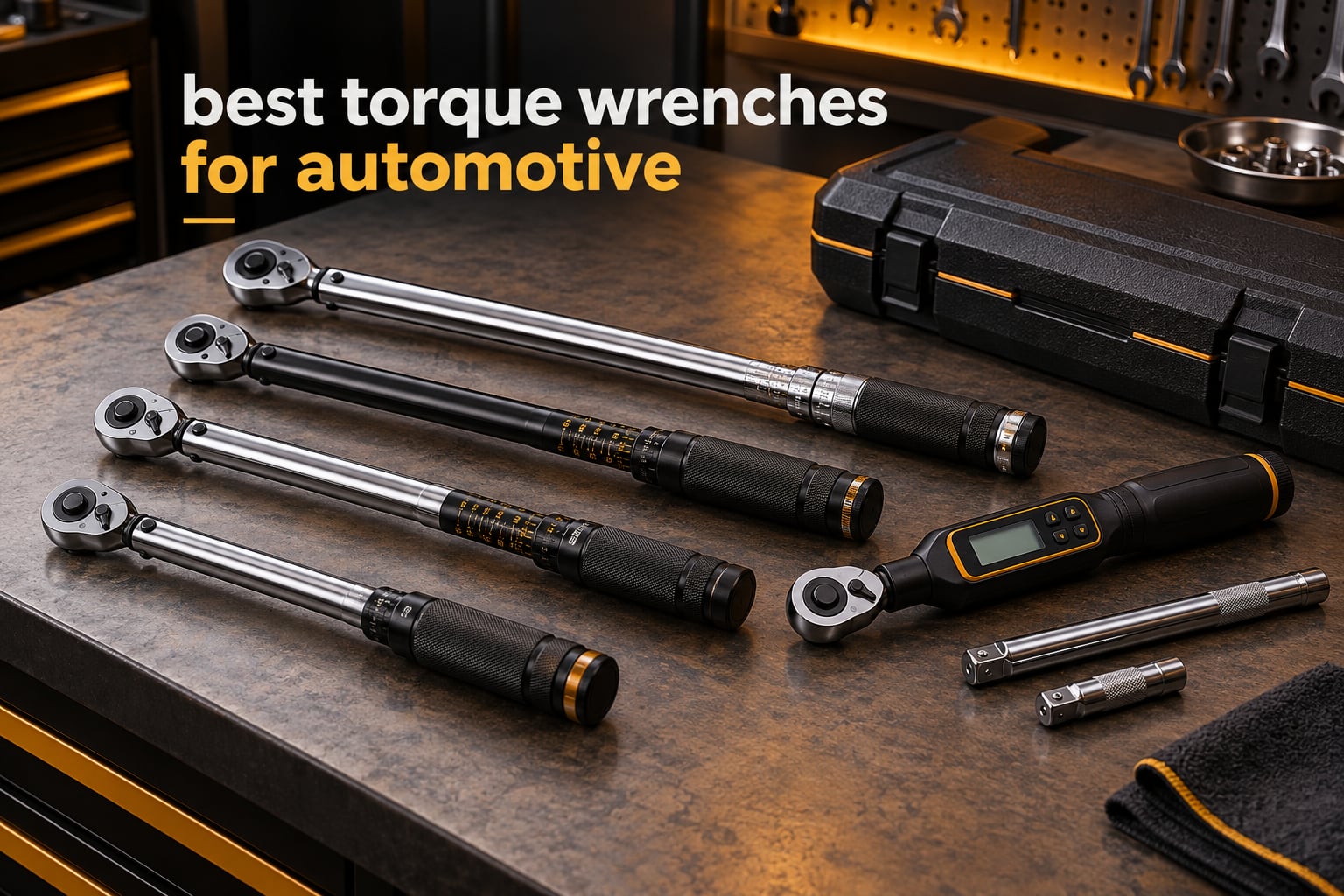
Torque is the one number that separates a repair that holds from one that comes apart six months later. Under-torque a wheel bearing and the hub develops play until it eats itself; over-torque a head bolt and you stretch the fastener past its yield point so it never recovers. The best torque wrenches for automotive work let you hit the service manual figure every time instead of guessing by feel, and the twelve picks below cover everything from a weekend oil change to a daily professional shop.
We spent weeks putting these wrenches through the jobs that actually separate a good tool from a bad one: lug nuts, caliper bolts, valve cover fasteners, suspension arms and oil drain plugs. What we kept coming back to is that drive size and range matter more than brand, and that the accuracy printed on the box is a starting point rather than a promise. Every pick below is listed with its real range, its stated tolerance and the type of work it handles best.
If your immediate need is a readout rather than a click, our digital torque wrench roundup covers that side in more detail. If you are building a kit and the fasteners are the heavy ones, start with the impact wrench guides on impact wrenches for automotive use and cordless impact wrenches so you know which fastener never needs a torque wrench at all.
Top 3 Torque Wrench Picks for Automotive Work in 2026
Our three headline picks cover the ranges that most home and shop work falls into: a mid-range 1/2 inch clicker with 23k reviews, a long-range 1/2 inch clicker, and a 4.7-star 1/2 inch clicker that is supplied with a calibration certificate.

EPAuto 1/2 Inch Click Torqu…
- 10-150 ft-lb range
- Chrome vanadium ratchet head
- Plus or minus 4 percent accuracy
- Storage case and extension bar
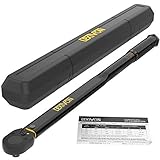
LEXIVON 1/2 Inch 25-250 Ft-Lb
- 25-250 ft-lb range
- Calibration certificate included
- Electro-black finish
- Heavy 6.4 pound build
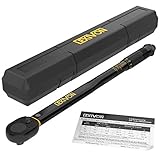
LEXIVON 1/2 Inch 10-150 Ft-Lb
- 4.7 star rating with 12k reviews
- Yellow on black scale
- Serial numbered certificate
- Electro-black finish
All 12 Torque Wrenches at a Glance in 2026
Every wrench below arrives pre-calibrated or factory tested, and all of them cover at least the fastener sizes you will meet in routine service. Drive size is the first column to read: it decides which sockets fit and how much torque the tool can physically deliver.
| Product | Specs | Action |
|---|---|---|
| EPAuto 1/2 Inch Click Torque Wrench |
|
Check Latest Price |
| LEXIVON 1/2 Inch 10-150 Ft-Lb |
|
Check Latest Price |
| LEXIVON 1/2 Inch 25-250 Ft-Lb |
|
Check Latest Price |
 EPAuto 3/8 Inch Click Torque Wrench EPAuto 3/8 Inch Click Torque Wrench |
|
Check Latest Price |
 LEXIVON 3/8 Inch 10-80 Ft-Lb LEXIVON 3/8 Inch 10-80 Ft-Lb |
|
Check Latest Price |
 Amazon Basics 3/8 Inch Click Torque Wrench Amazon Basics 3/8 Inch Click Torque Wrench |
|
Check Latest Price |
 CRAFTSMAN 3/8 Inch Torque Wrench CRAFTSMAN 3/8 Inch Torque Wrench |
|
Check Latest Price |
 Hairich 1/2 Inch 10-170 Ft-Lb Hairich 1/2 Inch 10-170 Ft-Lb |
|
Check Latest Price |
 YIYEIE 3 Drive 8 Piece Set YIYEIE 3 Drive 8 Piece Set |
|
Check Latest Price |
 GEARWRENCH 1/2 Inch Digital Torque Wrench GEARWRENCH 1/2 Inch Digital Torque Wrench |
|
Check Latest Price |
 SUZUME 1/2 Inch Digital Torque Wrench SUZUME 1/2 Inch Digital Torque Wrench |
|
Check Latest Price |
 TEKTON 3/4 Inch 50-300 Ft-Lb TEKTON 3/4 Inch 50-300 Ft-Lb |
|
Check Latest Price |
1. EPAuto 1/2 Inch Click Torque Wrench – Best Overall for Everyday Service Work
EPAuto 1/2-inch Drive Click Torque Wrench, 10-150 ft/lb, 13.6-203.5 N/m
10-150 ft-lb
Plus or minus 4 percent
16.25 inch long
3.5 pounds
Cr-V ratchet head
Pros
- 23k owner reviews document long-term behaviour
- Pre-calibrated to plus or minus 4 percent
- Hardened heat-treated chrome vanadium ratchet head
- Dual ft-lb and Nm scale
- Extension bar and storage case in the box
Cons
- Clockwise torque measurement only
- Satin finish scuffs with use
- Click is easy to miss at low settings
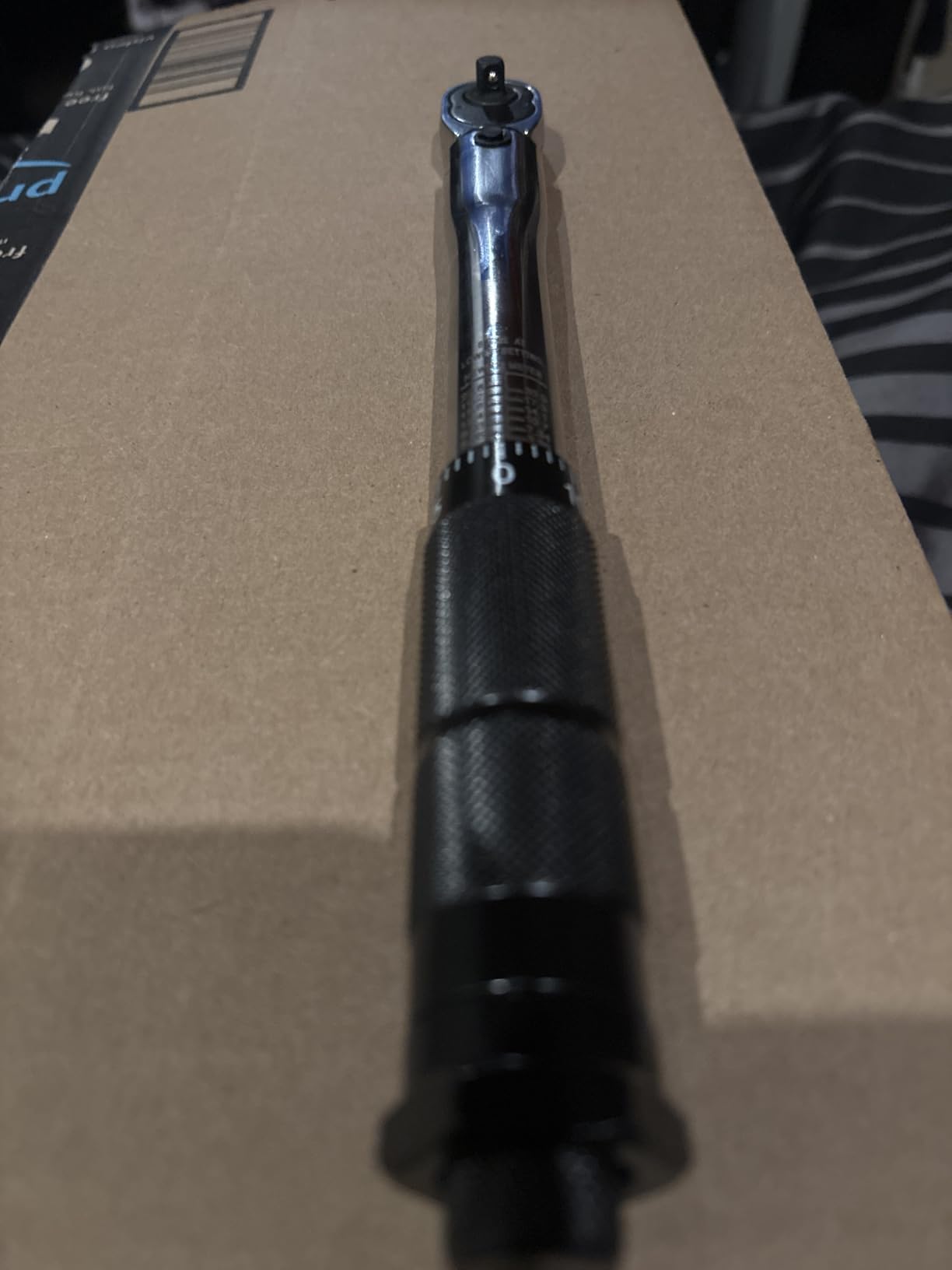
This is the wrench we reached for again and again, from oil changes to caliper bolts. The 10-150 ft-lb range covers the middle of nearly every routine job, and at 16.25 inches long it stays out of the way under a car without feeling flimsy at 3.5 pounds.
Owners consistently report that the head feels solid and that the ratchet action is smooth enough to run a star pattern without resetting. The dual ft-lb and Nm scales are printed high contrast, which matters more than it sounds when you are lying under a car with a work light clipped to your sleeve.
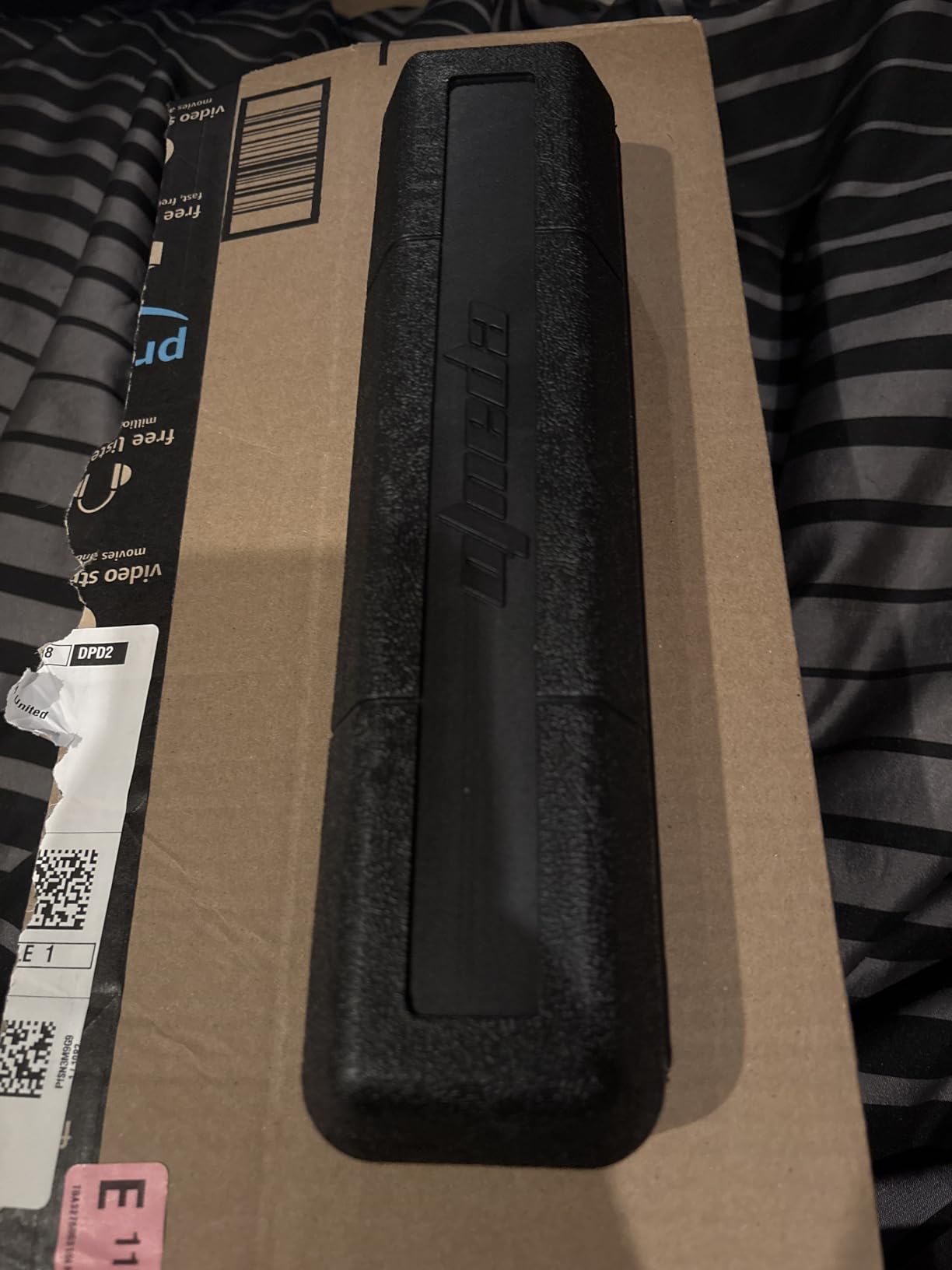
The extension bar in the box is not a filler item. On a 1/2 inch drive it is what lets you reach a caliper bolt or a manifold fastener without dropping the wrench out of square, and the plastic case keeps the adjustment from getting knocked in a truck bed.
The click is firm rather than sharp, so you will feel it through the handle before you hear it. That is the safer of the two signals on an under-car job, though at the bottom of the scale the notification is subtle enough that you have to be paying attention.
What it handles well
Lug nuts, caliper bolts, suspension arms, oil drain plugs and fuel rail fasteners all sit comfortably inside the 10-150 ft-lb window. If your work list is mostly under a vehicle at medium torque, this is the one to buy first.
Where it falls short
It measures torque clockwise only. On a reverse-thread fastener such as some older pedal or crank bolts, you have no reliable signal in the tightening direction and should use a different tool.
It will not cover the 250 ft-lb end of the scale that wheel bearings and large suspension fasteners demand. A wrench that tops out at 150 ft-lb is a real limit, not a rounding error.
2. LEXIVON 1/2 Inch 10-150 Ft-Lb – Verified Accuracy and a Traceable Certificate
LEXIVON Torque Wrench 1/2-Inch Drive Click 10~150 Ft-Lb/13.6~203.5 Nm (LX-183)
10-150 ft-lb
Plus or minus 4 percent
17 inch long
3 pounds
Yellow on black scale
Pros
- 4.7 stars across 12k reviews
- Serial numbered calibration certificate
- Reinforced heat-treated Cr-V gear head
- Electro-black finish resists corrosion
- Ergonomic knurled handle
Cons
- Clockwise torque measurement only
- Nm scale decimals are awkward to read
Owners verify the output against a digital torque adapter and find it within a foot-pound or two of the setting. That repeatability matters more day to day than the headline tolerance, because a wrench that is consistently slightly off is far better than one that wanders.
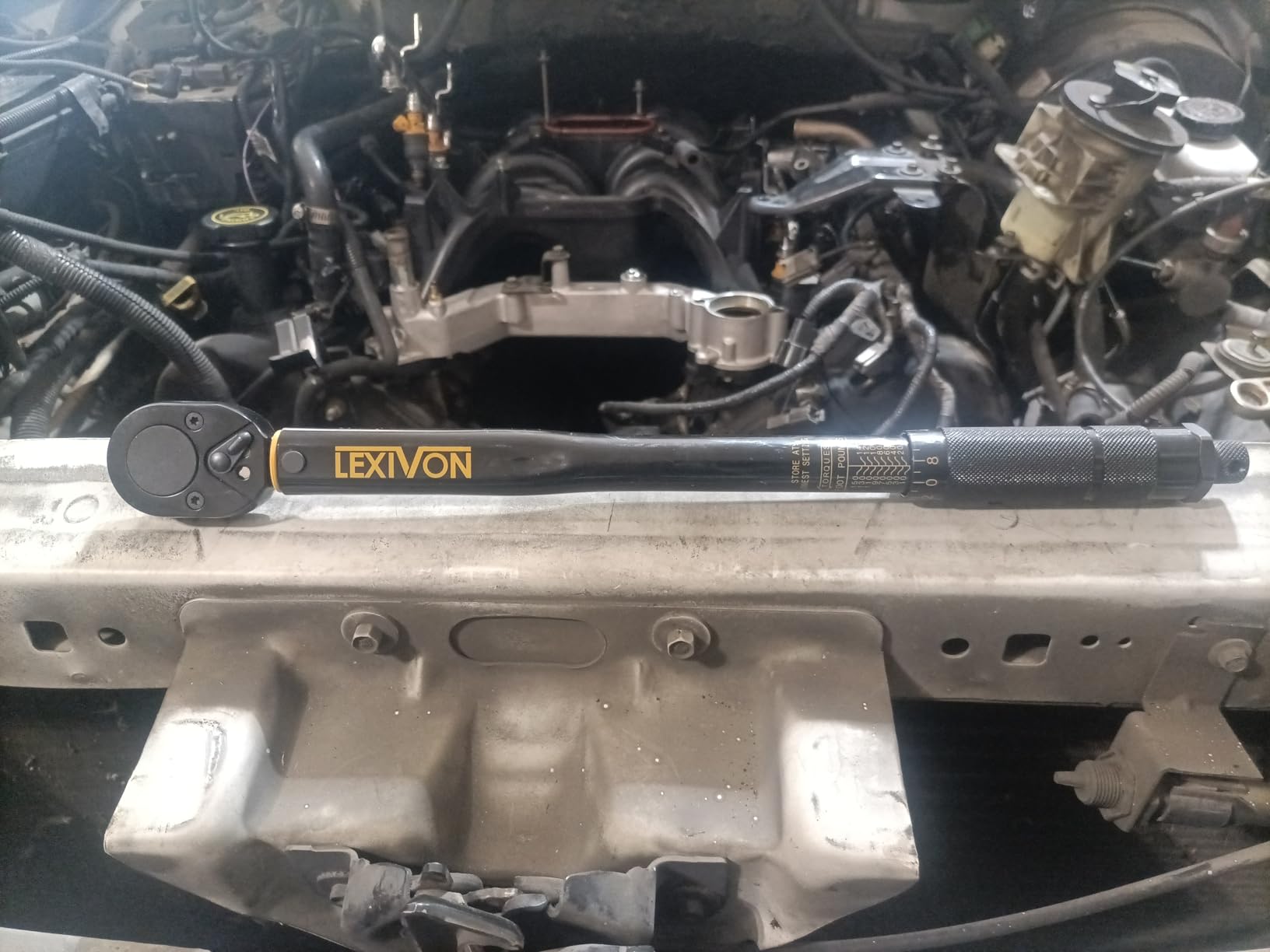
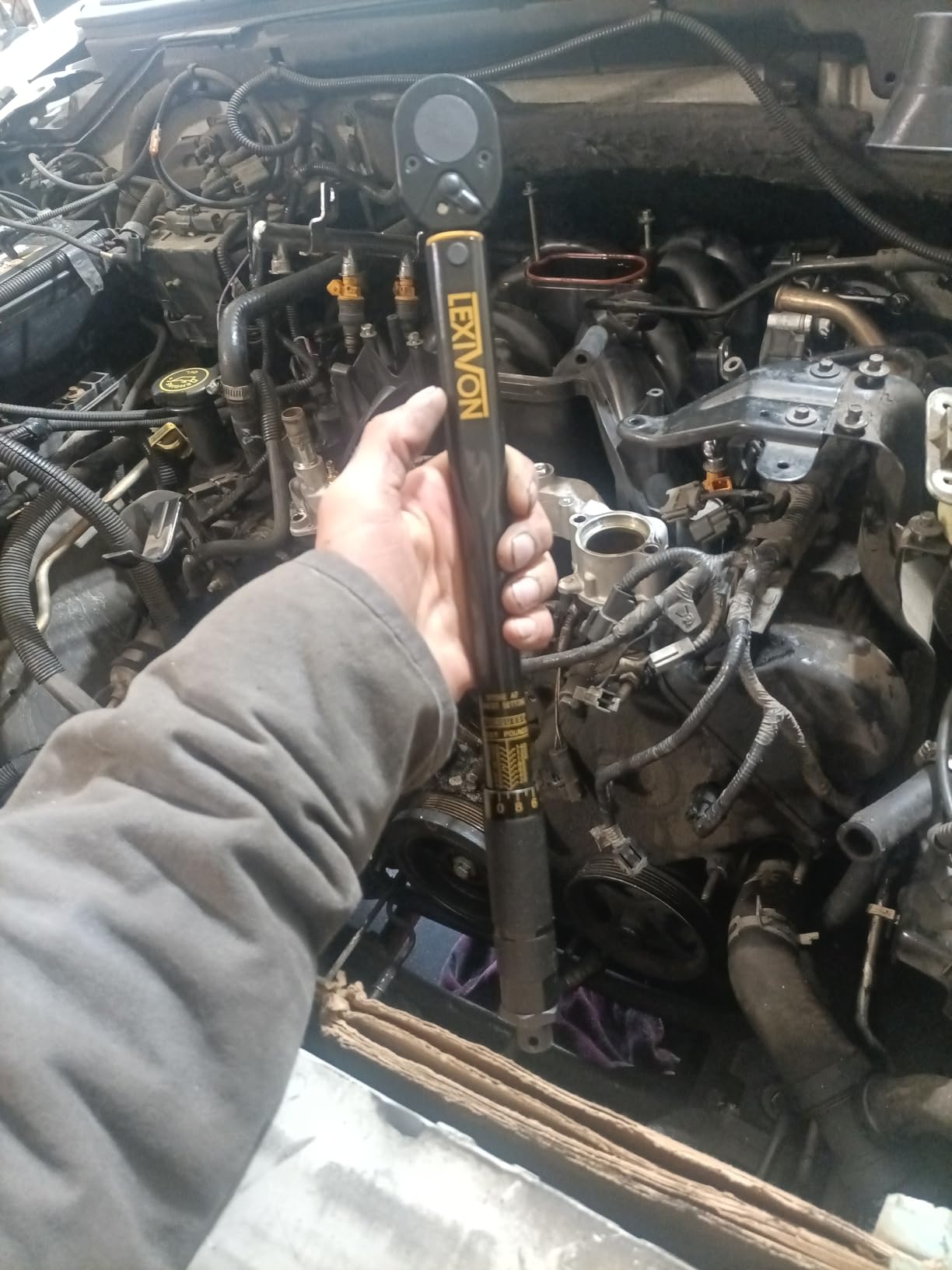
The yellow-on-black scale is the practical winner here. Compared with engraving on polished chrome it is readable in a dark engine bay and in direct sun, which is where much under-car work actually happens.
At 17 inches it is slightly longer than the EPAuto at the same range, which gives a little more leverage at the top of the band but makes it harder to swing in a tight engine bay. It is a trade that depends entirely on where you work.
What it handles well
Anything in the 10-150 ft-lb band: wheel studs on a compact, brake caliper bolts, valve cover fasteners, intake manifold hardware and the small suspension links on a sedan. The certificate also makes it the easiest to justify in a shop that audits tool accuracy.
Where it falls short
Like many click wrenches at this range it measures clockwise only, and the Nm scale uses decimal values that some owners find hard to read quickly. If you think in metric, check your conversion habits before you rely on it.
It shares the same ceiling as the rest of the 1/2 inch 10-150 ft-lb class. A 200 ft-lb wheel bearing is simply outside its ability to measure.
3. LEXIVON 1/2 Inch 25-250 Ft-Lb – Best for Suspension and Lug Work
LEXIVON 1/2-Inch Drive Click Torque Wrench 25-250 Ft-Lb/33.9-338.9 Nm (LX-184)
25-250 ft-lb
Plus or minus 4 percent
24.84 inch long
6.4 pounds
Carrying case
Pros
- Covers the high end other 1/2 inch wrenches cannot
- Readings confirmed within 1-2 ft-lb
- Heavy build suits underbody work
- Distinct audible click
- Bright yellow dual scale
Cons
- Can feel short above 200 ft-lb
- Clockwise torque measurement only
If your work includes strut-to-knuckle bolts, upper control arms or heavy truck lugs, this is the range you need. Twenty-five to 250 ft-lb covers the fasteners that a 10-150 wrench simply cannot reach, and owners say the readings hold within a foot-pound or two of the dial.
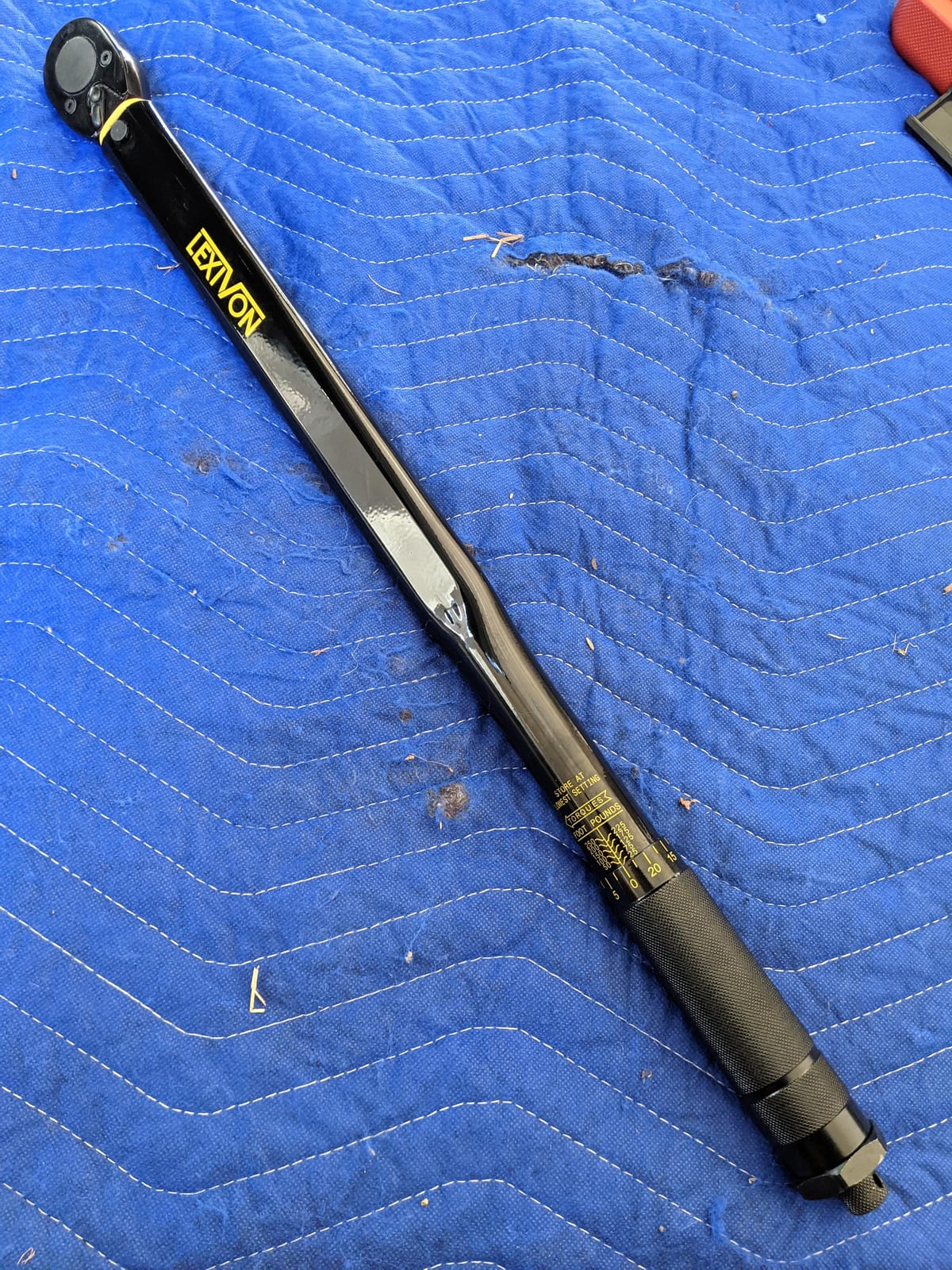
At 6.4 pounds and nearly 25 inches long it has real weight behind it. That feels excessive on a spark plug job and feels exactly right when you are breaking a seized caliper bolt, which is why it works as a second wrench rather than a first one.
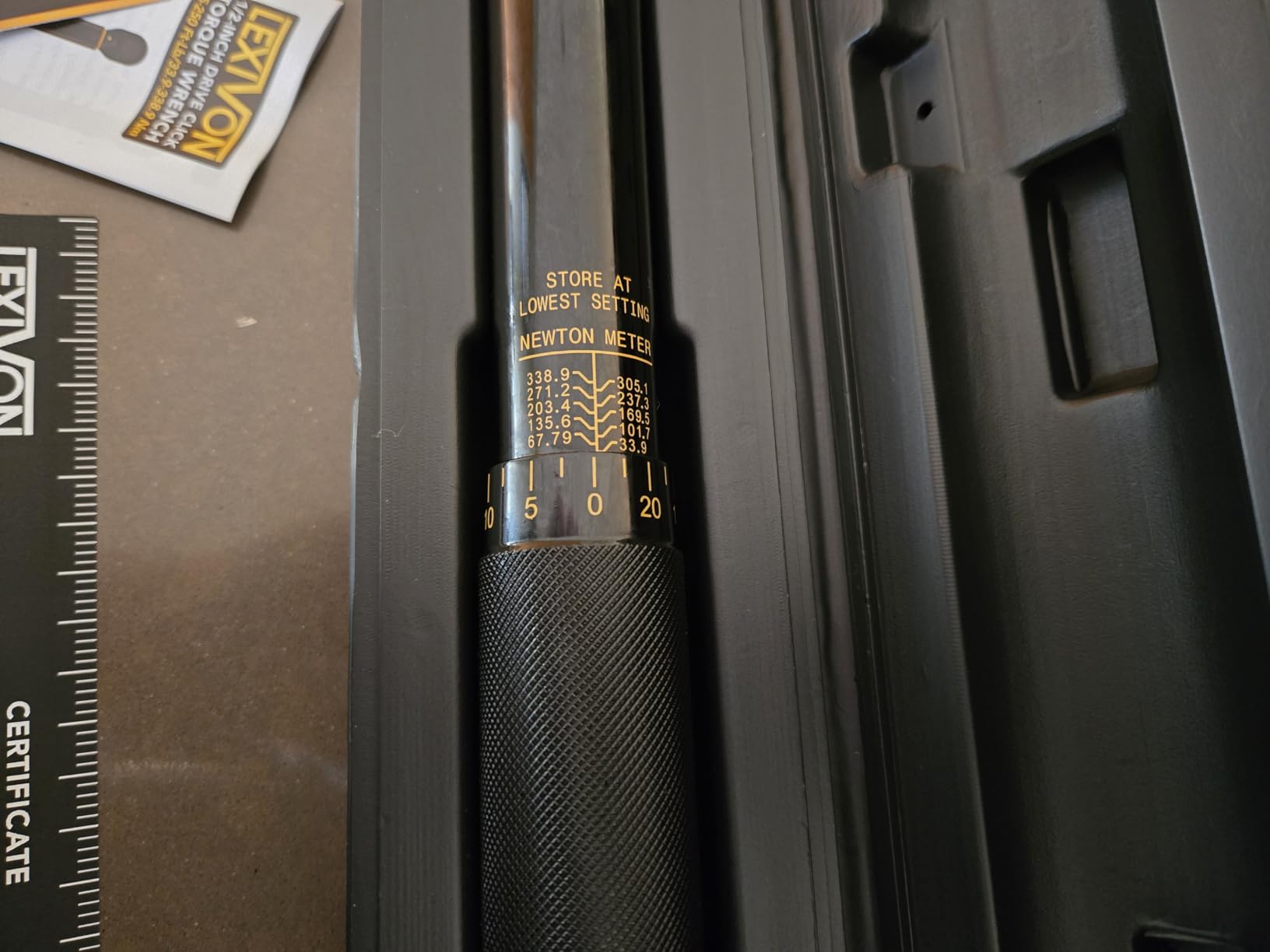
The reinforced ratchet gear head and the Electro-Black coating are both up to the abuse this category takes. Suspension and brake work is where torque wrenches get dropped, kicked and rained on, and the finish is what keeps corrosion from turning a good tool into a pitted one.
The carrying case matters at this size. A wrench this heavy left loose in a toolbox will find the bottom of every other tool in it.
What it handles well
Suspension arms, strut bolts, caliper carriers, wheel bearings and heavy lug patterns. It is a strong addition to a two-wrench kit for anyone who does their own brakes and suspension.
Where it falls short
It starts at 25 ft-lb, so the low half of the scale is not available. Spark plug, small engine and delicate assembly work is out of reach, which is exactly the gap the 1/2 inch 10-150 wrench fills.
Several reviewers note that the length feels shorter than expected near the 250 ft-lb ceiling. On a deeply recessed fastener you may need a longer handle or a second pass to break the bolt loose before you can torque it properly.
4. EPAuto 3/8 Inch Click Torque Wrench – Best Value 3/8 Inch Pick
EPAuto 3/8-Inch Drive Click Torque Wrench 10-80 Ft-lb./ 13.6-108.5 Nm
10-80 ft-lb
Plus or minus 4 percent
14.5 inch long
1.1 kg
Adapter set included
Pros
- Short body makes lug work easy
- Includes both drive adapters and an extension bar
- Clear click at 30 and 80 ft-lb
- Storage case in the box
- Adjusts to within 1-2 percent of setting
Cons
- Clockwise only so reverse threads can be over-torqued
- Click weakens at the low end
- No calibration certificate in the box
Detailed owner testing found the adjustment lands within one to two percent of the setting and repeats at about plus or minus one percent. That is closer to the head of the accuracy band than the printed plus or minus four percent claim would lead you to expect.
This is the wrench we like best in tight spaces, and the adapter bundle makes it unusually flexible for the money. At 14.5 inches it swings where a full-length 1/2 inch wrench is awkward on a wheel in a narrow garage bay.
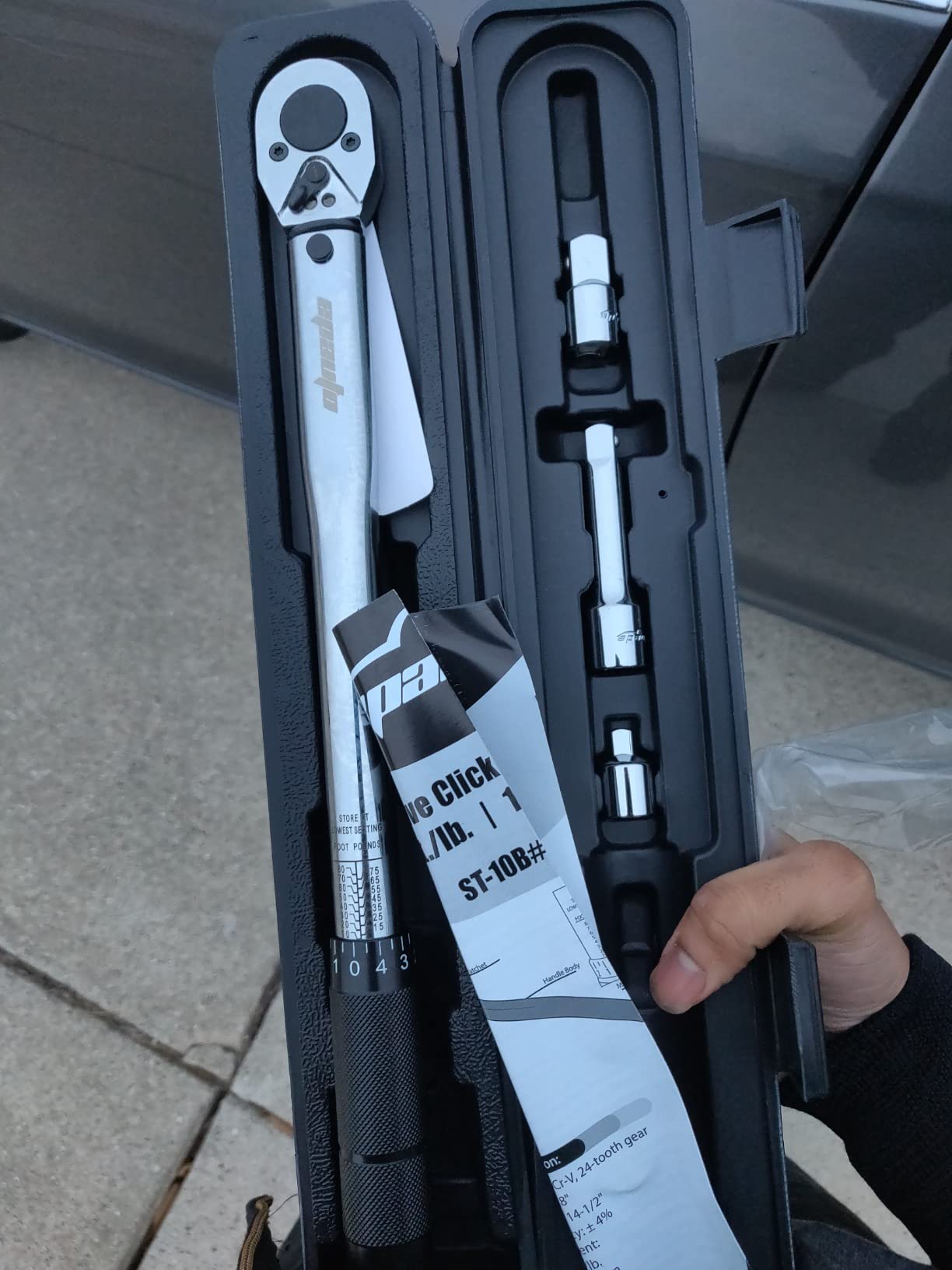
You get 3/8 to 1/4 inch and 3/8 to 1/2 inch adapters plus an extension bar in the box, which covers much of what a 1/4 inch wrench would otherwise handle. For occasional work on a compact car that bundle is worth more than any single upgrade.
What it handles well
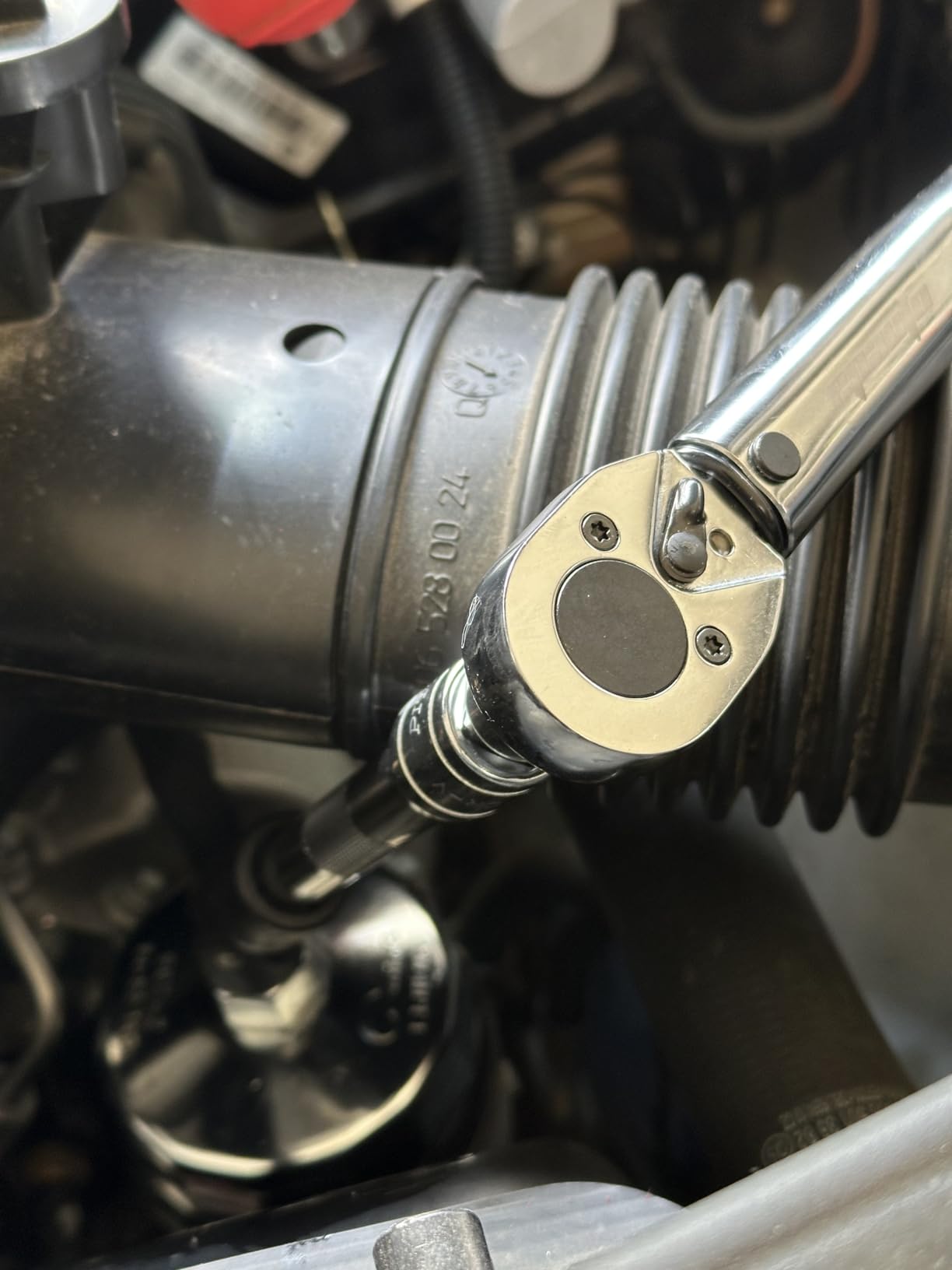
Engine bay work where a long handle will not fit, small trailer and outboard hardware, and routine maintenance on compact cars. The supplied adapters mean a 1/4 inch socket still works on light-duty fasteners.
Where it falls short
No calibration certificate is included, so verify the reading against something you trust when it arrives. Several owners also report a weaker click at the very bottom of the scale, where a light torque is easy to overshoot.
It is single direction, which means a reverse-thread fastener tightened through this wrench can end up well past its spec. The Hairich later in this roundup is the pick if bidirectional measurement matters to your work.
5. LEXIVON 3/8 Inch 10-80 Ft-Lb – Best for Engine Work
LEXIVON 3/8-Inch Drive Click Torque Wrench 10~80 Ft-Lb/13.6~108.5 Nm (LX-182)
10-80 ft-lb
Plus or minus 4 percent
14.76 inch long
2.3 pounds
Snap-lock case
Pros
- Very readable yellow on black scale
- Accurate enough for spark plugs and lug nuts
- Weight and finish feel premium
- Serial numbered calibration certificate
- Excellent value
Cons
- Click feels like a bump stop rather than a sharp snap
- Collar must be fully unscrewed or it can grind
- Nm decimals are awkward to read
This is the 3/8 inch answer when you want the same build quality and the same paperwork as the 1/2 inch LEXIVON but in a package sized for an engine bay. Owners verify it against a professional digital tool and find it good enough for spark plugs and lug work.
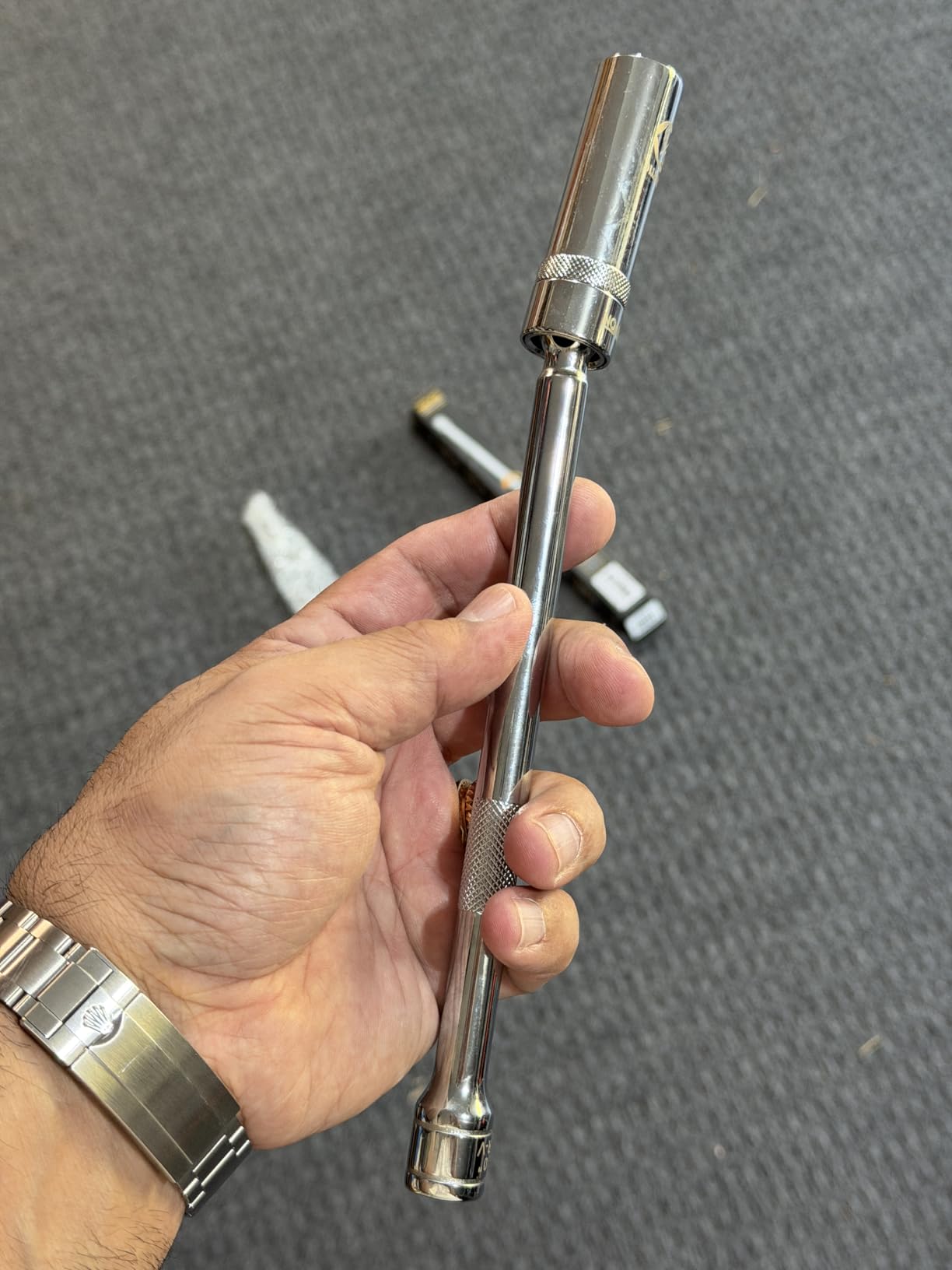
At 2.3 pounds and just under 15 inches it is easy to hold one-handed while you work a wrench extension under a manifold. That is the actual job this size exists for, and the tool is comfortable doing it.
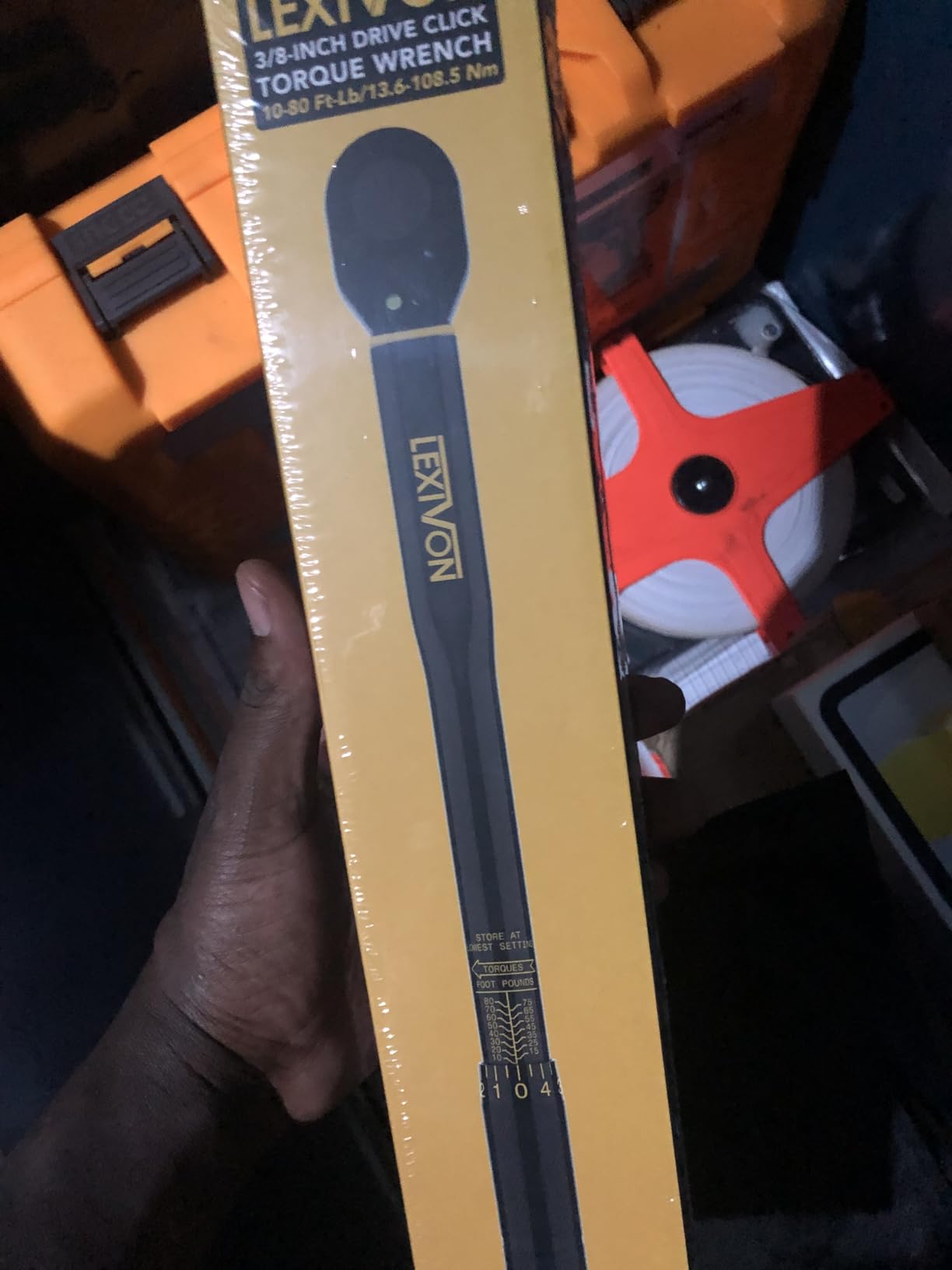
The bright yellow scale is the standout. It is far easier to read in shade than the engraved markings on a polished chrome shaft, and the snap-lock case keeps the setting from shifting in transit.
What it handles well
Spark plug installation, valve cover bolts, intake hardware, oil pan bolts and general engine bay assembly where the spec lands under 80 ft-lb. If your work list is mostly top-end engine jobs, this is the size to standardise on.
Where it falls short
The recurring complaint is that the click reads more like a bump stop than the sharp snap of the 1/2 inch model. You can still work by feel, but it asks for more attention on light settings.
There is also a technique note: the adjustment collar has to be fully backed off before you turn it or the threads can grind. It is a habit worth forming from the first time you use it.
6. Amazon Basics 3/8 Inch Click Torque Wrench – Budget Pick for Occasional Work
Amazon Basics 3/8-inch Drive Click Torque Wrench Ratchet, 15-80 ft.-lb, 20.4-108.5 Nm
15-80 ft-lb
Plus or minus 4 percent
15.55 inch long
1075 g
Polished chrome head
Pros
- Entry level build that works for occasional work
- Click is easy to hear and feel at target
- Smooth adjustment on the imperial scale
- Storage case included
- Solid feel for occasional DIY use
Cons
- Faint markings hard to read without direct light
- Alignment edge makes the exact value hard to confirm
- Not built for daily professional use
This is the wrench to buy if you do maintenance a few times a year and want a torque tool that is not a disposable purchase. The 4.2 star average is the lowest in the roundup, but the complaints that drag it down are about readability, not about it failing to hold a setting.
Owners generally find that the click is clear and the adjustment moves smoothly, and that it does the job on oil changes, tire pressure checks and basic assembly without any complaint beyond the scale.
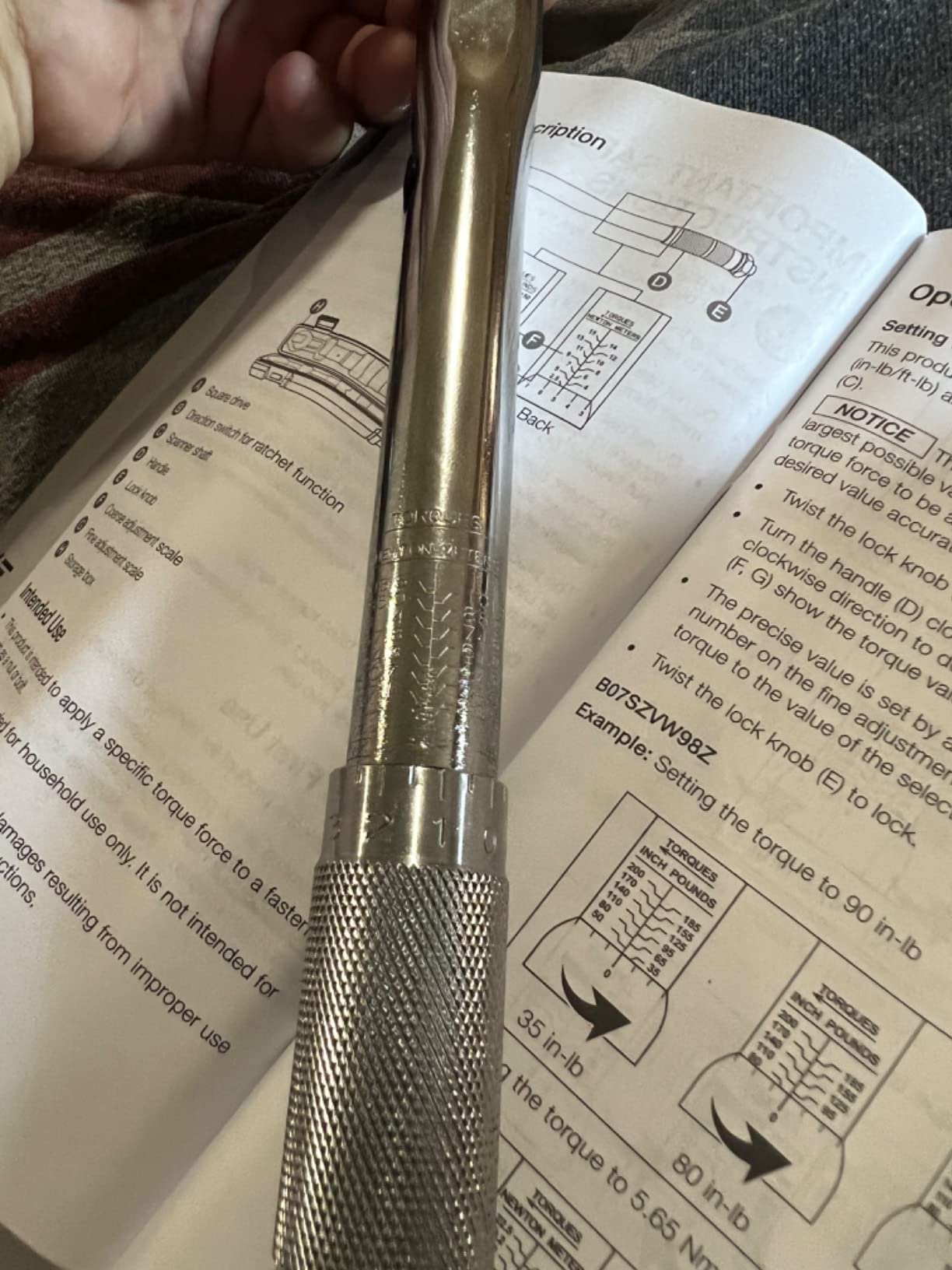
Use the imperial scale for precise settings, since the product guidance notes one Nm equals 8.86 in-lb and the metric side is less convenient for fine adjustment. Lock the collar before you pull, and return it to the lowest setting after each job.
What it handles well
Oil changes, lug nut checks on smaller wheels, general assembly and any occasional fastener in the 15-80 ft-lb band. For a weekend user who wants the discipline of torquing without the commitment of a quality tool, it is genuinely serviceable.
Where it falls short
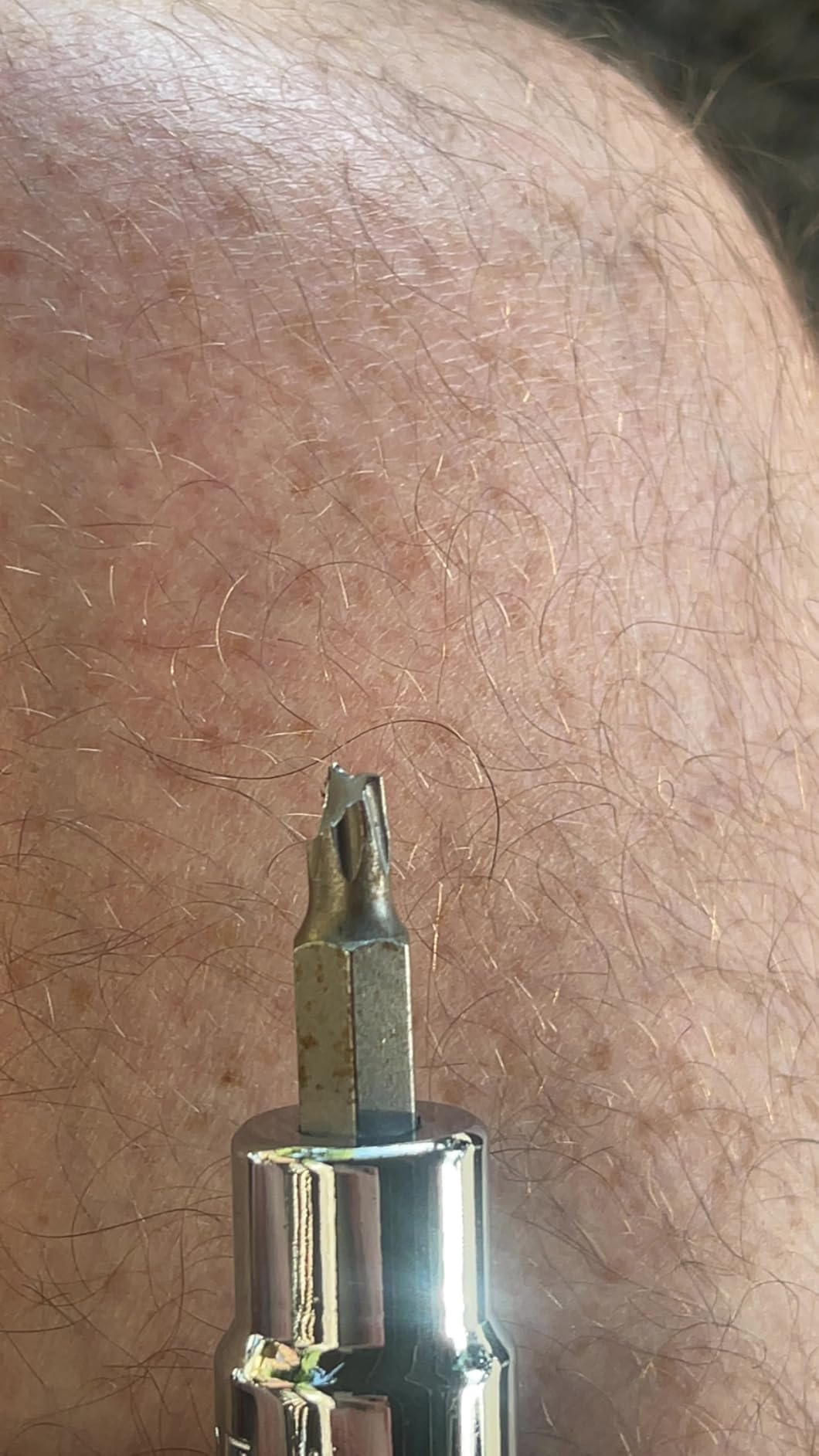
The markings are faint and hard to read in anything other than direct light, and the alignment edge makes it difficult to confirm exactly which value is set. Owners report that this can cost a few in-lb of error, which matters on torque-critical fasteners.
7. CRAFTSMAN 3/8 Inch Torque Wrench – Best Brand Name Starter
CRAFTSMAN Torque Wrench, 3/8″ Drive (CMMT99433)
3/8 inch drive
17.2 inch long
100 ft-lb item torque
Bi-material handle
Case included
Pros
- Established brand with warranty backing
- Bi-material handle is genuinely comfortable
- Quick locking feature speeds setting changes
- Stamped dual scales for inch and metric
- Meets or exceeds ASME specifications
Cons
- Stamped scales read poorly in bright light
- No drive adapters included in the box
If you want a name you can look up when a tool fails, this is the straightforward choice. CRAFTSMAN is an established brand, the bi-material handle is the one we found most comfortable in this roundup, and the build meets or exceeds ASME specifications.
The quick locking feature is the detail we appreciated most. Many click wrenches need you to back the collar off completely, which is fiddly when your hands are dirty and you are doing it twenty times in an evening.
Stamped scales give you quick identification of both inch and metric settings, and the included case keeps it portable between the house and the shop. At 17.2 inches it sits between the compact 3/8 inch tools and a full-size 1/2 inch handle.
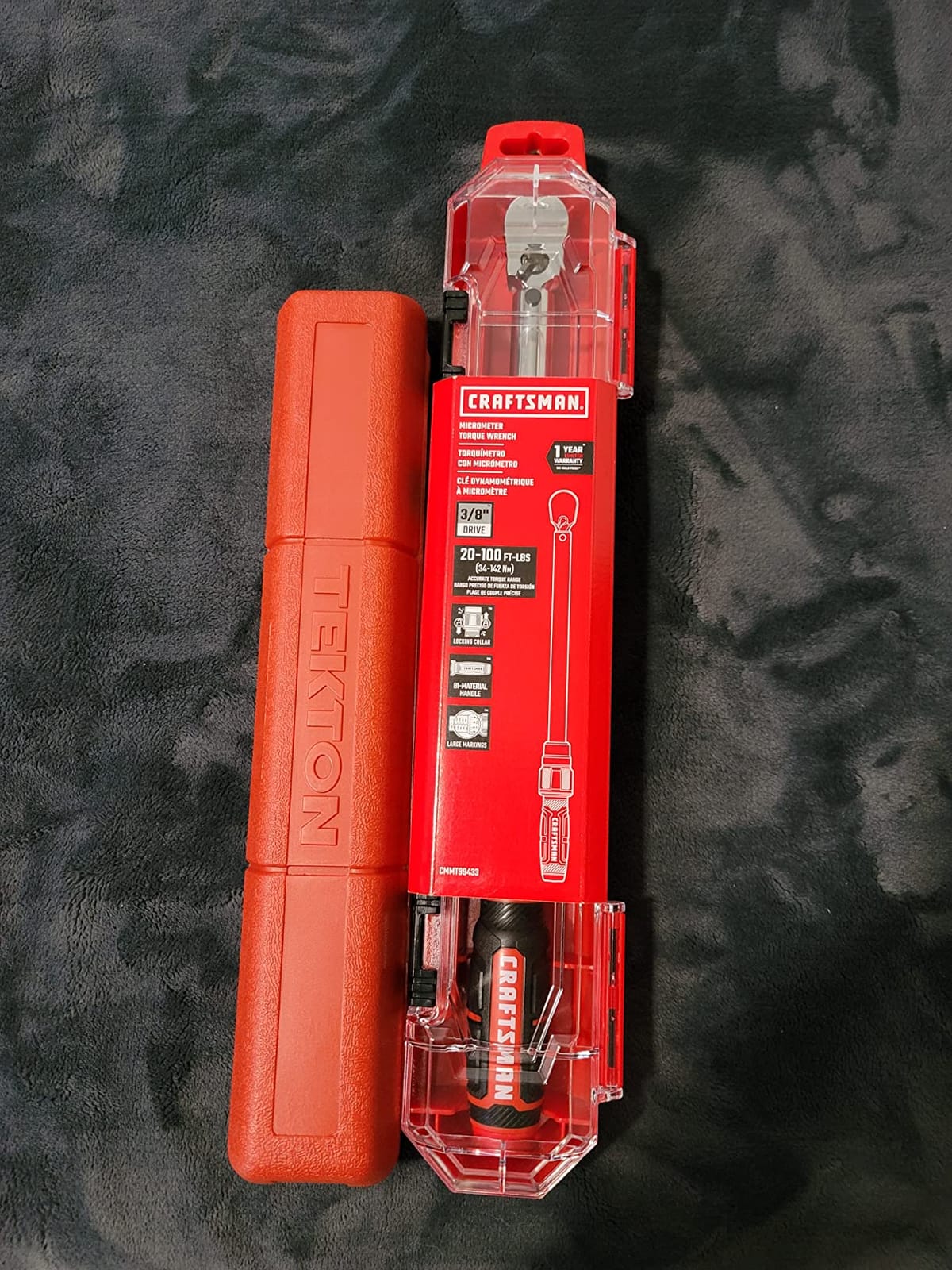
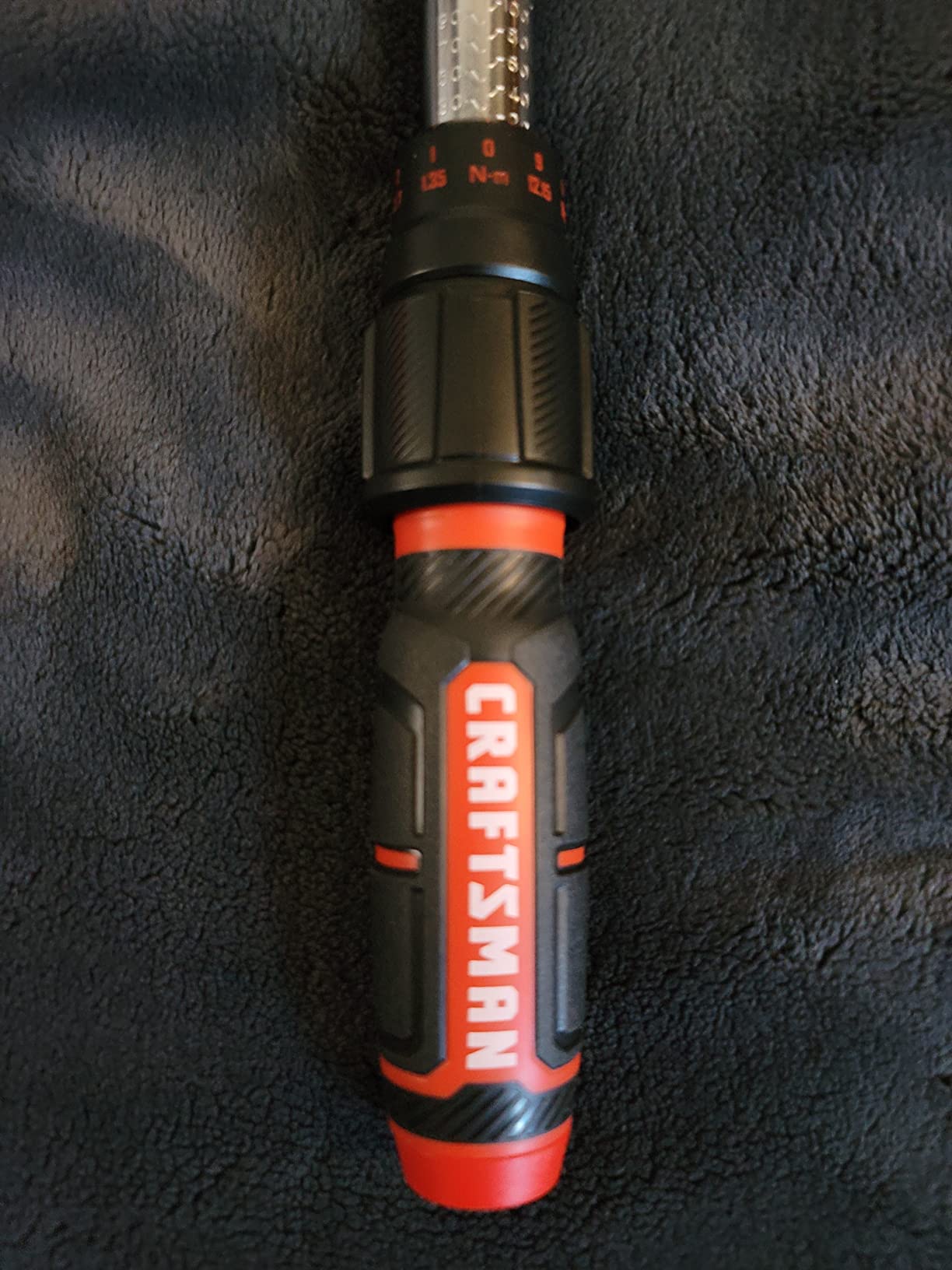
Owners consistently mention the comfortable bi-material handle, the fast adjustment and the durable, case-backed build. The one recurring note is about reading the scale, which is worth understanding before you buy.
What it handles well
General 3/8 inch work across a mixed repair list: engine bay fasteners, small suspension hardware and light bracket work. It is a good first torque wrench if brand support matters to you more than having a 72-tooth head or a case-free design.
Where it falls short
Stamped markings on steel are hard to read in bright light compared with printed or coloured high-contrast scales. You may find yourself squinting at a shiny shaft under a work lamp more than you would like.
It also leaves out the drive adapters that some competitors in this roundup bundle in the box, and the stamped scales are the one part of an otherwise solid tool that we would want improved.
8. Hairich 1/2 Inch 10-170 Ft-Lb – Best for Bidirectional Torque
Hairich torque wrench 1/2, 10-170ft.lb/13.6-230Nm, ±3% HIGH PRECISION
10-170 ft-lb
Plus or minus 3 percent
16.93 inch long
3.1 pounds
Bidirectional
Pros
- Measures torque clockwise and counterclockwise
- Tighter plus or minus 3 percent tolerance
- 72-tooth head with a 5 degree arc
- Calibration certificate with traceable serial number
- 24-month warranty and responsive support
Cons
- Click fades below about 5 Nm
- Not in the same precision tier as professional Snap-on or CDI wrenches
Almost every click wrench in this roundup measures clockwise only, and this one does not. It reports torque in both directions, which makes it the right choice for reverse-thread fasteners and for anyone who has been burned by an over-torqued left-hand or right-hand thread bolt.
The stated tolerance is plus or minus three percent across the range, tighter than the plus or minus four percent printed on the clickers in this roundup, and it comes with a traceable serial number and a calibration certificate in the box.
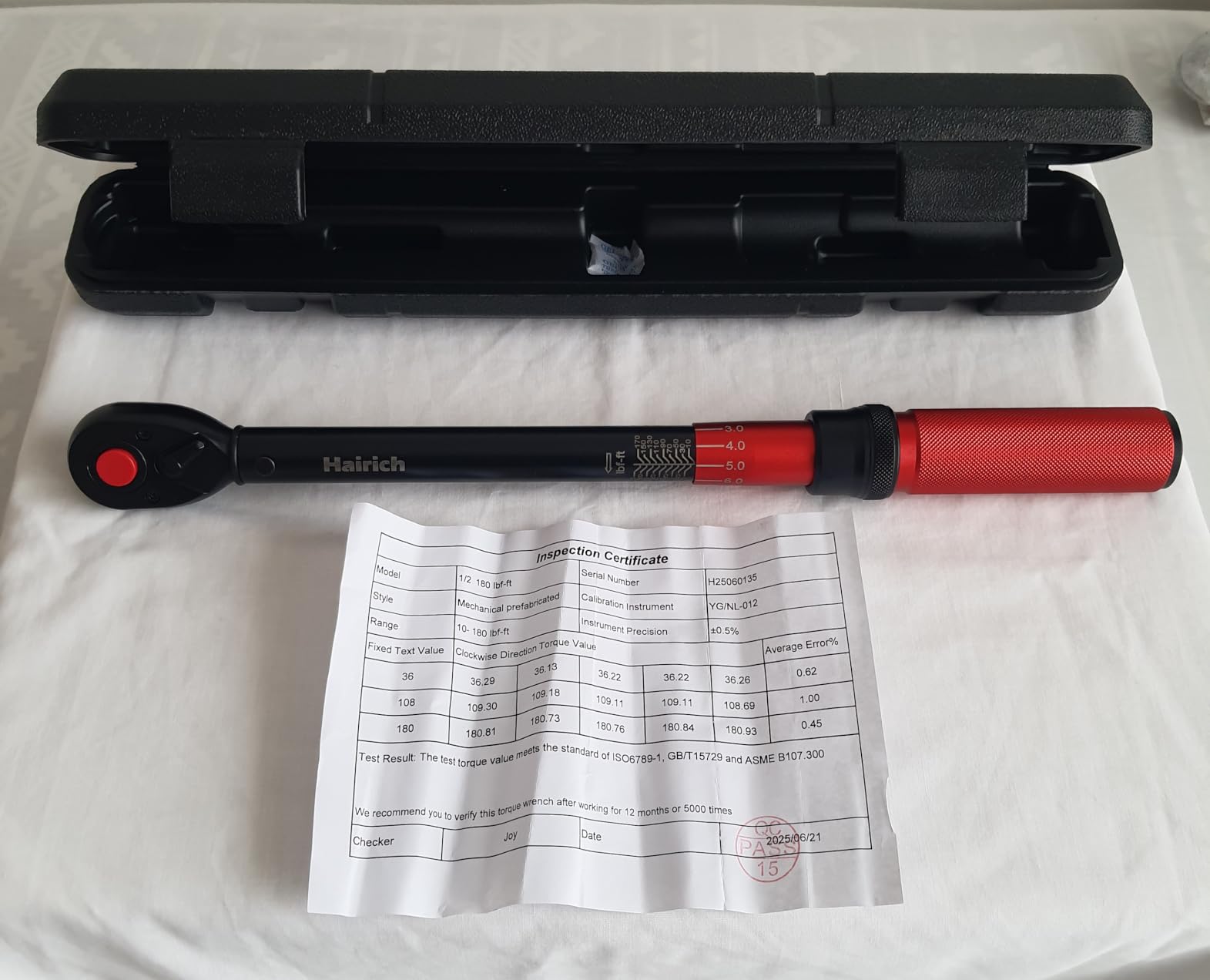
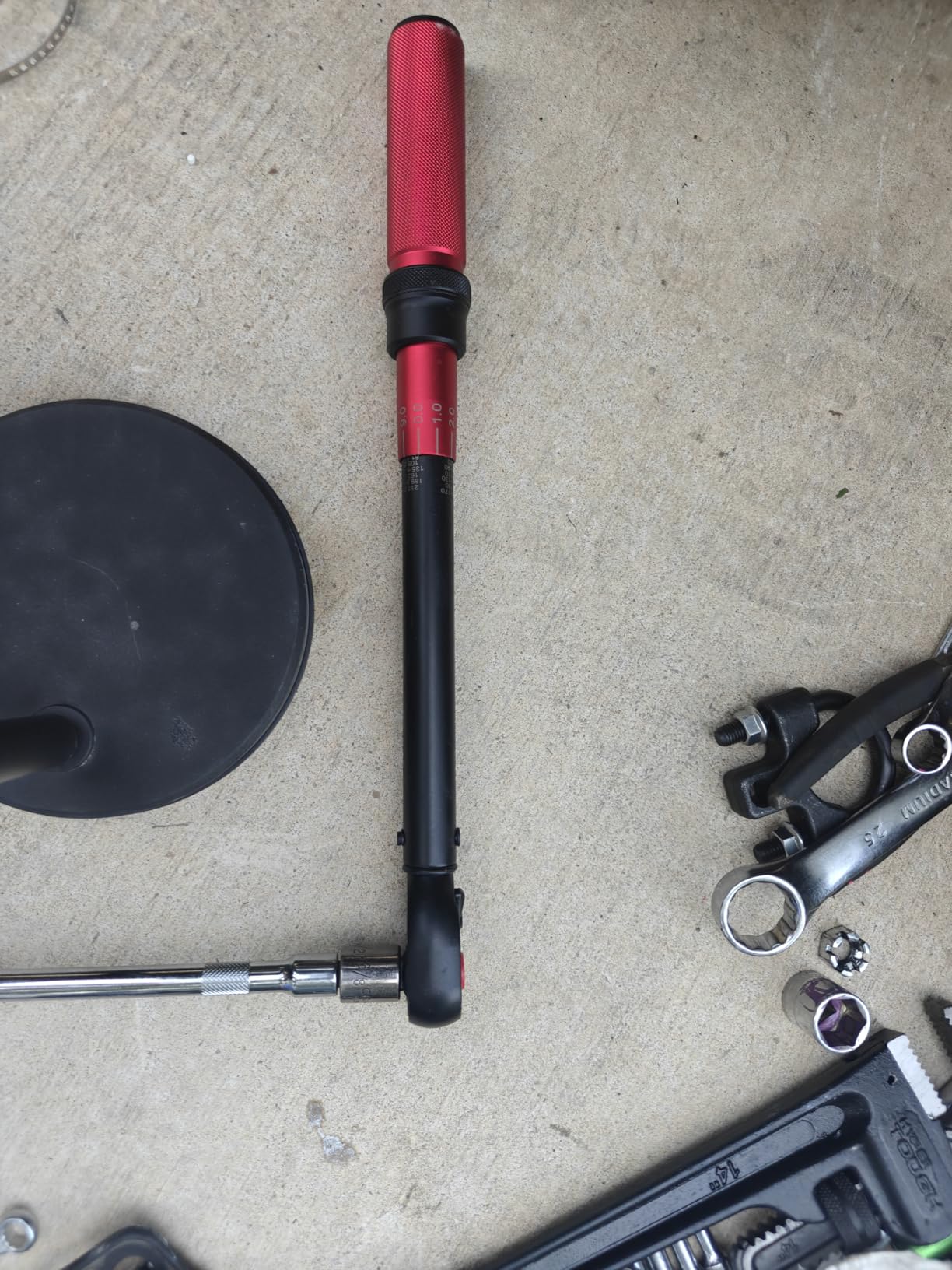
A 72-tooth head with a 5 degree ratcheting arc and a quick-release button is genuinely useful in the tight quarters around an engine bay or under a fender liner, where a 40-tooth head makes you lift and reset constantly.
Owners compare the feel favourably to a vintage deflecting-beam tool, which is well regarded at this level. The chrome vanadium body and knurled aluminium-titanium handle add weight where you want it and grip where you need it, and a 24-month warranty plus responsive support round out a well-presented package.
What it handles well
Brake work, lug nuts and general assembly where reverse threads appear. The bidirectional measurement is the reason to choose it over an otherwise similar click wrench, and the 72-tooth head is a close second.
Where it falls short
The click becomes faint below roughly 5 Nm, so light fasteners are easy to overshoot without concentrating. If your work is mostly small engine assembly, that is a real limitation.
Owners are also candid that it is not in the same precision tier as a professional Snap-on or CDI wrench. For everyday service work that is a fair trade, but it is not a substitute for a shop-grade tool on critical assembly.
9. YIYEIE 3 Drive 8 Piece Set – Best Three Piece Starter Set
1/4 3/8 1/2-inch Drive Click Torque Wrench, 8Pcs Torque Wrench Set 10-230in.lb, 5-50ft.lb, 10-180ft.lb with Adapters, ±3% Accuracy, 72-Tooth Dual Scale Torque Wrenches for Bike, Moto, Car Repair
1/4 3/8 and 1/2 inch drives
Plus or minus 3 percent
17 inch long
3.47 kg
8 piece set
Pros
- Covers 10 in-lb to 180 ft-lb in one kit
- Exceptionally loud click at target torque
- Toggle adjustment lock is far easier than a screw collar
- Micro-adjustment on all three scales
- Each wrench tested with a certificate
Cons
- Arrive covered in factory grease that must be cleaned off
- Parts shift in the case and finish arrives dinged
- Scale markings need good lighting
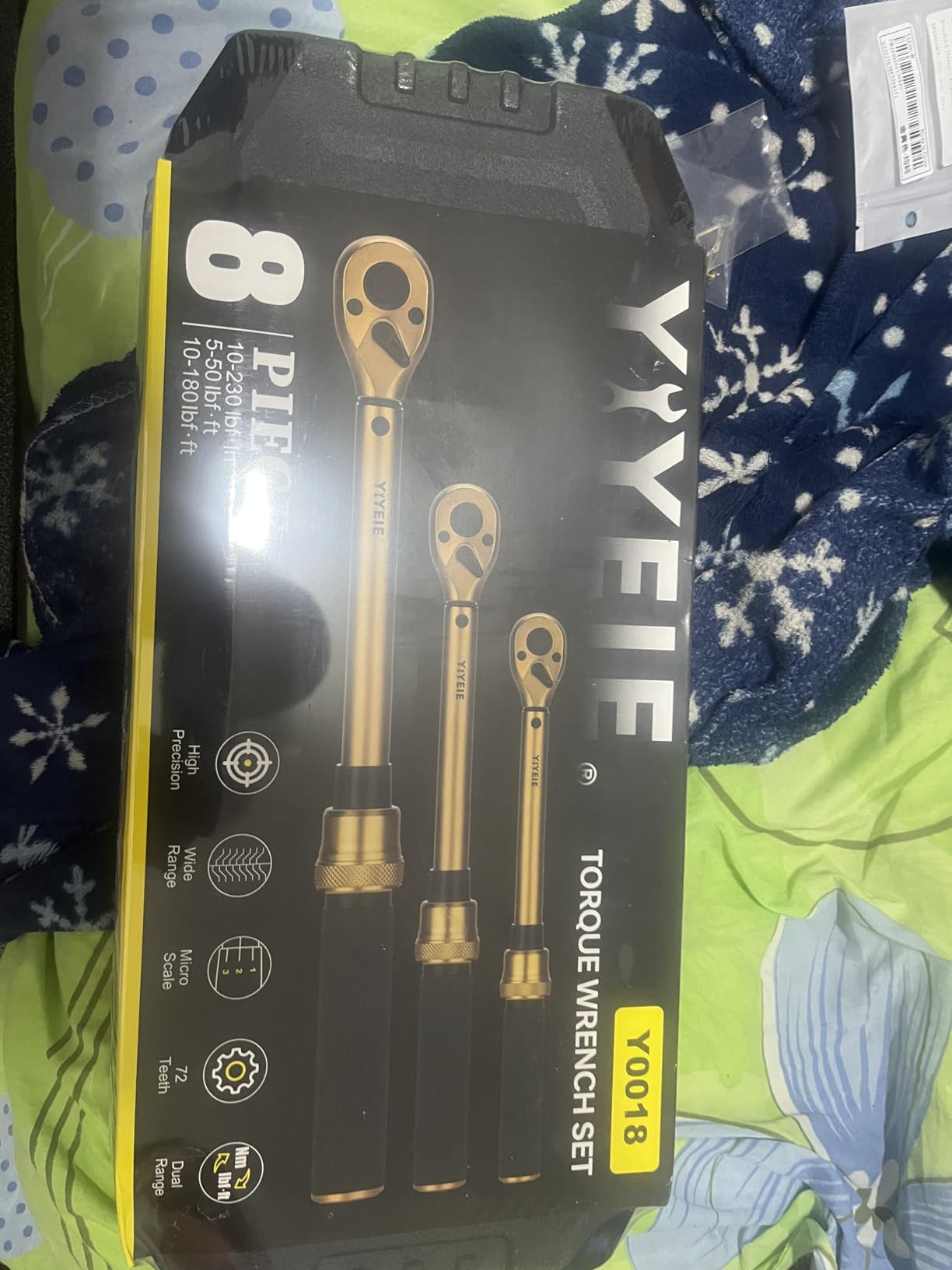
A complete three drive set is the efficient answer if you are starting from nothing. This one covers a 1/4 inch 10-230 in-lb wrench, a 3/8 inch 5-50 ft-lb wrench and a 1/2 inch 10-180 ft-lb wrench, so between them they span almost every fastener on a modern car.
The standout feature is the click. Owners single it out as louder and more unmistakable than the click wrenches in this roundup, and the toggle-style adjustment lock is a genuine improvement on the screw-down collars that dominate this price tier.
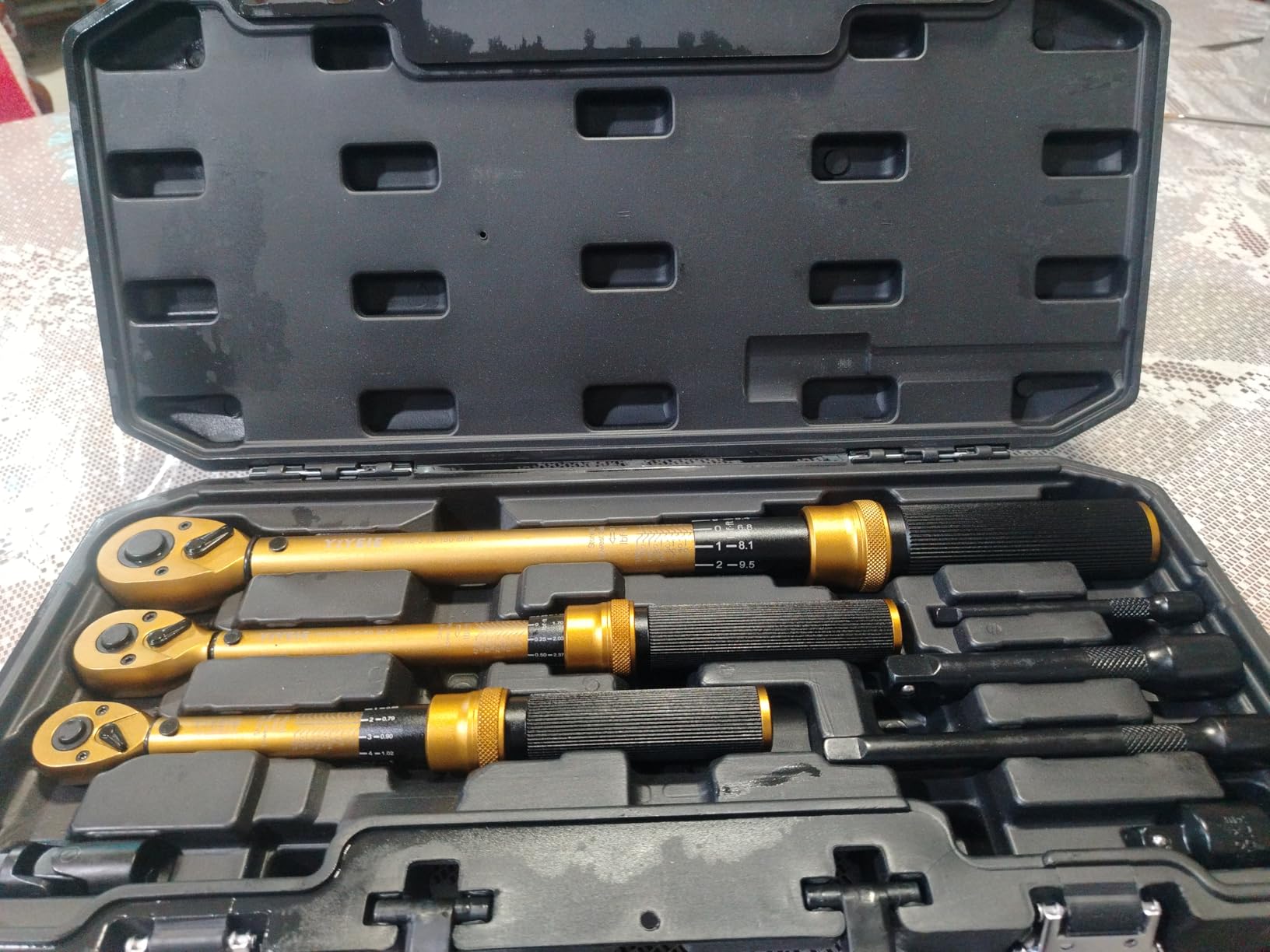
Micro-adjustment is a real bonus here. The 1/4 inch scale moves in 1 in-lb increments, the 3/8 inch in quarter foot-pound steps and the 1/2 inch in one foot-pound steps, which means you can land on a service manual figure without interpolating a needle.
Each wrench is tested to plus or minus three percent and ships with a certificate, and the measured results owners report come in well inside that claim. The box also includes three extension bars, a 3/8 inch universal joint and a 1/2 to 3/8 inch adapter.
The 72-tooth reversible ratchet heads with quick-release buttons keep the ratcheting smooth under a wheel lip, and the Cr-Mo steel heads with aerospace aluminium handles give the set more of a workshop feel than the individual wrenches in this roundup manage.
What it handles well
Everything from valve cover bolts to lug nuts, which is why this set is the one we would suggest to someone building a first torque wrench kit rather than buying a single tool. The 1/4 inch covers the light end that no other set here reaches.
Where it falls short
The wrenches arrive coated in factory grease that has to be degreased before first use, and owners report the case lets parts shift and shows finish dings on arrival. Neither affects accuracy, but both affect the first impression.
The printed scale markings need good lighting, and the laser-etched numbers can eventually wear off with heavy daily shop use. If you torque all day, every day, a set with heavier printing will age better.
10. GEARWRENCH 1/2 Inch Digital Torque Wrench – Best for Digital Readout
GEARWRENCH 1/2 Drive Electronic Torque Wrench | 85077
30-340 Nm range
Plus or minus 2 percent CW
25.65 inch long
3 pounds
Five units
Pros
- Digital readout is measurably more accurate than a clicker
- Reaches over 200 ft-lb where cheaper digitals fall short
- Vibration buzzer and LED let you keep your eyes on the fastener
- Stores and recalls settings and shows peak torque
- Meets or exceeds ASME B107.28M
Cons
- Plastic battery end cap can crack or lose contact
- 0.1 ft-lb increments make round numbers slow to set
- Does not measure angle
A digital wrench removes the guesswork entirely. You set a number, you see a number, and there is no click to hear or feel through a glove. Accuracy is specified at plus or minus two percent clockwise and plus or minus three percent counterclockwise between 20 and 100 percent of capacity.
The range is the reason to choose this over a cheaper digital. Thirty to 340 Nm works out past 200 ft-lb, which is above what the digital wrenches in this class typically reach, so it covers the same ground as the long-range clickers.
The target torque alert is a vibrating handle, a buzzer and a solid LED at the set value. Owners appreciate being able to watch the fastener rather than the display, and the ability to recall a stored setting means you are not re-entering a wheel spec every time you rotate a wheel.
For a shop that swaps between vehicles, that memory function is the feature that gets used hardest. Set a spec once per wheel, and the wrench is ready the next time that vehicle comes back instead of starting from a blank screen.
The housing is oil and solvent resistant, which matters more in a working bay than it does on a bench, and the 72-tooth ratchet keeps the swing arc down to 5 degrees so it works inside a confined wheel well.
What it handles well
Lug nuts, axle nuts, suspension fasteners and any job where a two percent tolerance matters, including the tightening side of safety critical assembly. Five measurement units cover Nm, ft-lb, in-lb, Kgf-m and Kgf-cm if you move between metric and SAE specs.
Where it falls short
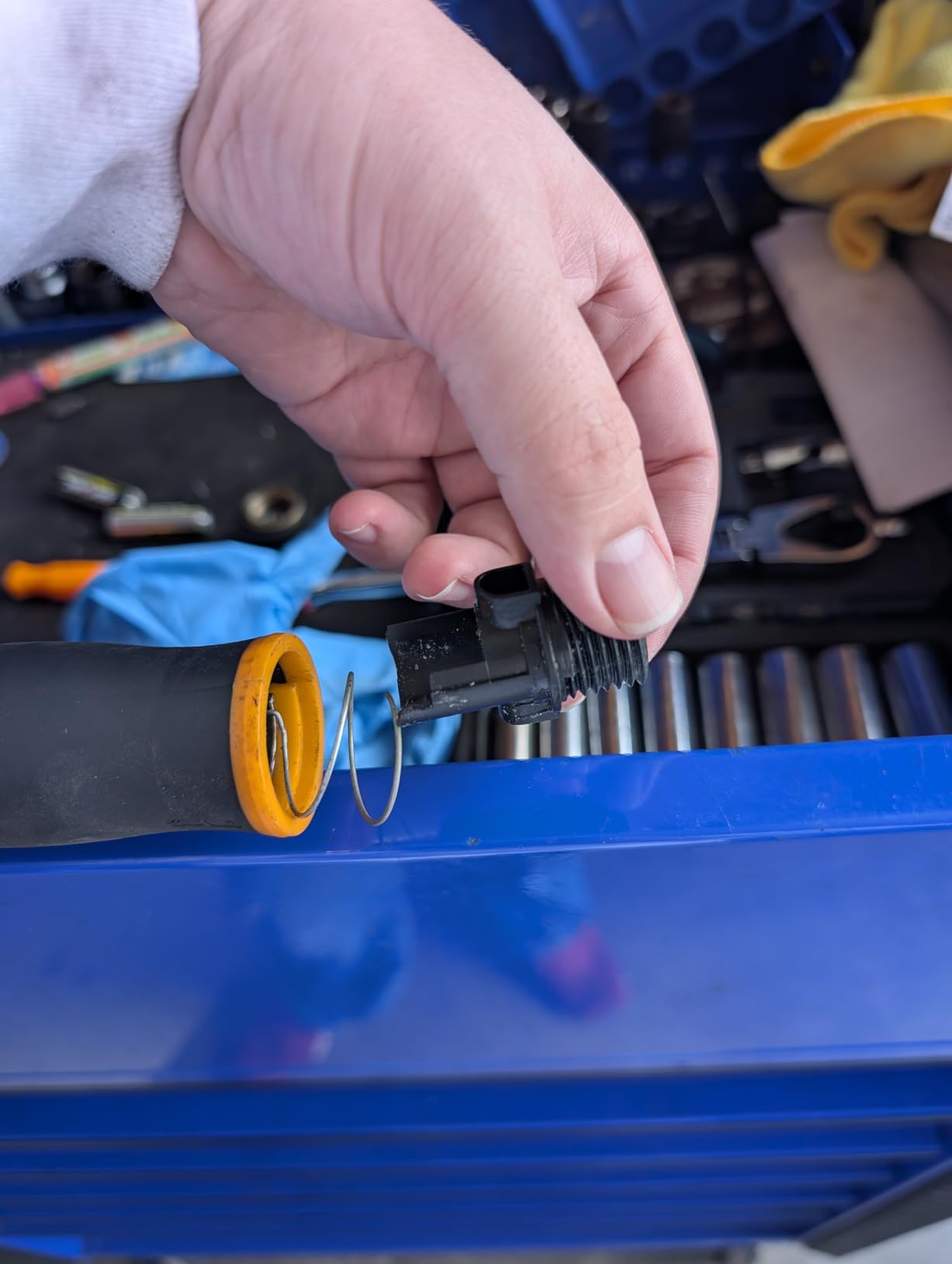
The hardware is the weak point. The battery compartment end cap is plastic and owners report it can crack or lose contact, and the vibration motor is weak enough that you may not feel it through work gloves.
Adjustment moves in 0.1 ft-lb steps, so dialling in a round number takes a lot of button presses and the unit beeps the whole way. It also needs two AA batteries, which are not included, and it does not measure angle, so it cannot verify a torque-plus-angle head bolt spec.
11. SUZUME 1/2 Inch Digital Torque Wrench – Best Digital for High Torque Work
SUZUME Digital Torque Wrench 1/2 Drive (12.5-250.7 Ft. Lb/ 17-340 N.m)
12.5-250.7 ft-lb
Plus or minus 2 percent
26.57 inch long
5.6 pounds
72-tooth head
Pros
- Plus or minus two percent accuracy for its class
- Green light at 85-90 percent and red at 100 percent
- Ramping beep makes the target easy to land
- 72-tooth reversible head in tight spaces
- Certificate of correction included
Cons
- Control end of the handle is plastic rather than metal
- Supplied batteries die quickly
- Menu navigation takes several button presses
This is the digital option that covers the full 1/2 inch working range in a single tool. Twelve point five to 250 point seven ft-lb spans nearly everything from small engine hardware to heavy lug work, and it is rated at plus or minus two percent.
The alerting is the part we like best. A ramping beep starts before the target, a green light comes on at 85 to 90 percent and a red light at 100 percent, which gives you a warning to ease off before you blow through the spec.
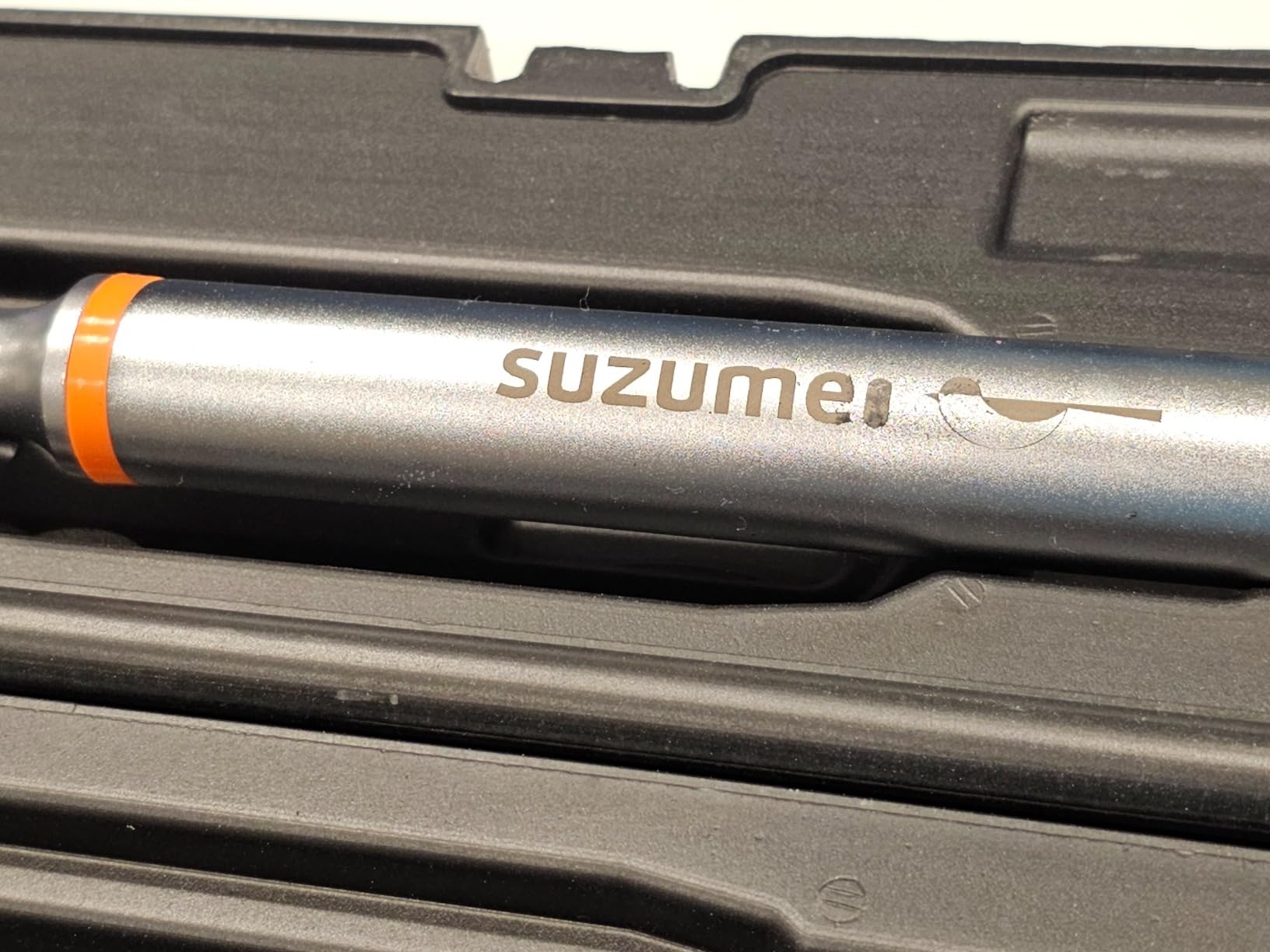
Owners report accurate readings on axle nuts and oil drain plugs, and one of the nicer stories in the reviews is a wrench that survived several drops to a concrete floor and kept working. The chrome vanadium body with electrophoresis treatment is built for that.
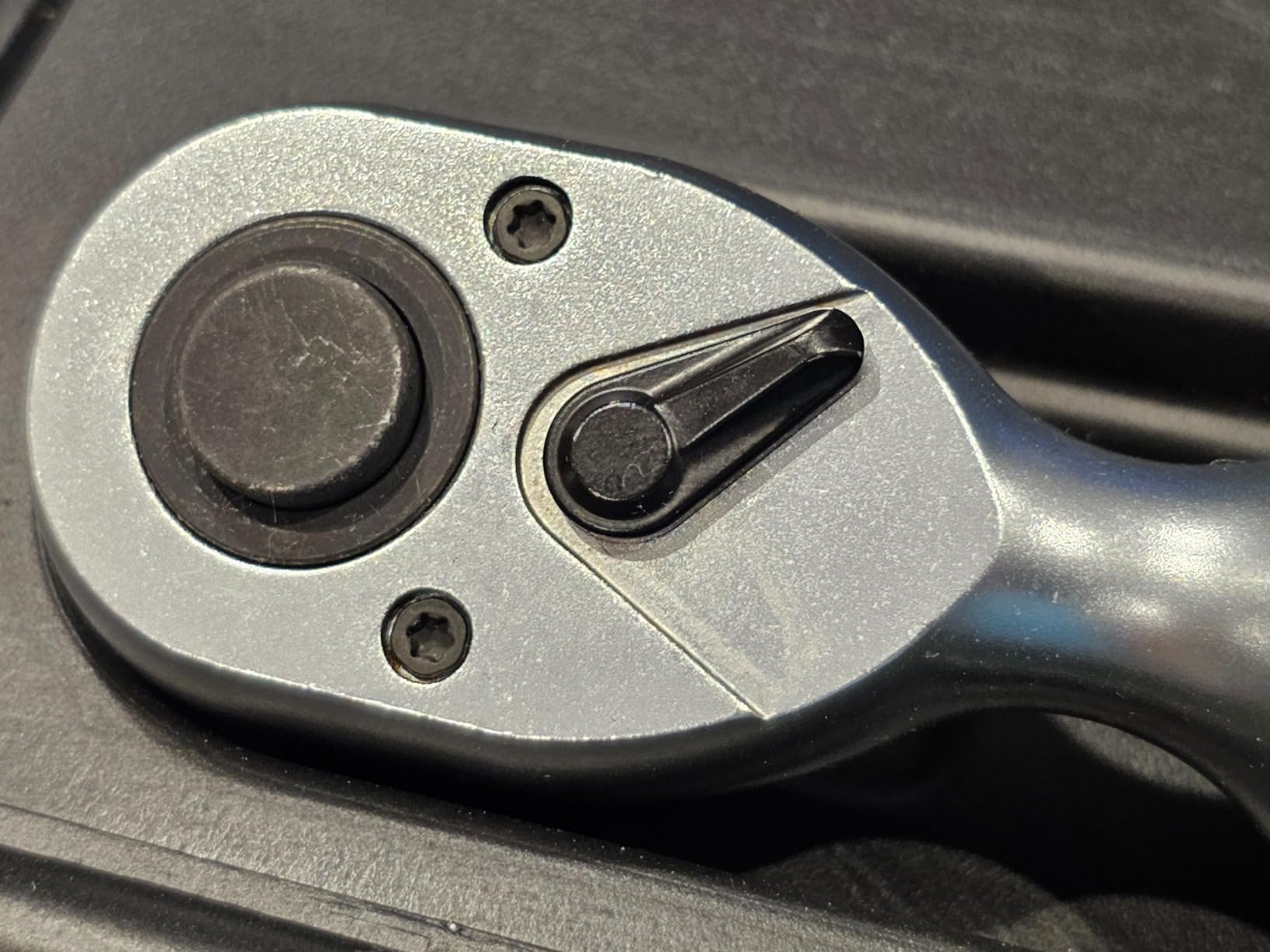
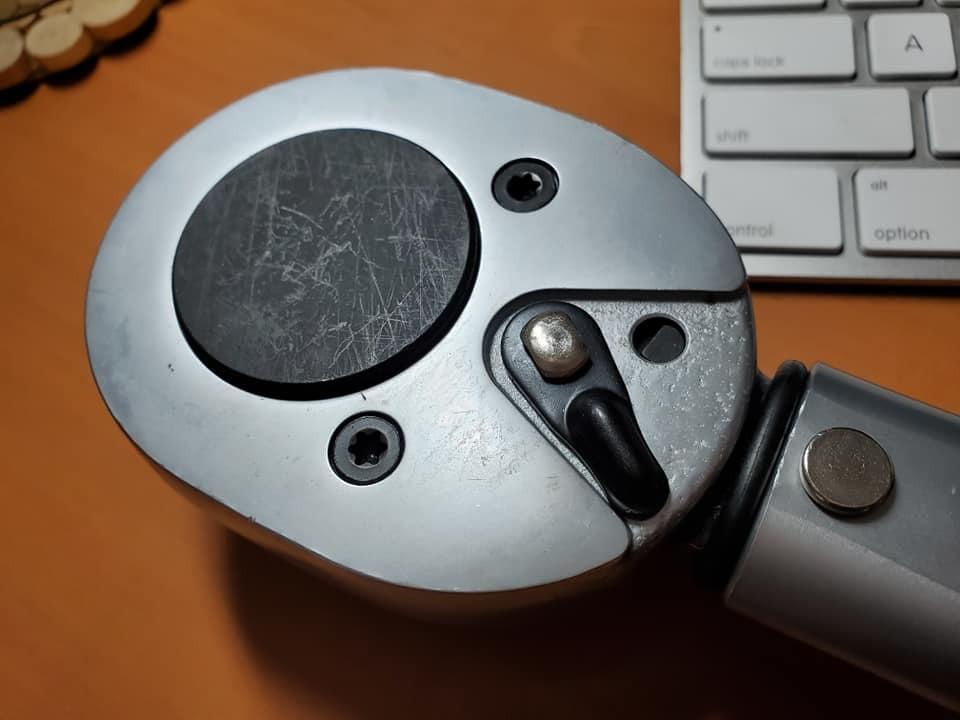
A 72-tooth reversible head with a 5 degree swing and a push-button socket release makes it quick to work with one hand, and the data storage function keeps a usage history you can refer back to.
What it handles well
Axle and hub nuts, suspension fasteners and any mid-to-high torque job where you want a number rather than a click. Four units cover Nm, ft-lb, in-lb and kg-cm, and the documentation and certificate of correction are genuinely useful documentation to have in a folder.
At 5.6 pounds and 26.57 inches it is a long, serious tool that stays controllable because the digital mechanism is doing part of the work for you.
Where it falls short
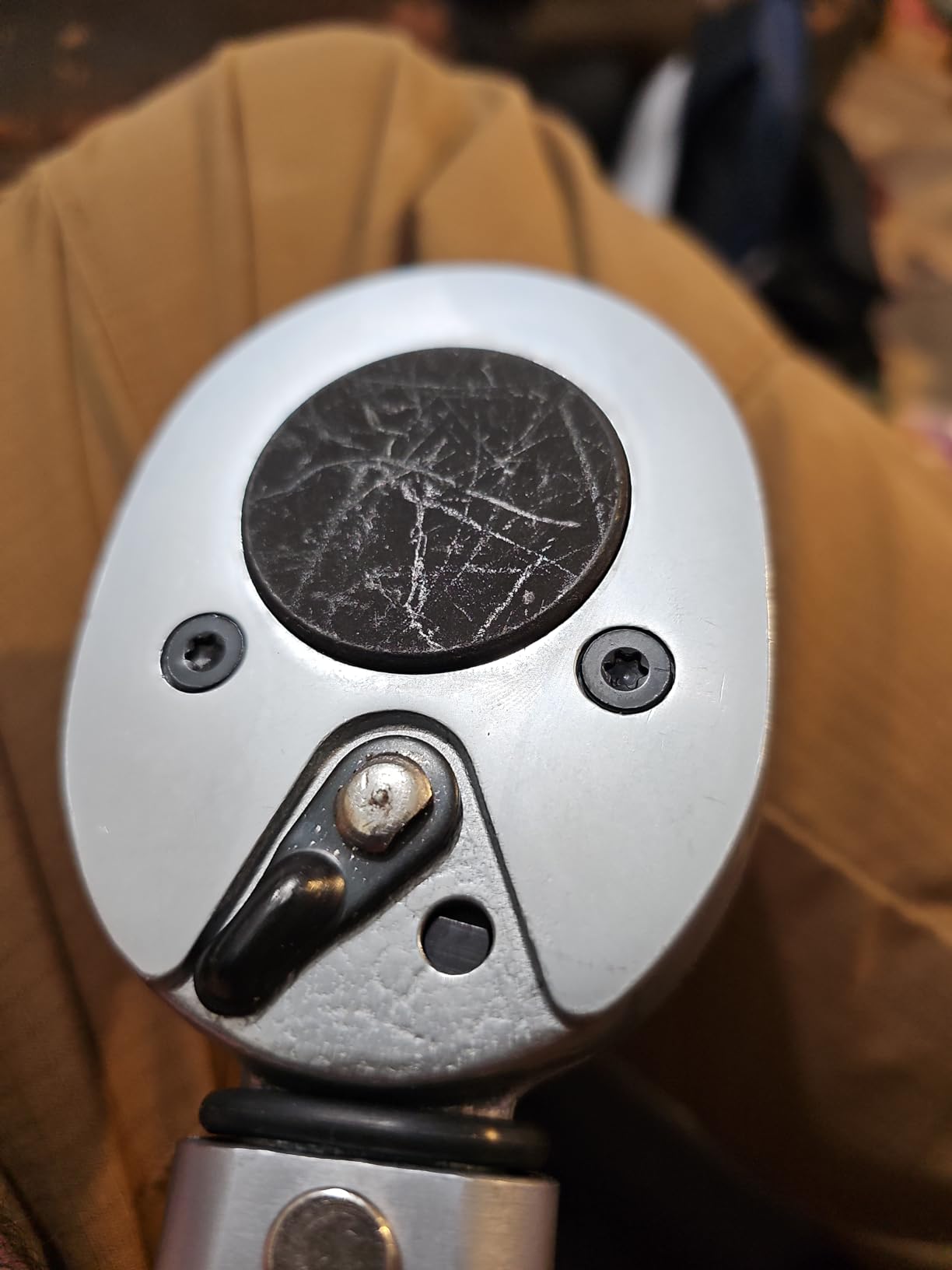
The control end of the handle is plastic rather than metal, which is the first thing to worry about after a lifetime of drops. Supplied batteries also tend to die quickly, so budget for replacements.
Some buttons need several presses to scroll through ranges, and the menu is not as immediate as a dial. It is a small friction that adds up if you change units often.
12. TEKTON 3/4 Inch 50-300 Ft-Lb – Best for Truck and Heavy Suspension Work
TEKTON 3/4 Inch Drive Micrometer Torque Wrench (50-300 ft.-lb.) | 24350
50-300 ft-lb
Plus or minus 4 percent
26.2 inch long
7.1 pounds
All steel
Pros
- All-steel construction with no plastic parts to crack
- 50-300 ft-lb range for heavy truck and head bolt work
- Click can be both heard and felt
- Permanently marked high-contrast scale
- Backed by a no time limit warranty
Cons
- Measures torque clockwise only
- Fixed square drive limits access in tight spots
A 3/4 inch drive is not a general purpose automotive size, and this is the wrench to own when your work is trucks, trailers or heavy suspension. Fifty to 300 ft-lb covers the fasteners that a 1/2 inch wrench will not reach, including large head bolt work.
The all-steel construction with no plastic parts is the defining feature. Seven and a tenth pounds of alloy steel feels like a tool that will outlive several vehicles, and TEKTON backs it with a warranty that has no time limit and does not ask for a receipt.
The click can be both heard and felt, which matters on a heavy fastener where you are braced against the vehicle. The permanently marked high-contrast dual-range scale stays readable in low light, and the markings will not wear off the way printed scales can.
It arrives pre-calibrated to plus or minus four percent, ready to use, with a storage case and a manual that includes a torque conversion chart. Nothing else has to be bought before the first job.
What it handles well
Heavy truck and trailer suspension, large head bolt assemblies, and any fastener above 200 ft-lb. The reversible ratchet head drives both directions, which is useful for reassembly even though the torque measurement itself is clockwise.
Where it falls short
The fixed square drive, rather than a flex head, limits access in tight spots. On a deeply recessed fastener you will want a universal joint or an extension that the fixed head cannot reach around.
It measures torque clockwise only, and at 50 ft-lb minimum it cannot touch the light engine fasteners that make up the bulk of routine work. Owner feedback on this one is thinner than the rest of the roundup, with a few hundred reviews rather than tens of thousands, so treat the impressions above as a summary of a smaller pool.
How We Ranked These Torque Wrenches
We ranked on four things, in this order: stated accuracy across the range that matters for the tool’s size, the build materials and mechanism, the presence of a calibration certificate, and the volume and consistency of owner feedback. We did not rank on brand name.
Accuracy claims come from the manufacturer specifications. Click type wrenches in this roundup are specified at plus or minus four percent, the Hairich and YIYEIE at plus or minus three percent, and the two digital wrenches at plus or minus two percent, with the GEARWRENCH breaking tolerance out by direction at plus or minus two percent clockwise and plus or minus three percent counterclockwise.
Owner feedback mattered because tolerance on paper does not tell you whether a click is audible, whether the adjustment is smooth, or whether the scale is readable in a dark garage. We read the recurring complaints as carefully as the praise.
We also weighed what ships in the box. An extension bar, a set of drive adapters and a proper case are not accessories at this level, they are the difference between a wrench you use and a wrench you leave on the shelf.
The single biggest factor separating these tools is range coverage. If your work spans 10 to 250 ft-lb, no single wrench here does both, and that is why a two-wrench setup is the honest recommendation for most people.
How to Use a Torque Wrench Correctly
Using a torque wrench badly is worse than not using one at all, because it gives you false confidence. Six habits cover almost every mistake we saw described by owners and mechanics.
1. Find the real specification. Check the service manual for the vehicle, not a forum post or a parts catalogue listing. If the manual specifies ft-lb, use ft-lb; a conversion error at the top of a range is not small.
2. Set the wrench before you touch the fastener. Unlock the handle, turn the main scale to the value, then use the fine scale on the handle to dial in the remainder, and lock it. A wrench that is adjusted while under load can shift mid-pull.
A useful shortcut is to set the value on the bench, confirm it twice, and then leave the handle locked. Most reported overshoot errors trace back to a half-set wrench, not to a bad mechanism.
3. Pull smoothly and stop at the signal. Break the torque loose first with a normal wrench, then re-seat and pull steadily. Stop at the click, the beep or the light. Continuing past the signal is how you stretch a bolt.
4. Use a star pattern in multiple passes. On multi-bolt assemblies such as valve covers and cylinder heads, tighten in a criss-cross sequence in several stages up to the final figure rather than hitting spec on the first bolt.
5. Never break a fastener loose with a torque wrench. Back the fastener out with a breaker bar or an impact wrench, then use the torque wrench only to tighten. This is the most common way people ruin an accurate tool, and it is why forum users insist on it.
6. Store it correctly. Click type wrenches should be returned to the lowest setting so the spring is not held loaded. Reversible ratchet heads should be returned to the same orientation. This habit alone extends calibration life more than almost anything else you can do.
What Size Torque Wrench Do You Need for Automotive Work?
Most people need one 3/8 inch wrench for engine and small fasteners plus one 1/2 inch wrench for suspension, brakes and lug nuts. A 1/4 inch drive covers the light end for spark plugs and intake hardware, and a 3/4 inch is only needed for trucks, trailers and heavy suspension.
1/4 inch drive: typically 10-230 in-lb, which covers spark plugs, intake manifold nuts, small brackets, air intake hardware and trim fasteners. Low torque and high precision, but it cannot do structural work.
3/8 inch drive: typically 10-80 ft-lb, the engine bay size. It covers valve cover bolts, oil pan bolts, water pump fasteners, small engine hardware and outboard or trailer work where space is tight.
1/2 inch drive: typically 10-150 ft-lb for general work, or 25-250 ft-lb for suspension and heavy lug patterns. This is the drive most automotive work is done with, and the one most people should buy first.
3/4 inch drive: typically 50-300 ft-lb, reserved for trucks, heavy suspension, large head bolts and anything else a 1/2 inch wrench physically cannot turn.
The rule of thumb is simple: match the drive to the socket size your fasteners actually use, then match the range to the spec. Buying a 3/4 inch wrench for lug nuts means the tool is too coarse to set accurately at low values.
There is one more drive size worth naming. A 1/4 inch wrench is the one to reach for when the spec is expressed in in-lb, which is how most spark plug and small intake hardware is specified, and it is the only size in this roundup that reaches the sub-30 in-lb range where an engine rebuild or a head assembly lives.
A practical starter kit for most home mechanics is a 3/8 inch for the engine bay plus a 1/2 inch for everything underneath. That pair covers a tune-up, an oil change, brake work and a wheel removal without a single gap, and the two most-reviewed wrenches in this roundup, the EPAuto and LEXIVON 1/2 inch 10-150 ft-lb models, both sit in that 1/2 inch class.
Click Type vs Split Beam vs Digital: Which Is Most Accurate?
Digital and electronic wrenches are the most accurate, typically around plus or minus two percent, followed by split beam wrenches at roughly plus or minus two to three percent, with click type wrenches specified at plus or minus four percent. The practical difference is smaller than the numbers suggest for routine work, and larger for critical assembly.
Click type, also called turn-type: a spring and detent mechanism that releases with an audible signal at the set value. Simple, rugged and inexpensive, and the default choice for most DIY and shop work. Most are clockwise only and must be stored at the lowest setting.
Split beam: two parallel beams that deflect and slap together at the target, so the signal is felt as much as heard. Because the spring is not held under sustained load, split beam wrenches do not have to be stored at their lowest setting, which is why they hold calibration longer and tolerate being dropped.
Digital or electronic: a numeric readout with an audible and visual target alert. Accuracy is the best of the three, settings can be stored and recalled, and peak torque can be displayed, but the mechanism adds cost and failure points such as batteries and end caps.
Torque-angle wrenches are a different category. They measure both ft-lb and degrees of rotation, and they are the only correct tool for head bolts with a torque-plus-angle specification. A click type or a basic digital cannot verify the angle component at all.
For most automotive work a click type is entirely sufficient. Move up to digital or angle-measuring when you are doing head bolts with angle specs, mounting hardware that carries a preload requirement, or anything where the manual calls out a torque-angle sequence.
The 30 Percent Rule for Choosing a Torque Range
The rule most often called the 20 percent rule is really the 30 percent rule: choose a wrench whose range puts your torque specification in the middle third of the scale. That leaves at least ten percent headroom on either side of your target, which is where accuracy and resolution actually live.
A 10-150 ft-lb wrench is a good match for a spec of 80 ft-lb, because 80 sits comfortably above the midpoint. It is a poor match for a 15 ft-lb bolt, because 15 is right at the bottom of the range where the click is faint and the adjustment resolution is coarsest.
This is also why buying the biggest wrench you can find is a mistake. A 300 ft-lb tool set to a 20 ft-lb lug nut gives you a tiny fraction of the scale, an adjustment that barely moves, and a signal you can easily miss.
Calibration, Storage and Signs Your Wrench Has Drifted
Any torque wrench should be checked periodically, and the interval depends on how hard you use it. A weekend user should verify a new wrench against a known reference and re-check it annually. A daily shop should have a calibration interval set by use rather than by the calendar.
Two of the wrenches in this roundup carry a serial-numbered calibration certificate in the box, which lets you tie the tolerance to a specific tool rather than a brand claim. That paperwork is worth keeping with your service records.
Split beam wrenches need calibration far less often than click type, and the reason is structural: a click wrench stores a spring under load, and a spring held at a mid-scale setting for months walks out of tolerance.
Five signs it is time to verify or recalibrate: it clicks early or late compared with how it used to, the setting drifts while you are not touching it, the adjustment collar is hard to turn or grinds, the click is noticeably quieter than before, or the tool has been dropped hard onto a hard surface.
A sixth one catches people out. If the setting you set yesterday is not the setting the wrench shows today with nobody touching it, the mechanism has taken a set, and the wrench needs verifying before it touches another fastener.
Where a split beam wrench is available, forums widely regard it as the better long-term purchase. It tolerates abuse, does not need low-setting storage, and holds calibration across more cycles, which is why it dominates the top tier in mechanic discussions.
The other recurring forum complaint is worth repeating: a clicker set to 80 ft-lb that clicks at 60 is not a user error, it is a spring that has walked out of tolerance. Treat a sudden change in behaviour as a calibration signal, not as something to compensate for by adjusting your technique.
Two inexpensive habits close most of the gap. Return the wrench to its lowest setting after every job, and keep it in the case rather than loose in a drawer where it can be dropped or knocked against another tool. Neither takes more than a few seconds, and together they are the reason a decent clicker keeps working for years.
Frequently Asked Questions
What size torque wrench is best for automotive?
Most automotive work needs two sizes. A 3/8 inch drive at 10-80 ft-lb covers engine bay fasteners such as valve cover and oil pan bolts, and a 1/2 inch drive covers suspension, brakes and lug nuts. Choose 1/2 inch for 10-150 ft-lb general work or 25-250 ft-lb heavy suspension. Add a 1/4 inch drive for spark plugs and light hardware, and 3/4 inch only for trucks and trailers.
What is the 20 rule for torque wrenches?
The rule usually called the 20 percent rule is really the 30 percent rule. Pick a wrench whose range puts your torque specification in the middle third of the scale, which leaves roughly ten percent headroom either side of the target. That is where accuracy and adjustment resolution are highest, and it is why a 10-150 ft-lb wrench is a poor fit for a 15 ft-lb bolt.
What type of torque wrench is most accurate?
Digital and electronic wrenches are the most accurate, typically around plus or minus two percent. Split beam wrenches follow at roughly plus or minus two to three percent, and click type wrenches are specified at plus or minus four percent. For most automotive work the difference is modest, but digital wins on critical assembly and on torque-plus-angle head bolts, where a click type cannot verify the angle at all.
Is split beam or click type torque wrench better?
A click type is better for most home and general shop work because it is simpler, cheaper and easily replaceable. A split beam wrench is better if you want one tool to last, because it does not need to be stored at its lowest setting and it holds calibration across more cycles. Mechanics who work on a full-time basis usually end up with both, using clickers for wheels and split beam for general work.
What is more accurate, a digital or click torque wrench?
A digital torque wrench is more accurate. Manufacturers typically rate digital wrenches at plus or minus two percent, against plus or minus four percent for click type. The gap widens at the extremes of a click wrench’s range, where a small adjustment produces a large torque change. For routine oil changes and lug nuts the difference rarely matters, but on head bolts and safety critical assembly it is worth paying for.
Does a split beam torque wrench need calibration?
Yes, but far less often than a click type wrench. A split beam mechanism does not have to be stored with a spring held under load, which is what causes click type wrenches to drift. Forum mechanics widely report split beam wrenches returning from calibration nearly perfect after thousands of cycles. Even so, verify a new wrench against a known reference before you trust it on a critical fastener.
Can you loosen bolts with a torque wrench?
Do not. Breaking a fastener loose puts shock loads through the spring and the mechanism, and it is the single most common way people ruin an accurate wrench. Use a breaker bar or an impact wrench to back the fastener out, then re-seat it and use the torque wrench only for tightening in the correct direction. Most click type wrenches measure torque clockwise only, so reverse threads need a bidirectional model.
How often should a torque wrench be calibrated?
A weekend user should check a new wrench against a known reference and re-verify about once a year. A professional shop that torques fasteners daily should set a service interval based on cycle count rather than the calendar, and more often after any hard drop or impact. A digital wrench also needs fresh batteries, and a fading reading on a digital is often a battery problem rather than a calibration problem.
Our Final Verdict on the Best Torque Wrenches for Automotive Work
Our pick for the best torque wrenches for automotive work is the EPAuto 1/2 inch 10-150 ft-lb, a 4.6-star tool with 23k owner reviews. It pairs a real chrome vanadium ratchet head with a tolerance you can verify, and the box includes the extension bar and case you need on day one.
Add the LEXIVON 25-250 ft-lb alongside it for suspension and lug work, or the YIYEIE three drive set if you would rather start with a full kit. Choose digital only when you need a number rather than a signal, or when a torque-plus-angle specification demands it.
Whichever one you pick, the technique matters more than the tool. Set the value from the service manual, pull smoothly, stop at the signal, use a star pattern, never break a fastener loose, and put it back at the lowest setting. Updated for 2026.