
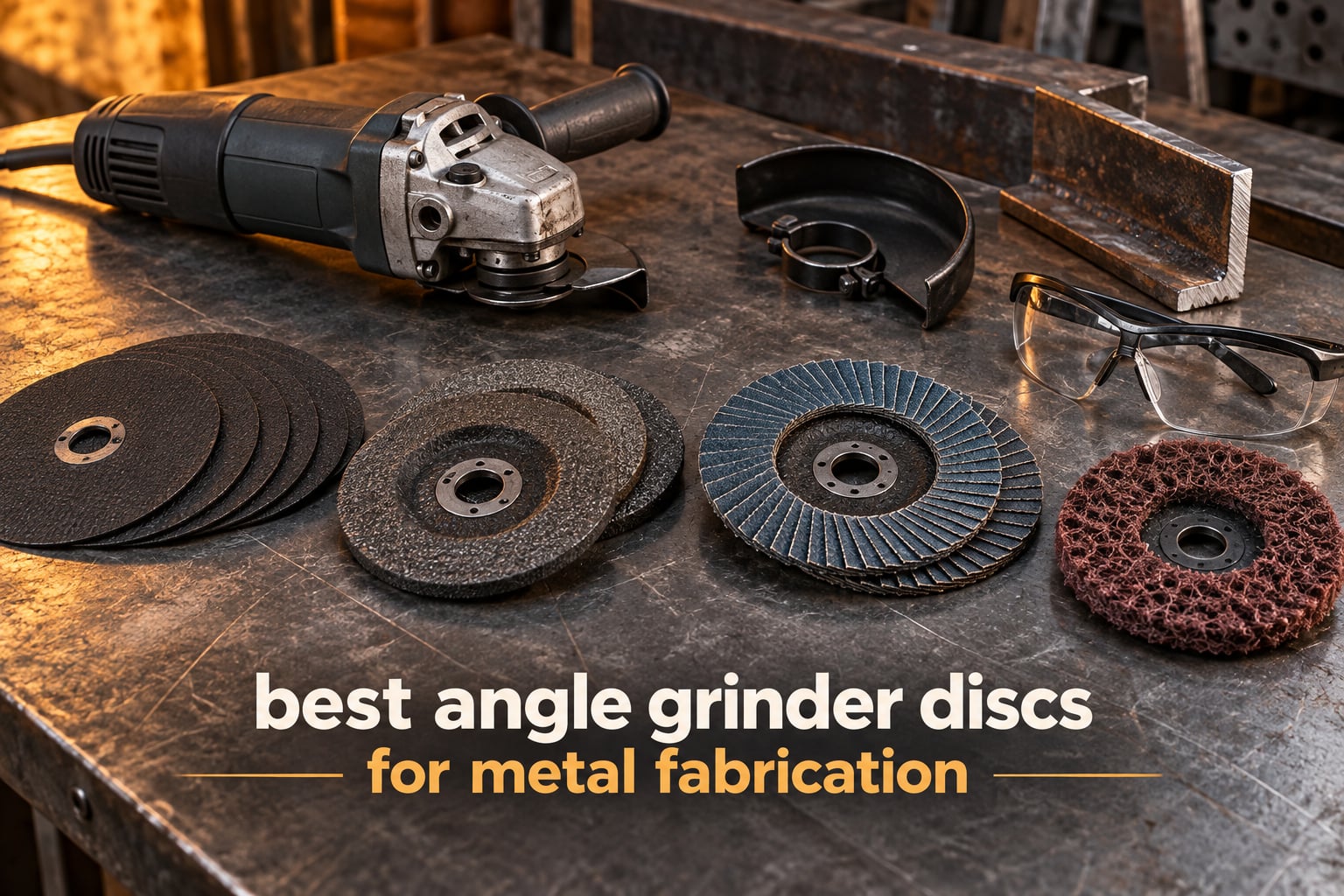
There is no single best angle grinder disc for metal fabrication, because the right answer changes with the job. A cut-off wheel slices plate and rebar, a depressed-center grinding wheel takes down a weld cap, a Type 29 flap disc grinds and blends in one pass, and a non-woven strip disc lifts rust and paint without touching the metal underneath. Pick the format first, then the grain.
That order matters more than any brand. Almost every roundup on this topic stops at cut-off wheels, which is a fraction of what a fabricator actually burns through. We covered the whole matrix for 2026 – cut-off wheels, grinding wheels, flap discs and non-woven strip discs – and matched each to the metal it handles best: carbon steel, stainless steel and aluminum.
Along the way we kept the shop details that decide whether a disc is worth buying twice: arbor size, max RPM, depressed-center clearance under the guard, grit progression for weld blending, and what a heavier grain actually costs you per cut. If you are still choosing the tool itself, our angle grinder roundup covers the bodies these discs bolt into.
Our picks are based on published specifications, manufacturer grain and bond data, and the patterns that come up repeatedly across fabrication forums, not on lab cut-rate testing. Where a spec was not published, we say so rather than guess.
Top 3 Angle Grinder Discs for Metal Fabrication in 2026
If you want three discs to cover most fabrication work, take these. The DEWALT cut-off wheel handles everything that needs separating, the DEWALT grinding wheel handles everything that needs removing, and the EZARC flap disc handles everything that needs finishing.

DEWALT DW8062B5 Cut-Off Wheel
- 4-1/2 in x .045 in
- 7/8 arbor
- 60 grit aluminum oxide
- two fiberglass layers
- 13300 rpm
DEWALT DW4514B5 Grinding Wheel
- 4-1/2 x 1/4 x 7/8 in depressed center
- 60 grit aluminum oxide
- OEM replacement wheel
- 10 pack

EZARC 40 Grit Zirconia…
- Type 29 bevel geometry
- 40 grit zirconia alumina
- 4-1/2 in with 7/8 arbor
- rated to 13300 rpm
10 Best Angle Grinder Discs for Metal Fabrication (October 2026)
Every pick below is a 4-1/2 inch or 3 inch wheel or disc with a published arbor and speed figure, except where the manufacturer did not publish one. The best-for labels are deliberately different for each row, because a shop that only needs one of these should be able to skip straight to it.
| Product | Specs | Action |
|---|---|---|
| DEWALT DW8062B5 Cut-Off Wheel |
|
Check Latest Price |
| DEWALT DW4514B5 Grinding Wheel |
|
Check Latest Price |
| EZARC 40 Grit Zirconia Flap Disc |
|
Check Latest Price |
 S SATC 20-Piece Flap Disc Set S SATC 20-Piece Flap Disc Set |
|
Check Latest Price |
 BHA 24 Grit Grinding Wheels BHA 24 Grit Grinding Wheels |
|
Check Latest Price |
 SALI 50-Pack Cut-Off Wheels SALI 50-Pack Cut-Off Wheels |
|
Check Latest Price |
 EZARC Diamond Cut-Off Wheel EZARC Diamond Cut-Off Wheel |
|
Check Latest Price |
 TPmax Strip Discs TPmax Strip Discs |
|
Check Latest Price |
 SALI 10-Pack Grinding Wheels SALI 10-Pack Grinding Wheels |
|
Check Latest Price |
 SHALL 3 Inch Cut-Off Wheels SHALL 3 Inch Cut-Off Wheels |
|
Check Latest Price |
1. DEWALT DW8062B5 – Best Overall Angle Grinder Disc for Metal
DEWALT 4 1/2 Cut Off Wheel, Angle Grinder Cutting Disc, 5 Pack, Aluminum Oxide Abrasive Chop with 7/8 Arbor for Metal Cutting, Grinding Wheels 4 1/2 in x .045 in (DW8062B5)
4-1/2 in x .045 in
7/8 arbor, 60 grit aluminum oxide
13300 rpm, two fiberglass sheets
5 pack
Pros
- Cuts carbon steel
- stainless and nickel alloys in one wheel
- Retains sharpness across multiple cuts
- Two fiberglass layers cut down breakage
- Best-selling cut-off wheel in its category
Cons
- Wears faster on heavy plate than a thicker wheel
- Slightly thicker than the thinnest competitor wheels
This is the wheel I put in a new shop bag first. It is a 4-1/2 inch by .045 inch depressed-center cut-off wheel with a 7/8 inch arbor, 60 grit aluminum oxide, and two fiberglass sheets for side-load strength. Rated speed is 13300 rpm.
Reviewers describe the same thing every time: one disc handles several cuts before it dulls. Pipe, EMT, angle iron and stainless exhaust all get mentioned, which tells you it is not a single-material wheel. The Temper Point grain and resin bond are what make that possible, since they keep the abrasive adhered as the rim wears.
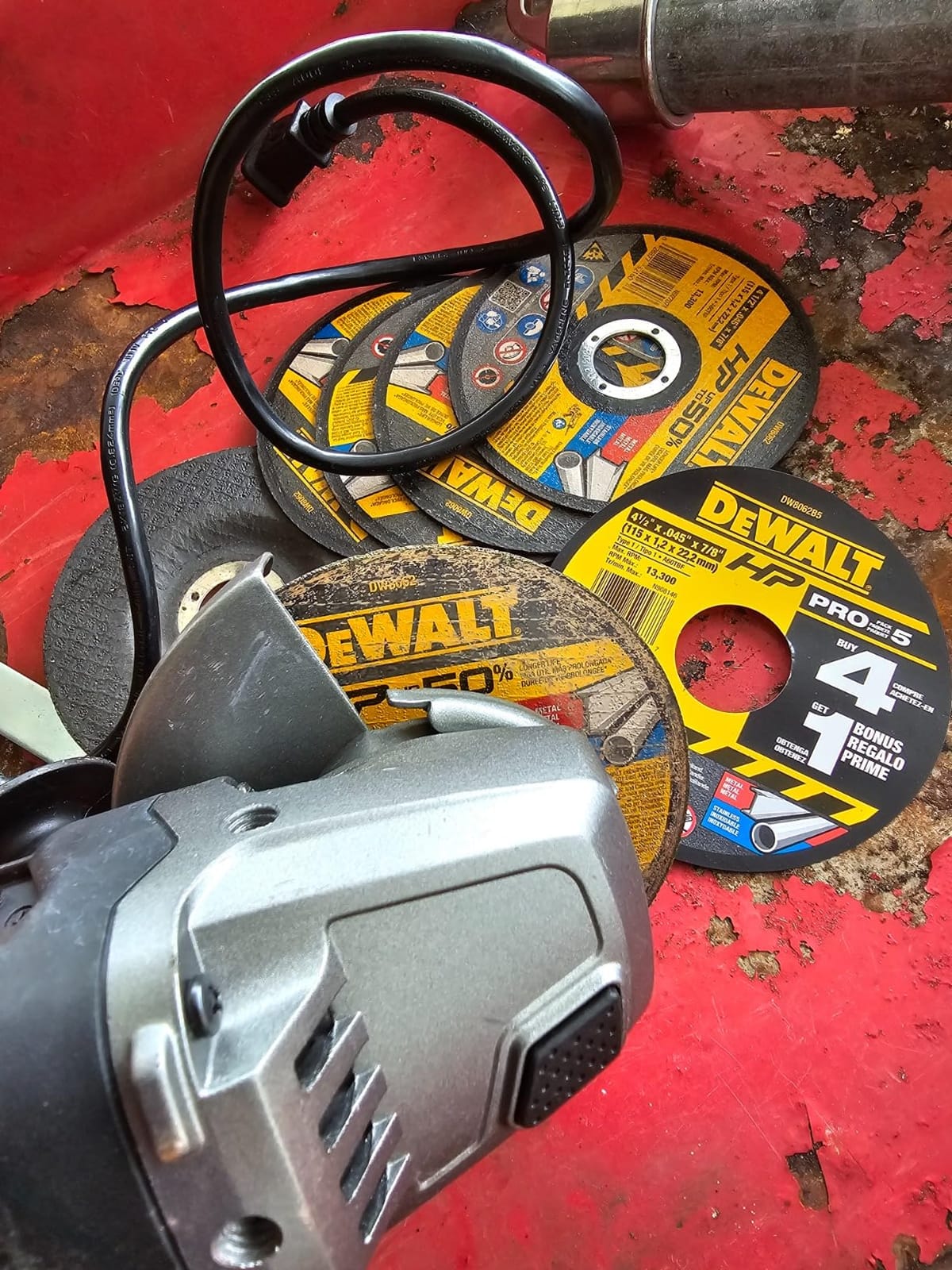
Two caveats. On heavy structural plate it wears faster than a thicker wheel would, so high-removal cutting is not its strength. It is also a hair thicker than the thinnest wheels in this roundup, which means slightly more material removed per cut.
When this wheel earns its slot in a shop
Reaching for a general cut-off wheel that handles mild steel, stainless and nickel alloys without a tool change. This is the default separator for pipe, tube, angle iron and everyday structural work. It is the wheel most shops buy first, and the one most shops re-buy without thinking about it.
Where it will disappoint you
Anyone grinding a heavy weld cap or blending a stainless fillet. At .045 inch it has no side-load tolerance for edge work, and pushing it sideways is how thin wheels get snapped. For heavy material removal you want a depressed-center grinding wheel at 1/4 inch instead.
2. S SATC 20-Piece Flap Disc Set – Best Value Angle Grinder Discs for Multi-Step Work
S SATC 20PCS Flap Discs 4 1/2 for Angle Grinder 40/60/80/120 Grit Flap Disc High-Density Bevel Type Angle Grinder Sanding Disc Abrasive Flap Disk #29
4-1/2 in, 0.04 in thick
Type 29 fiberglass backing
40/60/80/120 zirconia mix
20 pieces, 13300 rpm
Pros
- Whole grit progression in one purchase
- High-density zirconia outlasts basic flap discs
- Fiberglass backing dampens vibration
- Handles paint
- rust and weld cleanup
Cons
- Grit mix is weighted toward the coarse end
- Some reports of damaged packaging and missing pieces
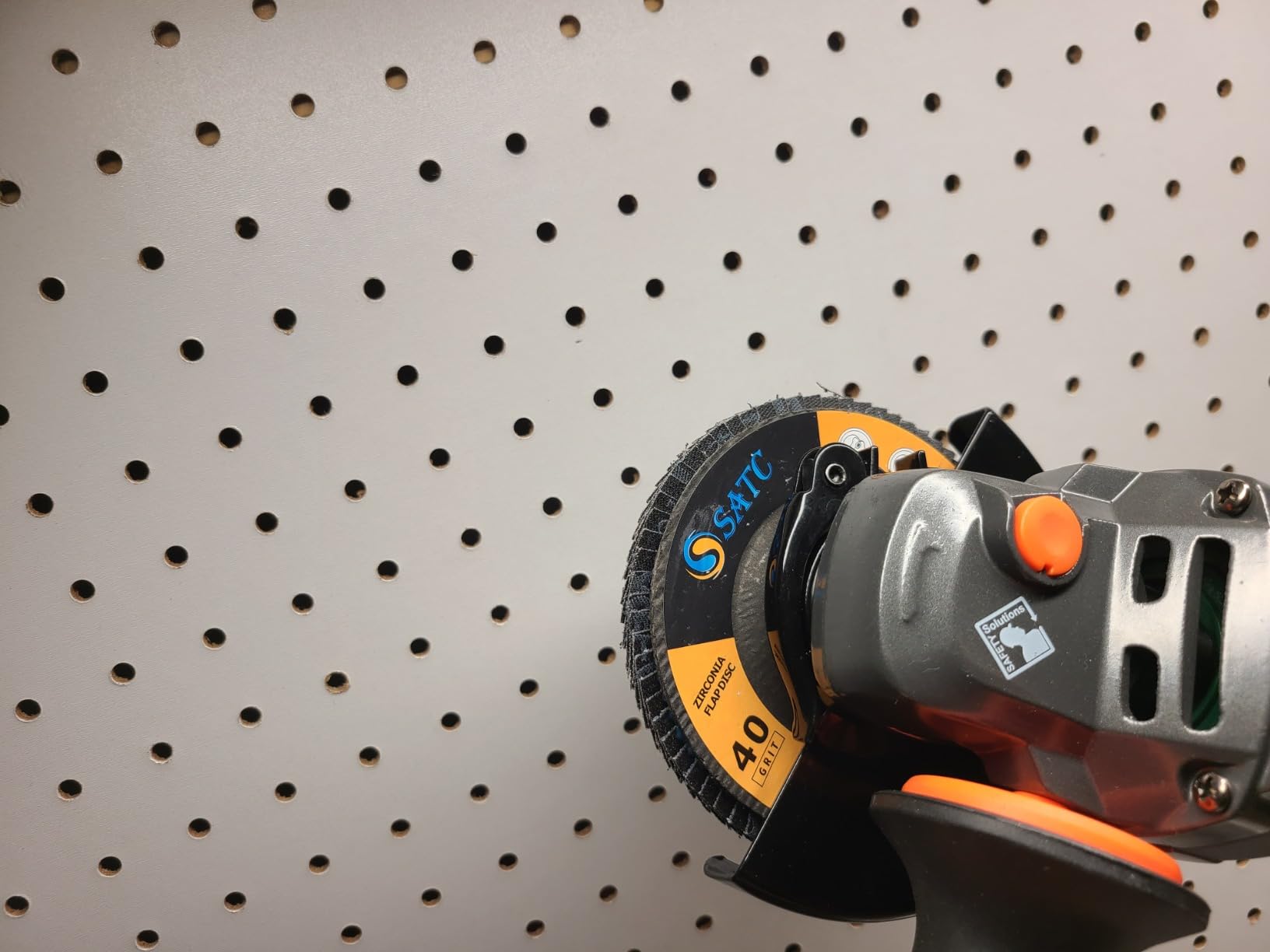
What makes this pack useful is the mix: ten 40 grit, five 60 grit, three 80 grit and two 120 grit. That is a full weld-blending sequence in one purchase, and it removes the excuse to never move past coarse grit because you ran out of discs.
The construction is high-density zirconia on Type 29 fiberglass backing, 4-1/2 inch, rated to 13300 rpm. Buyers treat it as a high-volume set that clears multiple layers of paint and cleans up welds without stopping, and the fiberglass pad is what keeps it steady rather than buzzy under load.
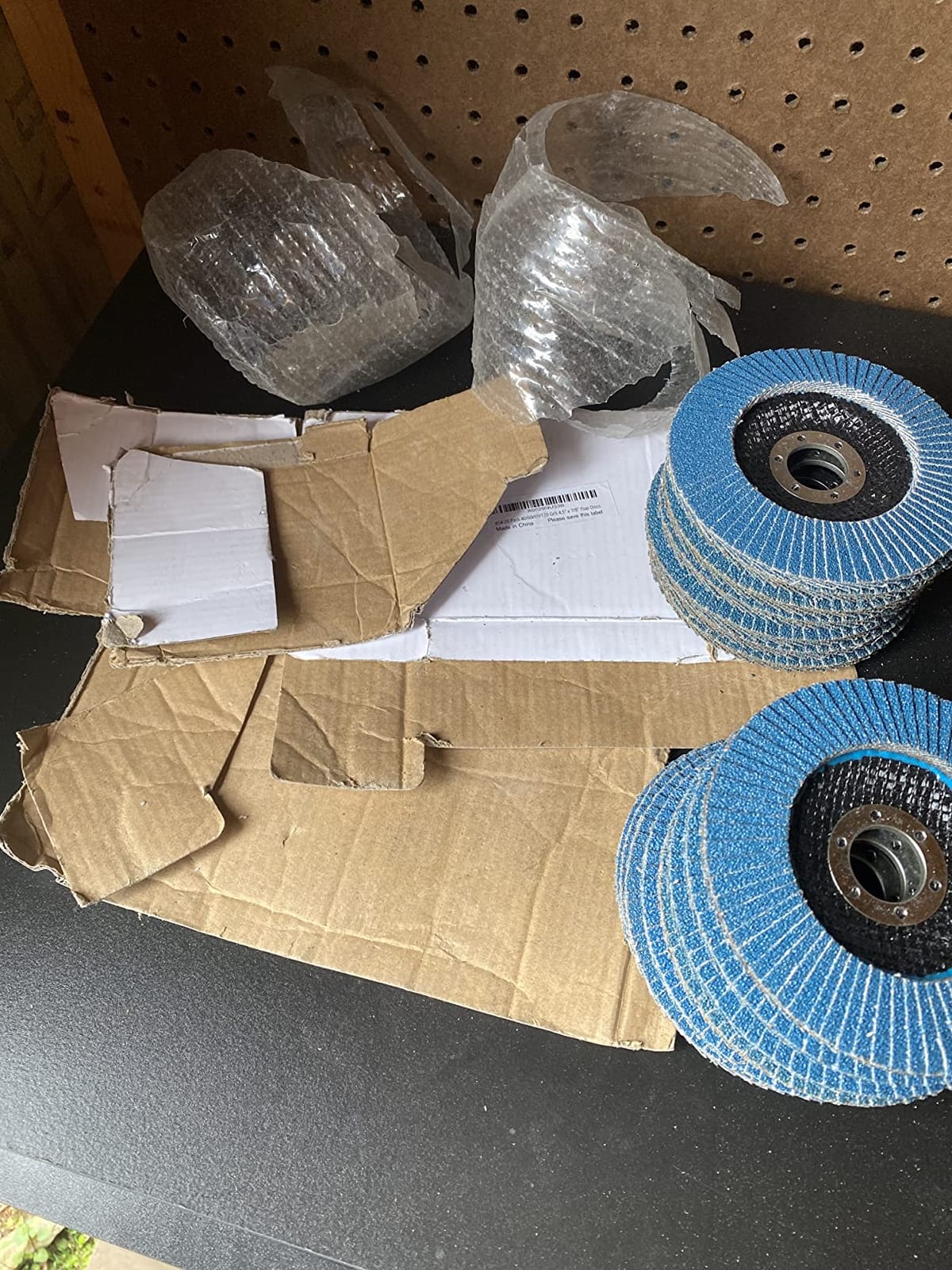
The distribution is the one real weakness. Two 120 grit discs will not finish a production weldment, so finishing passes need another purchase. A few buyers also report packaging arriving damaged with pieces missing, so open the box before you count on it.
When this set earns its slot in a shop
One stop for a fabricator who grinds a cap with 40 grit, blends at 60, refines at 80 and only occasionally touches 120. It is a sensible carry-in for field work where bringing four separate boxes is not realistic. You get four steps of progression from one purchase instead of four trips to the cabinet.
Where it will disappoint you
Anyone who needs a single fine-grit disc in a hurry, or who runs a dedicated blending cell and burns through fine grit. The zirconia cut rate is also a step below shaped ceramic grain on hard carbon steel, so heavy cap removal is not the strong suit.
3. DEWALT DW4514B5 – Best Grinding Wheel for Weld Cap Removal
DEWALT DW4514B5 4-1/2-Inch by 1/4-Inch by 7/8-Inch Metal Grinding Wheel – 10 Pack
4-1/2 x 1/4 x 7/8 in
Depressed center
60 grit aluminum oxide
10 pack
Pros
- Quarter-inch body handles heavy removal
- OEM replacement part number
- Reported to outlast generic wheels
- Sharpens mower blades and cleans metal
Cons
- Some variability in durability reported
- General purpose 60 grit is not a finishing wheel
The geometry is the point here. This is a 4-1/2 inch by 1/4 inch depressed-center grinding wheel on a 7/8 inch arbor, built for metal with 60 grit aluminum oxide in a ten-pack. The depressed center is what lets it clear the guard on a standard angle grinder, and the quarter-inch body is what lets you lean on it.
Owners comparing it against cheaper department-store wheels report getting several times the life out of it, and it runs true. The commonly reported uses are exactly what you would expect from a general purpose shop wheel: weld cap cleanup, edge deburring, lawnmower blade sharpening and general fabrication metal cleanup.
When this wheel earns its slot in a shop
Any grinder that needs a real removal tool: knocking down a cap, cleaning a fillet, knocking an edge back to line. The quarter-inch thickness takes side load without complaint, which is exactly the pressure a thin cut-off wheel cannot survive. Being an OEM part also means it is the correct replacement when your machine came with this spec.
Where it will disappoint you
Fine finishing and stainless blending, where 60 grit general purpose abrasive leaves a scratch pattern you still have to work out. Some buyers also report durability that varies from disc to disc, which is common in resin-bond wheels of this class.
4. EZARC 40 Grit Zirconia Flap Disc – Best for Stainless Steel and Aluminum Cleanup
EZARC Zirconia Flap Discs 40 Grit, 4-1/2 x 7/8-Inch, Type 29, 10-Pack
Type 29, 40 grit coarse
4-1/2 in with 7/8 in arbor
Zirconia alumina on fiberglass
13300 rpm
Pros
- Zirconia outlasts aluminum oxide discs
- 40 grit takes material off weld reinforcement fast
- Type 29 bevel works seams at 15 to 20 degrees
- Fiberglass pad absorbs vibration
Cons
- Shorter life than premium industrial discs
- Worn discs need replacing to regain bite
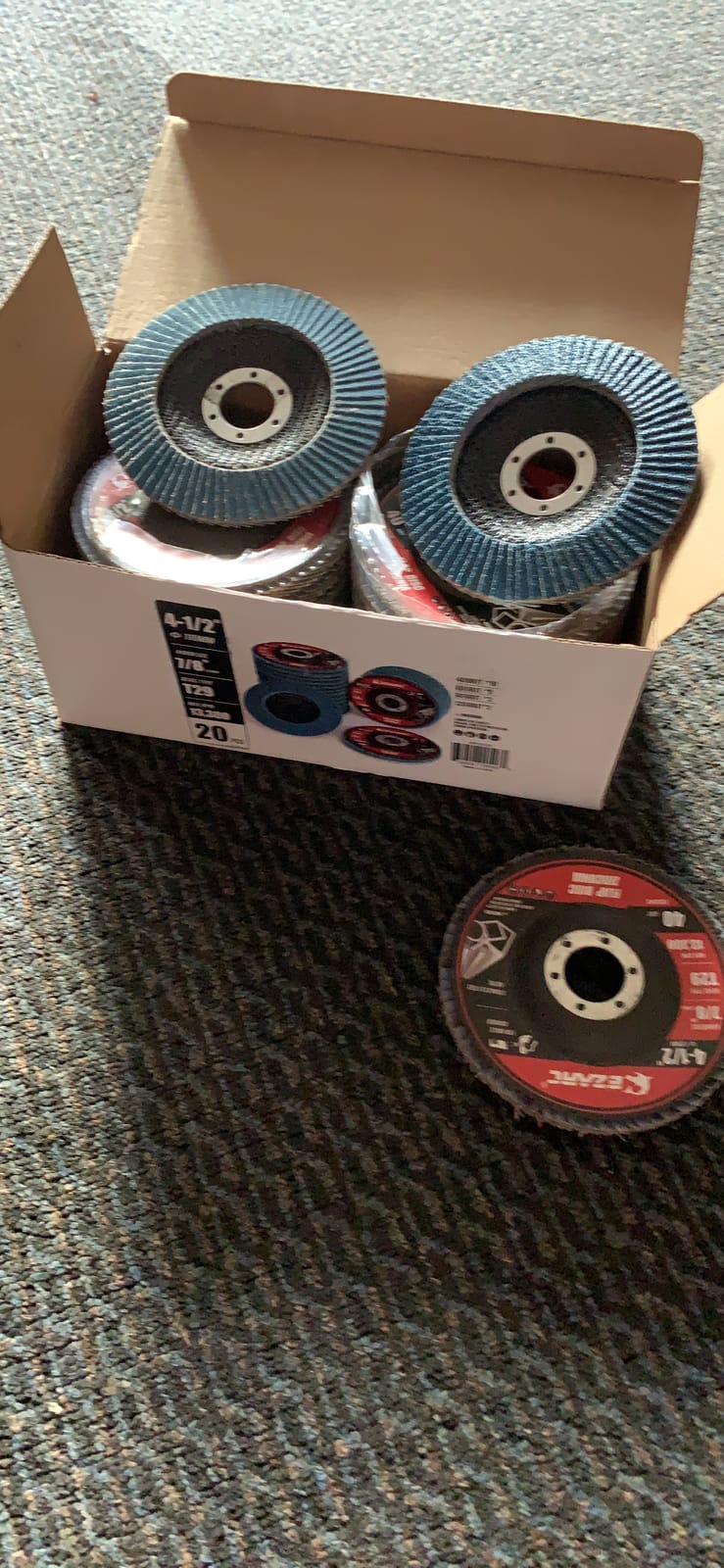
Flap discs get underrated because people treat them as a finishing tool. They are a removal tool with a finishing pass built in, and this 40 grit Type 29 disc is the reason a single disc can take a proud cap and blend it in the same session.
It is 4-1/2 inch with a 7/8 inch arbor, zirconia alumina, rated to 13300 rpm, and listed for cast iron and stainless steel. The Type 29 geometry gives roughly 15 to 20 degrees of working surface, which is what lets you get into a seam or the corner where two plates meet. The fiberglass pad is there to kill vibration and keep the cut steady.
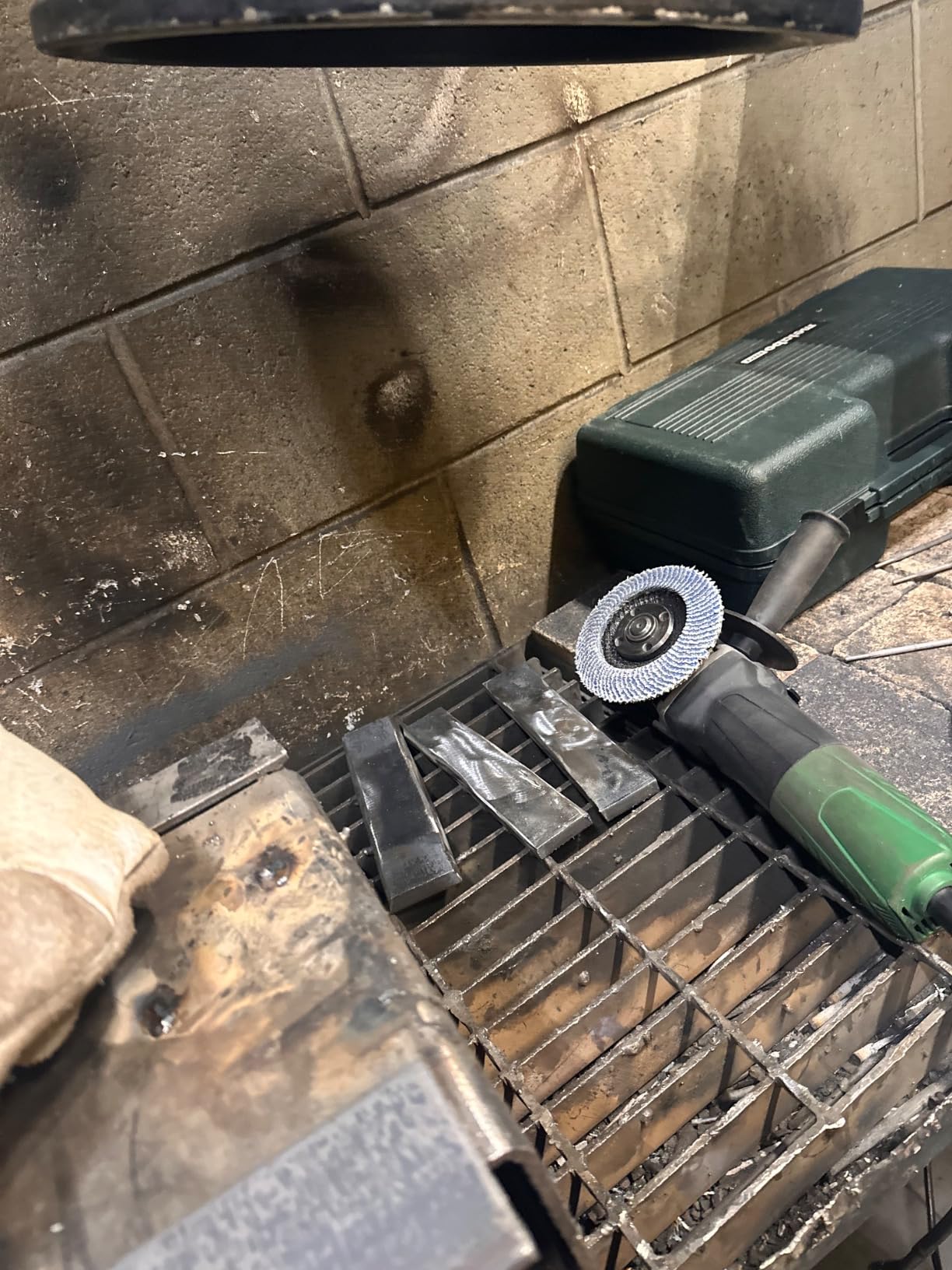
Shop operators rate these as a strong value across stainless, aluminum and hardened steels rather than as a long-life disc. Once the grit is worn flat, the disc is done – it cannot be dressed back like a grinding wheel. Budget for replacement rather than expecting one disc to last a month.
When this disc earns its slot in a shop
Stainless weld cleanup where aluminum oxide would glaze, and aluminum work generally, where fabricators regularly call flap discs the best thing available for the job. Zirconia holds a cutting edge on non-ferrous work where cheaper grain gums up. It also handles the awkward corners a depressed-center wheel cannot reach.
Where it will disappoint you
A finishing operation that needs a smooth surface, since 40 grit is a removal grit by definition. It is also the wrong tool for a long production run, because disc life runs shorter than a premium industrial equivalent and there is no way to revive it.
5. EZARC Diamond Cut-Off Wheel – Best for Rebar and Hard Metals
EZARC Diamond Cutting Wheel 4 1/2 x 7/8 Inch for Metal, Cut Off Wheel with 5000+ Cuts on Rebar, Steel, Iron and INOX
4-1/2 in diameter, 1.2 mm thick
Solid steel core, 400 grit diamond
13200 rpm rated
Single wheel
Pros
- Cut count far above bonded abrasive wheels
- Steel core reduces shatter risk
- Keeps its diameter for consistent cuts
- Lower dust than bonded abrasives
Cons
- Lowest star average in this roundup
- Sold as a single wheel rather than a pack
This is the odd one out in the list, and that is why it is worth knowing about. Instead of a bonded abrasive rim, it is a solid steel body with a diamond segment, and the manufacturer rates it for more than 5000 cuts in metal. Buyers describe it the same way: it keeps cutting long after a normal wheel has been thrown away.
The listed spec is 4-1/2 inch diameter, 1.2 mm thickness, 13200 rpm, 400 grit fine diamond. It is listed for rebar, iron, alloy steel, aluminum, pipe and sheet metal. Because the body does not erode, the wheel keeps its original diameter and gives a much more consistent cut line than a shrinking abrasive rim.
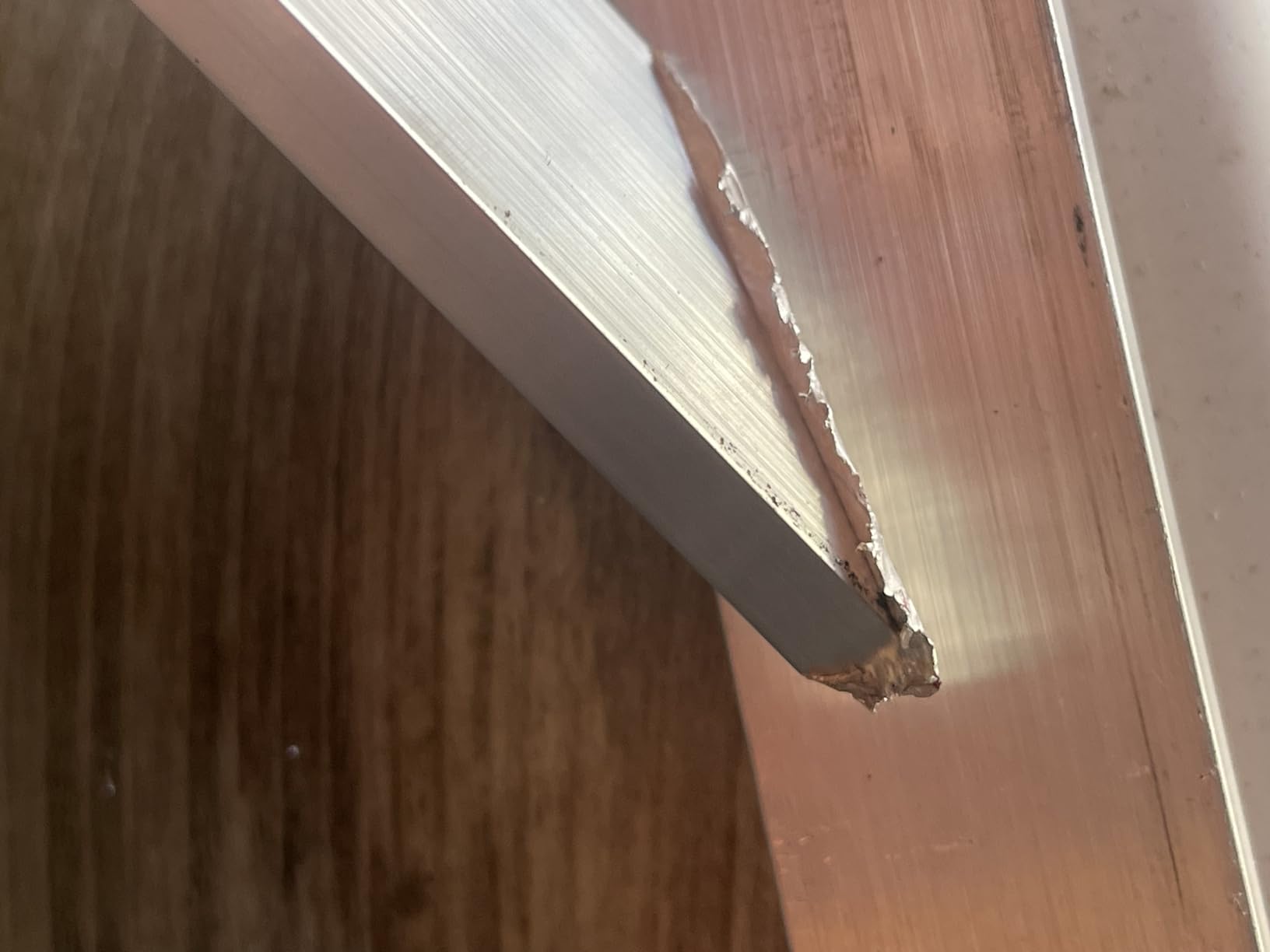
Two honest limitations. It is a single wheel rather than a multipack, and it carries the lowest star average in this roundup at 4.5, so there is a slightly larger share of critical reviews than the other picks carry. The dust reduction and the safety profile of a solid core are the trade you are making.
When this wheel earns its slot in a shop
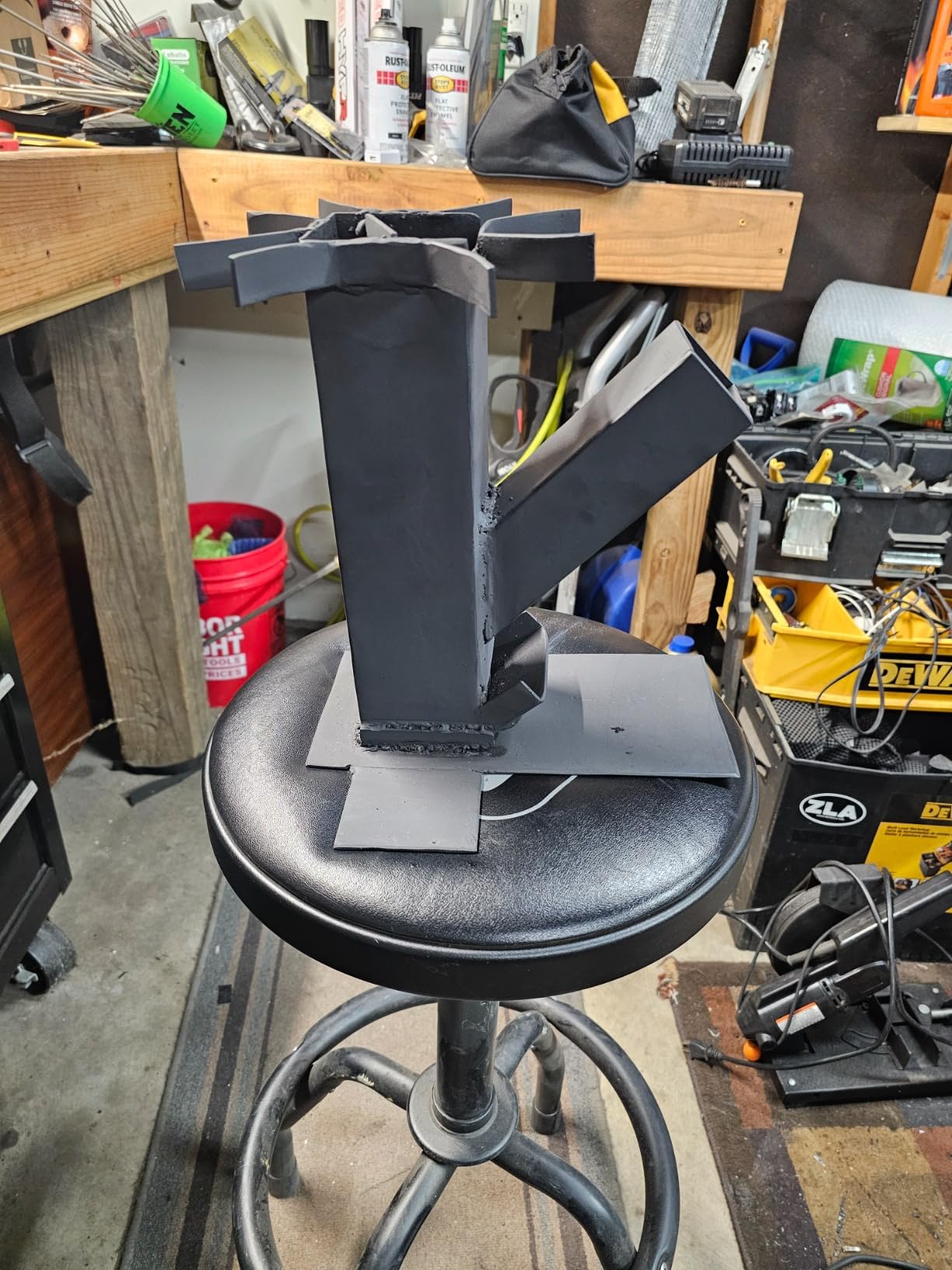
Cutting rebar, rusty structural steel and anything that destroys abrasive wheels. Users on demolition and fabrication work report cut counts that change the economics of a job. For a crew that cuts the same rebar or deck steel daily, this is a different product category, not a better cut-off wheel.
Where it will disappoint you
General fabrication cleanup where you want a cheap general wheel, and non-ferrous work, where diamond is the wrong abrasive and aluminum oxide or silicon carbide is cheaper and better. The solid body also means it will not shape into a taper like an abrasive rim does.
6. SALI 50-Pack Cut-Off Wheels – Best for High-Volume Shops
SALI 50 Pack Cut Off Wheel 4 1/2 Inch Cutting Wheels 4-1/2″ x 3/64″ x 7/8″ for Metal & Stainless Steel, Angle Grinder Cutting Wheel,Cutting Discs with Aggressive Cutting
4-1/2 x .047 x 7/8 in
60 grit aluminum oxide
Double fiberglass mesh
13300 rpm and 80 m/s, 50 pack
Pros
- Bulk pack suits disc-heavy shop use
- Thin profile cuts fast and burr-free
- Double fiberglass mesh resists chipping
- Fits any 7/8 arbor 4-1/2 inch grinder
Cons
- Thin profile is for cutting
- not grinding
- Durability below solid-body wheels in abuse
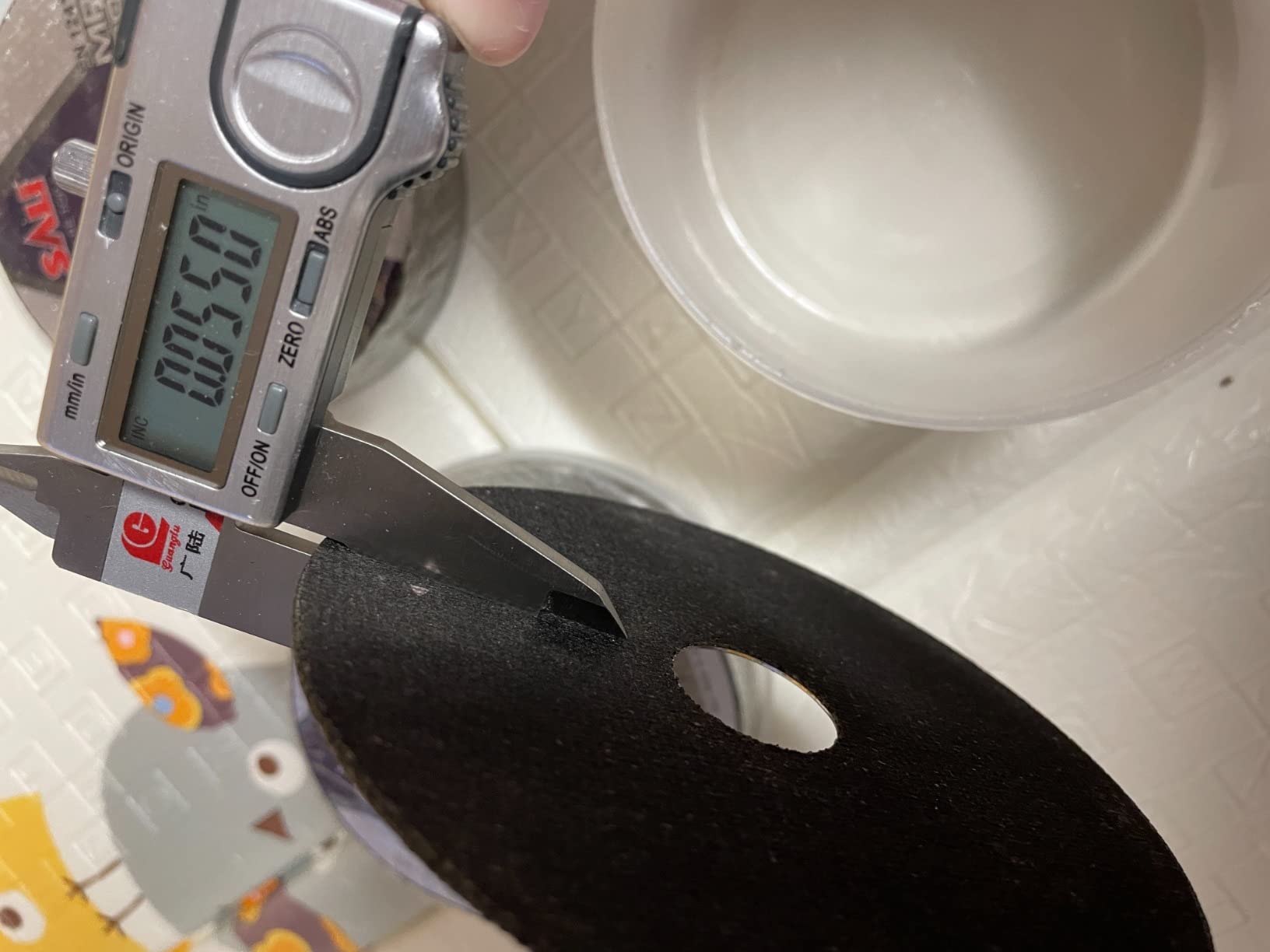
When disc consumption is the problem, the answer is arithmetic. Fifty 4-1/2 inch by .047 inch wheels on a 7/8 inch arbor, 60 grit aluminum oxide, rated to 13300 rpm and 80 m/s, means nobody is walking to the grinder mid-afternoon to find a spare.
Reviewers emphasize fast, clean cuts on metal and stainless with no chipping or cracking, and the double fiberglass mesh is the reason. It is a thin cutting profile, and it behaves like one – it wants light, steady pressure and a clean entry, not a hard push.
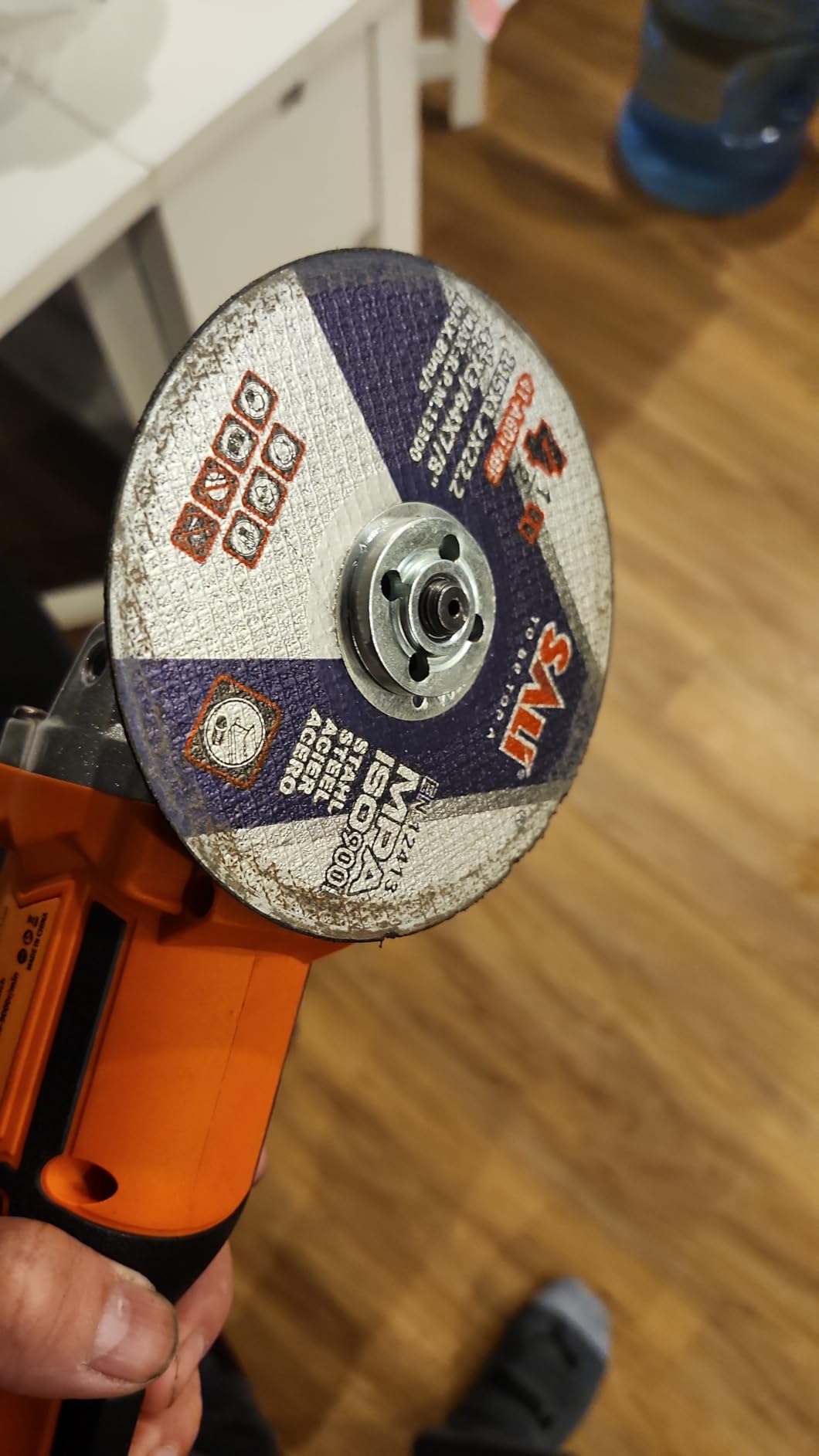
The honest limitation is that this is a cutting wheel, full stop. Owners are clear that the thin profile suits cutting rather than heavy grinding or removal, and it is not rated as durable as a solid-body wheel when abused. Using it sideways is how you get the snap you were warned about.
When this wheel earns its slot in a shop
Production cutting cells, duct and pipe shops, and any crew that puts a grinder in every hand. The 0.045 to 0.047 inch thin profile is the fabrication compromise that cuts fast, leaves a clean edge and wastes less of the plate you paid for. It is also simple to keep on hand without thinking about it.
Where it will disappoint you
Anyone expecting a grinding wheel out of it, and anyone cutting thick plate with a heavy hand. A thin wheel under high pressure heats, binds and breaks. If your work is mostly removal rather than separation, the quarter-inch grinding wheel is the better buy.
7. BHA 24 Grit Grinding Wheels – Best for Aggressive Material Removal
BHA 4-1/2 x 1/4 x 7/8 Metal Grinding Disc, Angle Grinder Wheel – 5 Pack
4-1/2 x 1/4 x 7/8 in
Type 27 depressed center
A24 extra coarse aluminum oxide
5 pack, 13300 rpm
Pros
- Extra coarse grit strips weld caps and mill scale
- Quarter-inch body tolerates heavy pressure
- Depressed center clears the standard guard
- Balanced with low wobble
Cons
- Extra coarse is not a finishing grit
- Five-piece pack is the smallest here
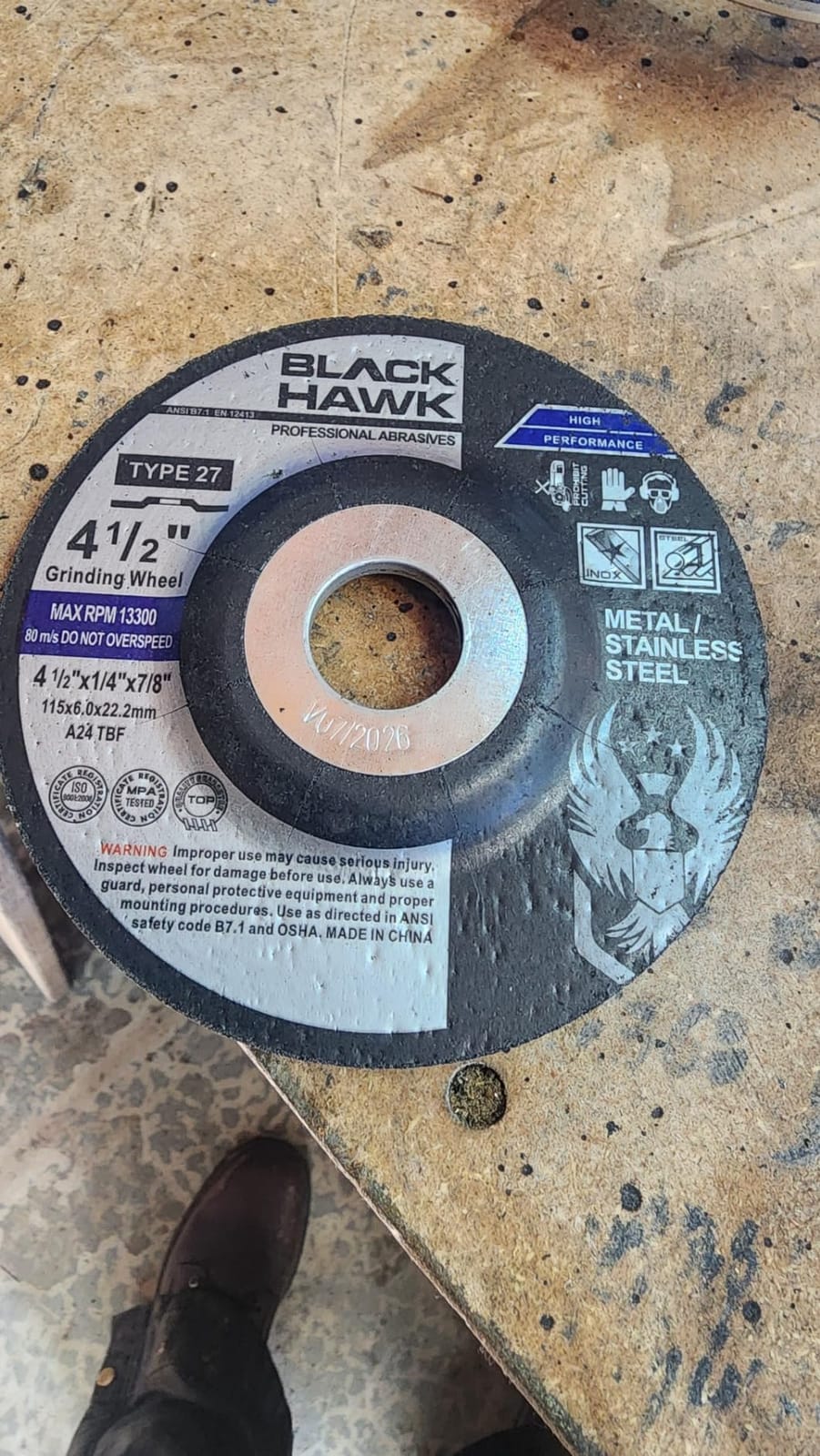
This is the disc you reach for when a cap is proud by a quarter inch and the schedule does not care. A24 extra coarse aluminum oxide in a hard resinoid bond, fiberglass reinforced, 4-1/2 by 1/4 by 7/8 inch, five per pack, rated to 13300 rpm.
Fabricators and welders report fast, aggressive removal on carbon steel, stainless and cast iron with steady, low-vibration operation. The hard resinoid bond is what lets it take pressure without the rim shedding, and the depressed-center profile keeps the working face clear of the guard on a standard 4-1/2 inch grinder.
It does one job. Extra coarse grit is not a finishing abrasive, and using it for a blending pass is how you end up taking a weld toe down 3/16 inch and then having to build it back. Treat it as the removal step at the head of your sequence, not the step at the end.
When this disc earns its slot in a shop
Heavy material removal on ferrous work: cap reduction, mill scale, edge cleanup, cast iron. The quarter-inch body shrugs off side load, so it is the right disc when the operator is pressing hard. It is also the right first pass before any flap disc or blending sequence.
Where it will disappoint you
Stainless finishing, aluminum finishing and anything that needs a flat, smooth transition. Because the grit is so aggressive, it is easy to dish a plate edge without meaning to. If the job is blending, not removing, start coarser in intent and use a flap disc.
8. TPmax Strip Discs – Best for Rust and Paint Removal Without Gouging
4-1/2″ x 7/8″ Strip Disc 5Pk Rust & Paint Removal for Angle Grinder
4-1/2 x 7/8 in nonwoven nylon
Silicon carbide abrasive
Surface-safe, no gouging or warping
5 pack
Pros
- Strips paint
- rust
- mill scale and spatter to bare metal
- Will not gouge or warp the workpiece
- Low noise and low dust
- Works on metal
- wood and fiberglass
Cons
- Wears out quickly on heavy coatings
- Can clog on thick coatings
- Build quality below big-box strippers
For removing rust and paint without removing metal, the abrasive type changes completely. This is a nonwoven strip disc: nylon fiber impregnated with silicon carbide, 4-1/2 inch on a 7/8 inch arbor, five per pack. There is no grit number in the usual sense – the cutting edges are the fiber points themselves.
Restoration users confirm it strips coatings down to bare metal without damaging the base metal, and report noticeably lower noise and dust than coated abrasives. On thinner steel that is the difference between a part you can still weld and a part you have warped.
The recurring complaint is life. These discs wear out quickly, often after only a few pieces, and they can clog depending on the coating being stripped. Several reviewers also place the general build quality below big-box branded strippers. For a restoration job, that is a fair trade; for a production cell, plan on consumption.
When this disc earns its slot in a shop
Rust, mill scale, weld spatter, oxidation and old paint where the substrate must survive. Surface prep before paint or powder coat on thin material is the classic case, and the same silicon carbide nonwoven format is the standard answer for stainless passivation prep. It is also the gentler option when a coated abrasive would be too aggressive.
Where it will disappoint you
Anyone hoping to remove a thick coating fast. Nonwoven material has no hard grain points, so it abrades rather than cuts, and heavy coatings clog the disc instead of shedding. General build quality is also a step below the major brands, so do not expect a precision finish.
9. SHALL 3 Inch Ultra-Thin Cut-Off Wheels – Best Angle Grinder Discs for Tight Quarters
SHALL 25-Pack Cut Off Wheels 3” x 3/8” x 3/64” – Ultra Thin Cutting Wheel with Pouch for Angle Grinder & Cut-Off Tools – Fast Cutting Disc for INOX, Steel, Iron, Non-Ferrous Metal & PVC
3 in diameter, 3/8 in bore, 3/64 in thin
24000 rpm rated
Ansi B7.1-2017 listed
25 pack with pouch
Pros
- Ultra-thin 3/64 inch profile cuts fast with low burn
- Includes a cloth carrying pouch
- Double reinforced fiberglass mesh
- Handles sheet metal
- rebar
- aluminum and PVC
Cons
- 3/8 inch bore is tight on some compact tools
- Smaller diameter limits cut depth
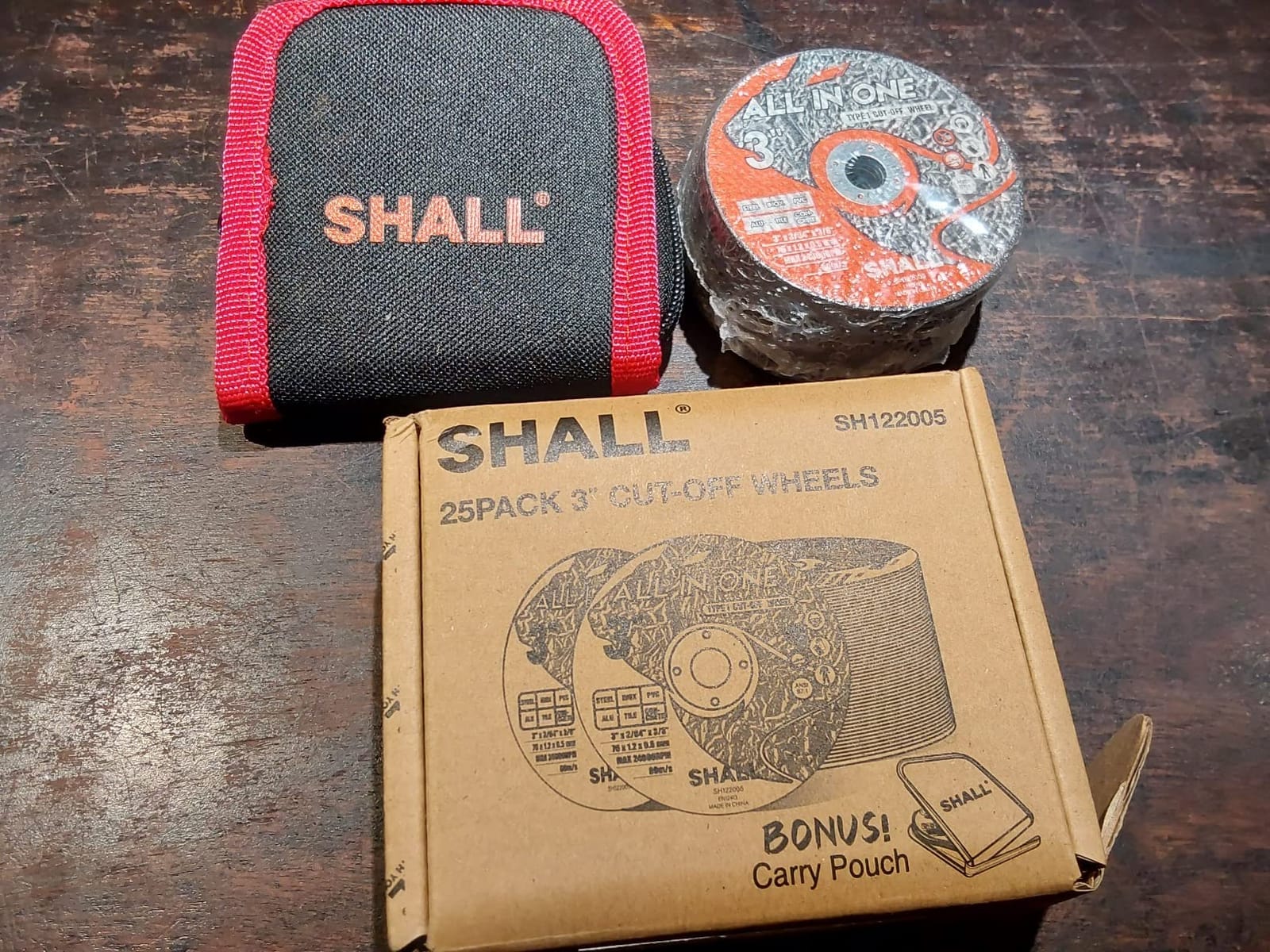
Size is the whole argument. A 3 inch wheel with a 3/8 inch bore, rated to 24000 rpm, gets into places a 4-1/2 inch wheel physically cannot – between studs, inside a frame, in a confined chase. It is made of calcined corundum and single crystal abrasive with double reinforced fiberglass mesh, and it is listed to Ansi B7.1-2017.
Users report performance close to OEM wheels at a fraction of the cost, and the included 600D Oxford cloth pouch is genuinely useful for keeping 25 thin wheels from rattling around a tool bag. It is also listed for galvanized steel, aluminum, rebar, sheet metal and PVC, which covers a lot of odd jobs in one box.
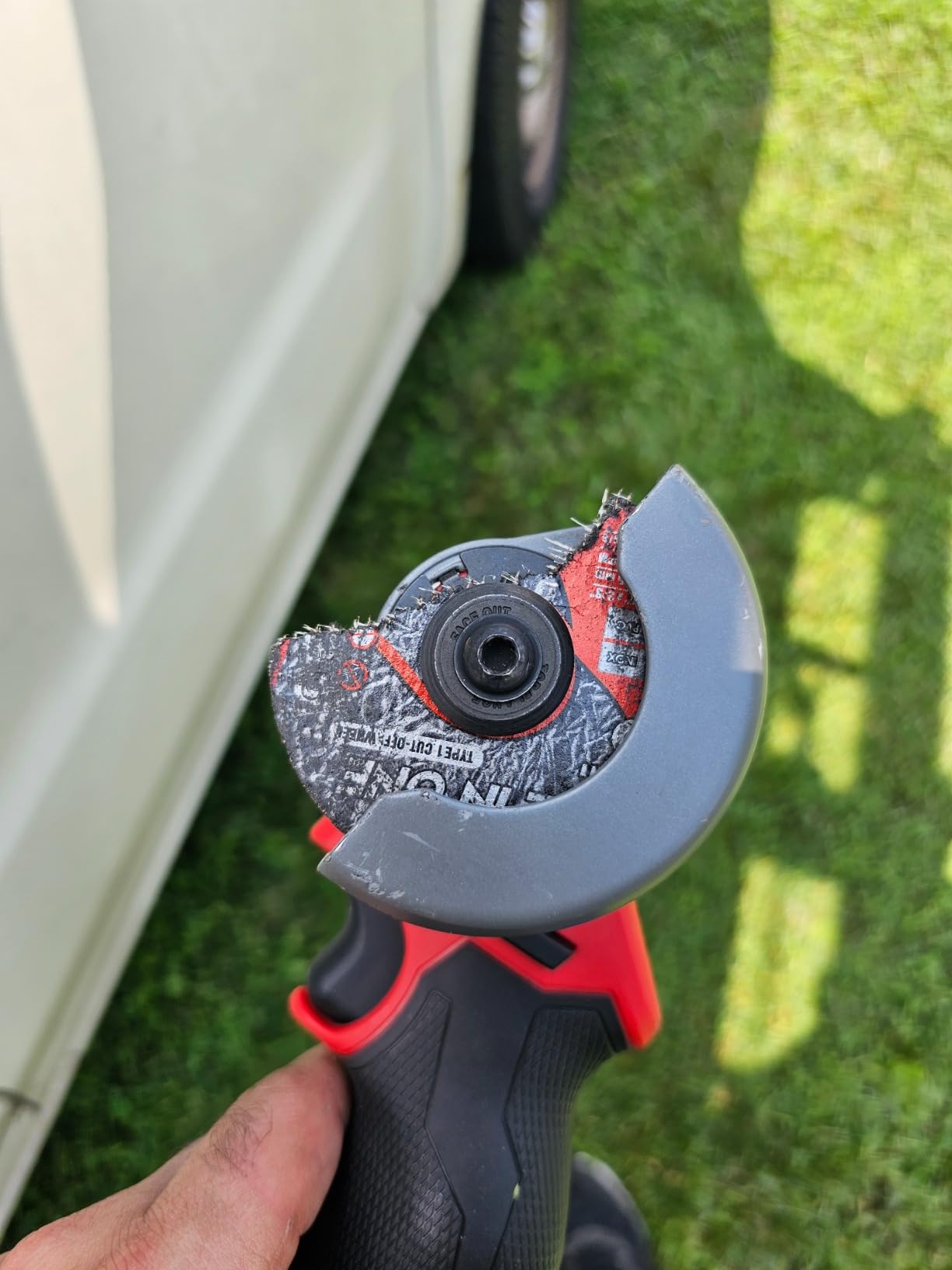
Two real constraints. The 3/8 inch bore is a tight fit on some compact tools, and the smaller diameter limits how deep a cut you can make in one pass. On heavy plate, plan to finish the cut with a 4-1/2 inch wheel or a second pass.
When this disc earns its slot in a shop
Confined cuts, sheet metal notching, and small tools with a 10 mm arbor. Carrying a 25-pack with a pouch in a service bag solves the problem of thin wheels getting destroyed in transit. It is also a good secondary wheel for anyone who owns a lot of battery tools with small form factors.
Where it will disappoint you
Structural plate work, where a 3 inch wheel simply cannot reach through the material. The bore size also means it will not mount to a standard 7/8 arbor spindle, so it only works if your tool is sized for it.
10. SALI 10-Pack General Purpose Grinding Wheels – Best All-Round Shop Wheel
SALI 10 Pack 4-1/2 Inch Grinding Wheels for General Purpose Metal & Stainless Steel, Aluminum Oxide Grinding Disc for Angle Grinder, Depressed Center 4.5″ * 1/4″ * 7/8″(115 * 6.0 * 22.2 mm)
4-1/2 x 1/4 x 7/8 in
115 x 6.0 x 22.2 mm
Depressed center, aluminum oxide
10 pack
Pros
- Good removal rate on edges and flat faces
- Low vibration over extended use
- No clogging or chattering reported
- Suits construction steel
- tool steel and sheet steel
Cons
- General purpose grit is not as aggressive as 24 grit
- Smallest review base in this roundup
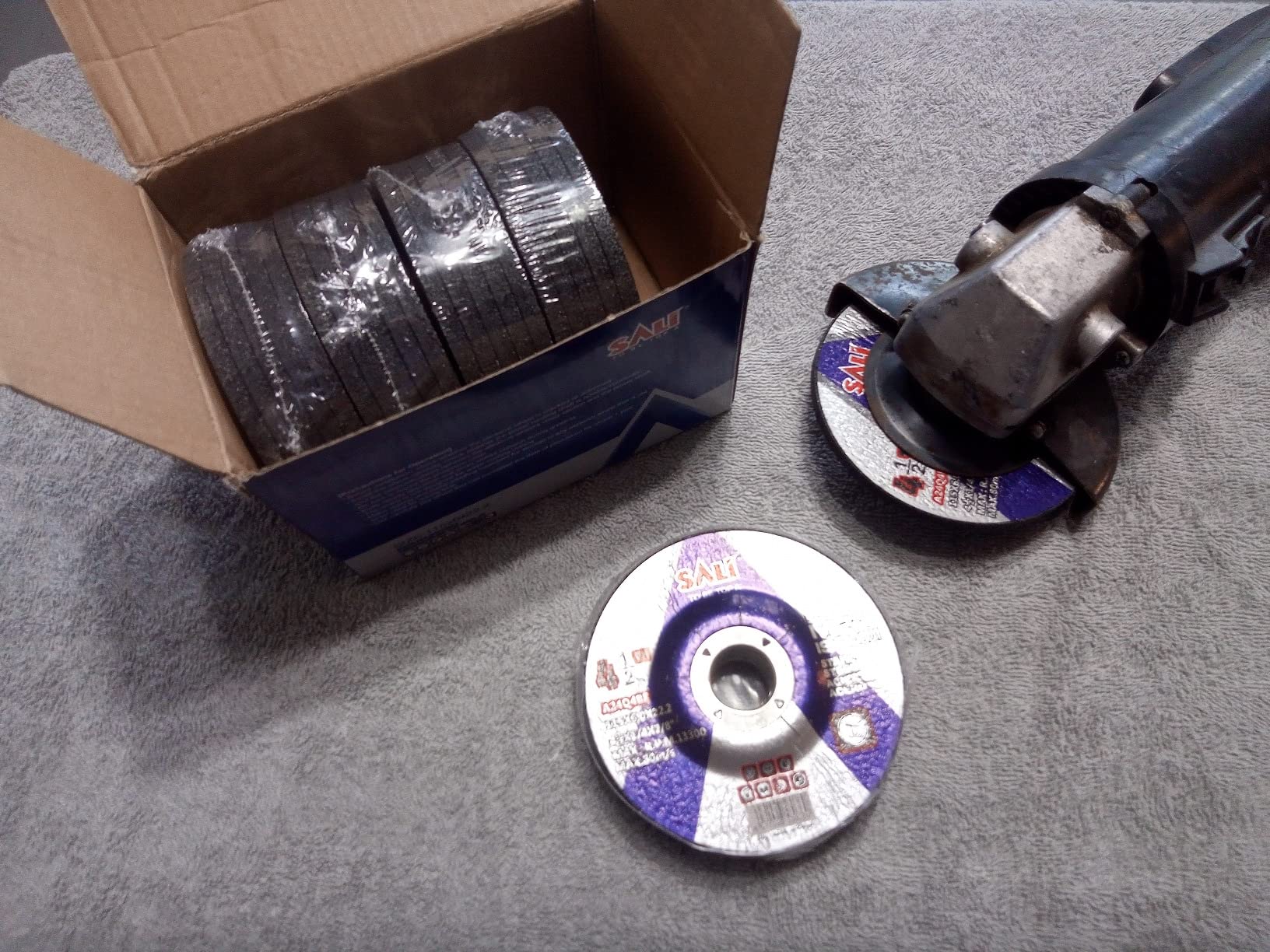
Metric sizing is the giveaway on this one: 115 by 6.0 by 22.2 mm, which is the same disc as a 4-1/2 by 1/4 by 7/8 inch depressed-center wheel. It is aluminum oxide, medium grit, ten per pack, and it is sold under a metric part number because it is made for markets that spec in millimeters.
Buyers like the smooth, low-vibration run and the steady removal rate on construction steel, tool steel, high-speed steel, sheet steel and stainless, treating it as a dependable general-purpose shop wheel. The reviews specifically mention no clogging and no chattering, which are the two complaints that shorten wheel life on real shop work.
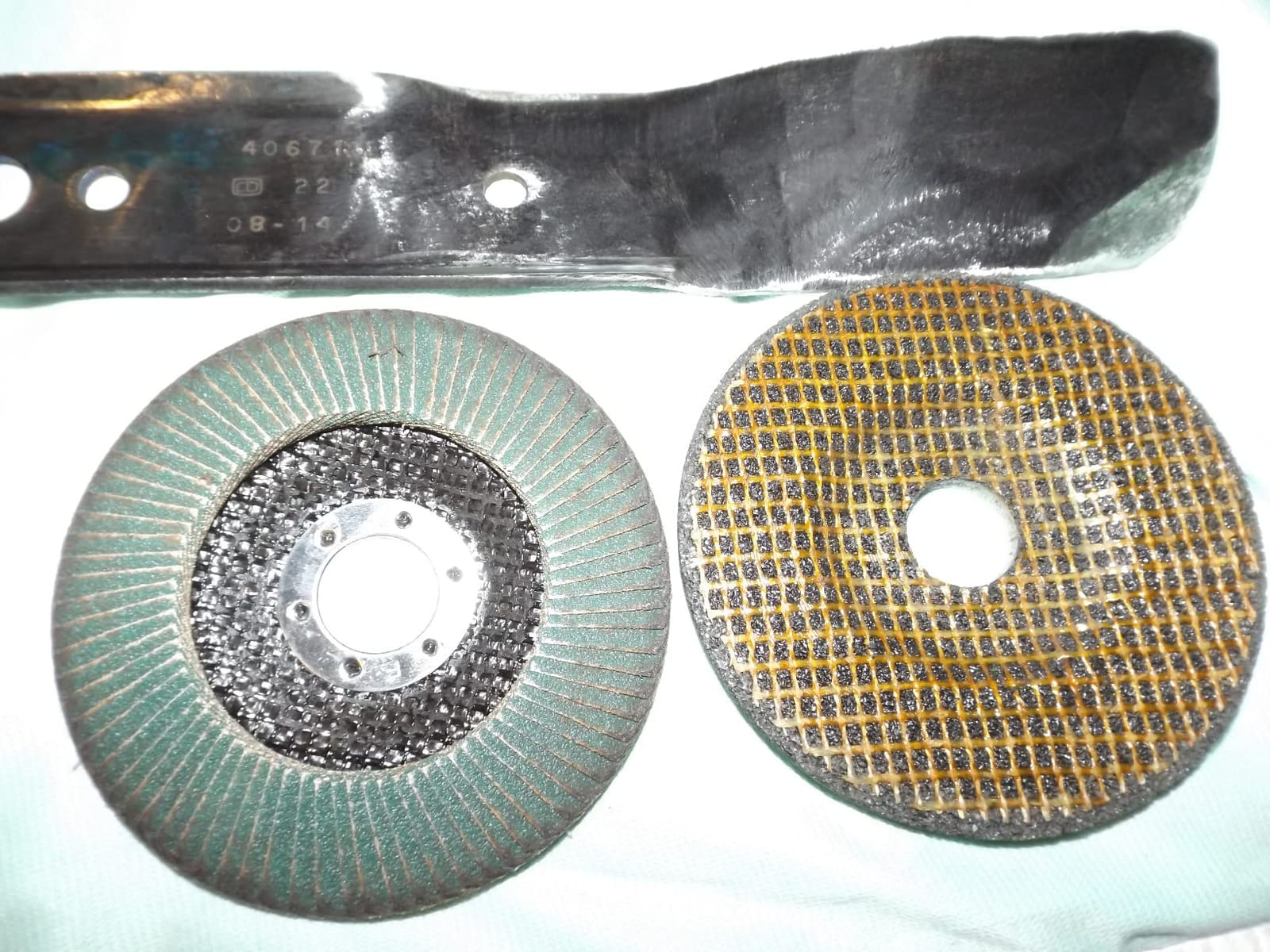
Two limitations to be straight about. Medium grit will not match a 24 grit wheel on raw removal, and this has the smallest review base in the roundup at 550 ratings, so there is less long-term field data behind it than behind the picks above it.
When this wheel earns its slot in a shop
A grinder that does a bit of everything – a maintenance welder, a hobbyist, a small fab shop that does not specialize. Vibration and chatter stay low over long sessions, which matters when the same person grinds all day. It is the wheel to buy when you want one part number that covers most jobs.
Where it will disappoint you
Aggressive cap removal, where the extra coarse wheel is faster by a clear margin. And anyone buying on review volume alone – there is simply less evidence here that it holds up over years, which matters if it is your only shop wheel.
Which Disc Format for Which Fabrication Job
Format beats brand for metal fabrication, because each format is built around a different kind of contact. Cut-off wheels shear material at the edge and want a light touch. Grinding wheels have a thick body and take side load. Flap discs and strip discs abrade the surface rather than cutting into it.
Cutting metal: the best disc type for cutting metal is a thin cut-off wheel at 0.045 to 0.047 inch, fiberglass reinforced, on a 7/8 inch arbor. Thin means more metal removed per pass and less heat left in the cut edge. A diamond wheel wins on rebar and hardened material because it does not erode.
Removing material: heavy stock removal and cap reduction want a 1/4 inch depressed-center grinding wheel. The thickness is the pressure tolerance. This is also the disc that clears the guard properly, because a depressed center holds the working face below the guard line.
Grinding and blending: the best type of flap wheel for grinding steel is zirconia alumina at 40 grit for removal, moving to 60 and 80 for blending. Fabricators argue about 40 versus 80 endlessly; the resolution is that they are different steps, not competing answers.
Surface prep and coatings: the best grinding disc for removing rust without damaging metal is a nonwoven strip disc with silicon carbide. It abrades the coating rather than the substrate, which is why it will not gouge or warp thin material. If a coated abrasive has already taken the surface past bare metal, go back to grinding first.
Two formats you will see in shops and should not confuse with the above. Fiber discs are thick, hard-bonded and run at higher speed for production work – aggressive removal with no blending capability. Wire cup and wire wheels are for descaling and cleanup, and they carry their own serious safety profile.
Abrasive Grain and Material Matching
The best grinding disc for metal is the one whose grain matches your metal. Grain is the cutting edge, the bond holds it in place, and the wrong pairing is why discs load, glaze and burn.
Aluminum oxide is the general purpose standard, and it is the right answer for carbon steel and mild steel. It is what most of the cut-off and grinding wheels in this roundup use, and it is the sensible default when you have no information about the work.
Zirconia alumina is tougher than aluminum oxide and holds an edge under pressure on carbon steel. That is why fabricators describe zirconia flap discs as a shop favorite for aggressive removal, and why both flap disc picks here are zirconia. It is a solid choice on aluminum too, where softer grain tends to smear.
Ceramic alumina is the grain to reach for on stainless steel. Shaped ceramic grain fractures into sharp points as it wears, so it stays fast and runs cooler, and the cooler cut matters because stainless work-hardens fast and discolors when it heats. It is the grain most likely to cause work hardening problems when it is missing.
Silicon carbide is the non-ferrous answer. It is sharper and more friable than aluminum oxide, which makes it cut aluminum and soft metals cleanly instead of loading. It appears here as the abrasive in the nonwoven strip disc, which is the standard surface prep format for aluminum and stainless passivation.
Diamond is the hardest and longest-lived option, used when a metal defeats a bonded abrasive wheel. It is a poor choice for general non-ferrous work and costs more per wheel, but on rebar and heavily oxidized steel the cut count changes the job economics.
Buying Guide: Format, Thickness, Arbor, RPM and Cost Per Cut
Type 27 vs Type 29 flap discs
Type 27 has a raised hub, and the abrasive sits at roughly a 22 degree angle, which puts more of the disc face into contact. Type 29 is flat with the abrasive spread across the full face at roughly 15 to 20 degrees, giving a longer contact patch and faster removal at higher temperatures.
The practical rule: Type 27 for surface work, blending and more control at low pressure. Type 29 for seams, edges and corners where you want the disc to reach into the joint and grind with more aggression. A 20 degree seam is exactly the situation the Type 29 geometry was built for.
Thickness, kerf and cut speed
Thickness controls both kerf loss and how much pressure the wheel tolerates. Thin profiles at 0.045 to 0.047 inch cut faster because they remove less material per pass and shed heat faster, but they break if you lean on them. Thick profiles at 0.060 inch and above, and every quarter-inch grinding wheel, survive pressure and side load.
Ask yourself which failure you would rather have. A thin wheel that breaks is a safety event. A thick wheel that is slow is just slow. For a fabrication shop, light steady pressure on a thin wheel is the operating norm.
Arbor size and max RPM matching
Most 4-1/2 inch grinders use a 7/8 inch (22.23 mm) arbor, and that covers every 4-1/2 inch pick in this roundup. The 3 inch wheels here use a 3/8 inch (10 mm) bore, which will not fit a standard 7/8 inch spindle. A bore that is too small is a fit; a bore that is too large is dangerous.
On speed, compare the disc’s rating to your spindle speed, not to marketing language. Wheels here are rated at 13300 rpm (4-1/2 inch), 13200 rpm (the diamond wheel) and 24000 rpm (the 3 inch wheels). Never mount a lower-rated disc on a faster spindle. For quick verification, check diameter, bore, the RPM printed on the label or box against your tool, and that the guard and flange clamp the profile correctly.
Grit progression for weld blending
This is the question fabrication forums argue about most, so here is the sequence rather than a single number:
1. 24 to 40 grit grinding wheel or flap disc to knock the cap down level with the plate.
2. 40 to 60 grit flap disc to blend the cap into the surrounding plate without dishing it.
3. 60 to 80 grit flap disc to remove the blending marks left by the previous step.
4. 80 to 120 grit flap disc for the final surface, only where paint or powder coat will actually see it.
The reason 40 versus 80 is a false argument: 40 leaves a scratch pattern that 80 exists to remove. If you stop at 40 you have done grinding, not blending. On thin material, stay lighter on pressure and change grit more often rather than pushing harder on the same disc.
Fiber disc vs flap disc
A fiber disc is a thick, hard-bonded grinding wheel in a fiber format, built for maximum removal and higher speed, with no blending capability. A flap disc is a flexible layered abrasive that grinds and blends in one pass and can follow a contour.
Use a fiber disc when you want maximum removal and do not care about the surface afterwards. Use a flap disc whenever the surface will be seen, coated or welded to. On thin sheet metal, the flap disc wins decisively because it will not gouge or dish the panel.
What a premium disc actually buys you
Premium grain, typically shaped ceramic, means more cuts per disc and less time changing discs. Better fiber reinforcement means fewer edge snaps, and better backing means a smoother surface pattern. None of that makes a cheap wheel bad, but it changes the unit of comparison: cost per disc is close to meaningless, cost per cut is the number that matters.
Run it simply. Divide the cost of the disc by the cuts you realistically get out of it, then multiply by the number of cuts in the job. A shop doing two cuts a week will not amortize a premium wheel, and a shop doing sixty will notice the difference within a month. Related reading on the tools these mount to is in our best angle grinders guide, and for shaped metalwork our sheet metal shrinking discs guide covers the finishing end of the process.
Disc Safety and Shop Practice
Every disc failure traceable to a shop injury comes down to one of five things, and all five are checkable before the wheel ever touches metal.
Inspect the edge before every change. Threads both discard threads on r/Welding and r/Tools carry the same warning: a backing disc that catches a sharp edge on dropped stock can turn a grinder into a 12,000 rpm projectile. Run a finger along the rim of every disc before mounting it, and throw out anything nicked, chipped or cracked. No exceptions, no “it will probably hold”.
Never exceed the RPM rating. The disc rating has to meet or exceed the spindle speed. Overspeeding a wheel is the fastest way to turn a grinding accident into an eye injury.
Keep the guard down and the flange correct. The guard is there to contain fragments if a wheel breaks. A depressed-center wheel under a raised hub guard, or a wheel clamped by the wrong flange, defeats the whole system.
Expect kickback. If the disc snags on the workpiece, the wheel can grab and throw the tool. Never grind with the side of the wheel unless it is a Type 27 or 29 design intended for it, keep the face tilted upward about 10 to 15 degrees, and let sparks fall away from your body.
Use the right disc for the right grinder. A cut-off wheel is not a grinding wheel. Side-loading a thin cut-off wheel is the single most common avoidable breakage we see discussed in shop forums, and it is entirely preventable with the correct format and a light touch.
PPE is the last layer, not the first: face or eye protection, hearing protection, leather gloves, and a respirator when grinding stainless or stripping coatings. You can also read our general disc guide for general abrasive applications if you work outside the metal shop.
Frequently Asked Questions
What is the best angle grinder disc for metal?
A thin fiberglass-reinforced cut-off wheel for cutting, a 1/4 inch depressed-center grinding wheel for removal, a zirconia Type 29 flap disc for blending, and a nonwoven strip disc for surface prep. No single disc does all four jobs well.
What is the best grinding disc for metal?
For carbon steel, zirconia alumina under pressure and aluminum oxide for general work. For stainless steel, ceramic alumina runs cooler and resists work hardening. Match the grain to the metal before matching the grit.
What is the difference between a type 27 and type 29 flap disc?
Type 27 has a raised hub with about 22 degrees of surface angle, giving more disc face contact and better control at low pressure. Type 29 is flat with roughly 15 to 20 degrees, giving longer contact and faster, more aggressive removal in seams and corners.
Which brand of flap discs is considered the best?
The answers that come up most often from working fabricators are Walter Enduro, Norton and DeWalt for carbon steel work, and 3M ceramic grain for stainless. Brand matters less than grain: a zirconia Type 29 disc from any major maker will beat a basic aluminum oxide disc.
What is the best grinding disc for removing rust without damaging metal?
A nonwoven strip disc with silicon carbide abrasive. It abrades the coating instead of the substrate, so it will not gouge or warp thin material. The trade-off is speed and life, since nonwoven material wears faster than a coated abrasive.
What disc type is best for cutting stainless steel?
A ceramic alumina cut-off wheel, or a diamond wheel for very hard or heavily contaminated stainless. Ceramic grain runs cooler, and cool cutting is what prevents work hardening and heat discoloration on stainless.
How can I tell if a disc is compatible with my angle grinder?
Check four things: the diameter matches the guard, the arbor or bore matches your spindle, the max RPM on the disc meets or exceeds your spindle speed, and the wheel profile sits correctly under the guard and flange. Most 4-1/2 inch grinders use a 7/8 inch arbor.
Are more expensive cutting discs always better?
Not for light work. Premium ceramic and diamond wheels pay off through cuts per disc, so they win on high volume and hard material. For occasional cutting on mild steel, a bulk pack of aluminum oxide wheels is the more sensible buy.
Building Your Disc Lineup for 2026
Build from the job backwards. One disc for removal, one for blending, one for prep, and one for cutting if you are doing it daily. For most fabricators that means a quarter-inch grinding wheel, a zirconia Type 29 flap disc, a nonwoven strip disc, and a bulk pack of thin cut-off wheels like the SALI 50-pack.
If you want a single starting wheel rather than a set, the DEWALT DW8062B5 is the one we would hand you, because a general cut-off wheel is the first thing a new grinder needs. If your work is stainless or aluminum, swap the grinding wheel before anything else.
The right angle grinder discs for metal fabrication are the ones matched to a format and a grain, and both are knowable before you buy anything. Once you have settled the grinder itself, our best angle grinders guide covers the machines these discs mount to.