
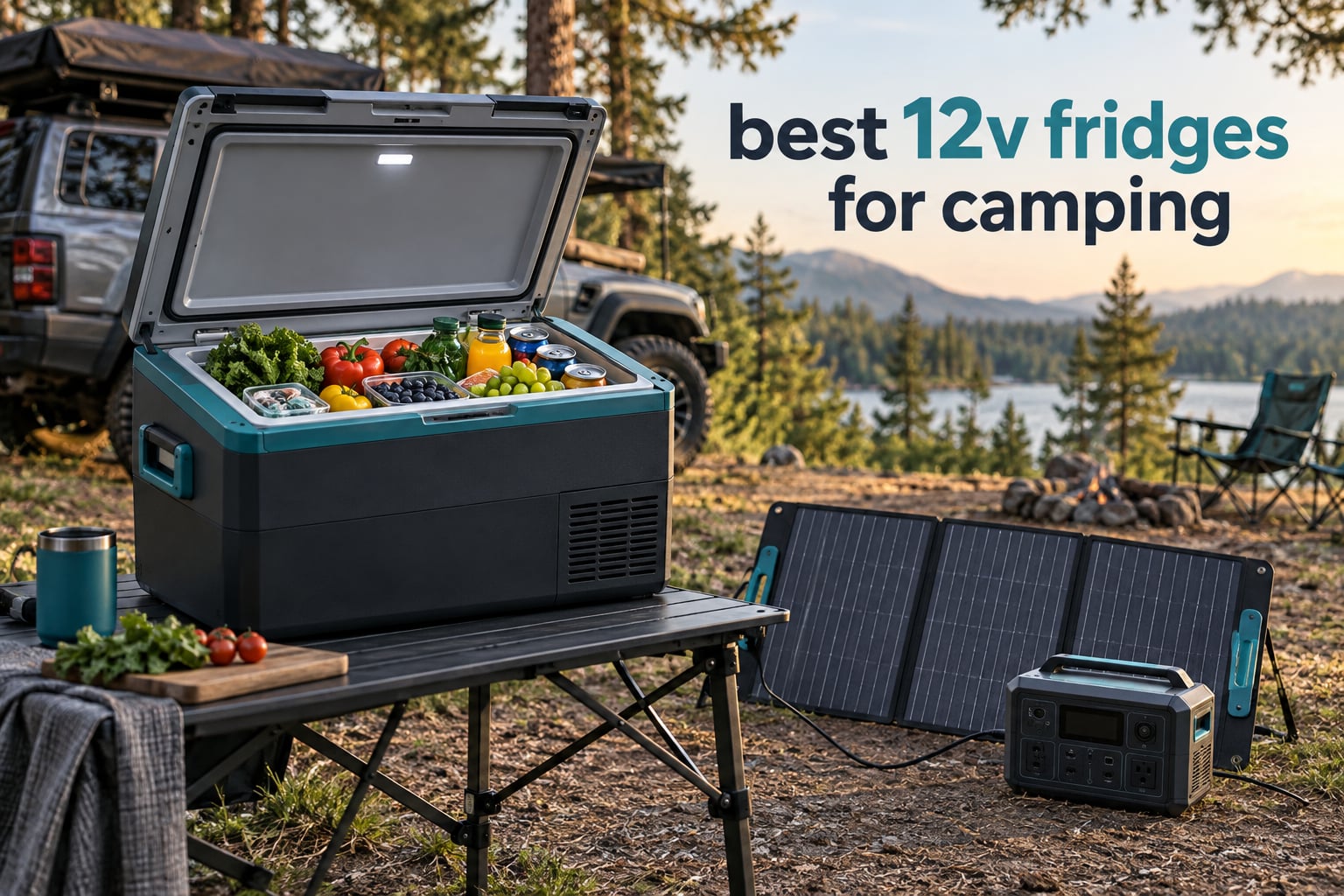
Ice is the most expensive thing you never budget for on a camping trip. A good cooler gives you cold drinks for the first afternoon, then becomes a warm box of meltwater by day two. A 12V camping fridge uses the same sealed vapor-compression cycle as your kitchen refrigerator, scaled down for DC power, and keeps food at a set temperature for as long as you have electricity to give it. That single change is why more and more overlanders, van builders and road trippers have swapped the ice chest for a compressor unit.
Choosing the best 12v fridges for camping is not a brand contest though. Three questions decide it before any model name matters: does the box physically fit in your vehicle with the lid fully open, can your power source keep up with the compressor, and does the interior volume match the number of people you actually feed. Get those three right and the rest is preference. Get one of them wrong and the most capable fridge on the market will frustrate you every single weekend.
We compared ten 12V compressor fridges and freezers across capacity, zone layout, compressor behavior, noise, app control, power draw and warranty, then weighed all of it against the real-world needs camper and overlander forums keep asking about. This guide is updated for 2026, and every capacity, wattage and temperature figure below comes straight from the manufacturer’s specification sheet and the customer review record rather than from a spec sheet alone.
Still deciding between formats? Our guides to the best 12V coolers for cars and the best 12V car refrigerators cover the cooler-versus-fridge threshold in more detail, and the best compact 12V fridges for small SUVs is worth reading if cargo space is tight.
Top 3 Picks for the Best 12V Fridges for Camping in 2026
The three fridges below cover the most common camping setups: an all-round unit for mixed conditions, a compact dual-zone box that fits a small vehicle, and a larger dual-zone cabinet for families. Every pick here has enough customer history to be a safe bet, which is the first thing we screen for.

BODEGA 38 Quart Dual Zone
- Independent dual zone with removable divider
- 12 minute MAX cooling
- app control
All 10 12V Camping Fridges at a Glance in 2026
This table covers every fridge in the guide with its headline numbers, so you can rule products in or out before reading the individual reviews. Capacities are the manufacturer’s usable figure rather than a packed-volume estimate, and the temperature ranges match the specified operating window for each unit.
| Product | Specs | Action |
|---|---|---|
| BougeRV 23 Quart |
|
Check Latest Price |
 EUHOMY 19 Quart EUHOMY 19 Quart |
|
Check Latest Price |
| BODEGA 38 Quart Dual Zone |
|
Check Latest Price |
 Megiu 23 Quart Megiu 23 Quart |
|
Check Latest Price |
 ICECO GO20 Dual Zone ICECO GO20 Dual Zone |
|
Check Latest Price |
 EUHOMY 24 Quart EUHOMY 24 Quart |
|
Check Latest Price |
 EKOJUCE 54 Quart EKOJUCE 54 Quart |
|
Check Latest Price |
 Setpower 21 Quart Setpower 21 Quart |
|
Check Latest Price |
 BODEGA 16 Quart BODEGA 16 Quart |
|
Check Latest Price |
 Dometic CFX2 28L Dometic CFX2 28L |
|
Check Latest Price |
1. BougeRV 23 Quart – The All-Round 12V Camping Fridge
BougeRV 12v refrigerator 23 Quart, -8℉~50℉ Portable Freezer for Car, Grey
23 quart capacity, 22.3 lb, 45 dB, 3-level battery protection
Pros
- 77F to 32F in about 15 minutes
- ECO draw under 45W
- three-level vehicle battery protection
- holds steady on a 30 degree incline
- 2 year warranty
Cons
- No internal battery so off-grid use needs external power
- a little short for tall bottles
- ventilation clearance needed around the case
This is the fridge we recommend to most people reading this page, and the reason is unusually consistent. It carries a 4.6 star average across more than 3100 customer reviews, which is the deepest owner history of any unit we looked at. Depth matters for a product that lives in the back of a truck, because a rating built on hundreds of reviews tells you something real about compressor longevity and sealing.
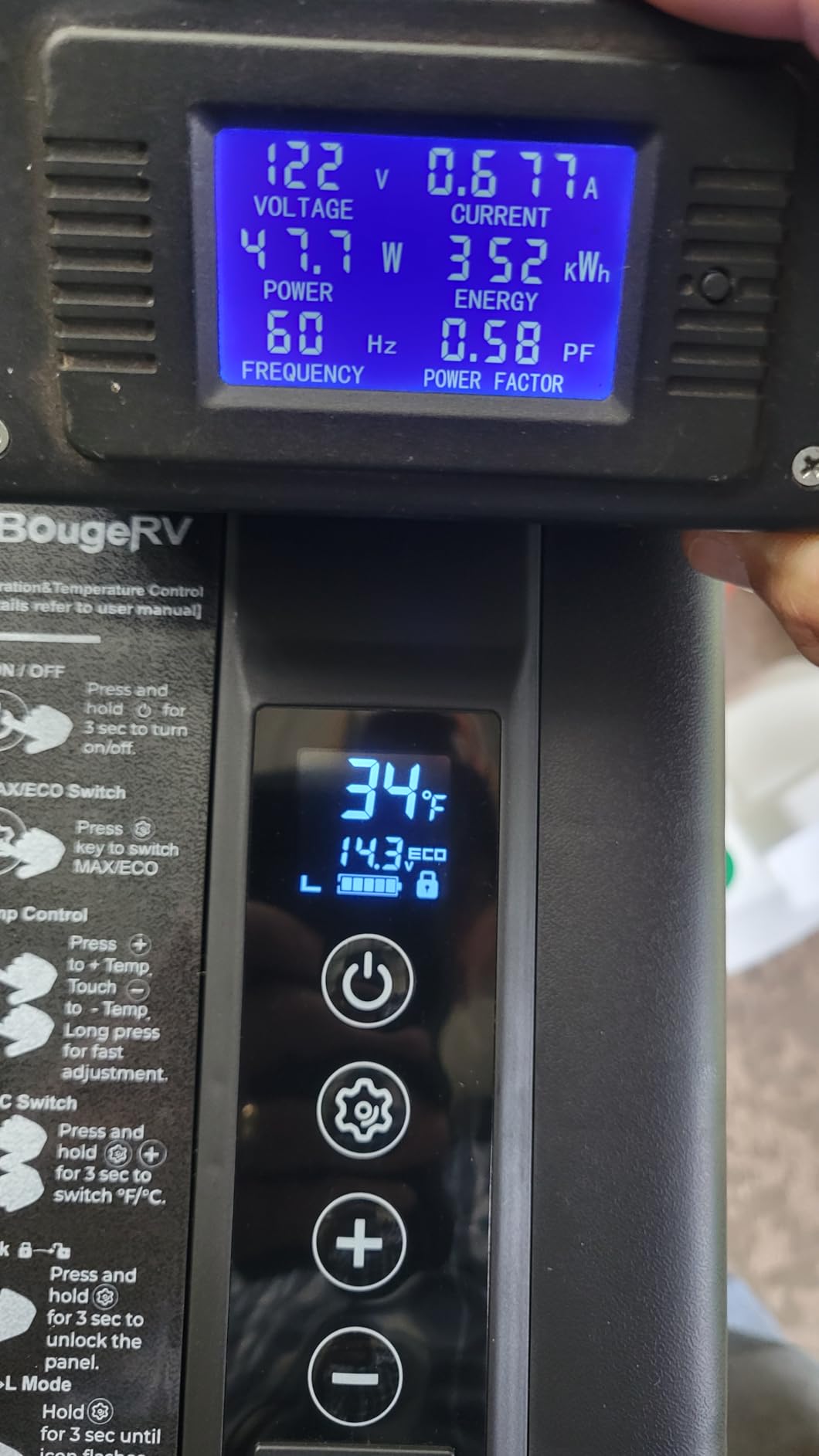
Performance is squarely in compressor-fridge territory rather than ice chest territory. The specification sheet claims a drop from 77F to 32F in roughly 15 minutes and down to -5F in about 50 minutes, and owners confirm both figures in practice. The R-600A compressor pulls under 45W in ECO mode and about 60W in MAX, settling to roughly 0.6W when idle, and foam insulation holds a stable 35.5F to 37.5F cold zone across multi-day trips.
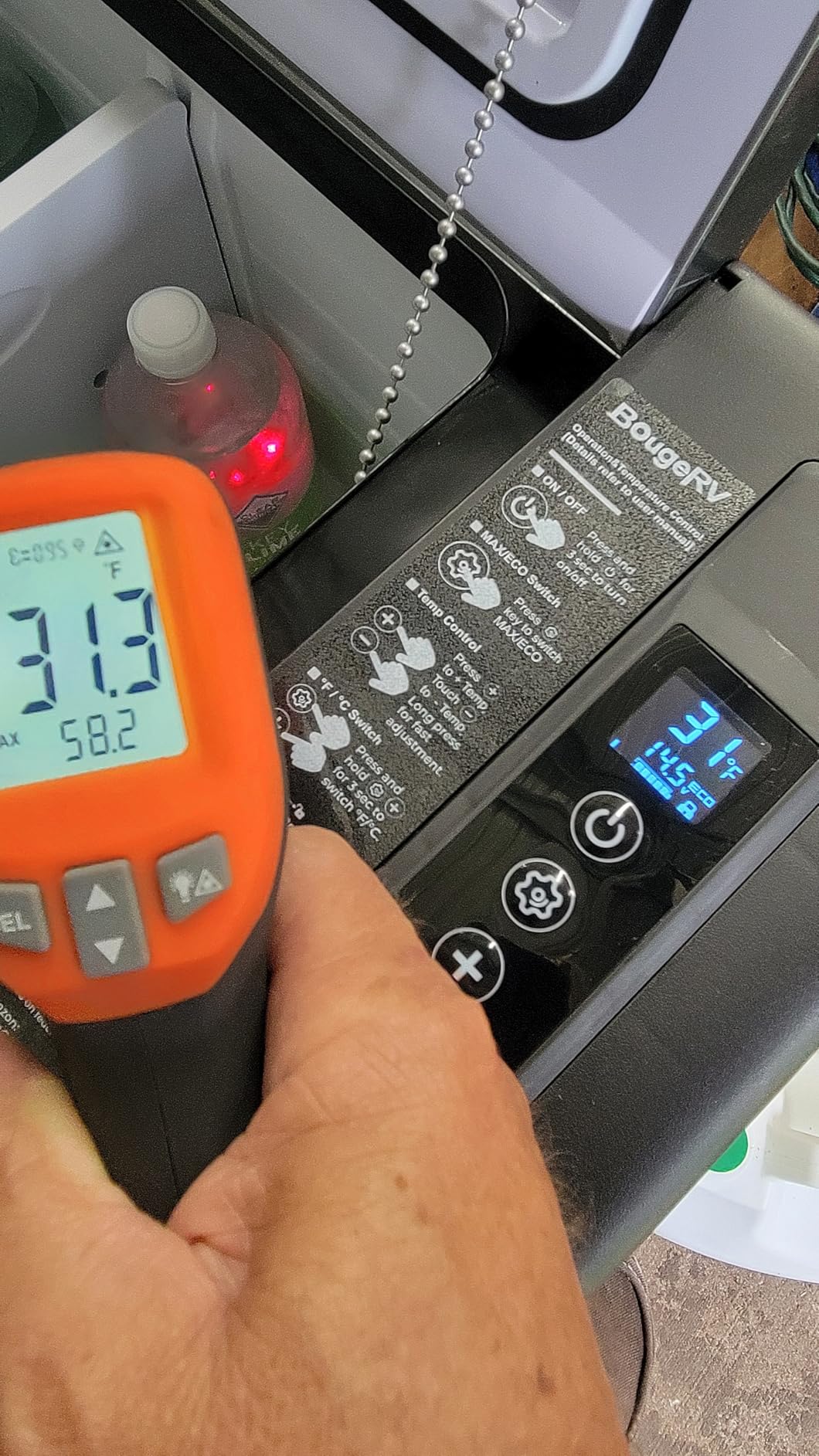
Two details keep it at the top of our list. The first is three-level battery protection, which is the feature campers on the forums worry about most, because a fridge that flattens a starter battery ends the trip. The second is the shock-proof rating for 30 degree inclines, which matters more than it sounds on a rutted forest road or a badly parked campsite.
At 22.68 inches deep, 12.6 inches wide and 12.97 inches tall it is not a large box, but the 23 quart interior fits a weekend of food for two or three people without any clever stacking. Both an AC adapter and a 10.82 foot DC cable are included, so you can run it at camp at home base and on the road.
Why the BougeRV CR22 holds up on rough weekends
Every one of those ratings comes from a lot of review themes, and the strongest cluster is durability plus consistency rather than headline cooling speed. Owners report multi-day temperature holds, near-silent running described as virtually inaudible even when parked, and foam insulation rather than air-gapped plastic, which is the difference between a stable compartment and one that drifts with ambient heat.
For an overlanding build or a truck-bed weekend this is the combination you want: a case that survives tilt, a compressor that is hard to hear, and a draw low enough that a modest auxiliary battery can support it. The included 2 year warranty and the availability of common replacement parts also make it a safer long-term bet than the budget tier.
Where the 23 quart box limits you
There is no internal battery, so once you switch the vehicle off the unit stops unless you feed it from a power station or a house outlet. That is the single most common limitation owners raise, and it is a real one for anyone boondocking away from a working socket.
Some owners also wish it were slightly taller for upright bottles, and the unit needs ventilation clearance around the compressor, so a fully closed trunk or a sealed tonneau cover can make it work harder than it should. A handful of buyers report an E1 error code when running from a depleted power pack, so treat a low battery as a stop signal rather than something to push through.
2. EUHOMY 19 Quart – The Best 12V Fridge for App Control on a Budget
EUHOMY 19QT 12 Volt Refrigerator, -4℉~68℉ Electric Cooler for Car
19 quart capacity, 21.4 lb, 42 dB, Bluetooth app control
Pros
- Bluetooth app lets you set temperature from the cab
- cools 77F to 32F in about 15 minutes
- 42 dB running noise
- magnetic lid seal held food frozen for 9 hours unplugged
- dual AC and DC cords plus three-level battery protection
Cons
- No forced air circulation so contents near the walls chill slower
- thin walls warm quickly when switched off
- about 24 cans of interior space
If your decision for a 12v fridge comes down to app control without moving the price band up a tier, this is the unit to look at. It pairs a 4.5 star average with more than 2400 customer reviews, which puts it second only to the BougeRV in terms of how much real-world evidence sits behind the rating.
The inverter compressor brings 77F down to 32F in about 15 minutes using roughly 45W, dropping to about 30W in ECO. Owners frequently pair this fridge with portable power stations for camping and road trips, and the efficiency figures they report line up with the specification sheet rather than contradicting it.
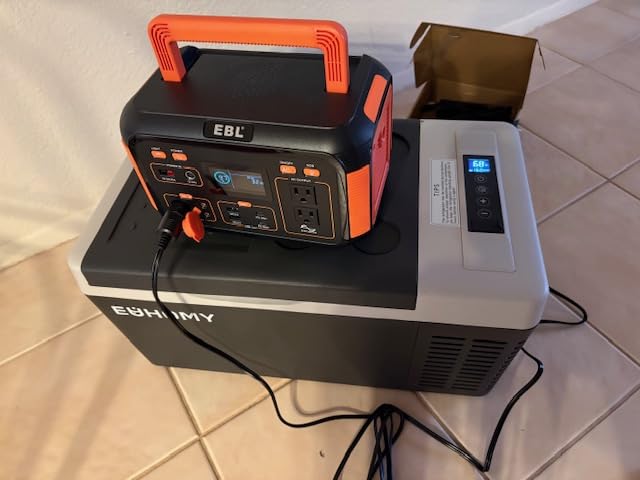
What stands out more than the cooling is the magnetic lid seal with its rubber gasket. Several owners report contents staying frozen for nine hours after unplugging, which is unusual for a unit in this size class and tells you something about how well the gasket seals against dust and warm air. At 42 dB, owners compare it to a small fan rather than an appliance.
The 19 quart interior is the limiting factor, not the electronics. It holds roughly 24 cans, and tall bottles only fit laid on their side, so plan your drinks layout before a trip rather than discovering it in the parking lot.
What makes the 19 quart EUHOMY easy to live with
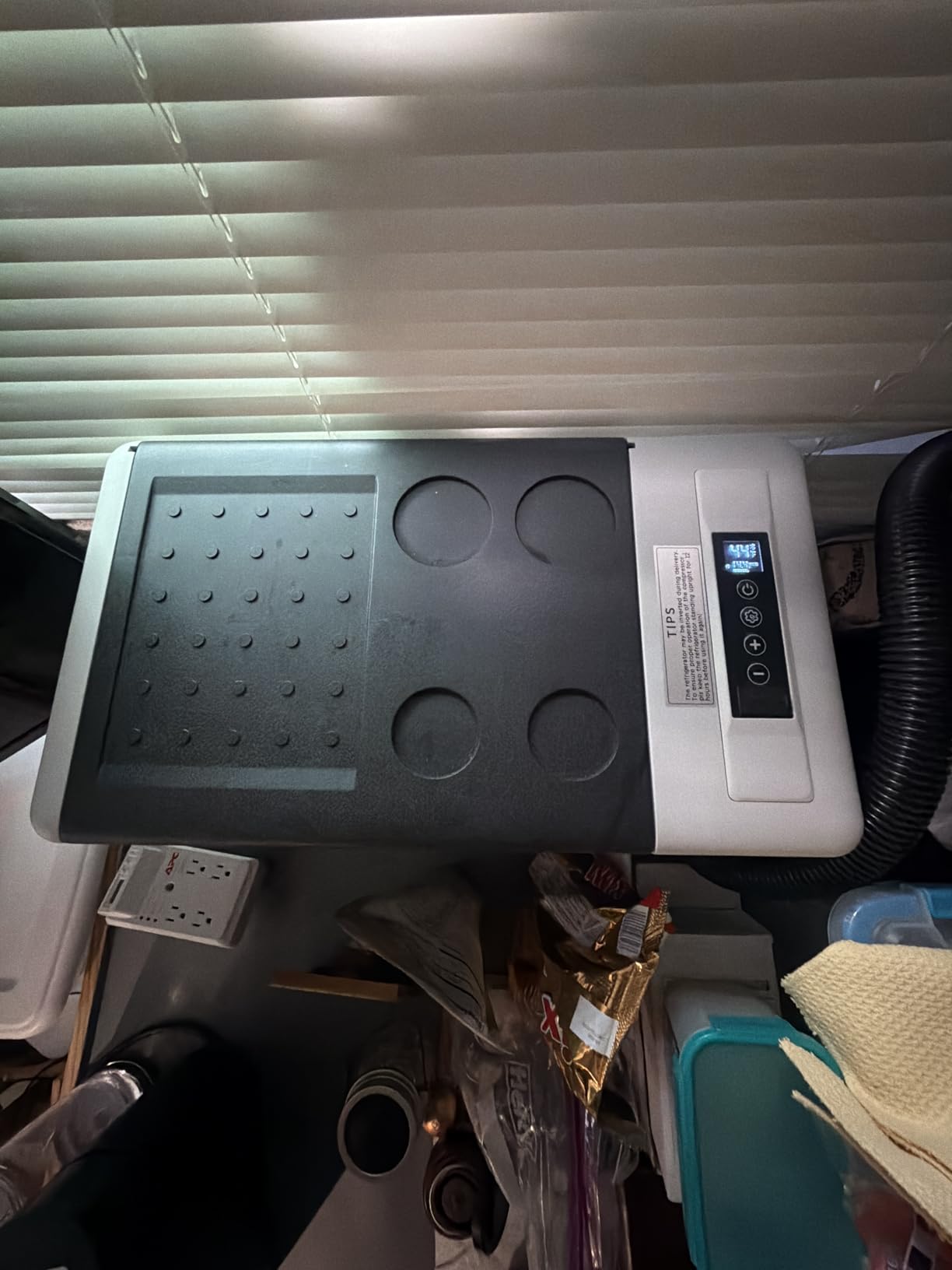
The Bluetooth app is the reason to choose this model specifically. Being able to set and monitor the temperature from the driver’s seat means you are not pulling over or opening the case in roadside heat every time you want to adjust it, and that convenience is what separates this unit from the very cheapest 12V fridges.
Three-level battery protection, dual AC and DC power cords and an anti-shock design rated for roads with up to a 30 degree incline complete a feature set that covers most camping conditions without any add-on purchases. The reverse door orientation and single shelf also make it easier to load in awkward cargo spaces.
Where the small cavity and thin walls show
There is no active air circulation, so food stacked against the walls can chill more slowly than the set temperature while the center of the box is already cold. If you are packing dense containers, leave air channels between them or accept a temperature spread across the cavity.
Thin walls are the other tradeoff. Owners note it warms more quickly when switched off than a thick-walled ice chest would, so if your plan depends on the fridge coasting through a long stretch with no power, this is not the box for you. A few fridges also arrived inverted and needed the manual’s 24 hour settling period before first power-on.
3. BODEGA 38 Quart Dual Zone – The Best 12V Fridge for Families
BODEGACOOLER 12 Volt Car Refrigerator,38 Quart Portable Freezer,Car Fridge Dual Zone APP Control,36L -4℉-68℉ Electric Compressor Cooler 12/24V DC and 100-240V AC for RV,Travel,Camping,Road Trip
38 quart dual zone, 33 lb, 12 minute MAX cooling, app control
Pros
- Two independently controlled zones for fridge and freezer storage
- removable divider converts it to one large zone
- 75F to 40F in about 12 minutes on MAX
- draws 0 to 30W in ECO once stabilized
- wheels and telescoping handle
Cons
- App needs a WiFi connection for Bluetooth to work
- app support and reliability draw frequent complaints
- small wheels roll poorly on rough ground
Dual-zone control is the feature that changes how a family actually eats on a trip, and the 38 quart BODEGA is the clearest implementation of it in this roundup. One side freezes while the other chills, so frozen meat and milk no longer have to share a single temperature band. It holds a 4.5 star average across nearly 2000 reviews.
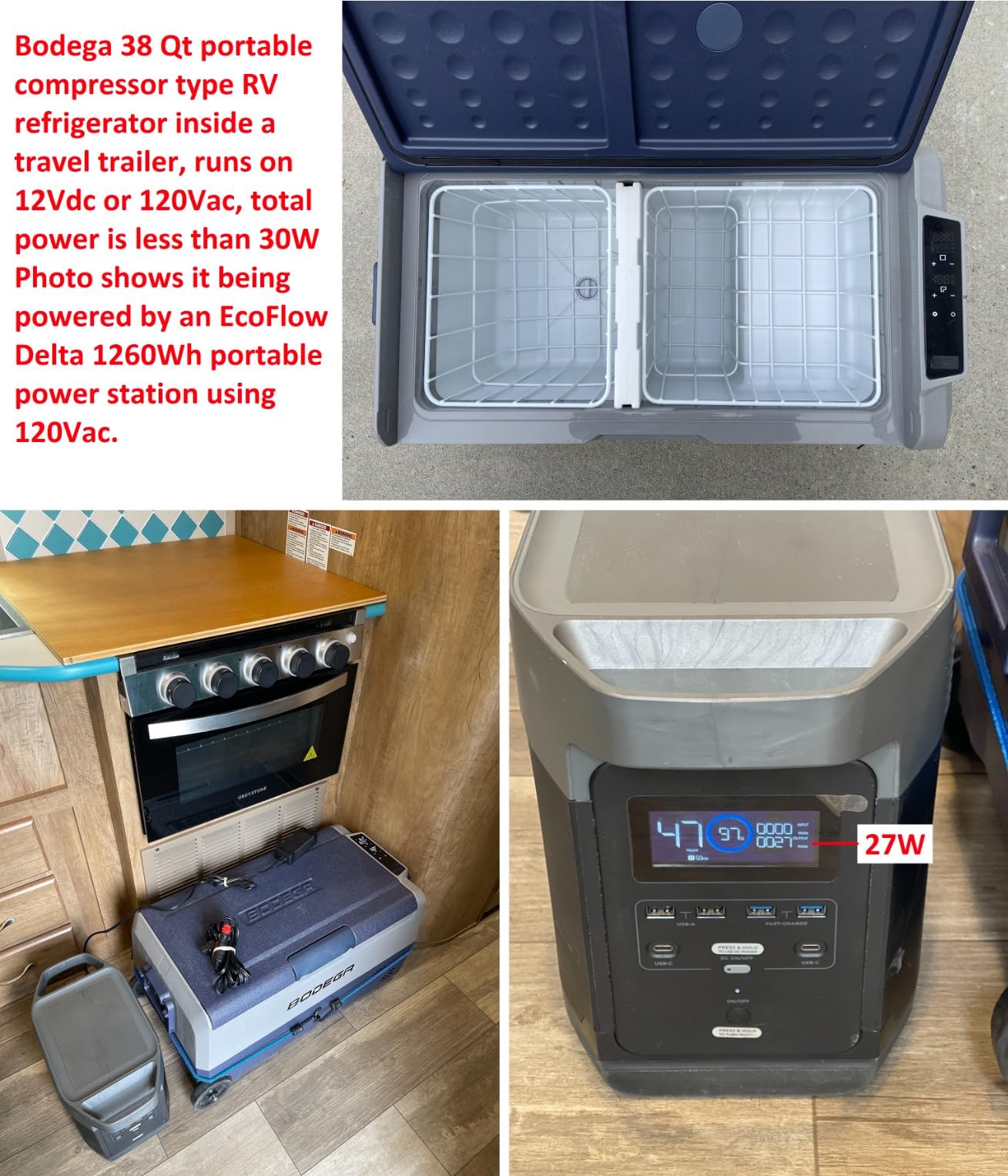
On MAX it brings 75F down to 40F in about 12 minutes, then settles to a 0 to 30W draw in ECO once stabilized, which is what makes multi-day holds on a 1 kWh-class power station realistic. Owners report temperature holds lasting for days on exactly that kind of setup.
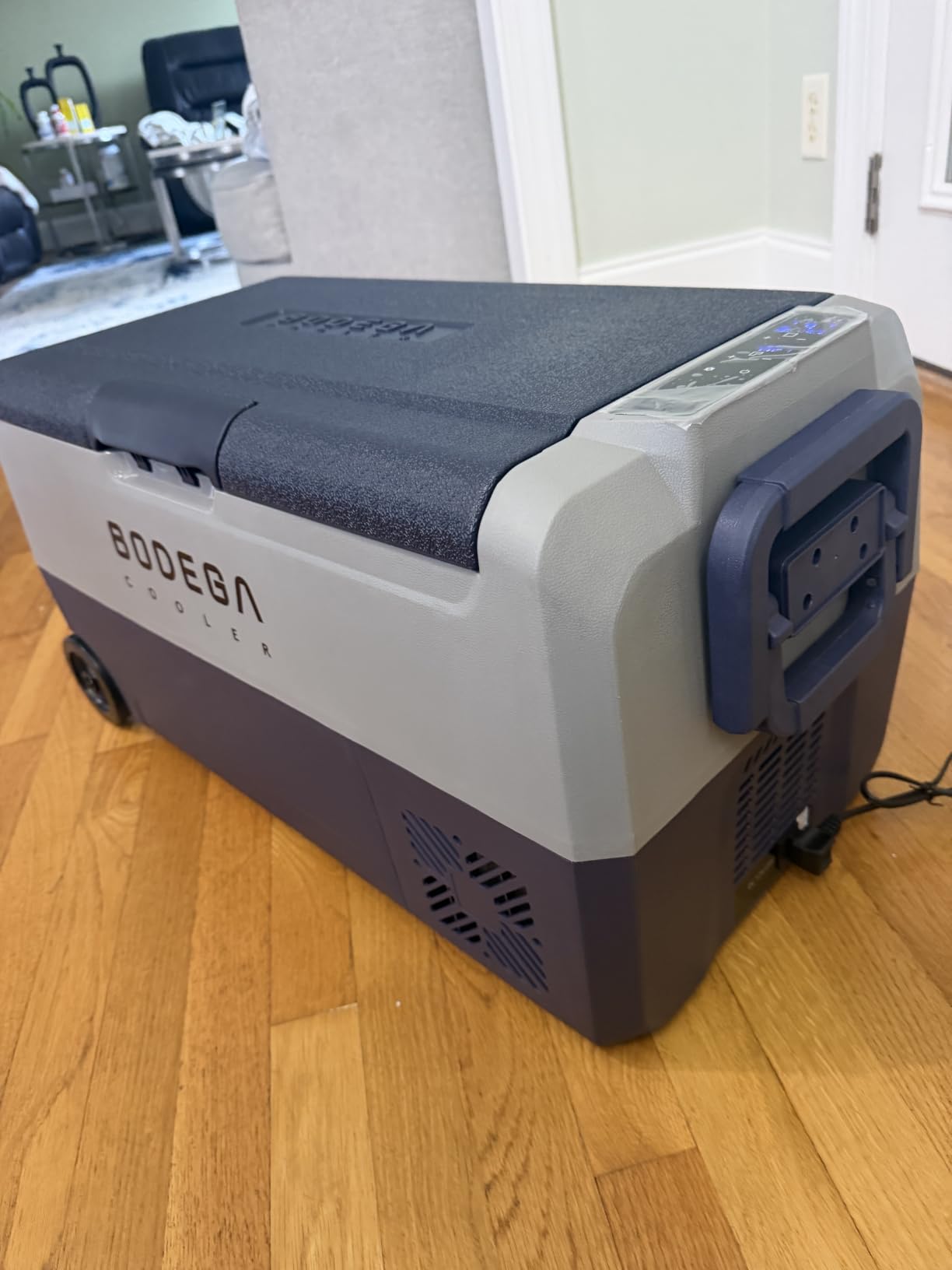
The removable middle divider is the piece people underestimate. Pull it out and two 38 quart zones become one large single compartment, which is what you want for a big catch, a long bulk run from the store, or a weekend where everyone is eating the same food anyway. That flexibility is why this box works for a family and for a solo overlander.
It also runs on 12/24V DC and 100-240V AC, includes a drain hole, a built-in LED light and a USB charging port, and holds a stable operating position on 30 degree inclines. Coverage on the compressor is 5 years, with 1 year on parts.
Why dual zone changes a family’s meal plan
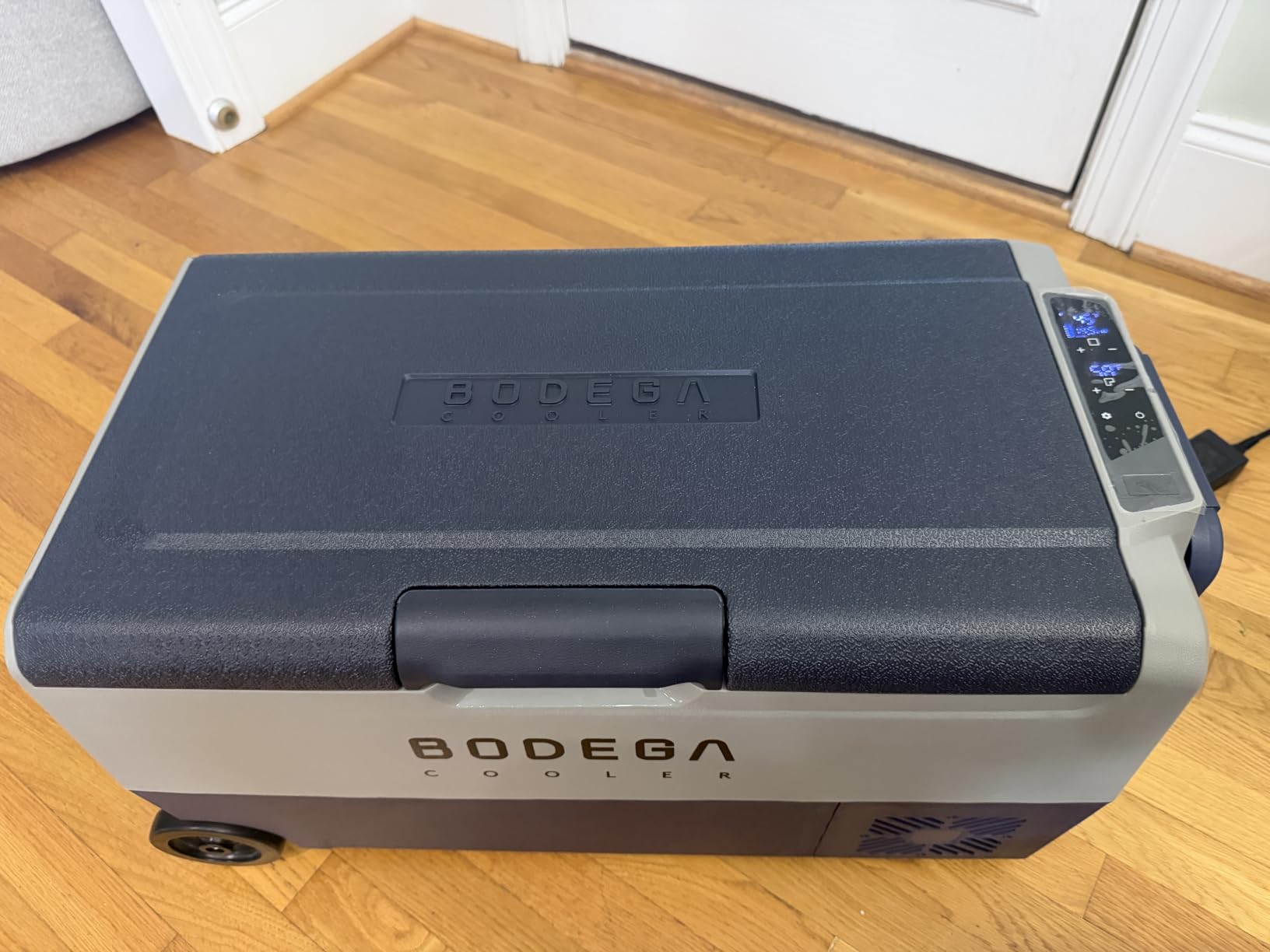
Single-zone fridges force a compromise: set the box for ice cream and your milk warms, set it for milk and nothing freezes. Independent zone control removes that compromise entirely, and the removable divider means you are not locked into two small compartments when you do not need them.
Capacity is the other family-friendly detail. The specification lists room for about 41 cans of cola, 21 water bottles or 13 wine bottles, which is the difference between one restock trip and two on a week-long trip with kids. Wheels and a telescoping handle also mean one person can move it from the tailgate to the picnic table.
Where the app and the weight work against you
The most reported complaint is that the app requires a WiFi connection for Bluetooth to function, which defeats the purpose of remote control in many campsites where you have no signal. Most owners fall back to the on-panel controls, which do work well, but it is worth knowing before you buy for the app specifically.
At roughly 33 pounds this is a two-hand load, and the small wheels do not roll well over rough camping ground. The handle is also short for taller users. Baskets and dividers can obstruct the interior layout, so measure your usable space honestly if you plan to run them.
4. Megiu 23 Quart – The Best 12V Fridge for Back-Seat and Small Car Camping
Megiu Car Refrigerator 23 Quart, Portable 12V Freezer for Camping Road Trip
23 quart capacity, 20.6 lb, under 40 dB, 18.3 inch width
Pros
- Cools 32F in 15 minutes and 0F in about 40 minutes
- under 40 dB running noise
- 18.3 inch width fits a back seat with a seat belt over it
- about 45W average draw under 1 kWh per day
- 3 year compressor warranty
Cons
- Manual defrost rather than frost free
- fewer digital and app controls than equipped rivals
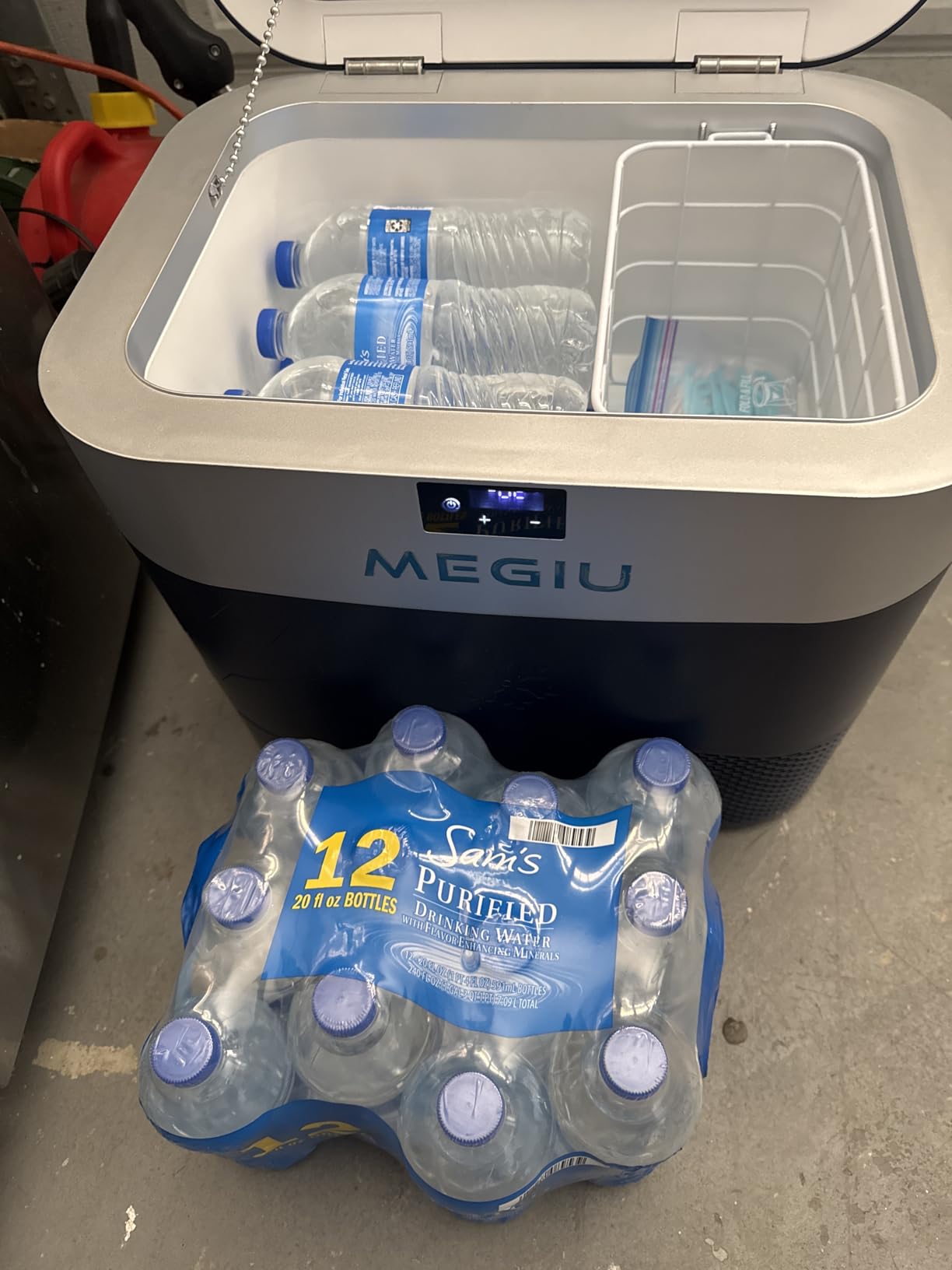
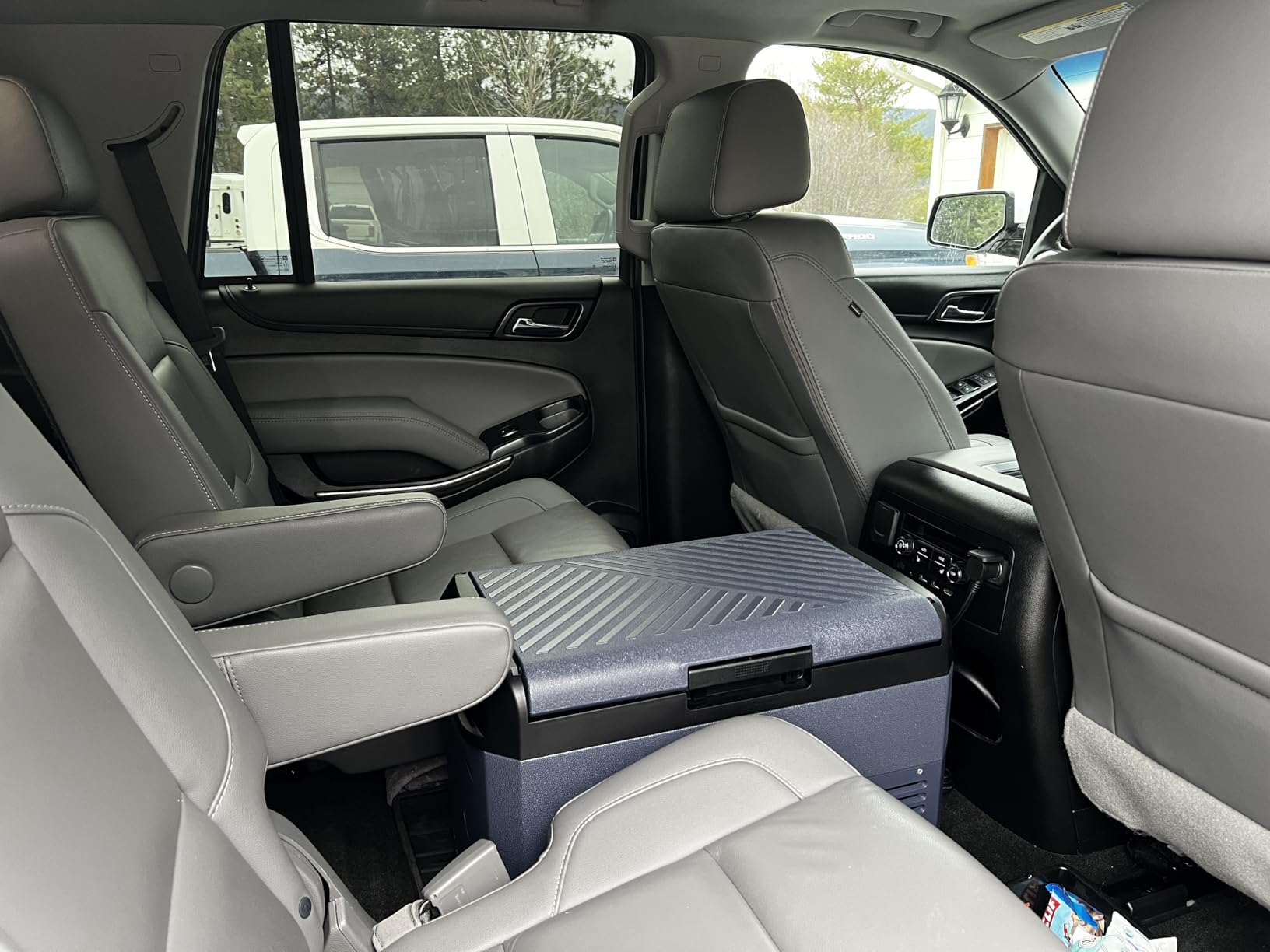
The Megiu solves a problem that most capacity lists ignore: where the box actually goes. At 18.3 inches wide it is narrow enough to sit across a back seat and be secured with a seat belt, which owners specifically call out for overlanding. At 20.6 pounds it is also one of the lighter options here, so you can lift it in and out without a second pair of hands.
Cooling performance is ahead of what the size suggests. The DC inverter compressor reaches 32F in 15 minutes and 0F in about 40 minutes, and the average draw of roughly 45W keeps consumption under 1 kWh per day. Noise stays under 40 dB, which is quieter than most conventional compressors.
The removable baskets double as a food tray, and the round fitting makes cleaning the interior straightforward, which sounds minor until you have cleaned a squared-off cavity with a frozen ice block in it. An AC adapter and DC cable are both included, so the same unit works at home and on the road.
This is a straightforward single-zone fridge, adjustable from -18C to +15C by touch screen, with a 4.4 star average across 939 reviews. That review base is a good deal deeper than many budget competitors, and the warranty runs 3 years on the compressor with 1 year on other accessories.
Why a narrow body matters in a small vehicle
Cargo space is the real constraint for most car campers, and a narrow fridge is one of the few ways to add cold storage without sacrificing the back seat or the bed. The seat-belt securing method is a genuinely practical trick that shows up repeatedly in owner reviews, and it keeps the unit from shifting on rough roads.
The 23 quart interior is a good match for a weekend with two people. Combined with the 3 year compressor warranty and next-day support response, it is one of the better-supported options at this capacity, and the 4.4 rating comes from enough owners to be meaningful.
Where manual controls cost you
Manual defrost is the trade you accept here. If you run the freezer zone hard every weekend, expect to defrost by hand periodically, which is an annoyance that frost-free designs in this roundup do not have.
Temperature control is touch screen rather than app-based in the listed feature set, so if remote adjustment from the cab is a requirement, the EUHOMY models elsewhere in this guide serve that need better. Defrost type and control style are the two real gaps; everything else about this fridge is competitive.
5. ICECO GO20 – The Best 12V Fridge for Precise Dual-Zone Control
ICECO GO20 Dual Zone 12V Refrigerator, Portable Fridge Freezer with SECOP Compressor, DC 12/24V, AC 100-240V, 0℉ to 50℉, Electric Cooler for Truck, RV, SUV, Outdoor, Driving, 21 Quart, Gray
21 quart dual zone, 25.5 lb, SECOP compressor, 0F to 50F
Pros
- SECOP rotary compressor with a fast cooling mode
- detachable partition switches between single and dual zone with two independent controllers
- 12/24V DC and 100-240V AC with a 2.5 m DC cable
- stable at 40 degree tilt
- 5 year compressor warranty
Cons
- Heaviest option per liter here at 25.5 lb for a 21 quart capacity
- one of the most expensive models in this roundup
The ICECO GO20 is the most precisely engineered fridge in this roundup, and the difference is the compressor. It uses a SECOP rotary unit with a dedicated fast cooling mode, which is a design that long-distance overlanders rate highly because the compressor is a widely proven architecture rather than an anonymous sealed unit. Cooling range runs from 0F to 50F.
Two independent digital controllers run the zones, and the detachable partition is the clever part. Pop it out and the unit reconfigures itself between single-zone and dual-zone operation without any menu diving, so you are not locked into two small compartments on a trip where you only need one big one.
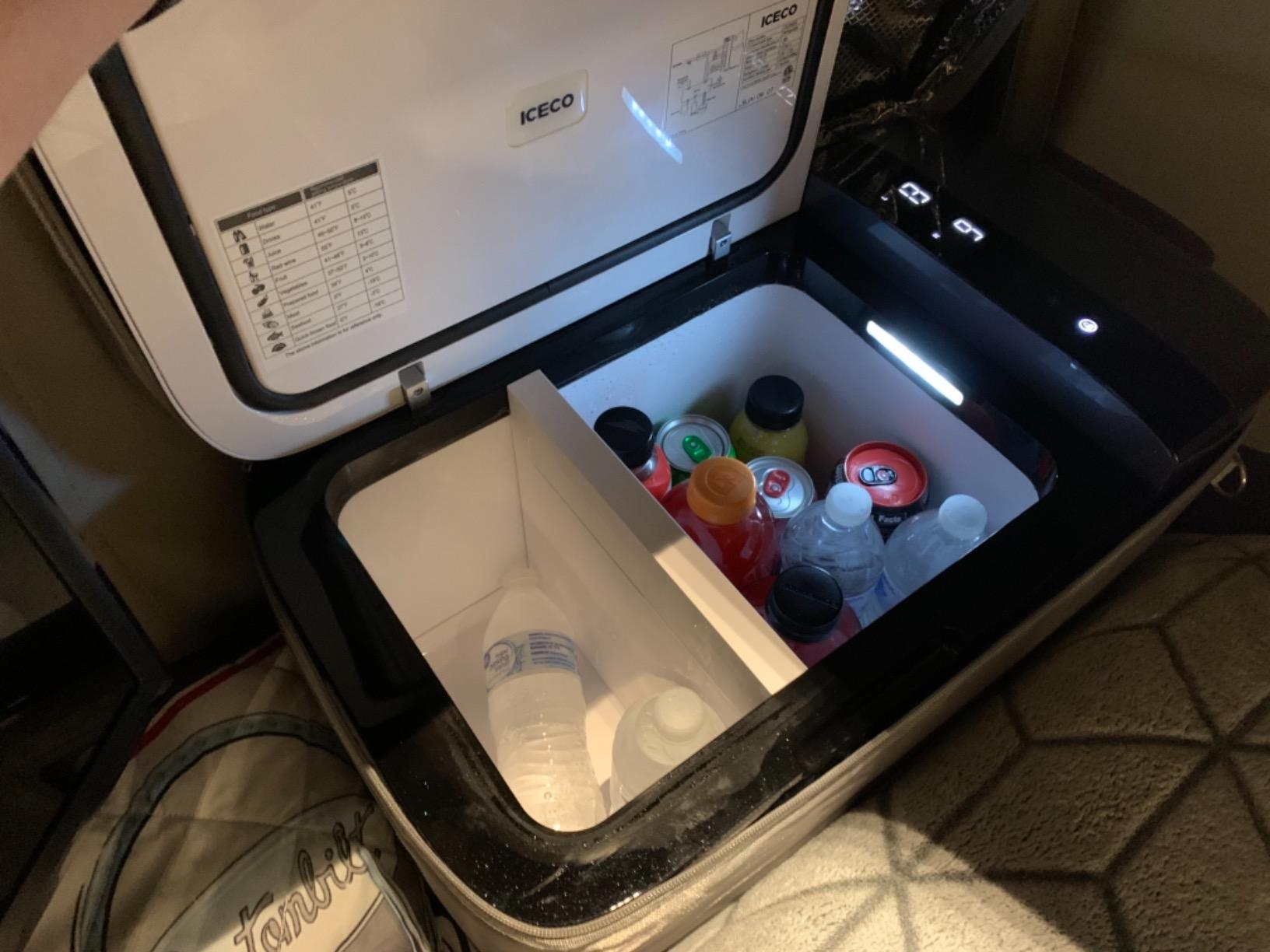
It runs on 12/24V DC and 100-240V AC, and the 2.5 meter cigarette lighter cable gives you real freedom to place the box away from the socket. The anti-bump compressor keeps it stable at a 40 degree tilt, which is the steepest figure any unit in this roundup claims, and the case carries ETL certification plus Red Dot and IDEA design awards.
Owners consistently point to the build quality and the finish as the reasons for the price, along with the ability to run the same box at home and in the vehicle. Coverage includes 5 years on the compressor and 1 year on accessories, plus local after-sales phone support, which is more than most competitors in this guide offer.
What a proven SECOP compressor buys you
Compressor design is the single most important long-term reliability signal in a portable fridge, and forum regulars consistently treat a proven, widely used design as more trustworthy than an unnamed alternative. The SECOP unit in the GO20 is exactly that kind of design, which matters most to people who keep the same fridge over multiple seasons.
The 40 degree tilt stability is the other quiet advantage. On a steep campsite or a heavily loaded truck bed, most fridges are operating outside their intended orientation, and this one is specified to hold together there. If your routes are rough, that claim is worth more than another five quarts of capacity.
Where weight and cost work against you
This is the heaviest capacity-per-liter option here: 25.5 pounds for a 21 quart interior. If you plan to move the fridge between the tailgate, the picnic table and the bed more than once a trip, that weight is felt every time.
It is also one of the most expensive models in this roundup, and owners are candid that the premium buys construction quality and finish rather than raw capacity. For most campers that is a worthwhile trade. For anyone buying strictly on usable quarts per dollar, a larger single-zone box is the better buy.
6. EUHOMY 24 Quart – The Best 12V Fridge With a Built-In Battery
EUHOMY 24QT 12 Volt Refrigerator, Electric Cooler, Usable Battery, -4℉~68℉
24 quart capacity, 22.7 lb, built-in battery compartment, app control
Pros
- Battery compartment runs the unit roughly 6 to 10 hours away from mains or vehicle power
- cools 77F to 32F in about 15 minutes at 45W average
- three-level battery protection adjustable from 9.6V to 12.4V
- built-in LED light and USB port
- Bluetooth app control
Cons
- Battery pack is a separate purchase
- interior space is smaller than the quart figure implies
- no wheels or telescoping handle
This is the answer to the question the forums keep asking, which is how to keep food cold when the vehicle is off and there is no socket nearby. The battery compartment gives roughly 6 to 10 hours of operation away from mains or vehicle power, which is enough to cover a night at a rest stop, a long layover, or a picnic day without running anything else.
Everything else about the fridge is conventional and good. The compressor cools 77F down to 32F in about 15 minutes at roughly 45W average, and owners report spot-on temperature control in both daytime heat and freezing-night conditions, which is the thermal range most camping trips actually cover.
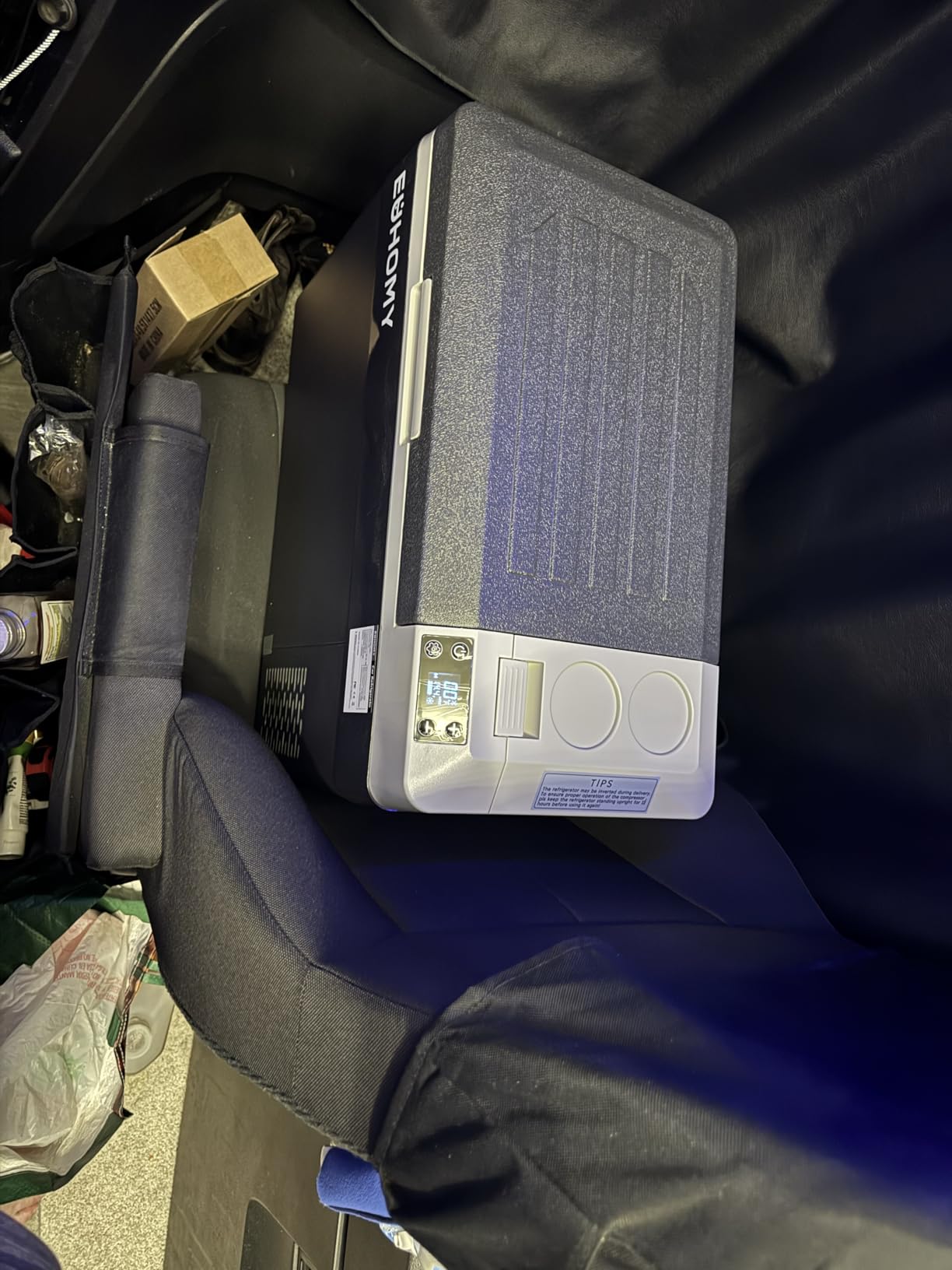
Three-level battery protection adjustable from 9.6V to 12.4V is a more granular setting than most units offer, and it lets you tune how aggressively the fridge protects a vehicle battery. The built-in LED light, USB charging port, recessed handles and hooks add to a feature set that reads as thoughtfully designed rather than specced.
At a 4.4 star average across 658 reviews, the owner history is solid, and one reviewer reports the company sent a free replacement unit after warranty expiry, which says something about support. Bluetooth app control is included rather than sold separately, unlike some built-in battery designs.
What the battery compartment actually buys you
Six to ten hours is enough for a full day of use away from a vehicle, and that is precisely the scenario that trips people up. Campers repeatedly report power banks and portable stations recharging too slowly to keep a fridge running between stops, so having a small reserve inside the fridge itself is a genuine safety net rather than a gimmick.
It also changes how the fridge is used. Owners treat it as a standalone unit in the trunk or the back of the wagon, and the low draw pairs well with the portable power stations that dominate camping setups today. For van builds where the main battery lives under a floor, the compartment is optional rather than essential.
Where the extra cost and weight show up
The battery pack is a separate purchase, and it was unavailable for some time after launch, so confirm what you are actually buying before ordering. The interior is also smaller than the 24 quart headline suggests, which is a recurring owner comment across this size class.
There are no wheels or a telescoping handle, so the unit is a two-hand carry by its recessed side handles. The display can be hard to read from certain angles in a dark cargo area, and a few buyers reported receiving a counterfeit rather than a genuine unit, so buy from an authorized seller.
7. EKOJUCE 54 Quart – The Best 12V Fridge for Families and Long Trips
EKOJUCE 12V Refrigerator 54QT Portable Freezer Electric Cooler
54 quart capacity, 31.1 lb, 45 dB, set temperature in 15 minutes
Pros
- 54 quart capacity for about 80 cans or 43 water bottles
- reaches set temperature in about 15 minutes on high
- quiet 45 dB operation
- three-level battery protection
- stable on a 30 degree tilt
Cons
- Heaviest model in this roundup at 31.1 lb
- must stand upright for 24 hours before first power-on after transport
- single zone only
Capacity is the whole argument for the EKOJUCE. Fifty-four quarts is the largest interior in this roundup, and the specification puts that at roughly 80 cans, 43 water bottles or 22 beer bottles. For a family road trip or a week of boondocking, that is the difference between provisioning once and provisioning twice.
The rest of the specification is respectable rather than exceptional. It reaches set temperature in about 15 minutes in powerful mode, runs at roughly 45 dB, and its energy-saving mode reduces consumption over the long trips this capacity is built for.
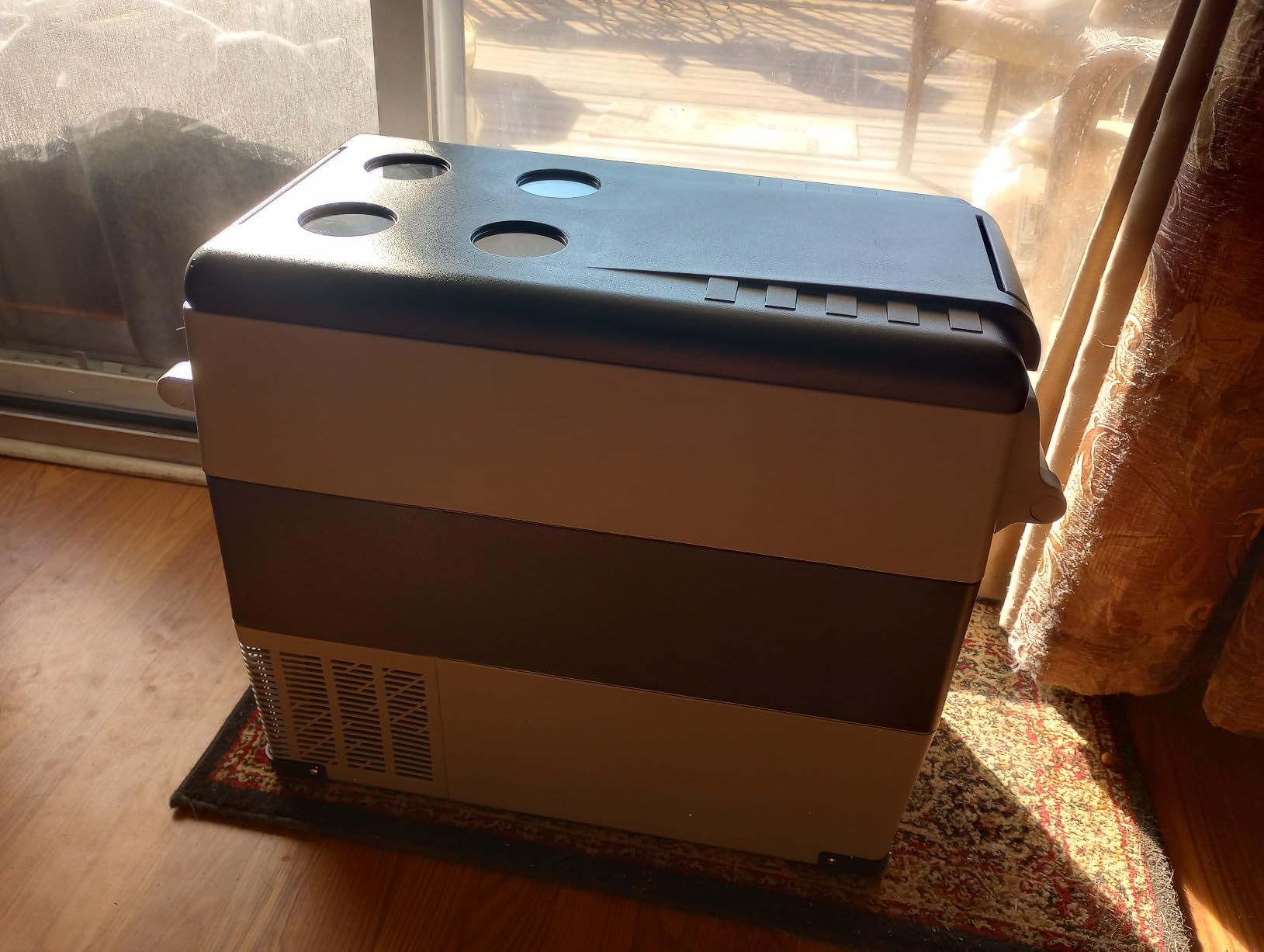
Buyers mainly respond to the combination of that interior volume with a price well below comparable large-capacity compressors, and the cooling speed and quiet running are confirmed rather than disputed. It holds a 4.5 star average across 485 reviews, which is a smaller but consistently positive record.
Do note this is a single-zone box in a very large package. If your household needs a separate freezer and fridge compartment, the dual-zone models in this guide serve that requirement better even though they are smaller overall.
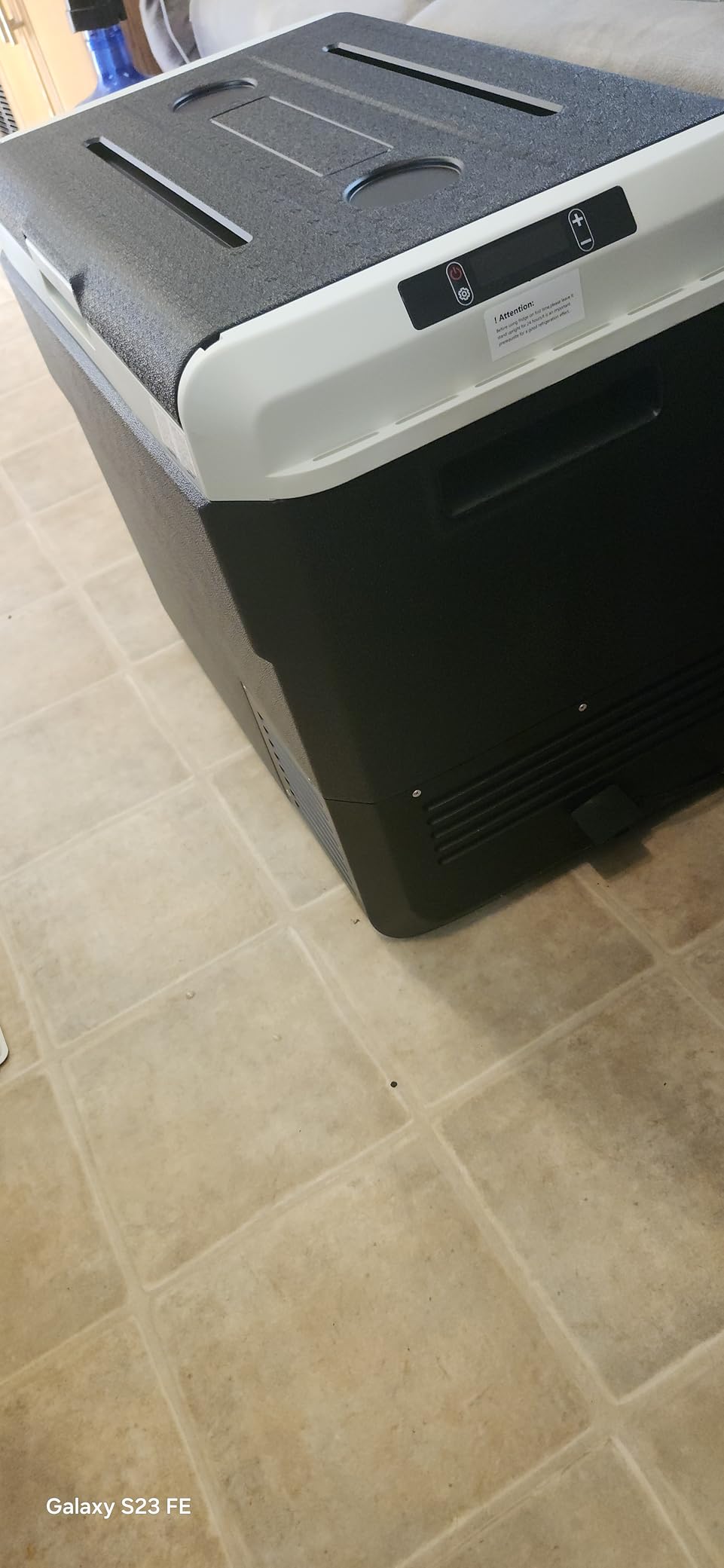
Why 54 quarts covers a long trip
Long trips are decided by provisioning. A 54 quart box holds a week of fresh food, drinks and a freezer section for a family without a second resupply run, and it does so in a single unit that runs off the same 12V socket as everything else in the vehicle.
The 30 degree tilt stability matters most for this size class, because a large box is exactly the one you end up securing in a truck bed or on a rear platform where the angle changes. Battery protection across three levels also lets you tune drain behavior for overnight running with the engine off.
Where 31 pounds becomes a problem
This is the heaviest model here, and at 54 quarts that is not surprising, but it is a real constraint if you plan to unload it at camp more than once. Two people can manage it comfortably; one person moving it alone across uneven ground will notice.
There is also a 24 hour upright settling requirement before first power-on after transport, which matters if you are collecting it close to a trip. A single zone layout and a 1 year warranty round out the tradeoffs on an otherwise well-built large-capacity box.
8. Setpower 21 Quart – The Best Low-Draw 12V Fridge
Setpower 12V Refrigerator 21QT Car Refrigerator,50H Keep Cool 12V Fridge
21 quart capacity, 28W in ECO, 40W in MAX, app control
Pros
- Draws just 28W in ECO and 40W in MAX for under 1 kWh per day
- included ice pack doubles as a divider and holds cooling up to 50 hours during a blackout
- cools 77F to 32F in 15 minutes and -4F in about 45 minutes
- works with AC
- DC
- battery and solar power
- 3 year compressor warranty
Cons
- Hollow uninsulated lid is where temperature is lost
- usable interior volume is smaller than 21 quarts implies
- no built-in interior light
On power draw alone, the Setpower is the most efficient fridge in this roundup. It pulls 28W in ECO and 40W in MAX, which works out to under 1 kWh per day, and that is the number that decides whether your auxiliary battery or power station will last the weekend. If you are sizing a solar setup, this is the model that makes the arithmetic easy.
The included ice pack is a genuinely clever accessory rather than a gimmick. It acts as a divider, and owners report it keeping food cool for up to 50 hours during a blackout, which covers the specific failure mode that worries campers most.
Cooling is fast for the class, reaching 32F in 15 minutes and -4F in about 45 minutes, and the compressor is quiet enough that some owners check it is actually running. The 4.2 star average across 237 reviews is the lowest in this roundup, so read the complaints below before committing.
It is also the only model here that lists battery and solar power sources alongside AC and DC, and app control means you can adjust temperature without stopping the vehicle. The warranty is 1 year on the whole unit and 3 years on the compressor.
Why 28 watts in ECO mode matters
Power draw is the number that separates fridges you can run all weekend from fridges you run carefully. At 28W in ECO, this unit consumes less than a third of what a typical built-in household appliance would on the same duty cycle, which is what makes a modest power station or a portable solar panel viable for a full trip.
It is also tall enough to fit water and sports drink bottles upright, which matters more than it sounds for a fridge used at a tailgate or on a boat. Ergonomolded side handles and lid lash points make securing it straightforward.
Where the uninsulated lid hurts
The dominant complaint, repeated by several buyers, is that the lid is hollow with no foam insulation and that this is exactly where temperature is lost. With a 4.2 rating and the smallest review base in this guide, the insulation tradeoff is worth taking seriously if you care about off-power retention.
Usable interior volume is also smaller than the 21 quart figure implies, and there is no built-in interior light for night use. Some buyers report higher-than-advertised draw and heavy weight, and listing imagery can suggest an upgraded lid that is not included, so check what is in the box.
9. BODEGA 16 Quart – The Quietest 12V Fridge for Sleeping in the Van
BODEGA 12 volt Car Refrigerator – 16QT Portable, Low Noise, Fast Cooling with LED Display, Multiple Charging Options, Energy-Efficient for Road Trips & Outdoor Adventures
16 quart capacity, 21.5 lb, 31 dB, LED display
Pros
- Very quiet at 31 dB thanks to vibration damping
- chills drinks in about 15 minutes across -4F to 68F
- MAX and ECO modes with H/M/L battery protection
- LED digital display readable in low light
- compact 15L size that fits a car easily
Cons
- Lid can bow over time and lacks straps to hold it shut
- freezer temperature can drift about 10F from the set point
- Bluetooth pairing needs a 2.4 GHz network
- customer support response times criticized
If the fridge sits beside your head, noise is the first spec that matters and no other unit in this roundup comes close. The 31 dB rating comes from a DC compressor with vibration damping, and owners describe it as quieter than most competitors by a clear margin. For van life and any sleep-in-the-vehicle setup, that is a decisive advantage.
The compact 15 liter size also helps. At 12.9 inches deep, 18.5 inches wide and 12.6 inches tall, it is one of the easiest units here to fit in a small car or a tight cargo area, and at 21.5 pounds it is light to lift out at camp.
Cooling is quick for the class, chilling drinks in about 15 minutes across a -4F to 68F range, with MAX and ECO modes plus H/M/L battery protection. The LED digital display is easier to read in low light than a conventional LCD and has a longer service life, which is a small thing that matters at 6am.
It runs on a 12V car adapter and a home AC plug, so the same unit works as a camp fridge and a backup option at home. The 4.2 star average across 1224 reviews is a solid record for a compact model, though the complaints cluster in specific places.
Why 31 dB is the quietest here
Most compressor fridges in this guide land between 40 and 45 dB, which sounds small but is a real difference in a sleeping compartment a few feet from your head. Vibration damping on the compressor mounts is what buys the extra quiet, and it is a design decision that costs nothing at purchase time and pays back every night.
The combination of quiet running, low weight and a small footprint also makes this the most practical fridge for beach days, road trips and short weekend trips where you want cold drinks rather than a full week’s food.
Where freezer drift and app pairing frustrate
Freezer temperature can drift about 10F from the set point, and a few examples in this brand’s wider dual-zone range fluctuate widely in the freezer compartment. If you need precise frozen storage, this is not the model to build a plan around.
The lid can bow over time and has no rubber straps to hold it tight, which accelerates the temperature drift. Bluetooth pairing is also fiddly and needs a 2.4 GHz network, and a few examples have a loud bang when the compressor starts. Support response times are criticized in a number of reviews, so treat this as a compact convenience fridge rather than a long-term food store.
10. Dometic CFX2 28L – The Best Built 12V Fridge for Long Off-Grid Trips
Dometic CFX2 28L Electric Cooler
28 liter capacity, 29.3 lb, polyurethane foam, 3-stage battery protection
Pros
- Polyurethane foam insulation across a -7F to 68F range
- about 45W running draw and 0.67 Ah per hour at mid-80s ambient
- runs roughly three days on a 1 kWh power station and four days on a single lithium battery in 100F heat
- 3-stage battery protection
- 2 year warranty
Cons
- No internal battery so it must be plugged into AC or DC
- lid hinges are on the short side which differs from the listing images
- Bluetooth and WiFi setup instructions are not in the box
- 12V socket can pull loose when unplugged
The Dometic is the most expensive fridge in this roundup and the one buyers are least likely to return. The reason is not capacity, it is build. Polyurethane foam insulation across a -7F to 68F adjustable range and a compressor that draws about 45W while running and only 0.67 Ah per hour in mid-80s ambient heat describe a unit designed to be used hard for years.
The runtime figures owners report are the strongest in this guide. Multiple buyers run it for roughly three days on a 1 kWh power station, and one reports four days on a single lithium battery in 100F heat, which is desert-condition evidence rather than lab data. That kind of off-grid endurance is what you are paying for.
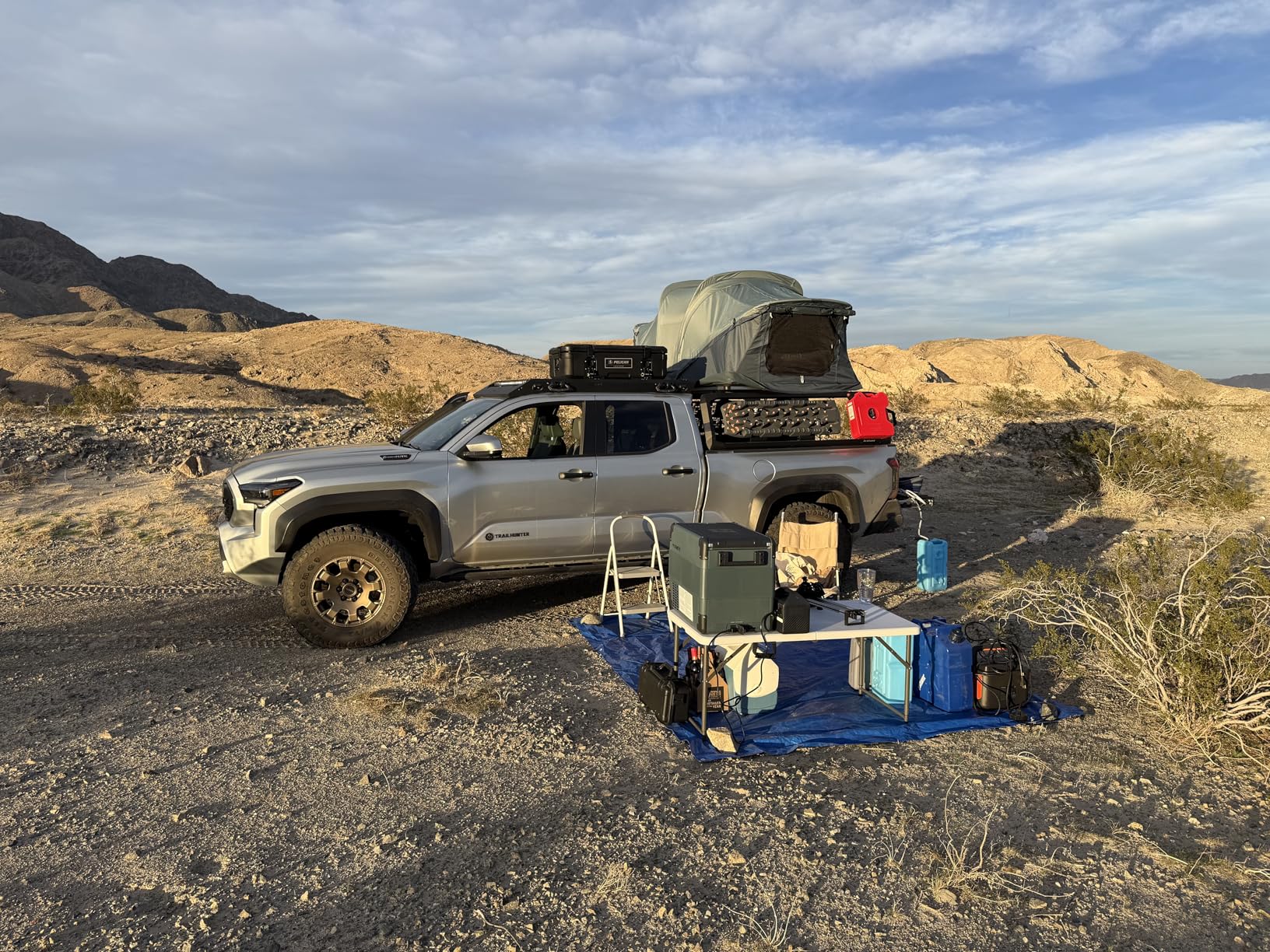
The 28 liter interior holds up to 36 cans or three 1.5 liter bottles, and the compact dimensions fit a sleeper berth or the gap between the front seats of a truck. Three-stage battery protection monitors vehicle battery draw, and the Bluetooth Mobile Cooling app handles temperature monitoring and adjustment.
Owners also compare the build favorably against ice coolers of the same capacity, specifically noting the absence of the melted-water problem that ends up in the carpet. A 4.5 star average comes from 149 reviews, which is the smallest review base in this roundup, so treat the rating as strong but less proven than the leaders.
Why the foam and compressor run cool and long
Polyurethane foam is a step up from the air-gapped plastic used in cheaper cases, and it shows up directly in temperature stability across a hot day. Paired with a low-draw compressor, that insulation is what turns a good day of camping into a solid week of food storage without a second resupply.
The brand is another factor. Dometic carries a long-standing reputation in portable cooling, and a 2 year warranty backed by that name is easier to rely on than a short warranty from an unknown label. For overlanders who keep equipment for a decade, build reputation is part of the product.
Where the hinge layout and cord fit disappoint
The most-reported complaint is that the hinges are on the short side and the lid opens lengthwise, which differs from the product images and the manual, so read the dimensions and hinge direction carefully before committing.
There is no internal battery, so it must be plugged into AC or DC, and the Bluetooth and WiFi setup instructions are not included in the box. The 12V socket connection can also be tight and prone to pulling loose when you unplug it, which is a small thing that gets annoying on a dark campsite, and a few examples reported a physical defect inside the tub on a new fridge.
12V Fridge Buying Guide: How to Choose the Right One
Once you have narrowed the list, these are the decisions that determine whether the fridge works for you. Skipping them is why so many people end up returning a perfectly good unit that simply does not fit the trip or the power budget.
Match capacity to travelers and trip length
Quarts are the number sellers lead with, and they are the least useful number on the page because usable volume depends on the shape of the cavity. A rough guide holds up well: 15 to 25 quarts suits one or two people on a weekend, 25 to 40 quarts covers two adults and children for several days, and anything above 45 quarts is built for a family or a week of provisioning.
Our guide to compact 12V fridges for small SUVs covers the low end in detail. When you compare sizes, check the can and bottle counts in the specification rather than the quart figure, and read owner comments about whether the real interior feels smaller than the headline. Several buyers make that exact complaint in this roundup.
Work out the amp-hours before you buy
Most campers underestimate this, and it is the number that decides whether a weekend works. Community consensus on Expedition Forum’s power thread is that a 12V fridge draws about 25 amp-hours per 24 hours at 40F, which means a 100Ah battery covers roughly two days with nothing else drawing. A separate thread on the Good Sam community reports a fridge averaging 1.1A over a full day, which works out to about one day per battery.
For planning purposes, the range across these reports is 25 to 30 amp-hours per day at 40F, and it climbs substantially if you run the freezer compartment. On that basis, a 100Ah lithium battery gives you about three days, a 200Ah gives about six to seven, and you need solar or vehicle charging beyond that. Forum users also note the recharging constraint clearly: a power bank worked for about a day and a half before the roughly 8 hour recharge cycle became the limiting factor, so a power bank is a top-up, not a primary supply.
Choose dual zone or single zone deliberately
A dual zone 12V fridge runs two independently controlled compartments, so one side can freeze while the other chills. The BODEGA 38 quart, the ICECO GO20 and the Dometic in this guide all use that layout, and the removable dividers on the BODEGA and ICECO let you collapse them into a single large space when a trip calls for it.
Single-zone models are simpler, cheaper per quart and often lighter, and they are entirely adequate if you are storing mostly drinks and fresh food rather than frozen items. The decision comes down to whether your trip involves real freezer storage, not to a general rule about quality.
Run it off a power station or solar
Every unit in this roundup accepts 12/24V DC and household AC, which means a portable power station works as a primary supply for all of them. The Setpower lists battery and solar power explicitly, and the Dometic is described as solar compatible. Owners across the forums recommend pairing a fridge with a 100W panel while parked, which is roughly what the low-draw models here need to stay topped up indefinitely.
Plan the arithmetic rather than the brand: a 1 kWh station runs the Dometic for about three days according to owner reports, and the Setpower at 28W in ECO will last longer on the same capacity. If you are running a fridge overnight with a power bank only, keep the overnight hours in mind, because recharge time is usually the real constraint.
Moving from a propane fridge to 12V
Migration from an absorption fridge to a compressor unit is an active question on camping and RV forums, and the answer has shifted. Propane absorption fridges consume less energy and work indefinitely on a full tank, but they cool slowly, hold a narrow temperature band and cannot drop food quickly when loaded at a store. Compressor fridges invert those traits entirely: fast pull-down, precise control, and a constant appetite for power.
For full-time RV travelers the practical test is dry camping. If you regularly spend days without hookups, a 12V fridge plus a lithium battery and a solar panel is the combination most people land on. Our guide to 12V electric blankets for car camping covers the other half of the cold-weather power picture for the same trips.
Check fit, ventilation and mounting
Measure the space before you order, and measure it with the lid open. A fridge that fits with the lid closed may not clear the vehicle’s hatch or tailgate when you actually need to reach the controls. Leave ventilation clearance around the compressor end, because a closed trunk or a sealed tonneau cover makes the unit work harder and live shorter.
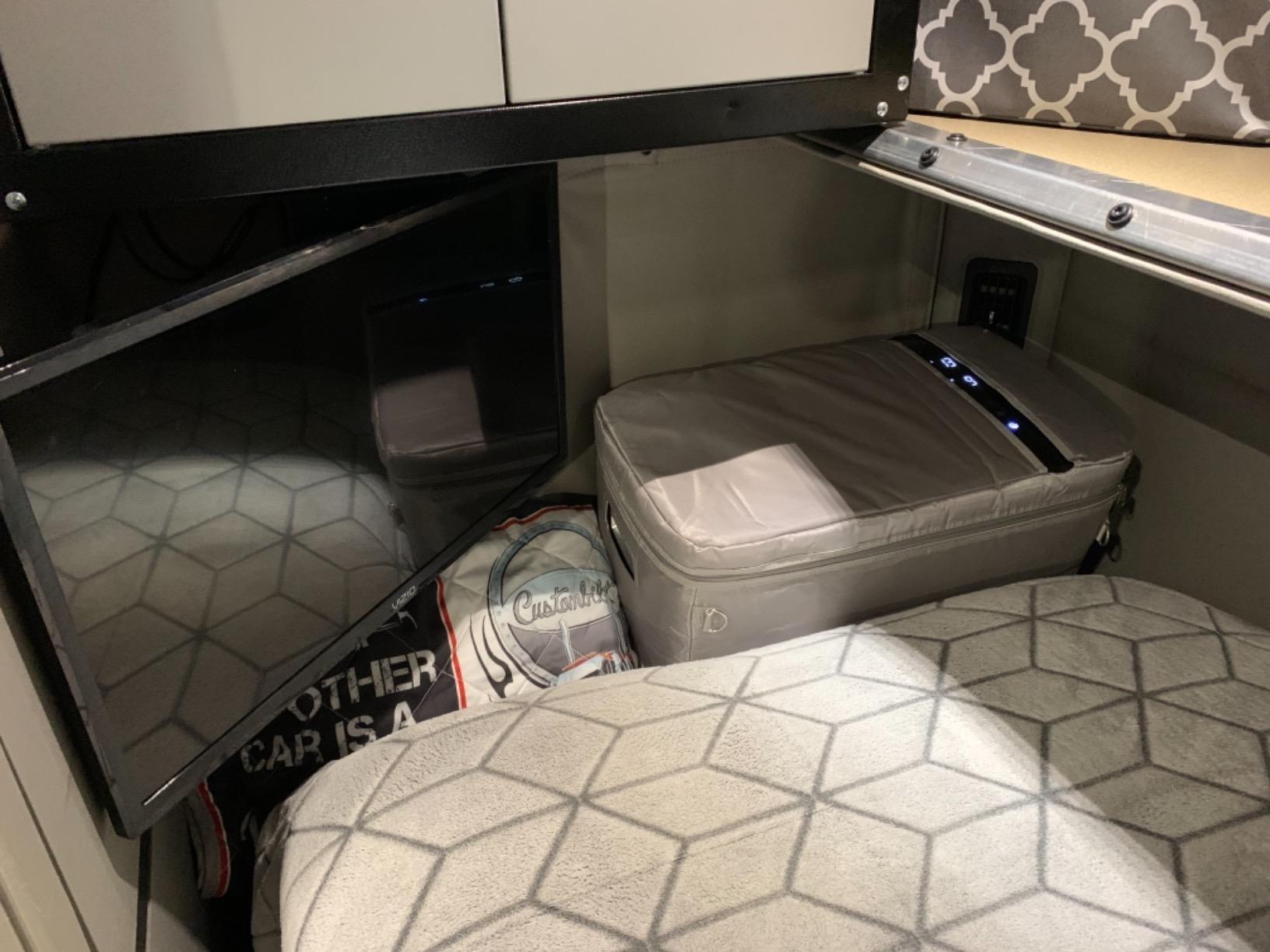
Also plan the mounting. Overlanders secure units with tie-downs, lash points or seat belts, and several models here include integral lash points or molded side handles designed for it. Check whether the fridge slide, transit bag and mounting hardware for your model exist from the same brand, since accessory support is a fair proxy for long-term commitment.
Factor in noise and food safety
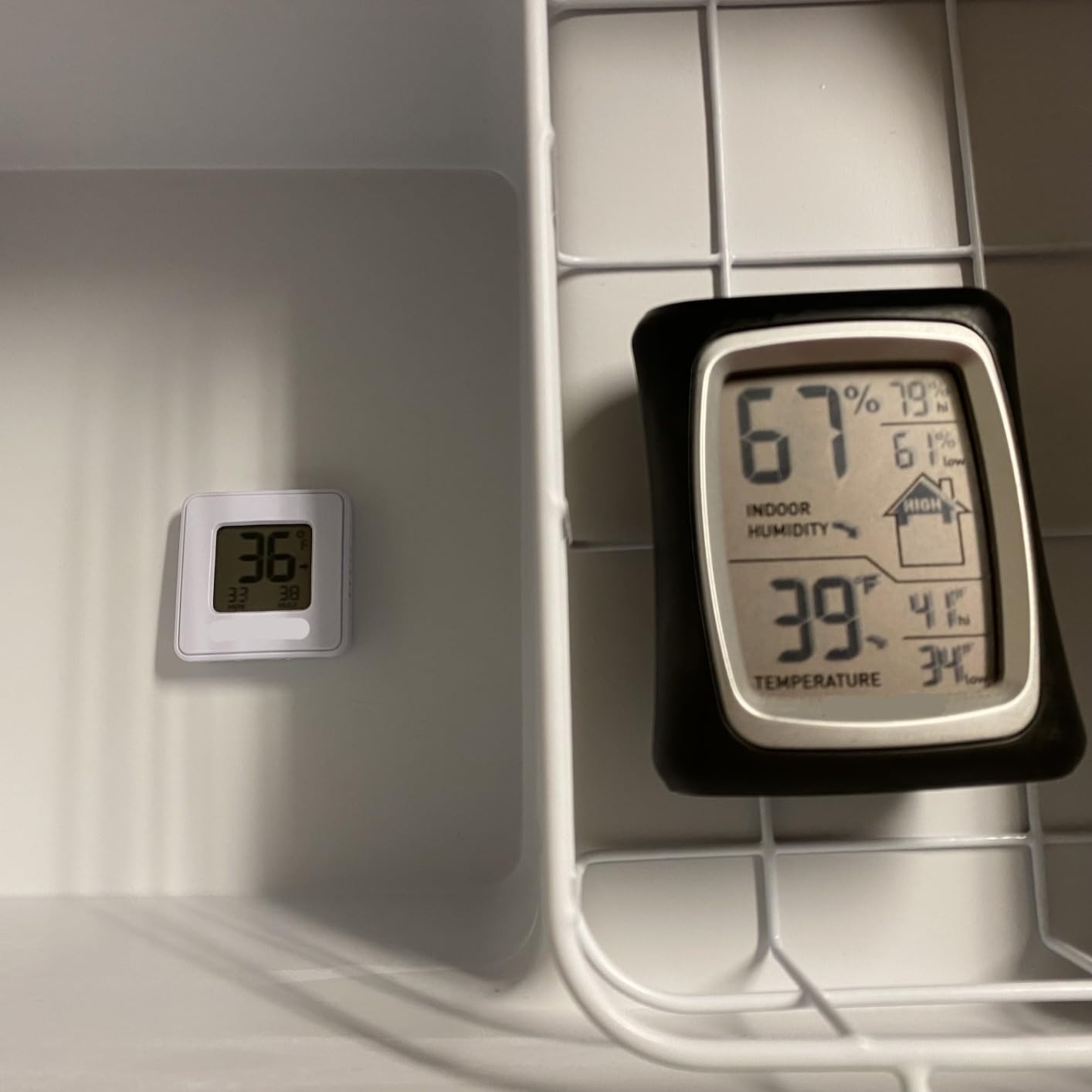
Noise matters most when the fridge shares a sleeping compartment. The BODEGA 16 quart at 31 dB is the pick here if you sleep beside the unit, while most others fall in the 40 to 45 dB band. For food safety, keep perishables at or below 40F, the FDA-recommended refrigerator temperature, and use an appliance thermometer on long trips, particularly when you are running the freezer compartment rather than the fridge zone.
Frequently Asked Questions
What is the most efficient 12V camping fridge?
Efficiency comes down to average amp-hours per day, not peak wattage. The Setpower 21 quart is the most efficient unit in our roundup, drawing 28W in ECO mode and 40W in MAX for under 1 kWh per day. The BougeRV 23 Quart is close behind, running under 45W in ECO with about 0.6W idle draw. Both pair well with a 100W solar panel or a 1 kWh power station.
How much power does a 12V camper fridge use?
Most 12V camping fridges pull 30 to 55W while the compressor is running, then drop to well under 1W when idle. Because the compressor cycles rather than runs continuously, the useful figure is amp-hours per day, and campers report roughly 25 to 30 amp-hours per 24 hours holding a fridge zone at 40F. Running the freezer compartment raises that noticeably. Owner tests show a Dometic CFX2 drawing about 0.67 Ah per hour in mid-80s ambient heat.
How long will a 100Ah battery run a 12V refrigerator?
At a typical 25 to 30 amp-hours per day at 40F, a 100Ah lithium battery runs a 12V camping fridge for roughly three days with nothing else drawing from it. Forum reports of closer to 36 hours usually involve the freezer compartment running hard or additional loads on the same battery. A 200Ah battery doubles that to about six or seven days, and a 100W solar panel keeps a 100Ah setup going while parked.
Do 12V fridges drain car batteries?
They can, and the fix is the three-level or H/M/L battery protection fitted on most units in this roundup, including the BougeRV 23 Quart, the EUHOMY 19 quart and the Dometic CFX2. The protection cuts the compressor before the vehicle battery reaches a low state. Running a fridge off the starter battery overnight without that protection is the most common way campers strand themselves.
Is a 12V fridge better than a cooler for camping?
A compressor fridge wins on trips longer than a weekend, when a cooler with ice loses its battle and you stop paying for daily ice runs. For one or two night trips, or when you mostly need cold drinks, a good ice chest is still cheaper and needs no power. Our guide to the best 12V coolers for cars covers the cases where the cooler is the right call.
Can you run a 12V fridge off a power station?
Yes. Every unit in this roundup runs on 12/24V DC, so any portable power station with a 12V output can serve as the primary supply, and several accept solar input. Owner tests show a Dometic CFX2 running about three days on a 1 kWh station. The limiting factor is recharge time, since a power bank took about a day and a half before its roughly 8 hour recharge cycle became the bottleneck.
Bottom Line: Which 12V Fridge Should You Buy?
For most campers, the BougeRV 23 Quart is the best of our ten 12v fridges for camping because it combines the highest rating in the group with the deepest owner history, three-level battery protection and a 30 degree incline rating, without asking you to compromise on capacity. It is the fridge we would put in our own vehicle.
Pick a different one when your situation is specific. Go dual zone with the BODEGA 38 quart for a family that needs a real freezer compartment, with the ICECO GO20 if you want a proven SECOP compressor and the tightest build, or with the BODEGA 16 quart if the fridge sleeps a few feet from your head at 31 dB. For a built-in battery that keeps running with the vehicle off, the EUHOMY 24 quart is the only model in this roundup that covers that need.
Whatever you choose, measure the space, work out your amp-hour budget, and confirm the mounting and ventilation before checkout. The right 12v fridges for camping is the one that fits your vehicle, matches your battery and survives the trip, and this guide is updated for 2026 as new compressor models land.