
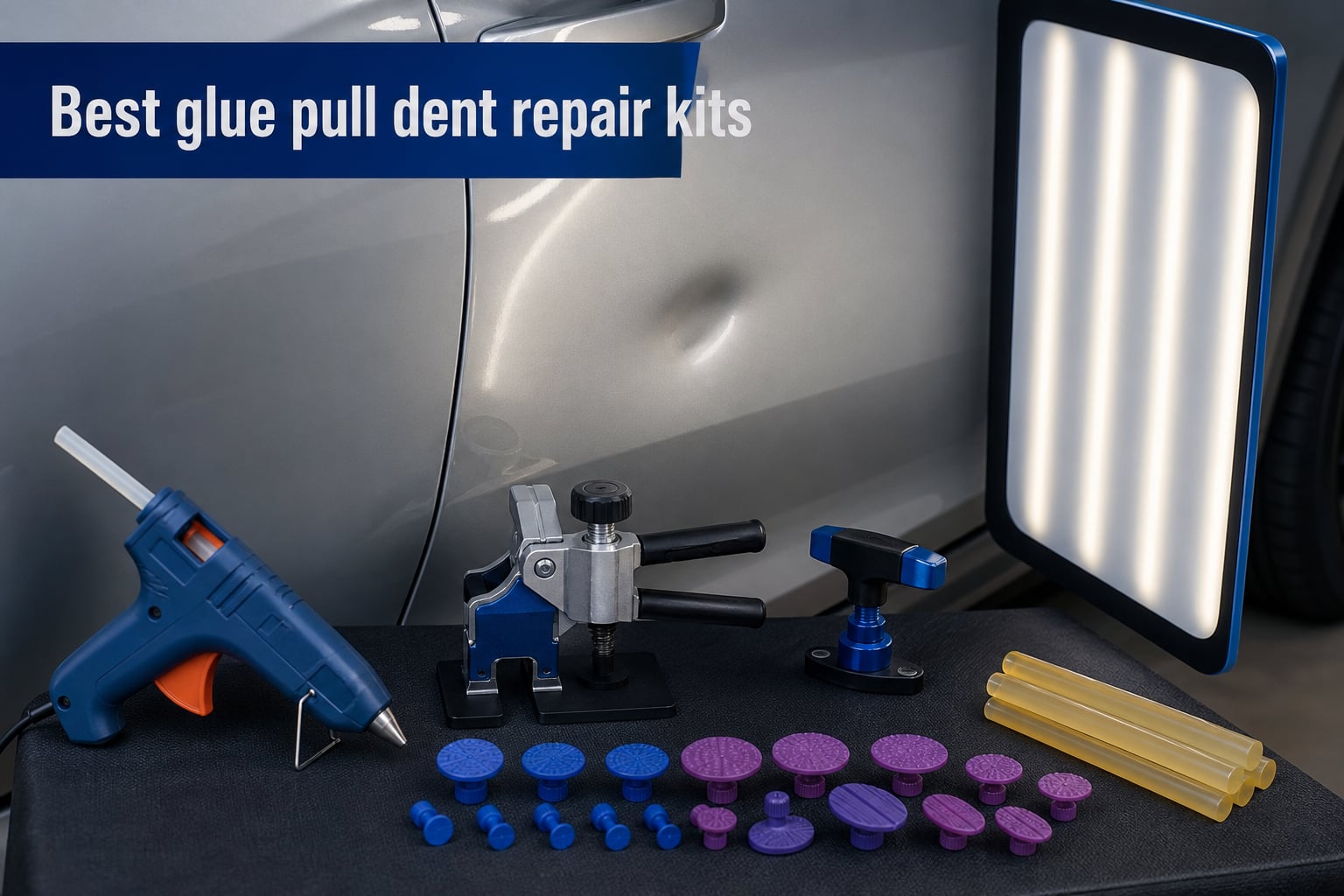
The best glue pull dent repair kits give a careful DIYer a non-invasive way to improve shallow door dings, broad hail dents, and gentle panel depressions while keeping original paint in place. They work when the panel, paint, tab, glue, and pulling tool are matched well; they are not a shortcut for sharp creases, damaged paint, reinforced edges, or collision damage.
Glue pulling is a paintless dent repair (PDR) method. You bond a purpose-made glue tab to the low area, let the adhesive set, make a controlled pull with a lifter, bridge, or slide hammer, then tap down any high spots before repeating.
I would approach this as a gradual correction, not a one-pull fix. Forum users repeatedly report that shallow dents respond best, that a cold panel weakens adhesion, and that patience over several cycles gets better results than a hard pull that stretches the metal.
This guide compares eight dent pulling kit automotive options from the supplied product data, including their documented tools, ratings, reviews, and stated limitations. If the job leaves glue residue, our guide to best adhesive removers for post-repair cleanup is a useful follow-up, especially before working near tint or trim.
Do glue dent pullers work? Yes, on suitable dents with intact factory paint, a clean warm panel, an appropriately sized tab, and moderate pulls. They can improve a dent substantially, but deep crowns and creases may require conventional PDR access or a body-shop assessment.
These are the top 3 picks for glue pull dent repair 2026
The FLY5D is our editor’s choice because it pairs an LED line board with a heat gun and several pulling tools, so the user can both see the panel’s shape and manage glue in cooler conditions. The VEXTRO is the broadest starting point for a first-time buyer who wants distinct tabs and finishing tools, while the Bolitmus supplies a large part count for simple household and vehicle dings.
These labels are comparisons of the documented package contents and customer feedback, not promises that one kit fits every repair. Pick the tool around the dent’s depth, diameter, panel location, and paint condition rather than the number of accessories alone.

Best glue pull dent repair kits make up the 2026 overview
Every kit below uses a hot-glue-and-tab approach, but the pulling hardware changes the kind of control you have. A dent lifter is the gentle tool for small, shallow lows, a bridge puller spreads force across a medium dent, and a T-bar or slide hammer provides the stronger, more deliberate pulls for broad damage.
Ratings are the supplied marketplace averages and review totals at the time of analysis. The comparison is designed to narrow the list; read the individual section before choosing because each kit has stated panel and paint restrictions.
| Product | Specs | Action |
|---|---|---|
| FLY5D PDR Kit with LED Board |
|
Check Latest Price |
 VEXTRO PDR Kit VEXTRO PDR Kit |
|
Check Latest Price |
 Bolitmus 97pcs Kit Bolitmus 97pcs Kit |
|
Check Latest Price |
 QwikFix 139PCS Kit QwikFix 139PCS Kit |
|
Check Latest Price |
 Super PDR 148PCS LED Kit Super PDR 148PCS LED Kit |
|
Check Latest Price |
 Super PDR Car Dent Kit Super PDR Car Dent Kit |
|
Check Latest Price |
 Super PDR 169PCS Kit Super PDR 169PCS Kit |
|
Check Latest Price |
 Sigoobal 135pcs Kit Sigoobal 135pcs Kit |
|
Check Latest Price |
1. FLY5D is the most complete choice for seeing and correcting a dent
Fly5D Paintless Dent Repair Kit with LED Line Board, Heat Gun for Glue Removal & Dent Heating, Dent Puller Kit with T-Bar, Dent Lifter, PC Glue Tabs, Auto Body Dent Removal Kit for Cars Trucks
LED board
Heat gun
T-bar, bridge and lifter
Pros
- LED board has three brightness levels
- Heat gun supports cold-weather work
- Multiple PC tab shapes
- Includes knockdown tools
Cons
- Not for body creases
- Original paint only
The FLY5D set stands apart because it includes tools for diagnosis as well as pulling. Its USB-powered LED line board has three brightness levels, which gives a user a reflected-line reference for finding the low spot and watching the panel change between pulls.
The included two-in-one heat gun is another practical differentiator. According to the product details, it is intended to improve adhesion and help remove glue, which directly addresses the cold-surface adhesion issue that appears often in community discussions.
This package also has a T-bar slide hammer for deeper dents, a bridge puller for shallow damage, a dent lifter for small dings, PC glue tabs in multiple shapes, a 100W glue gun, and knockdown tools. That tool range means you can make the pull gentler or stronger without forcing one device to cover every job.
The LED board makes this kit best for careful panel reading
I would put this kit in the hands of a beginner who wants feedback instead of guessing at reflections in the paint. The board can show whether the low is centered, whether a crown has formed around it, and whether tapping down is needed before another pull.
It also suits a person working on a few different shallow dents rather than a single quick door ding. Its 8.86-pound listed weight and 15.47 by 9.96 by 5.98 inch package suggest a more substantial home-workshop set than a pocket-sized emergency tool.
The paint condition limits this kit to intact original finishes
FLY5D specifically says this kit is for original paintwork and not for body creases. Do not take that as a minor footnote: loose repaint, a cracked clear coat, prior filler, or a sharp line can fail before the metal moves.
Warm the panel modestly if conditions are cold, clean off wax and road film, and begin with the smallest reasonable tab. A controlled lifter pull followed by inspection is safer than immediately using the T-bar’s stronger force.
2. VEXTRO is the best first kit for varied tab and finishing-tool practice
VEXTRO Paintless Dent Repair Kit, Car Dent Puller Kit for Auto Door Dents
Three pullers
Nylon, PC and metal tabs
Nine-tip tap-down pen
Pros
- Three dedicated pulling tools
- Mixed tab materials
- Finishing tools included
- Storage bag
Cons
- Not for corners or creases
- Needs flat accessible panel areas
The VEXTRO kit is a balanced PDR kit for beginners because its content list separates pulling jobs instead of treating every dent the same. It includes a two-in-one slide hammer T-bar, a dent lifter, a bridge puller, and nylon, PC plastic, and long metal puller tabs.
That mix makes a useful learning package. A user can compare the feel of a smaller lifter pull with the spread of a bridge puller, then step up to the T-bar only when a wider shallow dent needs more energy.
VEXTRO also includes a fast-heating glue gun, dual-color glue sticks, a scraper, a rubber hammer, and a tap-down pen with nine tips. The finishing equipment matters because a successful repair is not simply pulling metal outward; it is balancing the low and any raised areas around it.
The mixed tabs make this kit good for matching tab shape to the dent
I would choose VEXTRO when the dents vary in size and I want to learn what tab geometry does. Nylon tabs are listed for softer panels, PC plastic tabs are intended for repeat use, and the long metal tabs target larger hail dents.
Start with a tab that sits fully inside the low rather than covering the dent’s outer edge. A tab that bridges a crown can pull the wrong section of metal and leave more finishing work afterward.
The finishing tools make this kit better for gradual correction than fast pulls
The tap-down pen and nine tips let you reduce small highs after a pull. That is a serious advantage when you are learning, because a high spot can make a dent appear fixed at one angle and uneven in reflected light.
The product’s stated restriction is clear: do not use it on corners or creases. Those areas have stronger metal memory and structural contours, so this kit is better reserved for flat or gently curved accessible panels.
3. Bolitmus is the broad accessory set for light vehicle and appliance dings
97pcs Dent Puller Kit, Car Dent Puller for Dent Repair, Car Dent Puller Kit with Golden Lifter, Slide Hammer T-Bar, Bridge Puller, Paintless Dent Removal Kit for Car Refrigerator Door Ding Repair
97 pieces
Three-in-one T-puller
Gold lifter and bridge
Pros
- 97-piece assortment
- Three pulling methods
- Rubber-bottomed tools
- Suction cups included
Cons
- Not for corners or creases
- Very small dents excluded
- Alcohol not included
The Bolitmus 97-piece set has the widest review base among the three lead picks, with a supplied 4.2 rating from 161 reviews. It is designed around a gold lifter for small dents, a bridge puller for medium lows, and a three-in-one T-puller sliding hammer for larger areas.
Its documented equipment also includes three suction cups, a rubber hammer, a leveling pen with multiple tips, high-viscosity glue sticks, and a glue gun that heats in three to five minutes. The kit is listed for metal surfaces including cars, trucks, motorcycles, refrigerators, and washing machines.
More accessories do not automatically mean more repair ability. The useful distinction is that the parts give a beginner multiple ways to test gentle pull direction and tool placement on a low-risk ding before trying a visible body panel.
The 97 pieces make this kit suitable for owners with several small projects
I would look at Bolitmus for a household that has both a car door ding and appliance dents to address. The listed suction cups can be a separate, non-glue option for selected shallow areas, while the glue tabs and pullers cover jobs that need a more localized grip.
Use the rubber-bottomed lifter and bridge feet on clean paint, and keep the contact pads free of grit. The manufacturer describes those bases as paint protective, but contamination under any tool foot can still mark a panel.
The published limits make this a poor choice for tiny or sharply folded damage
Bolitmus says dents under 0.2 inches cannot be repaired and excludes corners, creases, and vehicles with sheet-metal painting. It also does not include alcohol for glue removal, so plan a paint-safe release and cleanup method before beginning.
Customer feedback in the supplied data flags cold-weather adhesion as a possible issue. Work on a clean, dry, temperate panel and wait for the glue to firm up; a tab that releases early is a setup problem, not a cue to pull harder.
4. QwikFix is the control-focused 139-piece kit for adjustable pulls
QwikFix 139PCS Dent Puller Kit, Paintless Dent Removal Kit, Car Dent Repair Kit with Metal Dent Lifter, Bridge Puller, T-Slide Hammer, Professional PDR Tools for dents, dings, creases and Hail Damage
139 pieces
Alloy tools
Rotating bridge
Buffered T-hammer
Pros
- High-grade alloy tools
- Adjustable bridge alignment
- Spring-buffered hammer
- Ergonomic lifter
Cons
- No Prime eligibility stated
- Requires technique for crease work
QwikFix focuses its 139-piece kit on mechanical adjustment. The bridge puller and dent lifter are described as angle-adjustable and rotating, while the two-in-one T-type slide hammer has two lengths and a spring link intended to buffer the pull.
That design is meaningful for PDR glue pulling because tab alignment affects the direction of force. If the tab is glued at the low’s center but the puller is angled away from it, the metal can move unevenly rather than returning toward its natural shape.
The product details list high-grade alloy construction, an ergonomic metal lifter, a professional hot glue gun, and high-viscosity glue sticks. It has a supplied 4.2 rating from 86 reviews, so it has less review volume than some Super PDR sets but a similar recorded average to Bolitmus.
The adjustable pullers make this kit useful for centered and angled access
I would select QwikFix when a dent is on a gently curved panel where straight-on tool placement is awkward. The rotating bridge design can help line up the pulling point, though it still needs two stable, clean feet on sound paint.
Set the bridge to the smallest stable span that keeps its feet outside the low. A bridge that is too wide can make the pull less targeted; one that is too narrow may sit on a moving portion of the panel.
The buffered slide hammer makes this kit better for measured force changes
The spring-buffered hammer is a sensible feature for users who want to increase force gradually. Begin with the lifter or bridge when possible, inspect the reflection, and move to short, controlled slide-hammer strokes only if the dent requires it.
QwikFix describes the kit as paintless, but good process remains the protection. Do not glue to failing paint, do not pull on a hot sun-baked panel, and stop if a tab lifts paint or the shape turns into a sharp high.
5. Super PDR 148PCS is the LED-equipped choice with the largest review count
Super PDR Paintless Dent Repair Kit 148PCS Dent Puller Kit with LED Light Board(Batteries Not Included) Can Removal 99% of Car Dents in 30 Minutes for Repair Work of Door Ding, Creases and Hail Damage
148 pieces
LED board
Lifter to 5.2 inch
Bridge to 7 inch
Pros
- LED board for inspection
- Adjustable lifter and bridge
- Long and short T-bar
- High review volume
Cons
- Four-star average
- Alcohol needed for glue removal
The Super PDR 148PCS kit has the largest supplied review total in this lineup: 496 reviews and a 4.0 average rating. It includes an LED light board, an adjustable dent lifter documented for 0.2 to 5.2 inch dents, a bridge puller for dents within 7 inches, and a two-in-one T-bar puller.
An LED board is useful because the reflection makes it easier to judge the depth and edge of a low. It does not repair the dent itself, but it can prevent a common beginner error: pulling a point that only looks like the center from one viewing angle.
The set has rubber-bottomed tools, a quick-heating glue gun, and stated support availability. The product claim about removing 99% of dents in 30 minutes should be treated as a manufacturer claim rather than a typical outcome; review feedback shows that results vary.
The size ranges make this kit suitable for broad, accessible dents
I would consider this kit for a broad door or hood depression that stays within the manufacturer’s stated lifter and bridge ranges. The adjustable height and width on the lifter help it sit squarely over different diameters, while the bridge gives a separate option for spreading force.
For a wide dent, make multiple modest pulls with a correctly sized tab instead of trying to shift the entire panel at once. Use the LED lines after each pull to identify the remaining low and any new high spots.
The review pattern makes realistic expectations especially important
A 4.0 average from 496 supplied reviews gives this kit a substantial feedback base, but it also signals that not every user gets the same outcome. The kit requires 90% or higher concentration alcohol for glue removal according to the supplied details, so have the cleanup item ready before gluing.
Do not treat alcohol as a reason to scrub aggressively. Apply the release method carefully at the glue edge, let the bond release, then wipe residue with a clean microfiber rather than prying a tab straight off the paint.
6. Super PDR Car Dent Repair Kit is the simpler setup for flat steel panels
Super PDR Car Dent Repair Kit – Paintless Dent Puller Tool Set with 2 in 1 Slide Hammer, Glue Gun & New GlueTabs – No Paint Damage DIY Dent Remover for Door Dings, Hail, Hood & Fender Dents
Two-in-one slide hammer
Adjustable bridge
Gold lifter
Soft tool feet
Pros
- Detachable slide hammer
- Adjustable bridge and lifter
- Soft paint-protective bases
- DIY-focused set
Cons
- Not for aluminum or high-strength steel
- Not for edges or prior repairs
This Super PDR package is the narrower, more straightforward sibling to the larger sets. Its core tools are a detachable two-in-one slide hammer, an adjustable-height-and-width bridge puller, a gold dent lifter, glue gun, and glue tabs.
The documented fit is specific: flat, soft metal panels with small or shallow dents on single-layer steel. That clarity is valuable, because it helps a buyer avoid assuming that every paintless dent removal kit for cars can repair aluminum, high-strength steel, reinforced sections, or sharp edge damage.
Soft material on the bridge puller and lifter bottoms is intended to protect original paint. The supplied review data show a 4.0 average from 388 reviews, a solid volume that makes this a familiar option but not a substitute for careful suitability checks.
The defined panel limits make this kit a good fit for simple door-ding work
I would reserve this kit for an accessible shallow ding in a flat steel door, hood, or fender panel with intact paint. That is where a gold lifter can make small, repeatable pulls and where the bridge can be placed level without fighting a contour.
Inspect behind the panel if access allows, and avoid areas near bracing, seams, and body lines. A clean low in open sheet metal is the right training job; a dent close to an edge is not.
The exclusions make this kit unsuitable for compromised or specialized panels
The product data exclude edges, corners, reinforced areas, aluminum, high-strength steel, deep damage, cracks, and prior repairs. Those restrictions are broad enough that a modern vehicle owner should identify panel material and repair history before using hot glue.
If the paint is split or the panel has evidence of filler, skip glue pulling and ask a qualified repairer to assess it. Preserving the finish is the point of PDR, so a doubtful surface is not worth testing with a strong pull.
7. Super PDR 169PCS is the fullest accessory kit for organized repeat use
Super PDR 169PCS Dent Puller Kit Paintless Removal Set with 100W Glue Gun and Slide Hammer – for Repairing Car Dents Hail Damage and Door Dings on Auto Body Surface Washing Machine Fridge
169 pieces
100W glue gun
Prismatic tabs
Stainless slide hammer
Pros
- Largest kit count
- Adjustable heavy-duty lifter
- Prismatic tabs
- Storage bag included
Cons
- Practice needed for best results
- Four-star average
The Super PDR 169PCS package is the most accessory-heavy set in this review. Its product information lists a heavy-duty adjustable metal lifter for dents from 0.2 to 5.3 inches, six prismatic tabs, a two-in-one stainless slide hammer with spring buffer, a 100W glue gun, and a storage bag.
Prismatic tabs are noted for maximum bond in the supplied details. Tab design can affect how securely the adhesive holds, but bond strength still depends on a clean panel, suitable temperature, full glue coverage, and waiting for the adhesive to set.
The bridge puller has a brushed surface and an anti-rust copper nut, while the lifter uses non-slip rubber foot pads. It is listed for car, refrigerator, and washing-machine surfaces, though the same caution about intact paint and manageable dent shape applies across all of them.
The organization and tool count make this kit best for repeat repairs
I would favor this kit for someone who expects to work on several minor dents over time and wants the parts kept together. The storage bag is not a repair feature by itself, but organized tabs and tools make it easier to compare shapes, keep glue supplies clean, and avoid losing the small finishing pieces.
Use the 100W glue gun only as directed and keep a safe, stable workspace. Lay out tabs by size before heating glue so you are not searching through the kit while adhesive is cooling.
The larger kit still needs a simple learning sequence
A 169-piece assortment can be intimidating, so do not begin with every attachment. Pick one small shallow dent, one tab that fits inside it, the metal lifter, and a clean release plan; add the bridge or hammer only after you understand the result of a light pull.
The supplied customer summary says practice may be needed for the best result, and that is the fair expectation. The kit can support professional-style steps at home, but it cannot replace a technician’s panel reading and metal-finishing experience.
8. Sigoobal is the broad 135-piece option with a cautionary review profile
Sigoobal Car Dent Puller Kit, 135pcs Paintless Dent Removal Kit, Car Dent Repair Kit with Golden Lifter, Bridge Puller, Slide Hammer 2 in 1 T-Bar, Dent Puller for Car Refrigerator Door Ding Repair
135 pieces
Stainless two-in-one hammer
Gold lifter
Suction cups
Pros
- 135-piece assortment
- Two-length slide hammer
- Fast-heating glue gun
- Suction cups included
Cons
- 3.9 rating
- One-star reviews are notable
The Sigoobal 135-piece kit includes a two-in-one stainless steel slide hammer that can be assembled in two lengths, a bridge puller for medium dents, a gold lifter for small ones, high-viscosity glue sticks, a fast-heating glue gun, and suction cup pullers.
Its supplied 3.9 average from 229 reviews is the lowest in this group, and 12% of the recorded reviews are one-star. That does not make it unusable, but it is a reason to set more careful expectations about consistency and inspect every component before placing it on a vehicle.
The listed multi-surface compatibility includes car doors, motorcycles, refrigerators, and washing machines. Treat the claim that it can repair 99% of car dents in 30 minutes as a manufacturer statement, not a result you should expect from a first attempt.
The two-length hammer makes this kit flexible for tool reach and dent size
I would use the shorter hammer configuration for more controlled work in a confined space and consider the longer configuration only for a broad, accessible low that needs additional pull distance. The bridge and gold lifter provide gentler alternatives that should be tried first.
Suction cups can be worth trying on very shallow, broad depressions, but they do not replace a glue tab where precise pulling at the center is needed. Clean, smooth metal and an unbroken seal are necessary for any suction-based attempt.
The rating profile means this kit needs a careful inspection before use
Before heating the glue, check that the slide-hammer connections, puller threads, feet, tabs, and glue gun are secure and clean. A weak tab or rough tool pad can compromise the repair and make it harder to judge whether the problem is technique or hardware.
This is best treated as a general DIY assortment for minor, low-risk dents rather than a kit for difficult crease removal. Stop if the tab bends, the glue releases repeatedly despite proper preparation, or the panel shape becomes sharper instead of smoother.
The right buying approach starts with matching the kit to the dent
Choose the dent before choosing the kit. Glue pulling has the best chance on a broad, shallow low with intact factory paint and room to position a lifter or bridge; it has a poor chance on a narrow crease, a sharp body line, an edge, a panel with cracked paint, or a dent caused by structural impact.
Start by washing and drying the area, then remove wax, oil, and road film with a paint-appropriate prep method. Look at the reflection from several angles, mark the low mentally, and confirm that the surrounding panel has enough stable area for the puller’s feet.
The three pulling tools answer different dent sizes
A dent lifter is the least aggressive choice for a small ding because it applies a short, controlled pull directly over the tab. Use it first when you are learning or when the low is isolated.
A bridge puller spans the panel and works well for a medium, shallow low because its feet distribute the reaction force outside the dent. Position it squarely and make small tension changes while watching the reflection.
A slide hammer or T-bar provides stronger pulling force for broad or deeper accessible dents. It is not automatically the better tool: force without careful tab placement can overpull the metal or create a high that needs tapping down.
Hot glue is the normal starting point, while cold glue is a different system
For these kits, use the included or compatible high-viscosity hot-melt glue sticks with the supplied tabs and glue gun. Hot glue is applied to the tab, pressed onto the panel, allowed to set, then released with the manufacturer-recommended method after the pull.
Cold glue dent puller systems use a tacky reusable adhesive and a different working technique. Do not assume a cold glue product will behave like a hot glue stick, and do not mix adhesives, tabs, or release methods without clear compatibility guidance.
Hot glue that will stick well enough is specialized PDR hot-melt glue matched to the current panel temperature, the tab, and the vehicle’s intact original finish. Generic craft glue is not a reliable substitute, especially when a controlled automotive pull is involved.
Temperature and paint condition decide whether the glue can do its job
Cold metal is a recurring reason for weak bonds in user discussions. Work in a dry, sheltered area, avoid a cold-soaked panel, and use gentle warming only where the product instructions permit; excessive heat can damage paint or trim.
Let the adhesive cure until it is firm rather than grabbing the tab the moment it touches. Forum experiences cite allowing at least five minutes and checking that the glue feels hard before pulling, but actual cure time can vary with glue, temperature, and tab size.
Only pull on sound paint. Factory paint is the typical intended surface, while cracked clear coat, weak repaint, existing body filler, corrosion, and prior damage raise the risk that the coating releases before the dent improves.
The beginner process is a sequence of small checks, not one forceful pull
Clean and dry the panel, then inspect the dent in reflected light.
Select a tab that fits inside the low and prepare the least aggressive puller.
Apply glue evenly to the tab, seat it at the low’s center, and allow it to set.
Make a small controlled pull, then check the reflection for remaining lows and new highs.
Use a tap-down tool gently on high spots when needed, release the tab carefully, and repeat only while progress remains predictable.
Do not keep escalating force because a dent does not move. Community reports suggest that some light dents take multiple cycles over several hours or days, and deep creases are a sensible point to stop and seek professional PDR work.
After repair, remove adhesive patiently rather than scraping with metal. For a related cleanup resource, see our best adhesive removers for post-repair cleanup; keep any solvent or remover away from areas where it is not approved, including window film and vulnerable trim.
A professional is the better call when paint, structure, or access is in doubt
Ask a professional for help when the dent is on a body line, corner, reinforced area, aluminum or high-strength steel panel excluded by the kit, or a surface with cracked paint. A professional can evaluate backside access and metal tension, two things a glue-only kit cannot solve.
DIY glue pulling is best viewed as a way to improve appropriate cosmetic damage. It is not a replacement for collision repair, paint repair, or assessment of damage near safety-related structures.
For more vehicle ownership reading after the panel work is done, browse our car care and maintenance guides. Keeping your expectations tied to the panel condition is the most reliable way to get a satisfying result.
These answers cover common glue pull dent repair questions
What glue should I use on a dent puller?
Use specialized PDR hot-melt glue that is compatible with your glue tabs, glue gun, current panel temperature, and intact original paint. The included high-viscosity sticks are the appropriate starting point for these kits; generic craft glue is not a dependable substitute for automotive pulling.
Do glue dent pullers work?
Yes. Glue dent pullers can improve shallow, accessible dents on sound factory paint when the panel is clean, warm enough for adhesion, and pulled gradually with the correct tab and tool. They are not designed for sharp creases, edges, cracked paint, or structural damage.
What is the best dent puller kit?
The FLY5D kit is the best all-around pick in this comparison because it includes an LED line board, heat gun, T-bar, bridge puller, dent lifter, and multiple PC tabs. The VEXTRO is a strong first kit for varied tabs and finishing tools, while Bolitmus suits buyers wanting a large accessory set.
What hot glue will stick well enough to pull a car dent?
A high-viscosity PDR hot-melt glue stick matched to the tab and applied to a clean, dry, suitably warm panel is the best choice. Let the glue set until firm before applying a controlled pull; cold panels, wax, moisture, and premature pulling can cause weak adhesion.
The FLY5D is the best glue pull dent repair kit for a well-equipped home setup
For the best glue pull dent repair kits in 2026, I would start with FLY5D when accurate dent reading and heat support matter, VEXTRO when tab variety and finishing control matter, and Bolitmus when a broad accessory assortment is the priority. The best choice is still the one whose puller, tabs, and stated limits fit the panel in front of you.
Begin on a shallow, accessible dent with intact paint, make the first pull light, and assess the reflection after every change. If the damage is creased, painted poorly, near an edge, or not responding predictably, stop before a DIY improvement becomes a paint repair.