
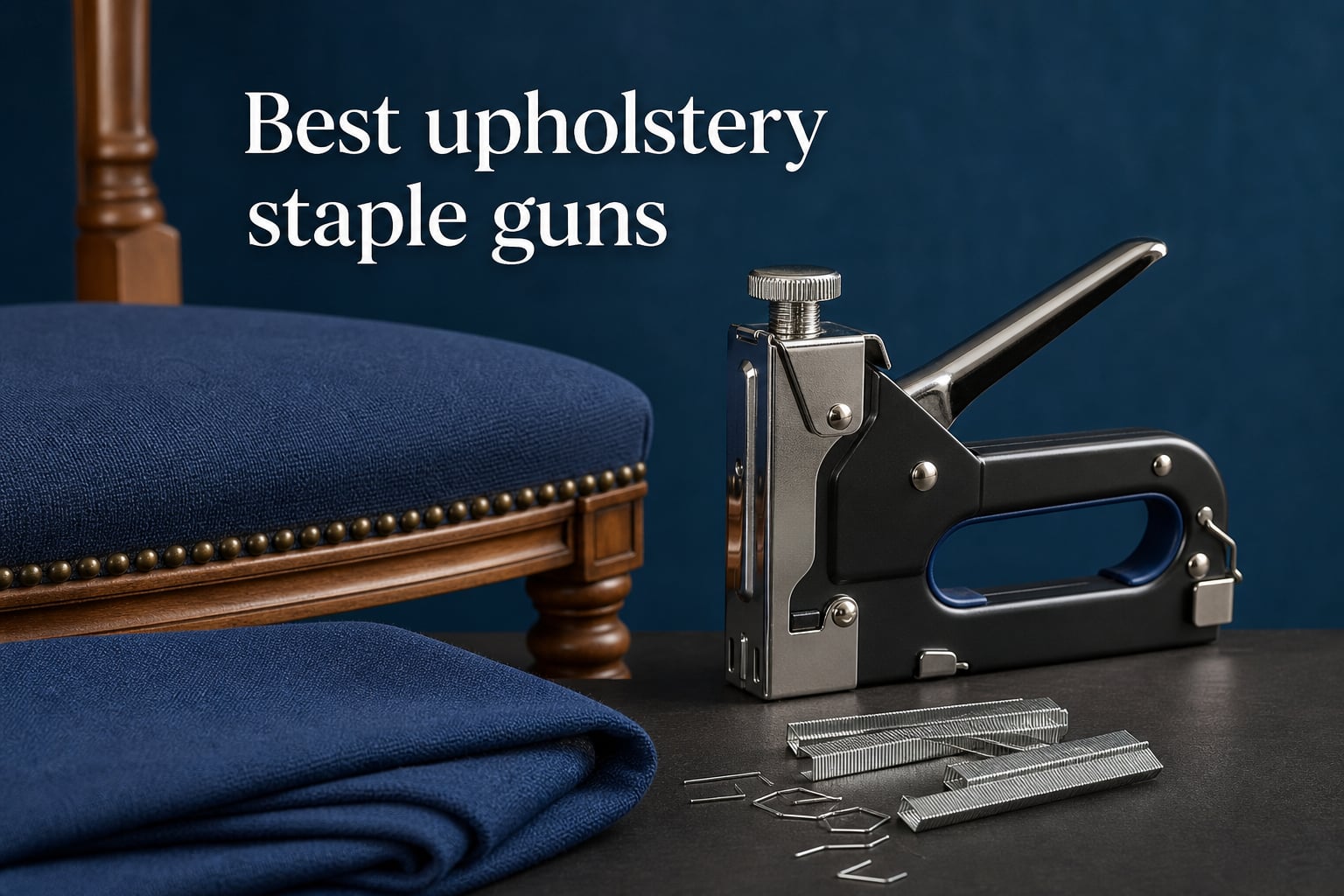
The best upholstery staple guns match the staple family, the wood in the frame, and the amount of work ahead. A fine-wire pneumatic upholstery stapler is the practical answer for frequent furniture or automotive trim work, while a corded electric, cordless, or manual model can make more sense for a small repair.
We compared the eight products in this guide against their published staple compatibility, power format, weight, convenience features, customer rating, and review volume. The list deliberately covers 71-series fine-wire staplers as well as T50 tools, because those are different staple systems rather than interchangeable names.
For a door panel, seat cover, or headliner project, start with our guide to pneumatic upholstery staple guns for auto trim. If your workspace also handles film work, the right window tint squeegees for professional film installation make the finishing side of the job much easier.
The top 3 upholstery staple guns cover professional, cordless, and first-project needs 2026
The BeA earns our Editor’s Choice because it is a dedicated 22-gauge, 71-series upholstery tool. Milwaukee is the flexible cordless pick for an existing M12 user, while the classic Arrow T50 is the straightforward manual option for an occasional repair.

The best upholstery staple gun overview shows each tool’s staple system first.
Compatibility is the fast way to narrow this list. Choose a 71-series stapler when fine-wire upholstery staples are the requirement, and choose a T50 model only when the project and staple supply call for T50 staples.
| Product | Specs | Action |
|---|---|---|
 BeA 71/16-401 BeA 71/16-401 |
|
View Product |
| Milwaukee M12 2447-20 |
|
View Product |
 3PLUS H7116SP 3PLUS H7116SP |
|
View Product |
 meite MT7116 meite MT7116 |
|
View Product |
 Arrow T50 Arrow T50 |
|
View Product |
 Arrow T50ACD Electric Arrow T50ACD Electric |
|
View Product |
 Arrow T50DCD Cordless Arrow T50DCD Cordless |
|
View Product |
 populo BCSG-4 populo BCSG-4 |
|
View Product |
The BeA 71/16-401 is the dedicated fine-wire choice for professional upholstery.
BeA 71/16-401 Fine Wire 22-Gauge Stapler for 71 Series or Senco C Style Staples with 3/8-Inch Crown and 1/4-Inch to 5/8-Inch Leg Length
22 gauge
71 series
3/8 inch crown
Pros
- Fine-wire 22 gauge
- 71-series compatibility
- Made in Germany
- Full-strip capacity
Cons
- Manual operation
- Specialty staple system
The BeA 71/16-401 begins with the specification that matters most in upholstery: it accepts 22-gauge, 71-series staples with a 3/8-inch crown. Its listed leg-length range runs from 1/4 inch to 5/8 inch, giving a restorer useful choices for fabric, backing, and wood-frame work.
Its 4.8 rating comes from 31 analyzed reviews, with 88% recorded as five-star reviews. That is a much smaller review pool than the mass-market tools here, but it aligns with the professional forum sentiment that names BeA as an industry-standard upholstery brand.
I would put this tool at the top of a serious upholstery shortlist when the project calls for fine wire staples rather than T50 fasteners. Thin 22-gauge wire makes more visual sense around fabric edges because it is intended for upholstery work, not general-purpose fastening.
The product data lists a full-strip capacity and German manufacture. Those facts speak to a purpose-built tool, although the supplied data labels its operation mode as manual, so buyers should verify the exact operating configuration they need before ordering.
The BeA suits repeat furniture work that needs 71-series fine wire.
This is the right direction for a shop repairing dining chairs, sofa panels, cushions, or trim where a consistent 3/8-inch crown is already the standard. It also fits technicians who want to stock one 71-series staple family rather than mixing it with T50 supplies.
Forum conversations repeatedly favor pneumatic tools for sustained professional work, and a BeA product sits naturally in that discussion. Match staple leg length to the combined fabric and frame depth, then make a few test drives on scrap hardwood before touching finished material.
The BeA is less suitable when T50 staples or casual convenience are the priority.
Do not buy a 71-series stapler assuming it will accept T50 staples; the crown and staple family differ. A beginner with a box of T50 staples already on hand will have an easier path with one of the Arrow tools below.
The limited review count also means there is less crowd-sourced feedback than on the Arrow or Milwaukee options. For one light household repair, a simpler electric or manual tool may be a more comfortable entry point.
The Milwaukee M12 2447-20 is the cordless pick for 3/8-inch flat-crown work.
Milwaukee 2447-20 M12 3/8†Crown Stapler
M12 cordless
3/8 inch crown
1/4 to 9/16 inch
Pros
- Cordless M12 system
- Compact 3 pound body
- 1500 staples per charge
- Two trigger modes
Cons
- Battery sold separately
- Flat-crown compatibility only
The Milwaukee M12 2447-20 accepts 3/8-inch flat-crown staples from 1/4 inch through 9/16 inch. That specification gives it a defined role: it is a cordless flat-crown stapler, not a 71-series fine-wire upholstery stapler.
At 7.25 inches long and 3 pounds, it is compact enough for repeated repositioning around a seat frame. The analyzed listing claims up to 1,500 staples per charge on an M12 battery and offers sequential plus contact actuation.
I like the practical freedom of a battery powered staple gun when a chair, vehicle, or boat cushion cannot stay near an outlet. There is no air hose tugging across the floor and no compressor cycling in a home garage, which changes the rhythm of small jobs.
The 4.7 rating is supported by 2.6k+ reviews, the broadest high-rating signal among the more powerful tools in this roundup. Remember that the tool-only listing does not include the battery or charger, so existing M12 ownership matters.
The Milwaukee works best for mobile jobs using its flat-crown staple range.
Choose it for mobile repair work, cabinet backing, or upholstery tasks that specifically use 3/8-inch flat-crown staples. Contact actuation can speed repetitive fastening, while sequential firing gives more placement control near an exposed fabric edge.
For auto-trim work, cordless reach is useful when you are moving around a vehicle interior. Keep a charged battery available and check that your preferred staples are flat crown and within the stated 1/4- to 9/16-inch range.
The Milwaukee is not the answer for 71-series fine-wire staples.
A tool’s crown type is not a minor detail. The Milwaukee’s flat-crown format does not make it a substitute for a 22-gauge 71-series model where fine wire and a specific crown profile are required.
Its 3-pound weight is manageable but more than a simple hand tacker. If you only need to secure a dust cover or recover one small chair, the Arrow T50 can be less complicated to store and operate.
The 3PLUS H7116SP gives DIY upholstery a lightweight pneumatic 71-series option.
3PLUS H7116SP 22 Gauge 3/8-Inch Crown Pneumatic Upholstery Stapler for 71 Series Staples, 1/4-Inch to 5/8-Inch
Pneumatic 22 gauge
71 series
1/4 to 5/8 inch
Pros
- Lightweight body
- 360 degree exhaust
- Quick-clear jam release
- Comfort grip
Cons
- Compressor required
- Does not take T50 staples
The 3PLUS H7116SP is a pneumatic upholstery stapler that takes 22-gauge, 3/8-inch crown, 71-series staples from 1/4 inch to 5/8 inch. That makes its staple specification closely aligned with dedicated furniture fabric work.
Its published features address two everyday workshop frustrations: a 360-degree adjustable exhaust and a quick-clear jam release. At 0.94 kilograms, it is also light enough to matter during a long run of staples around a chair seat.
A pneumatic staple gun changes the effort required per fastener because compressed air supplies the driving force. That is why upholsterers discussing larger projects often point people away from manual staplers when hand fatigue and dense hardwood frames become part of the job.
The listing’s 4.6 rating is based on 824 reviews, which is a meaningful body of feedback for a specialized format. It requires an air compressor that is not included, and it will not accept T50 staples.
The 3PLUS makes sense for repeated 71-series furniture repairs with an air supply.
It is a strong fit for someone who already has a compressor and wants an accessible route into fine-wire upholstery staples. The quick-clear feature is particularly useful when a project pauses because a staple fails to feed correctly.
Point the adjustable exhaust away from your face and loose fabric before beginning. On a finished wooden frame, use practice material to settle on a pressure setting that seats staples flush without crushing the surface.
The 3PLUS demands compressor space and the correct staple inventory.
The compressor, hose, and tool make more noise and take more setup time than an electric staple gun. That tradeoff is reasonable for batches of chairs but can feel excessive for a single dust cover or craft project.
Buy 71-series staples in the proper leg length and keep their boxes distinct from T50 staples. Cheap or mismatched staples are a recurring forum complaint because they can contribute to feed issues and incomplete driving.
The meite MT7116 combines a light body with a 71-series pneumatic format.
meite MT7116 Pneumatic Staple Gun, 22 Gauge 71 Series 3/8-Inch Crown 1/4-Inch to 5/8-Inch Length Air Upholstery Stapler Gun
2.07 pound pneumatic
22 gauge
71 series
Pros
- Light 2.07 pound body
- Rubber grip
- Durable driver set
- 71-series range
Cons
- Compressor required
- Staples not included
The meite MT7116 is another dedicated pneumatic tool for 22-gauge, 71-series staples with a 3/8-inch crown. It supports legs from 1/4 inch to 5/8 inch, which covers common upholstery fastening depths.
Its published weight is 2.07 pounds, and the rubber grip is intended to reduce vibration. The product description also calls out a durable driver set and bumper, parts that take repeated impact during normal stapling.
When I compare close pneumatic options, weight and grip are not side notes. A difference felt in the wrist after dozens of staples can decide whether fabric stays tensioned and your staple line remains controlled around curves and corners.
The meite has a 4.6 rating from 412 reviews, with 82% of those reviews recorded as five-star. It brings the same compressor and staple-selection responsibilities as the 3PLUS, but its low listed weight is a notable advantage.
The meite is a practical fit for upholstery sessions where wrist comfort matters.
Consider this model for dining chairs, ottomans, furniture restoration, and other tasks where you will repeatedly lift and turn the tool. The rubber grip and lightweight construction make the specification particularly appealing for longer sessions.
It also works for automotive trim where the frame and work position require frequent changes. Keep the hose routed behind you so it does not drag across clean fabric or catch on an interior panel.
The meite is a poor fit for a compressor-free setup or T50-only supplies.
This is not a plug-in or battery option, so a compressor and air hose are part of the purchase decision. In a shared apartment, quiet late-night workspace, or tiny closet workshop, that system may not be convenient.
The listing does not include staples, which leaves the buyer responsible for choosing the right 71-series length. Start shorter when possible and test; an overlong leg can break through a thin wood edge or create a rough back side.
The Arrow T50 remains the simple manual staple gun for occasional upholstery.
Arrow T50 Heavy-Duty Staple Gun, Manual Stapler
Manual T50
1/4 to 9/16 inch
chromed steel
Pros
- High-leverage handle
- Jam-resistant magazine
- Staple-view window
- Steel construction
Cons
- Hand force required
- Limited 90 day warranty
The Arrow T50 is the recognizable manual staple gun in this lineup, built around T50 staples from 1/4 inch through 9/16 inch. Its high-leverage handle, rear-load magazine, staple-viewing window, and chromed-steel construction explain why it remains a common household tool.
It has a 4.5 rating from 5.1k+ reviews, the largest review base of any product here. That scale makes it a useful baseline for an occasional user who wants a simple heavy duty stapler without batteries, cords, or an air compressor.
For a small repair, I appreciate that a manual tool is ready as soon as it is loaded. There is no charging cycle and no compressor noise, which can make the first attempt at a dining-chair seat feel much less intimidating.
Manual operation has a real limit: repeated squeezing can fatigue hands, especially when staples meet a dense hardwood frame. Forum discussions call out exactly this problem, so it is better to view the T50 as a light-to-moderate workload tool rather than a production stapler.
The Arrow T50 is best for a one-chair repair, dust cover, or light project.
Use it when a project takes a modest number of T50 staples and you value uncomplicated setup. The staple-viewing window helps prevent the annoying surprise of running empty halfway along a fabric edge.
It can also be useful for craft work, light woodworking, and cabinet backing when the staple format fits. Press the nose firmly against the work and stabilize the frame to give the staple the best chance of seating evenly.
The Arrow T50 is not the best choice for dense frames or high-volume upholstery.
Manual effort is the important drawback, not a cosmetic one. If your hands tire or staples stop short in hardwood, moving to a pneumatic or electric option is the safer route to consistent placement.
Its T50 compatibility also separates it from 71-series upholstery staplers. Check the project requirements before buying staples; T50 staples may work for a task, but they are not automatically the correct substitute for fine wire.
The Arrow T50ACD Electric gives beginners corded consistency with T50 staples included.
Arrow Electric Staple Gun Kit with 3750 Pieces T50 Staples, T50ACD
Corded electric
60 staples per minute
T50 kit
Pros
- T50 staples included
- 8 foot cord
- Contact safety
- Bottom-load magazine
Cons
- Needs an outlet
- Must be pressed firmly
The Arrow T50ACD Electric is a corded T50 staple gun kit with 3,750 staples in 1/4-, 3/8-, and 1/2-inch sizes. It uses a bottom-loading magazine, a contact safety mechanism, and a listed firing rate of 60 staples per minute.
Its 8-foot power cord offers more reach than a short bench-top cord and removes battery management from the day. The 4.5 rating is based on 1.1k+ reviews, and the included staple assortment lowers the barrier to making initial test drives.
This is my default direction for a beginner who has an outlet near the workbench and wants less hand effort than a manual staple gun. A corded electric tool can maintain a steadier pace without asking the user to buy into a compressor platform.
It still requires careful nose contact. The supplied product notes say it must be pressed firmly to work, which is a normal safety-and-placement habit but can feel different from a hand tacker.
The Arrow T50ACD is a strong starting point for controlled indoor upholstery repairs.
The included T50 selection lets a first-time user test a few lengths on scrap material before committing to a chair frame. That is valuable because staple length depends on fabric thickness, padding, and the wood beneath it.
Use the corded format for a workbench, dining-room repair, or a garage project within reach of power. It is also less noisy and less involved to set up than a compressor-driven stapler, though the firing sound still calls for hearing awareness.
The Arrow T50ACD is less convenient for vehicle interiors and outlet-free work.
An 8-foot cord is helpful, yet it is still a cord. Working around a car, boat, or large sofa may call for an extension arrangement or a cordless tool instead.
The T50 system is its other boundary. If the upholstery task specifies 71-series fine-wire staples, choose the 3PLUS, meite, or BeA family rather than forcing a general T50 solution.
The Arrow T50DCD Cordless brings T50 convenience to portable upholstery work.
Arrow Cordless Staple Gun Kit with 3750 Pieces T50 Staples, T50DCD
Cordless T50
500 shots per charge
60 per minute
Pros
- No cord
- 500 shots per charge
- T50 staples included
- Contact safety
Cons
- Battery needs charging
- Use supplied charger only
The Arrow T50DCD is a cordless electric T50 staple gun that includes 3,750 staples across 1/4-, 3/8-, and 1/2-inch lengths. The listing states up to 500 shots per charge, a 60-staple-per-minute firing rate, and a contact safety feature.
It weighs 1.88 kilograms according to the product data. That is more than a basic hand tacker, but cordless movement can be worth the extra body weight when working around furniture or inside a vehicle.
I would choose the T50DCD over the corded T50ACD when freedom from the outlet matters more than unlimited runtime. It keeps the approachable T50 staple format while removing the cable that can snag on upholstery, tools, and corners.
The 4.5 rating comes from 683 reviews, with 80% recorded as five-star. Charging is the key planning point: the listing says to use the provided charger and not one over 5V.
The Arrow T50DCD serves mobile T50 jobs that need easy repositioning.
This tool fits a person moving from chair to chair, working on a loose cushion, or reaching across a large furniture piece. It is also a reasonable portable option for automotive trim if the staple type and leg length fit the panel construction.
Pack the charger and check battery status before beginning a long run. The stated 500 shots per charge can be plenty for smaller repairs, but a large sofa project calls for a planned recharge break.
The Arrow T50DCD is not the right tool for a nonstop shop schedule or 71-series work.
A battery has a finite work cycle, while a corded electric or pneumatic setup can continue as long as power or air is available. For production furniture work, that distinction can outweigh the convenience of no cord.
It also remains a T50 tool, not a fine-wire 71-series model. Do not let the cordless format distract from staple compatibility, because the staple family determines the job it can do cleanly.
The populo BCSG-4 is the compact USB-C option for light staples and brad nails.
Bielmeier 2-in-1 Cordless T50 Staple Gun & Brad Nailer, 4V Battery Powered
4V USB-C cordless
2-in-1
850 shots per charge
Pros
- Stapler and brad nailer
- USB-C charging
- Light 1.6 pound body
- Three safety features
Cons
- Not for heavy-duty frames
- Durability concerns in reviews
The populo BCSG-4, sold under the Bielmeier listing title, is a 4V cordless 2-in-1 tool that drives staples and brad nails. It weighs 1.6 pounds, uses USB-C charging, and is listed for up to 850 staples per charge at 50 shots per minute.
Its included fastener count is 1,200 T50 staples and 400 nails, so it offers a broad starter assortment. The 4.3 rating is based on 4k+ reviews, though the analyzed review data also records 10% one-star ratings and flags durability concerns.
This is the best battery powered staple gun in the group for a very light project where a compact, rechargeable tool is more useful than high driving force. The brad-nailer function can also help with small wood details that an upholstery-only stapler cannot address.
I would not treat the 2-in-1 label as proof that it replaces a professional upholstery stapler. Its light design is a benefit for handling, yet it may not provide the right performance for dense hardwood frames or a full upholstery workload.
The populo BCSG-4 fits light household fastening and mixed staple-and-nail tasks.
Use it for light fabric attachment, crafts, thin wood projects, and repairs where brad nails are also useful. USB-C charging is particularly convenient for a homeowner who already has a simple charging setup instead of a dedicated tool battery platform.
Its three listed safety features and compact weight are approachable for new users. Still, wear eye protection, keep fingers away from the nose, and test on scrap material before working near visible fabric.
The populo BCSG-4 is not built around high-volume upholstery or dense hardwood.
The product data directly warns that the lightweight design may not suit heavy-duty work. If staples need to seat flush through thicker material into a hardwood chair frame, choose a pneumatic 71-series model or a more substantial cordless tool.
The one-star share in the analyzed reviews deserves attention as well. For a dependable professional setup, it is wiser to choose a tool whose format and build are focused on upholstery rather than broad DIY versatility.
The right buying guide begins with power type and staple family.
An upholstery staple gun is a fastening tool that drives thin staples through fabric and padding into a furniture frame. A regular staple gun can work for light jobs, but an upholstery-focused tool is designed around the fine-wire or crown staple format, drive control, and repeated fastening that fabric work requires.
The best power type depends on the number of staples and workspace limits.
A pneumatic staple gun is the choice for repeated fastening and dense frames because compressed air supplies the driving force. It needs a compressor and hose, and the compressor introduces noise, but it reduces the repeated squeeze force that makes manual tools tiring.
A corded electric stapler is a sensible middle ground for indoor repairs near an outlet. A cordless model is easier to carry around a vehicle, boat, or large sofa, but its battery capacity sets the work interval.
A manual staple gun is quiet, simple, and useful for limited work. It is not automatically weaker in every case, yet hand fatigue and incomplete drives become more likely as frame density and staple count rise.
The correct staple family is more important than a familiar tool name.
T50 staples belong with the Arrow T50, T50ACD, and T50DCD products in this list. They are available in multiple leg lengths and suit many household fastening jobs, but they are not the same as the 71-series staples used by the BeA, 3PLUS, and meite.
The 71-series tools here use 22-gauge, 3/8-inch crown staples with legs from 1/4 inch to 5/8 inch. Fine wire is often preferred in upholstery because it is intended to secure fabric with a less conspicuous fastening profile.
Use a short test strip before choosing a final length. A staple should pass through the material and bite into the wood without punching through an edge, showing on a visible surface, or leaving a proud crown that catches fabric.
The right staple length follows the material stack and frame depth.
For thin fabric and a sound wood frame, begin with the shortest length that gives reliable holding power. Add length only when the fabric, padding, or backing material needs it, because longer staples demand more driving force and create more risk near frame edges.
Common 1/4-inch, 3/8-inch, 1/2-inch, and 9/16-inch sizes are not universal instructions. Different woods, layers, and upholstery methods change the answer, so a test drive is more useful than copying a staple length from another project.
Seat each staple flush rather than burying it deep enough to cut fabric. If staples sit proud, first check the staple format, leg length, and tool pressure or power before blaming the gun.
The best buying decision accounts for fatigue, jams, and access.
Weight, grip shape, cord path, hose path, and nose placement affect the real work. A 2-pound pneumatic tool may be easier over a full chair than a manual tool, while a cordless model may be easier than either one in a vehicle interior.
Jams are best handled before they happen: use staples made for the listed tool, load them squarely, and avoid mixing partial strips from different staple families. A quick-clear mechanism, such as the one specified on the 3PLUS, is a helpful recovery feature rather than a substitute for compatible staples.
For a vehicle restoration, plan the whole tool set instead of treating the stapler as the only piece. Our guides to window tint application kits, vinyl wrap tool kits for professional results, and heat guns for window tinting and upholstery can help organize the adjacent finishing work.
The most common upholstery staple gun questions have simple compatibility answers.
What is the best staple gun to use for upholstery?
The best staple gun for upholstery depends on the staple system and workload. The BeA 71/16-401 is the dedicated fine-wire choice in this guide, while the 3PLUS and meite offer pneumatic 71-series options. For occasional T50 work, the Arrow T50 or its electric versions are simpler choices.
Is there a difference between a staple gun and an upholstery staple gun?
Yes. An upholstery staple gun is intended to secure fabric and padding to furniture frames with the correct staple profile and consistent driving depth. A general staple gun may use a different staple family or lack the power and control needed for repeated furniture work.
What T50 staples are best for upholstery?
Use T50 staples only in a tool specified for T50 fasteners, then choose the shortest leg that holds the fabric and backing securely in the frame. Test 1/4-inch, 3/8-inch, or longer staples on scrap material first. T50 staples do not replace 71-series fine-wire staples.
What staple size should I use for upholstery?
Choose staple length based on fabric thickness, padding, and the wood frame. Start with the shortest compatible staple that holds reliably, then test it. The products here accept ranges from 1/4 inch to 5/8 inch or, for some T50 tools, up to 9/16 inch.
Do I need a pneumatic staple gun for upholstery?
No. A manual, corded electric, or cordless staple gun can handle light repairs when its staple family matches the job. Pneumatic tools are the better fit for repeated work, dense frames, and users who want to reduce hand fatigue, provided they have a compressor.
The best final pick is the tool that matches your staples before your project starts.
For fine-wire furniture work, the BeA 71/16-401 is our leading recommendation because its 22-gauge, 71-series format is directly focused on upholstery. The 3PLUS H7116SP and meite MT7116 give compressor owners two lighter pneumatic paths in the same staple family.
For T50 staples, choose the Arrow T50 for occasional hand-powered work, the T50ACD for a corded setup, or the T50DCD when a cord would be in the way. Milwaukee makes sense for cordless 3/8-inch flat-crown work, while the populo BCSG-4 is best reserved for light mixed DIY tasks.
Check staple compatibility, make a few test drives, and then choose among these upholstery staple guns with the frame and workload in mind. That approach gives you a cleaner staple line and a better chance of finishing the job without fighting jams, fatigue, or mismatched fasteners in 2026.