
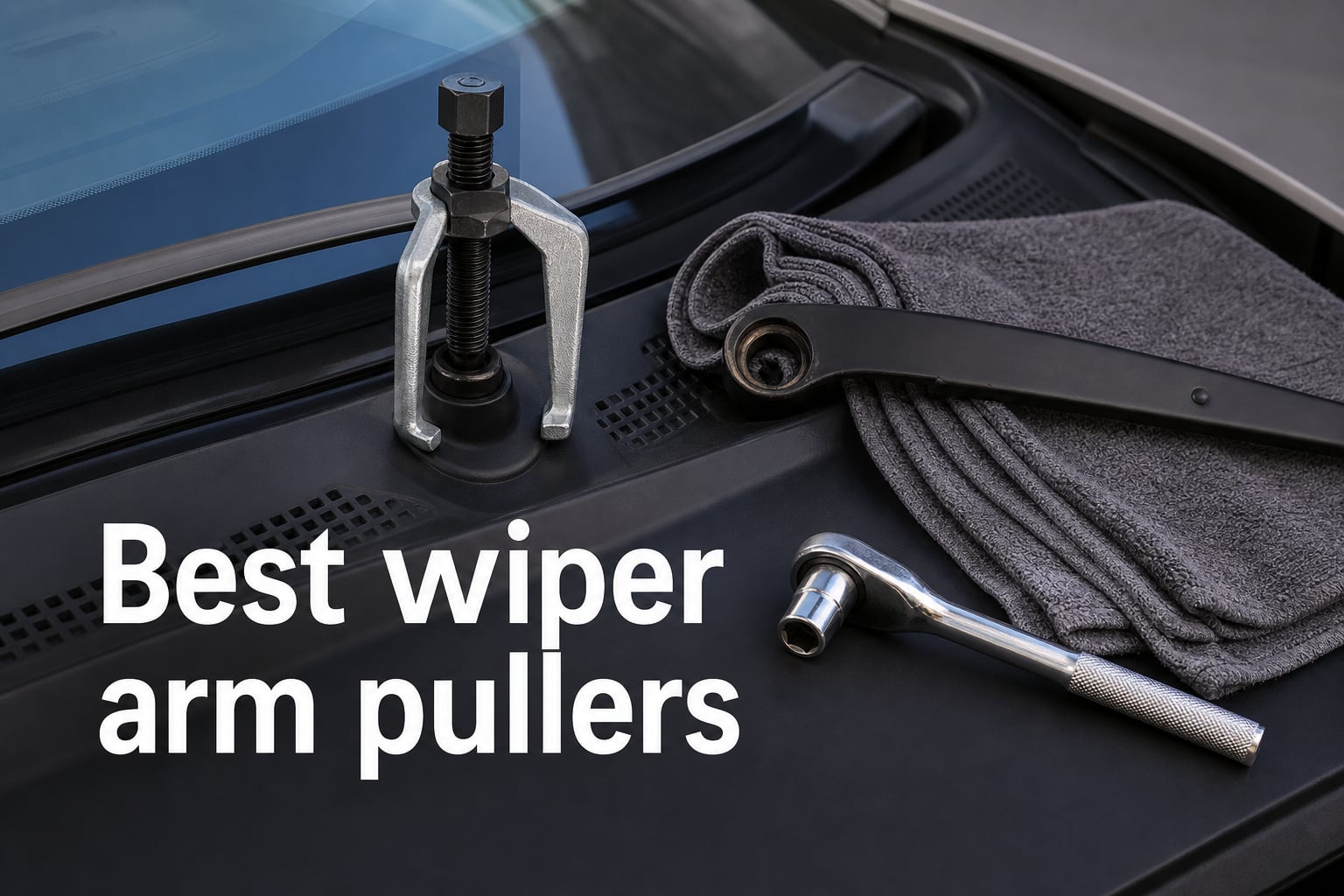
Wiper arm pullers are the small specialty tools that turn a stuck windshield wiper arm from a risky prying job into a controlled removal. When the retaining nut is off but the arm remains locked onto its tapered, splined shaft, a puller applies force at the hub instead of against the glass, cowl, or paint.
I compared eight wiper arm pullers using the manufacturers’ stated jaw sizes, materials, vehicle claims, and buyer feedback. The short version is simple: match the tool to the space beneath your arm and the diameter at its mounting point before you buy; the strongest-looking puller is no help if its claws cannot sit correctly.
For a typical wiper blade replacement, you may never need a tool. For corrosion-bound or stubborn wiper arms, though, a proper windshield wiper arm removal tool can prevent bent arm springs, scratched paint, and the far worse mistake of levering near the windshield.
The top 3 picks answer the most common wiper-arm jobs 2026
The GLEXQLAO is the fitment-led choice for the listed BMW generations, the HNeekyr is the practical dual-purpose pick, and the larger Stacool kit has the widest stated jaw range of the universal single pullers here. Check the mounting geometry on your vehicle before treating any one of these as universal.


The best wiper arm pullers in 2026 cover eight different fitment needs
This overview is a fast way to narrow the field. The product cards below matter more than a broad compatibility claim, because jaw opening, collar clearance, and the shape of the arm hub decide whether a puller can do its job without slipping.
| Product | Specs | Action |
|---|---|---|
| GLEXQLAO BMW Wiper Arm Puller |
|
Check Latest Price |
 HNeekyr Wiper and Battery Puller HNeekyr Wiper and Battery Puller |
|
Check Latest Price |
 KZINO Heavy-Duty Puller Kit KZINO Heavy-Duty Puller Kit |
|
Check Latest Price |
| Stacool Universal Puller Kit |
|
Check Latest Price |
 Stacool Adjustable Knob Puller Stacool Adjustable Knob Puller |
|
Check Latest Price |
 XINDELL Wiper Arm Puller XINDELL Wiper Arm Puller |
|
Check Latest Price |
 zipelo Adjustable Puller zipelo Adjustable Puller |
|
Check Latest Price |
 DUOYI 6-Piece Puller Set DUOYI 6-Piece Puller Set |
|
Check Latest Price |
1. GLEXQLAO is the best wiper arm puller for the listed BMW models
GLEXQLAO Car Windshield Wiper Arm Puller (Adjustable Claw Opening 15‑36mm)
15-36 mm claws
39 mm depth
Forged steel
Pros
- Broad listed BMW coverage
- 15-36 mm claw opening
- 39 mm pulling depth
- Forged steel
Cons
- BMW-focused fitment
- Manual force needed
The GLEXQLAO earns the lead spot because it provides measurements that make pre-purchase checking possible: a 15–36 mm claw opening and up to 39 mm of pulling depth. That is more useful than a vague “fits most” claim when a wiper arm sits low against a BMW cowl.
Its stated fitment list runs through many BMW E-series models, including E12 through E67 and E85, plus PR1. A BMW owner with one of those listed applications has a more defensible starting point than they would with a generic automotive wiper removal tool.
The forged-steel construction is intended for toughness and rust resistance, while the puller’s purpose is to lift the arm off without damaging the hood or arm. Its 4.6 rating from 63 reviews is encouraging, although that is a much smaller feedback pool than the most widely reviewed universal choices.
I would not assume this is the right answer for a non-BMW solely because a tapered spline looks similar. Measure the opening beneath the arm, compare it with the stated range, and stop if the claws do not lie flat and centered.
The listed BMW fitment makes this puller a focused choice
This puller makes the most sense for BMW E-series owners replacing an arm, repairing a linkage, or doing cowl-area work where an arm must come off first. The 39 mm pulling depth is also worth checking against a recessed mounting point.
For a one-car toolbox, vehicle-specific information can matter more than a collection of extra adapters that may never touch your vehicle.
The limited universal claim means other vehicles need measurement first
Owners of trucks, SUVs, and cars outside the stated BMW list should lean toward a tool with explicitly stated broad vehicle coverage or a kit with multiple profiles. A puller that is too narrow can score the hub or ride up the arm.
Do not add force to make a near-fit work. Back the screw off, remove the tool, and reassess the clearance.
2. HNeekyr is the best dual-purpose tool for wiper arms and battery terminals
HNeekyr Battery Terminal and Wiper Arm Puller Windshield Wiper arm Removal Tool Wiper arm Puller Remove Tool
6-28 mm jaws
Heat-treated carbon steel
Dual-purpose
Pros
- Removes battery terminals and wiper arms
- Heat-treated carbon steel
- 6-28 mm stated range
- 12-month warranty
Cons
- Range will not fit every arm
- Technique matters at battery posts
The HNeekyr is the sensible all-around selection if your garage work includes both a wiper arm and a battery-terminal clamp. Its stated 6–28 mm jaw range targets tapered-spline wiper arms on various cars and light trucks, and the carbon-steel body receives a heat treatment for hardness and corrosion resistance.
That dual role matches a pattern from mechanic forums: a battery-terminal puller can work well on some wiper-arm hubs because its small jaws can get underneath tight spaces. Here, that is an advertised function rather than a tool being pressed into an unrelated task.
The maker describes a sequence of seating the base on the arm, tightening the cone, putting the claw under the clamp area, and tightening the screw against the shaft. Controlled screw pressure is the whole point; it avoids the sudden sideways load that happens when a screwdriver is used as a pry bar.
With a 4.5 rating from 173 reviews and a 12-month warranty, it has a solid evidence base for a compact dual-use tool. The important limit remains the 28 mm maximum opening, so wider hubs are not a match.
The compact jaw range suits many light-duty tapered-spline arms
This is a good fit for a DIY owner who wants one compact puller for common service tasks rather than a vehicle-specific tool. It is especially appealing when storage space is limited and battery-terminal work is also on the schedule.
Before using it at a battery, follow normal battery safety procedures and keep the screw aligned; battery posts are not a place for misalignment or brute force.
The 28 mm ceiling rules out arms that need a wider spread
If the base of your arm is wider than the stated opening, choose the Stacool universal kit with its 30 mm maximum claim or a larger, appropriate puller. Do not grab the thin arm section to compensate for insufficient hub clearance.
Also inspect whether the center screw can land squarely on the shaft end after the nut is removed.
3. KZINO is the best heavy-duty multi-function puller for conical splines
KZINO Windshiled Wiper Puller Tool, Heavy-Duty Arm Battery Terminal Bearing Remover Puller Kit, Windshield Wiper Arm Removal Tool, Arm Bearing Remover Puller Repair Tool
45 carbon steel
Conical spline use
15.2 mm collar
Pros
- Heat-treated 45 carbon steel
- Conical-spline focus
- Knurled cone control
- Works on terminals and bolts
Cons
- Reported small jaw capacity
- 15.2 mm collar may not fit
KZINO positions this kit for wiper arms, battery-terminal bearings, stuck terminals, and bolts on conical splines. Its heat-treated 45# carbon steel construction and knurled cone are the features that separate it from a bare-bones two-jaw puller.
For wiper work, the stated design puts a screw pad on top of the spline terminal while the puller engages below the arm. That layout can deliver straight, gradual force, provided the tool sits squarely and the puller pad is centered on the shaft.
The product details identify a collar size of about 15.2 mm and cite a 6–28 mm jaw range, though one feature entry prints the range inconsistently. I would treat the 6–28 mm measurement from the technical details as the practical reference and verify the actual hub before ordering.
The 4.4 rating from 271 reviews offers a larger feedback sample than several options on this list. Customer feedback also flags the same real-world issue that affects every small puller: a larger arm may exceed the jaws’ workable opening.
The conical-spline design supports controlled removal work
This is aimed at a person who sees several tapered-spline jobs, not just an occasional wiper blade replacement. The knurled cone can make setup easier where finger access is limited around the cowl.
It also offers broader shop usefulness than a dedicated BMW-style tool if its dimensions match the work at hand.
The collar and jaw dimensions must match the mounting hub
Measure the hub and look at the arm from the side before selecting this puller. A collar that cannot clear the arm’s shape, or jaws that cannot get fully under its base, creates a poor pulling angle.
For an unusually seized arm, add penetrating fluid according to its label and give it time, but rely on the puller’s mechanical force rather than fluid alone.
4. Stacool universal is the best wide-opening puller for cars, trucks, SUVs, and RVs
Stacool Windshield Wiper Arm Removal Tool Kit,Heavy Duty Wiper Arm Puller/Battery Terminal Puller,Universal Car Accessories Carbon Steel Small Bearing Puller for Most Car Truck SUV RV
6-30 mm opening
T-shaped handle
Carbon steel
Pros
- Wider 6-30 mm jaw range
- T-shaped handle and bearings
- Listed car truck SUV RV use
- Large review sample
Cons
- Some lower ratings reported
- Very seized arms need effort
The Stacool universal kit is the broad-application pick because it states a 6–30 mm jaw opening, which is wider than the 28 mm figures claimed by the compact dual-purpose tools. It is marketed for most cars, trucks, SUVs, and RVs with tapered-spline wiper arms, but “most” still calls for a fitment check.
Its T-shaped handle, linkage bearings, and ball bearings are designed to let the bolt adjust and spread force evenly. In practice, the useful benefit is controlled turning with the hooks seated under the arm hub, not rushing the screw once resistance begins.
The tool has the largest review sample here at 643 reviews and a 4.3 rating. That scale is useful context: it shows many buyers have tried the design, while the 8 percent one-star portion is a reminder that universal pullers can still miss a particular arm geometry.
For the best wiper arm pullers across a household with different vehicles, I would start here only after confirming the arm uses a removable tapered-spline arrangement. Rear wipers and some covered or retention-clip assemblies can require a different approach.
The 30 mm maximum opening gives this kit extra vehicle flexibility
The extra stated spread makes this Stacool the first choice in this group for a wider hub that still fits a compact puller. It is a strong candidate for owners working on several vehicle types rather than one specified make.
The 5.25 inch overall height and 4.1 inch bolt length are helpful figures to compare with clearance beneath the windshield and cowl.
The universal label does not replace a visual fitment check
Check that both hooks can sit under solid metal near the hub and that the center screw has a clean, centered contact point. If the tool bears on trim, plastic, or the thin arm, stop before turning the handle.
Never brace a hand tool against the windshield to gain leverage. That is the failure mode this tool is meant to avoid.
5. Stacool adjustable knob is the compact answer for its listed Jeep, Kia, and Acura fitments
Stacool Car Windshield Wiper Arm Removal Tool – Carbon Steel Wiper Arm Puller with Adjustable Knob for Quick Disassembly & Installation -Windshield Wipers Puller Tool Compatible with Acura/Honda
0.63 inch collar
Adjustable top bar
Carbon steel
Pros
- Adjustable top-bar knob
- Compact 3.8 oz body
- Listed Jeep Kia Acura vehicles
- Carbon steel construction
Cons
- Limited leverage on seized arms
- 0.63 inch collar needs checking
This compact Stacool version has a stated 0.63 inch collar and an adjustable top-bar knob for different wiper-arm heights. Its fitment list includes multiple Jeep models, Kia Optima and Soul applications, and Acura vehicles, so it is more focused than the brand’s 6–30 mm universal kit.
At 3.8 ounces with a 2.4-inch height, it is a small windshield wiper replacement tool meant to fit into tight work areas. The adjustment knob is valuable when the arm hub sits at a different height than the tool’s base, as long as the collar diameter is correct.
Carbon steel provides the stated wear resistance, while the simple layout keeps the operating sequence easy: position it at the arm base, set the top bar, and apply gradual screw pressure. The tool has a 4.3 rating from 121 reviews.
I would consider compactness its main advantage and leverage its tradeoff. A small puller is not automatically a poor tool, but it is less suited to an arm that has spent years corroding on the shaft.
The adjustable top bar helps match different arm heights
This model is well suited to the listed Jeep, Kia, and Acura applications when the collar measurement agrees with the vehicle. The adjustment lets the tool settle in a stable position before force is applied.
That can be preferable to shimming a non-adjustable puller, which often makes the tool tilt off center.
The small body is not the choice for a deeply seized arm
For a stubborn arm, inspect the hub, treat visible corrosion, and choose a bigger puller if the compact collar cannot make full contact. The arm should release from the hub, not flex along its length.
If you feel the tool cocking to one side, release tension and reposition it rather than continuing to tighten.
6. XINDELL is a straightforward two-function puller for tapered-spline arms
XINDELL Car Wiper Arm Removal Tool – Heavy-Duty Battery Terminal & Wiper Arm Puller for Windshield Repair and Automotive Maintenance
6-28 mm jaws
45 carbon steel
15.2 mm collar
Pros
- Dual-purpose puller
- 45 carbon steel construction
- 6-28 mm jaw claim
- Clear center-screw operation
Cons
- Limited jaw spread
- Some arm designs are difficult
The XINDELL follows the familiar battery-terminal and wiper-arm puller format, with stated jaws from 6–28 mm and an outer diameter of 48 mm. It is made from heat-treated 45# carbon steel and includes a separate wiper-arm remover with an approximately 15.2 mm collar.
The manufacturer’s instructions are refreshingly direct: fasten the tool foot securely to the arm, then tighten the center screw. That sounds basic, yet seating the foot on the correct part of the arm and keeping the screw square are the two steps that most protect the arm and glass.
It is described for bolted-on windshield wiper arms over tapered splines, not every wiper attachment system. The 4.2 rating from 69 reviews is adequate context, but this is a smaller feedback base and calls for a careful fitment-first purchase.
Its dual-use construction makes it a reasonable garage tool if your wiper mounting point fits the stated opening. I would not select it for a visibly oversized hub without confirming the actual jaw span.
The two-function design helps a small home garage
Owners who maintain their own battery connections and wiper arms may find this layout practical. One tool can handle two jobs that both benefit from straight, screw-driven pressure.
The separate arm remover adds another option around the hub, though it does not eliminate the need to inspect clearance.
The stated dimensions limit this tool to compatible hubs
The 6–28 mm jaw range and 15.2 mm collar figure are not minor details; they are the selection criteria. Compare them with the exposed shaft and the room below your arm before use.
On an arm with an unusual ball-and-socket or covered design, consult the vehicle’s service information rather than forcing a standard puller into place.
7. zipelo is the compact adjustable option for light vehicle maintenance
zipelo Car Windshield Wiper Arm Removal Tool, Carbon Steel Heavy Duty Vehicle Windscreen Wiper Puller with Adjustable Knob, Auto Blade Remover Accessories, Universal for SUV RV Truck
Compact body
Carbon steel hooks
Adjustment knob
Pros
- Compact 2.75 inch body
- Carbon steel construction
- Hook claws grip firmly
- Adjustment knob control
Cons
- Small for heavy shop use
- Limited stated dimensions
The zipelo is a compact carbon-steel puller with hook claws and a top adjustment knob. Its small 2.75 by 1.12 by 0.67 inch body is meant for cars, trucks, and SUVs, and the maker says the claws grip the arm without scratching or denting it.
The adjustment knob is the useful feature here because it lets you add pulling force in small increments. That is the right way to handle an arm that seems stuck: build straight tension gradually, inspect the setup, and stop if the claws start to move.
At 4.1 from 296 reviews, it has a meaningful amount of buyer feedback. The available product data does not provide a jaw-opening range, however, so I would not call it a universal solution for a particular vehicle without comparing the product shape to the arm hub.
For basic automotive wiper removal tool duty, the small body is easy to store alongside a socket set. It is a less convincing choice for repeated professional work or a wiper arm that has been seized for many years.
The adjustment knob supports patient, incremental pulling
This puller is best for a user who values a compact tool and can confirm it sits solidly beneath the arm. The knob gives a controlled way to load the joint rather than using abrupt impacts.
Keep the screw centered on the shaft so the force travels straight through the mounting hub.
The missing jaw-range figure makes visual verification especially important
Because a stated opening range is not provided in the available specifications, compare photos, dimensions, and your own clearance carefully. A generic cars-and-trucks claim is not a measurement.
Move to a model with confirmed dimensions if the hub is wide, deeply recessed, or surrounded by trim.
8. DUOYI is the best multi-piece kit for varied vehicle applications
DUOYI 6Pcs Wiper Arm Puller Doesn’t Damage The Wiper Arm Removal Tool Strong Structure Windshield Wiper Arm Removal Tool with Toolbox Battery Terminal Puller Compatible with VW/BMW/Ford/Honda/Porsche
Six-piece kit
Brass shaft cover
Storage toolbox
Pros
- Six-piece selection
- Brass-covered shaft end
- Listed multi-make compatibility
- Includes storage toolbox
Cons
- Fitment has newer-model limits
- More kit than one-car owners need
The DUOYI set is the different option in this roundup: it supplies six puller pieces in a blow-molded toolbox rather than asking one compact tool to cover every arm. That makes sense for someone maintaining several older vehicles or doing recurring automotive work across brands.
The stated compatibility list is extensive, covering examples from Audi, VW, Honda, BMW, Ford, Porsche, and certain Mercedes applications. It specifically references BMW 5 Series E39 and 7 Series E38 through the stated cutoff, among other vehicle claims, so check the listing against the exact vehicle rather than relying on make alone.
A brass cover at the main shaft end is intended to protect the contact point, and the product claims the tools will not damage glass, wipers, shafts, or paint when correctly used. The toolbox is not just an accessory; keeping the pieces organized makes it easier to select the profile that actually fits.
Its 4.1 rating from 60 reviews is the smallest evidence base among the general-purpose choices. Still, a multi-piece wiper arm puller kit can be the safer answer when a single fixed collar would be a guess.
The multiple puller profiles suit a mixed-vehicle tool collection
This is the sensible choice for a DIYer with several compatible vehicles or a technician who sees older European and domestic applications. The case also keeps specialty pieces from disappearing into a general tool drawer.
Select the smallest profile that fully supports the hub and lets the center screw remain square.
The vehicle list still requires exact application confirmation
Some newer vehicle models may fall outside the stated compatibility, and a make/model list cannot show every variation in arm design. Check the exact model, year, and arm mounting style before assuming an adapter will fit.
A kit expands options, but it does not justify forcing a puller around a covered, clip-retained, or non-spline arm.
The right buying guide starts with fitment and safe pulling force
A wiper arm puller works by hooking beneath the arm hub and pressing a center screw against the shaft, so the key purchase questions are jaw spread, pulling depth, collar diameter, and room around the cowl. Carbon steel and heat treatment are useful durability indicators, but they come after fit.
A dedicated vehicle-oriented tool, such as the GLEXQLAO for listed BMW applications, is the lower-guesswork route. A dual-purpose battery-terminal puller can be a good general tool when its 6–28 mm-style jaw range matches your arm, while a kit is the practical answer for varied applications.
The safest removal method uses slow, centered pressure
Lift the wiper arm away from the windshield if its design allows it, then note its parked position so it can go back in the same place.
Remove the protective cap, if present, and remove the retaining nut with the correct socket. Keep the nut where it cannot fall into the cowl.
Inspect the arm hub and shaft. Clear loose rust or debris, and apply an appropriate penetrating product to the joint if corrosion is present.
Place the puller claws under the solid base of the arm, not on thin stamped metal, plastic trim, or the windshield edge.
Center the forcing screw on the end of the shaft, then tighten it slowly. Recheck the tool’s alignment after each small turn.
Once the arm releases, back off the puller, lift the arm free, and reinstall it in the original parked position when the service is complete.
This sequence answers the common question of how to remove stubborn wiper arms: use controlled mechanical pressure and keep the puller centered. If the arm does not move and the tool begins to tilt, release tension and change the setup instead of increasing force.
The common mistakes are prying against glass and ignoring geometry
Forum discussions repeatedly warn about the same problem: the nut comes off, the arm refuses to budge, and a screwdriver or pry bar is used near the windshield. That can bend the arm or put a concentrated load on glass, so it is not a sensible substitute for a correctly fitting puller.
WD-40 or another penetrating fluid may help at a corroded joint, but it does not replace a puller. Let the product work, then use straight screw pressure; heat should be reserved for situations where the vehicle’s service guidance and nearby materials make it appropriate.
A battery-terminal puller can work, but only when its jaws fit
Battery-terminal pullers appear often in real owner discussions because their small jaws can reach under some wiper-arm hubs. That makes a dual-purpose tool like the HNeekyr, KZINO, or XINDELL useful when its stated range and shaft contact point line up with the vehicle.
It is not a universal workaround. If the jaws are too shallow, too narrow, or cannot sit beneath the hub without contacting trim, choose a dedicated arm puller or a kit with the correct profile.
The FAQ answers the most common wiper arm puller questions
How do you remove stubborn wiper arms?
Remove the retaining nut, clean visible corrosion, fit a puller beneath the solid arm hub, and center its forcing screw on the shaft. Tighten the screw slowly and keep the tool square. If it tilts or the claws slip, release tension and reposition it rather than prying against the windshield.
What tool is used to remove wiper arms?
A wiper arm puller, also called a windshield wiper arm removal tool, is made for this job. Its claws sit beneath the arm hub while a center screw presses on the shaft, separating a stuck arm with controlled force.
How do you remove a windshield wiper arm without a puller?
First remove the retaining nut and try rocking the arm gently at its hub while pulling upward. Apply penetrating fluid to corrosion if appropriate. Do not pry against glass or trim; if the arm remains stuck, stop and use a correctly fitting wiper arm puller to avoid damage.
Do you need a wiper arm puller?
You need a puller when the retaining nut is removed but the arm will not lift from its tapered, splined shaft with gentle hand pressure. A puller is also a safer choice whenever prying would risk the windshield, paint, cowl, or wiper arm.
The best wiper arm puller is the one that fits the hub without compromise
For confirmed BMW E-series fitment, the GLEXQLAO gives the clearest dimensional and application case. For a general home garage, the HNeekyr combines wiper and battery-terminal work, while the Stacool universal offers the broadest stated jaw opening among the compact universal options.
The best wiper arm pullers in 2026 are not selected by force alone. Measure first, center the puller, and let the screw do the work rather than putting a pry bar anywhere near the windshield.