
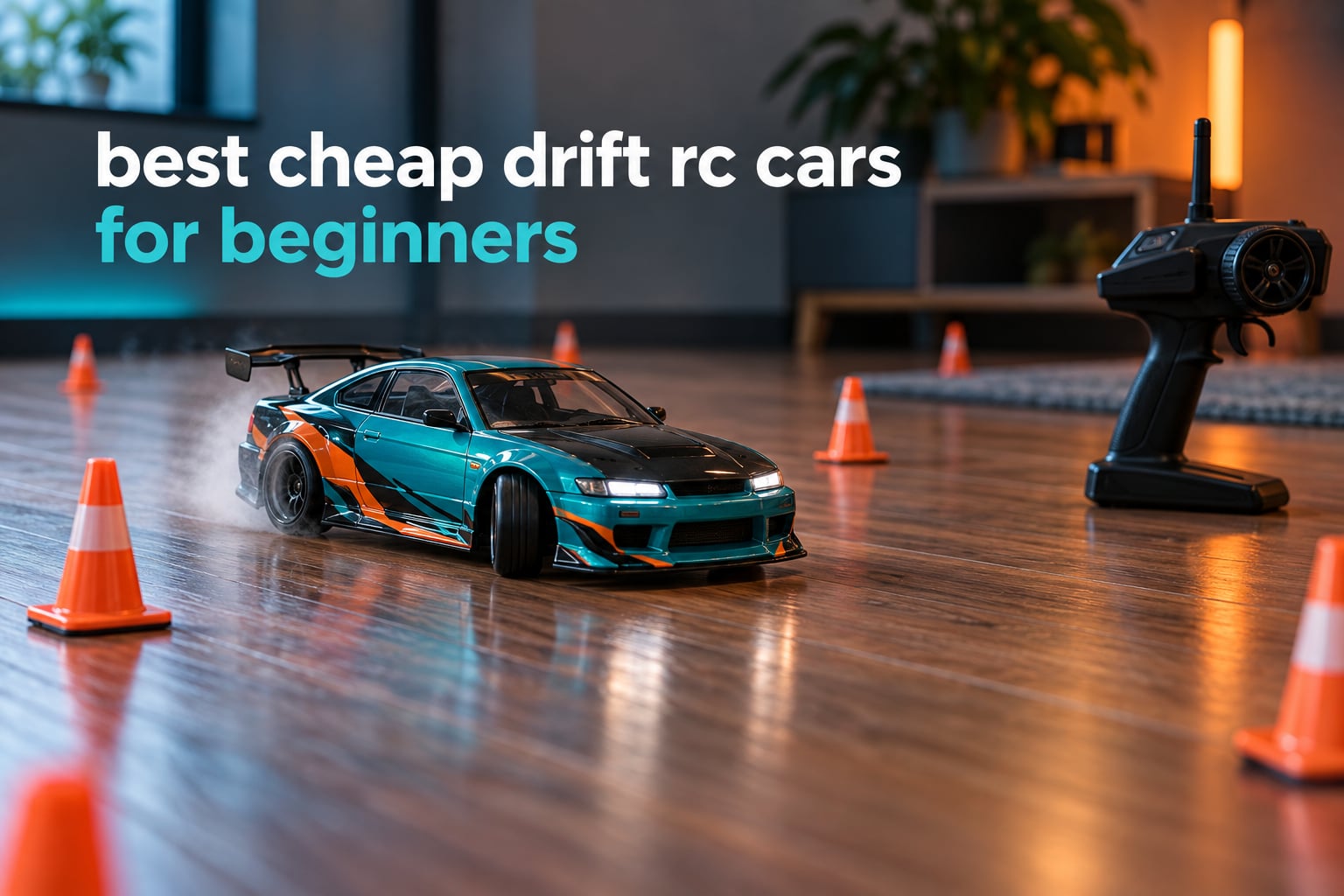
The cheapest car to drift is a ready-to-run 1/24 scale 4WD model with interchangeable hard drift tires, a proportional throttle and a 2.4GHz radio. Those toy-grade drifters slide predictably on smooth indoor floors for very little money, and they survive the learning curve that breaks more expensive cars. Everything above that tier buys you speed, runtime and durability instead of better drifting.
That is the honest version of this hobby. Drift RC has a reputation for being an expensive corner of the model car world, and it is, if you start at 1/10 scale. But the fastest way to learn throttle control and counter-steering is a small car on a smooth floor, not a hobby-grade platform on a proper track. Our team worked through eight of the most-reviewed cheap drift RC cars on the market, comparing published specifications against owner feedback to work out which ones actually help a complete beginner learn the basics.
What follows is our roundup of the best cheap drift RC cars for beginners in 2026, starting at the entry tier and climbing to one honest step-up pick. We cover scale, drivetrain layout, proportional versus on/off steering, runtime, tire sets and where each car is realistically usable. If you want the wider picture first, our budget RC drift car picks guide covers the entry tier in more detail.
Top 3 Picks for Cheap Drift RC Cars in 2026

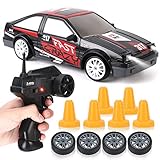
ACAMMZAR 1:24 4WD
- Full proportional throttle and steering
- Two selectable speed modes
- Two 3.7V 500mAh batteries
- About 50 minutes total runtime
Liberty Imports 1/24 4WD
- Lowest entry cost in the line-up
- Interchangeable slick drift tires
- Multi-car racing on 2.4GHz
- Runs on three AA batteries

Desdoni 1:24 4WD
- Interchangeable racing and drift tires
- Two batteries you can rotate
- Traffic cones for building a track
- 20 KM/H top speed
Best Cheap Drift RC Cars for Beginners in 2026 Compared
Every car below is ready to run out of the box and costs less than a hobby-grade 1/10 platform. Most of them carry two tire sets so you can move between gripping and sliding, and all eight run on 2.4GHz so several cars can be used by different drivers in the same room without interference.
| Product | Specs | Action |
|---|---|---|
| ACAMMZAR 1:24 4WD Drift Car |
|
Check Latest Price |
| Liberty Imports 1/24 4WD Drift Car |
|
Check Latest Price |
| Desdoni 1:24 4WD Drift Car |
|
Check Latest Price |
 HTURCCOP 1:24 4WD Drift Car HTURCCOP 1:24 4WD Drift Car |
|
Check Latest Price |
 KAIMIO 1:24 4WD Drift Car KAIMIO 1:24 4WD Drift Car |
|
Check Latest Price |
 Sakeye 1:16 4WD Drift Car Sakeye 1:16 4WD Drift Car |
|
Check Latest Price |
 FLYCOLOR Turbo Racing C64 1:76 FLYCOLOR Turbo Racing C64 1:76 |
|
Check Latest Price |
 DIKAVEY 1:12 Brushless Rally Car DIKAVEY 1:12 Brushless Rally Car |
|
Check Latest Price |
1. ACAMMZAR 1:24 4WD: The Car Most Beginners Should Buy First
ACAMMZAR RC Drift Car, 1:24 Remote Control Car for Kids, 20KM/H 4WD High Speed RC Cars with Lights, Extra Racing Tires, Vehicle for Adults Boys Girls
1:24 4WD at 20 KM/H
Full proportional throttle
Two selectable speed modes
About 50 minutes total runtime
Pros
- Full proportional throttle and steering make slides easy to modulate
- Two speed modes let a beginner start slow and build up
- Generous box contents with two batteries
- four spare tires
- a barricade and a screwdriver
- Survives stairs and jumps that break cheaper toy cars
- Swapping between drift and racing tires visibly changes handling
Cons
- Analog inputs feel insensitive at fine corrections
- Some users report intermittent connectivity that needs a quick power cycle
- Cosmetic trim such as mirrors and spoilers snaps off in hard crashes
This is the pick we would hand to someone who has never driven an RC car before. It runs 20 KM/H, it steers and throttles proportionally, and it comes with two speed modes you can select from the transmitter. For a first-time driver, that combination is what separates a car you learn on from a car you fight.
The box contents matter more than they usually do. You get two 3.7V 500mAh batteries, a USB charging cable, two AA batteries for the remote, four extra tires, a screwdriver and a head-to-head barricade accessory. Two batteries means roughly 50 minutes of runtime in total, which is enough to learn throttle modulation without stopping mid-session to wait for a charge.
Our experience with this tier is that proportional steering is the single feature that decides whether a beginner enjoys drifting. A toggle-style steering input only offers full lock or nothing, which makes a slide hard to catch. This car uses analog inputs throughout, so small thumb movements translate into small steering corrections.
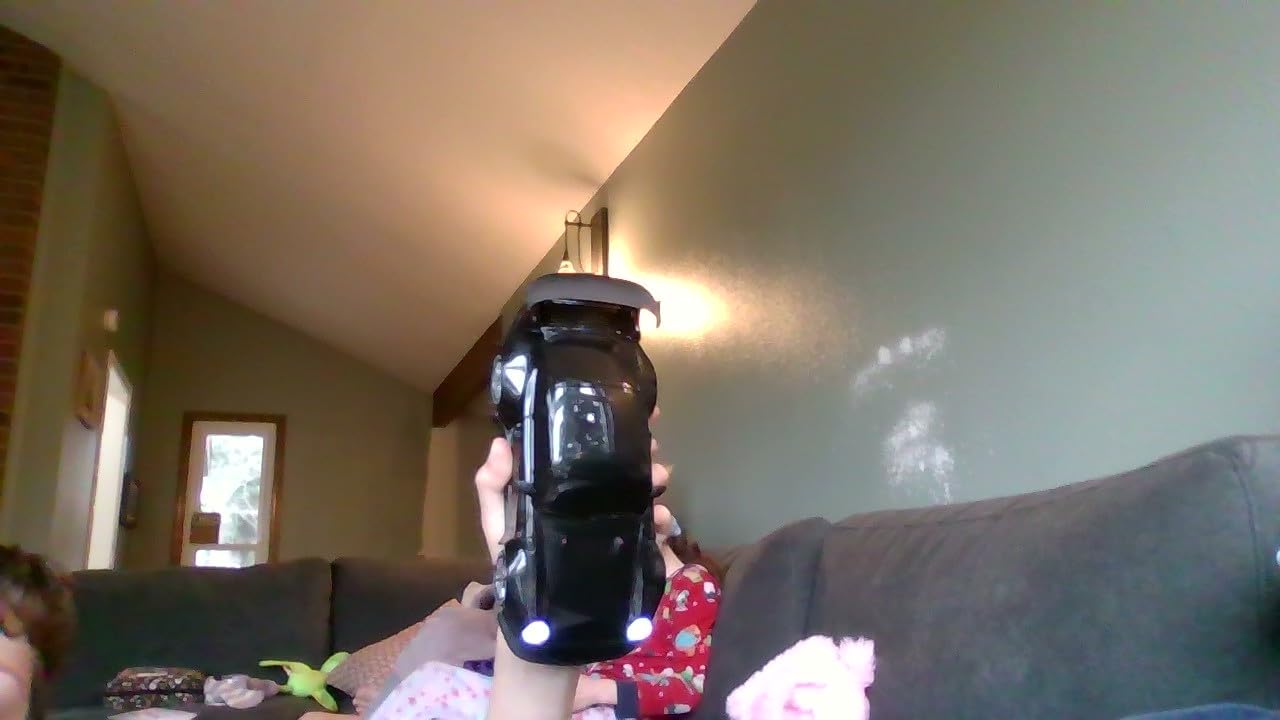
The tires matter as much as the electronics, and this car ships with both sets. Run it on the slick drift tires for sideways action on smooth boards or tile, and the grippy set for straighter running on rougher ground. Swapping between them takes a minute and is the cheapest possible way to understand how tires change a car’s balance.
It is rated 4.5 out of 5 across 1,332 owner reviews, which is the strongest combination of rating and review volume anywhere in this roundup. The recurring feedback is consistent: the proportional feel and the extra tire set are what people mention first.
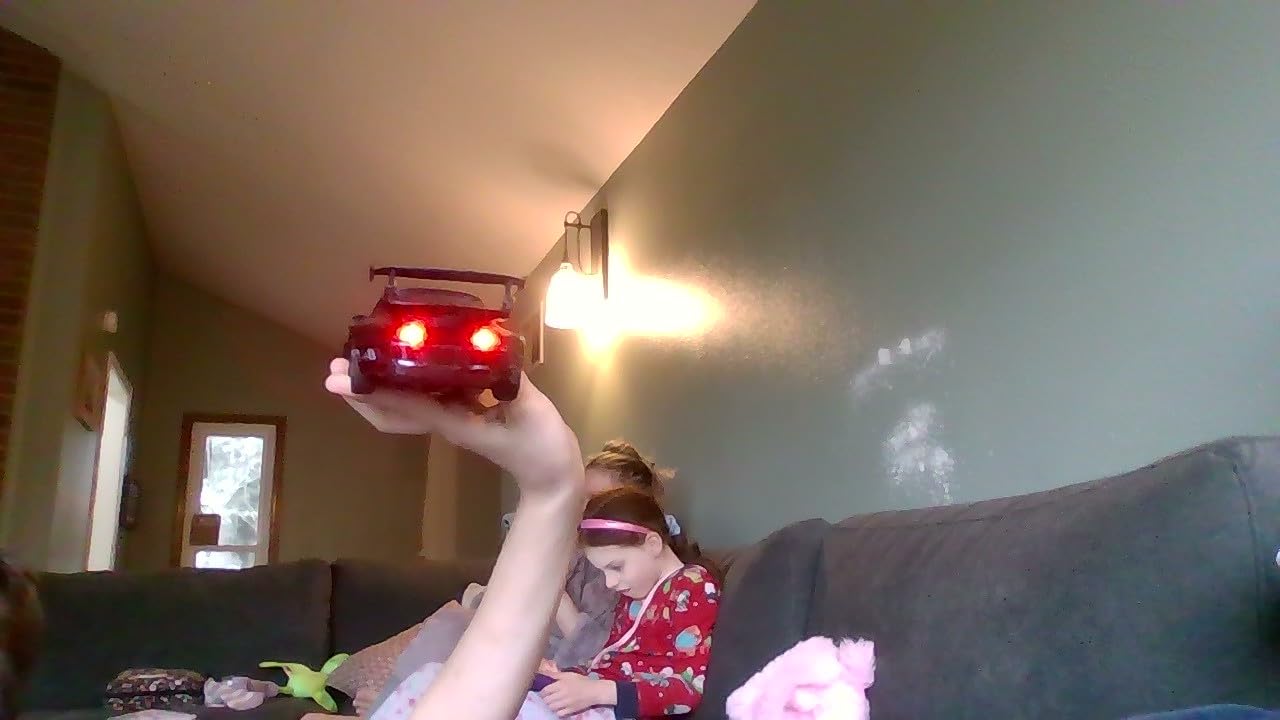
What you get with the ACAMMZAR that cheaper toys skip
The speed mode switch is more useful than it sounds. New drivers catch slides at low speed far more often than at full speed, and being able to dial the car down means you can practise the transition from grip to slide before you add speed.
Full proportional control also makes reverse genuinely usable. When you overcook an entry and end up facing a wall, proportional reverse lets you back out slowly instead of backing out at full commitment.
Where the ACAMMZAR falls short
Reviewers do report that analog inputs can feel insensitive at the very fine end of the travel, which matters once you start driving deliberately rather than just sliding around. It is a mild complaint rather than a fault.
There are also occasional reports of connectivity that needs a quick power cycle, and the cosmetic trim breaks off in hard impacts. Neither affects driving, but do not expect a showroom finish after a first month of crashing it deliberately.
2. Liberty Imports 1/24 4WD: The Lowest-Cost Way to Start Drifting
Liberty Imports RC Drift Car 1/24 2.4GHz 4WD Remote Control Sport Racing On-Road Vehicle with LED Light, Batteries and Drift Tires (Style 4)
1:24 4WD at 15 KM/H
Interchangeable racing and slick drift tires
Runs on three AA batteries
Best on hardwood, tile or pavement
Pros
- Lowest entry cost of any car in this roundup
- Holds up to crashes remarkably well
- Swappable slick and grippy tires change the driving feel
- Several cars can race together on 2.4GHz
- Working headlights add a lot when the car slides
Cons
- Steering and throttle are on/off rather than proportional
- Noisy drivetrain with obvious motor whine
- Only one speed setting so speed control is coarse
- Battery compartment needs a small screw removed to charge
This is the cheapest credible entry into the hobby, and it is the only car here that runs on three AA alkaline batteries instead of a proprietary lithium pack. That single design choice removes the most common frustration with toy-grade cars: when the rechargeable pack eventually fails, you can keep playing with standard batteries.
It is also the least demanding car in the roundup. At 15 KM/H it is slow enough that a first-time driver will not panic, and the reinforced frame is built to tolerate bumps and crashes. The size is small enough to be safe around very young children, which makes it a reasonable first car for a family.
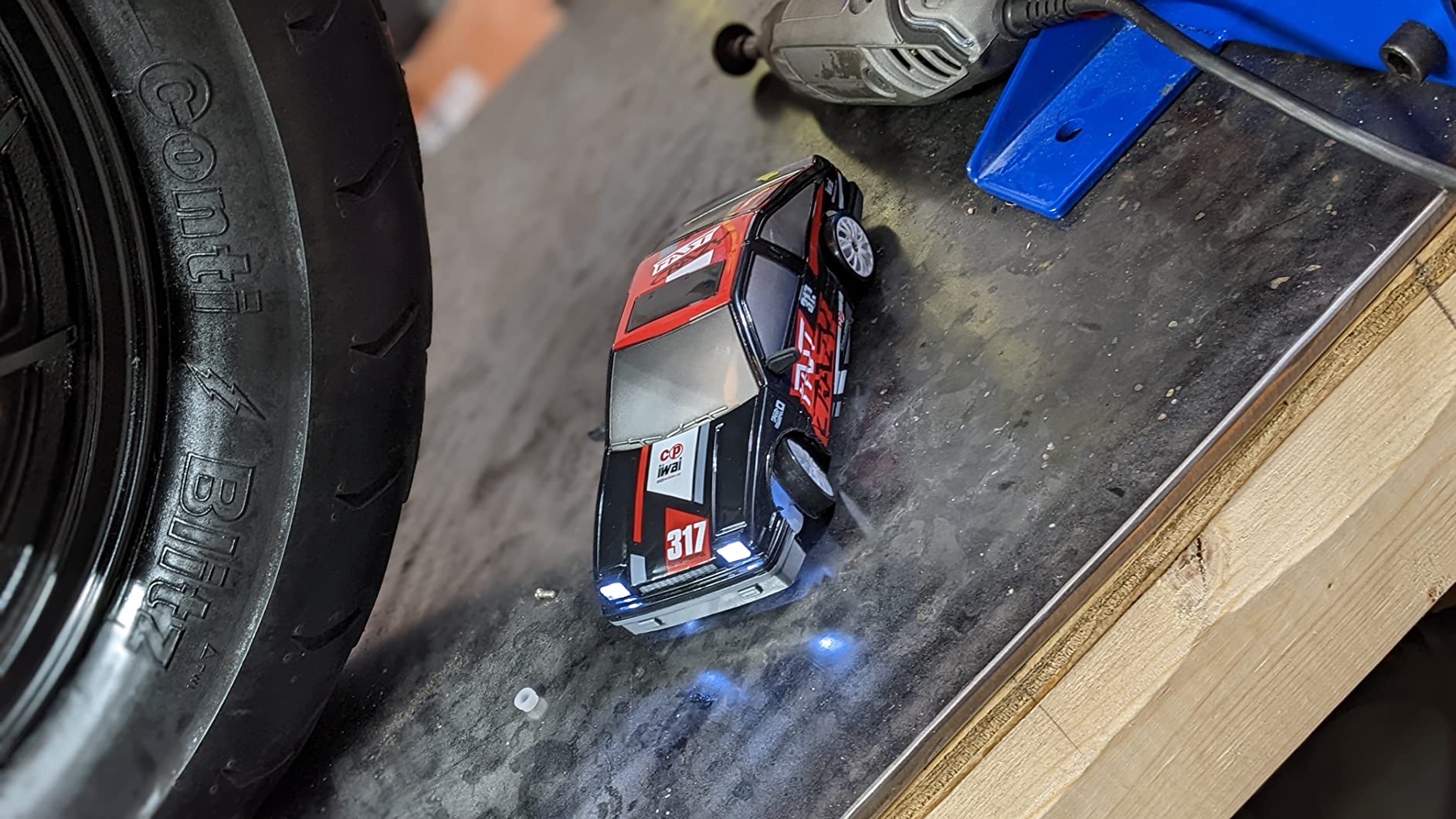
It ships with four grippy racing tires and four slick drift tires, and the manufacturer explicitly recommends smooth surfaces such as hardwood, tile, pavement and driveways. On those surfaces the slick tires slide predictably, which is exactly what you need to practise a drift.
Owner feedback rates it 4.1 out of 5 from 462 reviews. That is the lowest score in this line-up, and the reason is consistent: the on/off steering and single speed setting make fine corrections impossible. Understand that trade before you buy, because it is not a defect that later fixes.
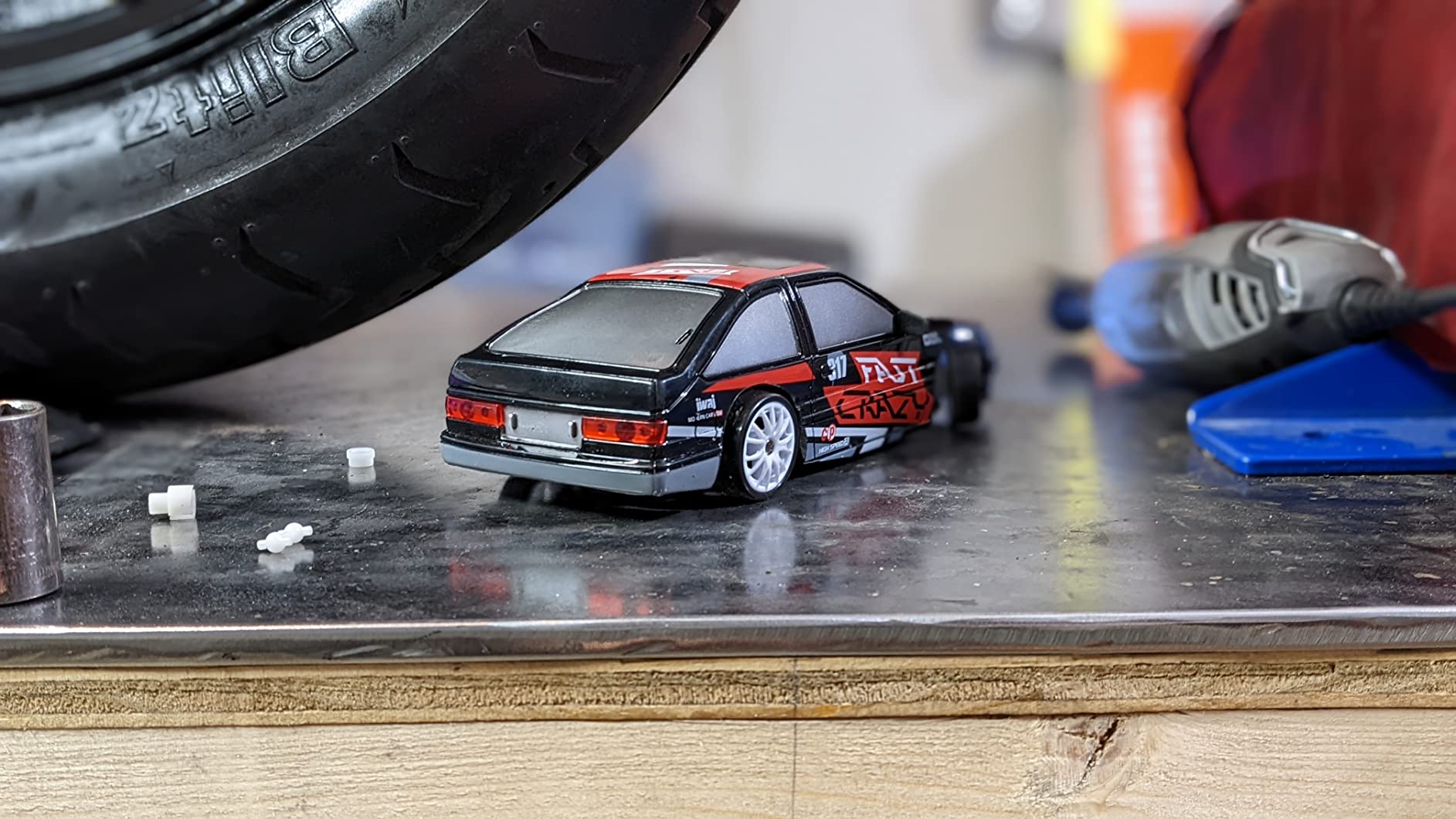
Why the AA battery design matters for a first car
Nearly every cheap RC car that ships with a lithium pack uses a vendor-specific connector and cell size. Once that pack degrades, replacing it means finding the identical pack, which for a no-name brand can mean nothing.
Running on three AA batteries means your running costs stay flat and your spares live in a drawer with everything else. For a first car, that reliability is worth more than raw speed.
Who should skip this car
If you already drive crawlers or on-road cars and want to practise proper drifting technique, skip it. On/off steering cannot teach counter-steering, and a single speed setting gives you nothing to modulate.
It is also the loudest-spirited car in the set, with a drivetrain whine that owners mention often. In a shared indoor space that noise carries.
3. Desdoni 1:24 4WD: The Most-Reviewed Drift Car in the Line-Up
Desdoni Remote Control Car RC Drift Car 2.4GHz 1:24 Scale 4WD 20KM/H High Speed Model Vehicle with LED Lights Drifting Tire Racing Sport Toy Car for Adults Boys Girls Kids Gift
1:24 4WD at 20 KM/H
Two rotatable lithium-ion batteries
Six traffic cones included
About 2 hour charge time
Pros
- Most owner reviews of any car here
- Drifting is easy to pick up on tile and hardwood
- Tough enough to drive over rugs and doormats
- Two included batteries rotate for continuous play
- Traffic cones let you build a small circuit
Cons
- Non-proportional on/off steering and throttle
- Racing rubber wheels do not drift without the plastic drift tires
- At full speed it can spin out and become hard to control
- Small screws secure the battery doors and no suspension
With 1,504 owner reviews at 4.4 out of 5, this is the most widely reviewed car we looked at, and that volume matters for a first purchase. When a product has that many reviews, the failure modes are well documented, so you are not gambling on unknowns.
The practical draw here is the bundle. It ships with two lithium-ion batteries, four racing tires, four drift tires and six traffic cones, plus a USB charging cable. The cones matter more than they sound: a drift car with no marked course is a car that gets driven in straight lines.
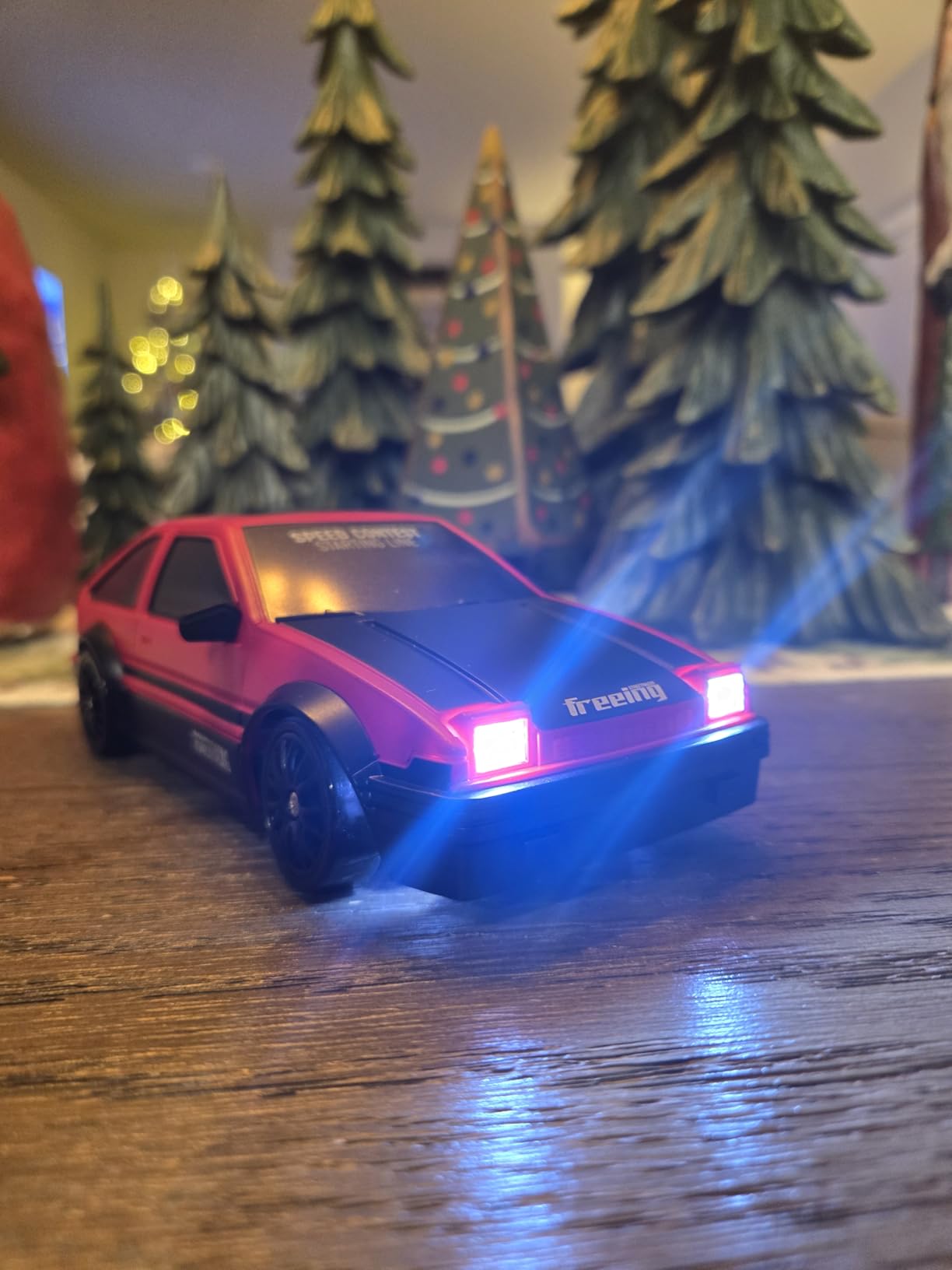
The 2.4GHz remote has automatic pairing and a stated 50 meter range, and multiple cars can run simultaneously. That makes it a good two-player car, which is often how people stay interested in a hobby after the first month.
It reaches 20 KM/H on a 1/24 4WD chassis with an impact-resistant hard shell, with about 2 hours of charging for roughly 20 to 30 minutes of play per battery. Two batteries means you can rotate them rather than waiting.
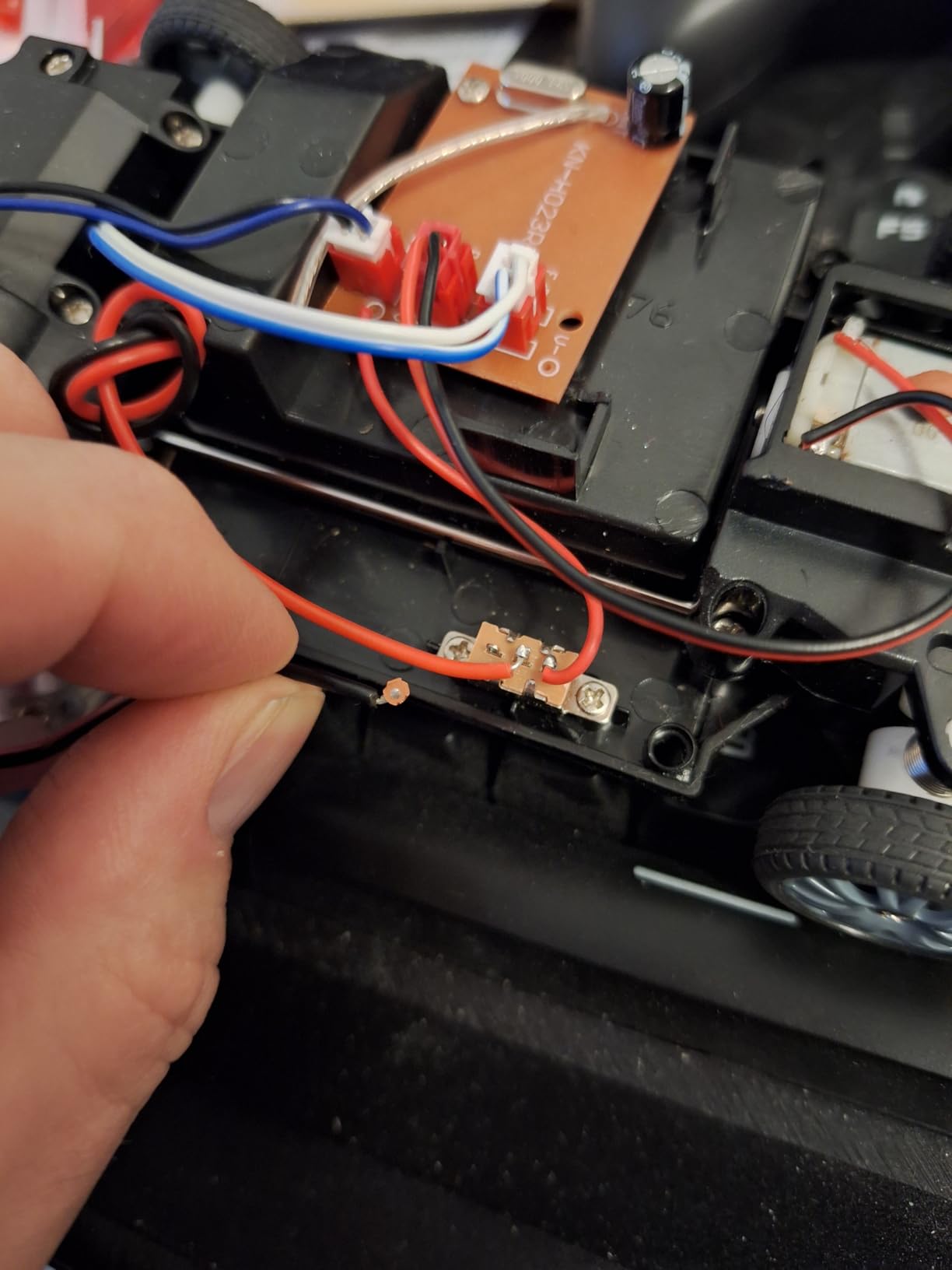
The two details worth knowing before you order
The battery compartment is secured with small Phillips JIS screws, and buyers who do not own a watch-size screwdriver will find that mildly annoying on day one. It is a five-minute fix if you buy the tool, a genuine annoyance if you do not.
There is also no suspension, so the car cannot absorb jumps. On a smooth floor that is irrelevant, but if your plan involves driving it off furniture, look elsewhere.
Where it loses to the pick above
The steering and throttle are on/off rather than proportional. That is the single reason it sits below the ACAMMZAR in our order despite having more reviews.
Owners also note that the rubber racing wheels do not drift well at all. The plastic drift tires are mandatory for sliding, and the difference in feel is dramatic enough that you will not mix them up twice.
4. HTURCCOP 1:24 4WD: Built for the Youngest Hands
HTURCCOP RC Drift Car 2.4GHz 1:24 Scale 4WD High Speed Remote Control Cars Vehicle with LED Lights Two Batteries and Drifting Tires Racing Sport Toy Cars for Adults Boys Girls Kids
1:24 4WD with two speed settings
Two batteries for 60+ minutes total
Swappable racing and drift tires
High-brightness headlights
Pros
- Genuinely easy to control for young children
- Low speed mode gives wider and easier-to-correct drifts
- Two batteries with 60+ minutes of claimed total runtime
- Swappable tires produce clearly different handling
- Low enough cost that parents are relaxed about crashes
Cons
- On/off steering and throttle with no proportional control
- Toy-grade materials that will not perform like a hobby build
- Can be noisy enough to bother a dog
- Undrivable if the two tire types are mixed at once
This is the car we would suggest for a child aged six to ten, and the reason is the low speed mode. Owners consistently report that setting the car to low produces wider, slower, far more correctable slides, which is what a small child needs to catch a slide and carry on.
The chassis uses a differential with a rear four-wheel drive system, and owners describe it as drifting well on kitchen tile and low-pile carpet. That surface tolerance is unusual in this tier, where most cars need a genuinely smooth floor.
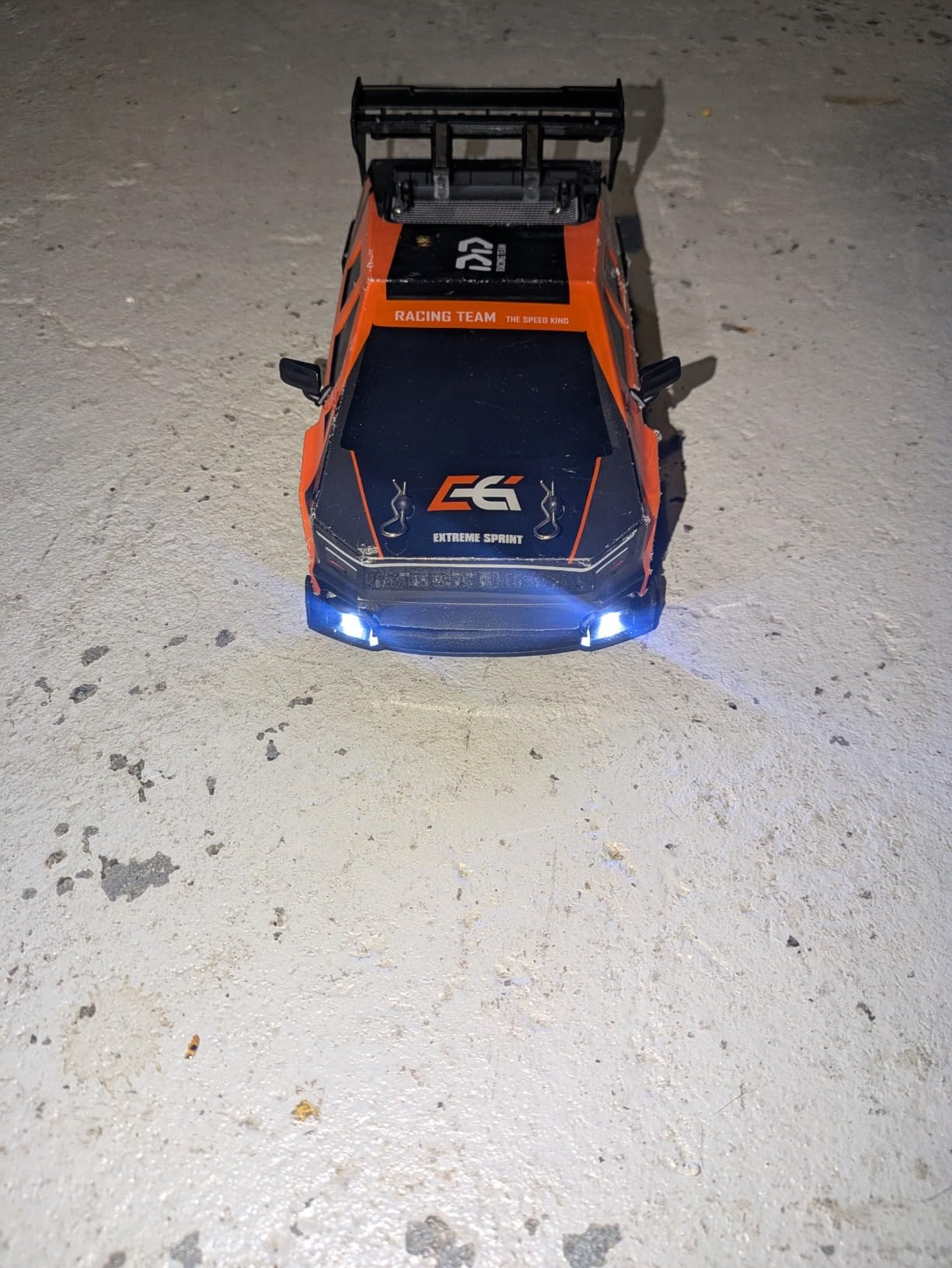
Two rechargeable batteries totalling 1000mAh give a claimed 60 minutes plus of runtime, which is the longest session figure among the 1:24 cars in this roundup. You also get four racing tires and four drift tires that swap over quickly, plus high-brightness headlights for finding the car in a dark room.
It holds 4.2 out of 5 across 354 reviews. The positive theme in those reviews is overwhelmingly beginner suitability: easy to control, forgiving, and cheap enough that nobody minds it being knocked about.
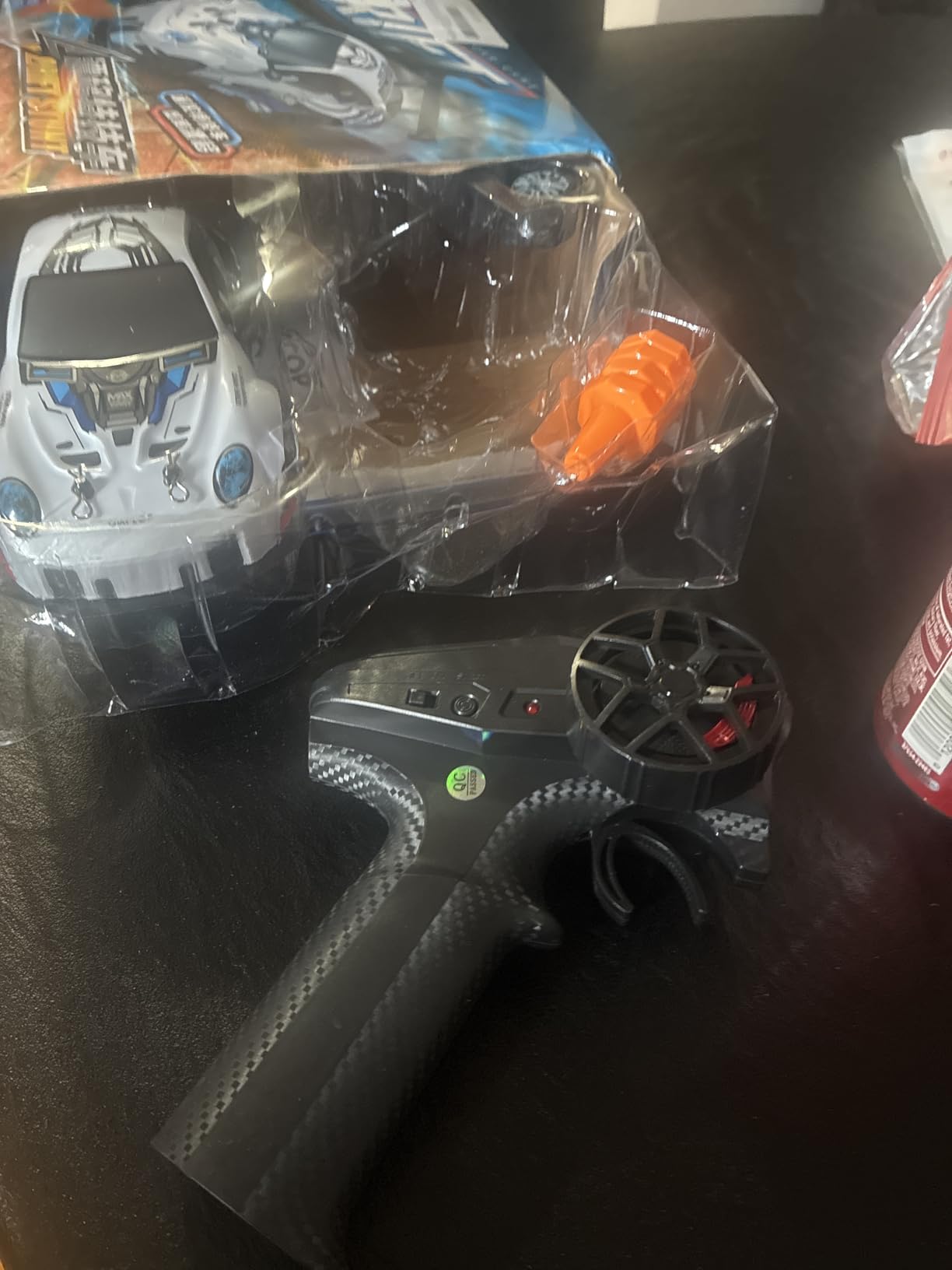
Two speed settings change the learning curve
Most cheap cars have one speed. This one has two, and the low setting is the reason owners recommend it for first-time drivers. A slower car gives you time to react to the moment the rear end steps out.
Switch to high only once the low-speed drifting feels boring. That progression is the whole point of having a cheap first car.
When to choose something else instead
The on/off steering is the same limitation as every other toy-grade car here, and the materials are toy-grade, so performance will not match a hobby build. Owners also report it can be noisy enough to bother a dog.
Do not mix the tire types. With one set fitted the car handles predictably; mixed tires make it effectively undrivable.
5. KAIMIO 1:24 4WD: The Quickest Toy-Grade Drifter Here
KAIMIO 1:24 Scale RC Drift Car 4WD 2.4GHz 30KM/H High Speed Racing Sport Toy Car with LED Lights, Racing and Drift Wheels(02-Blue)
1:24 4WD with a claimed 30 KM/H
Interchangeable racing and drift tires
Extensive LED lighting
Rounded body edges
Pros
- Highest claimed top speed of any 1:24 car in this roundup
- Slick drift tires slide well on hard surfaces
- Remotes arrive pre-bound so several cars work immediately
- Rounded edges are safer on furniture and floors
- Cones and spare tires included
Cons
- Steering is a toggle switch rather than a proportional wheel
- Non-standard battery pack is hard to replace when it wears out
- About 10 minutes of runtime per battery
- Some buyers received a car with reversed throttle
If speed is what draws you to this hobby, this is the fastest 1:24 car in the roundup, with a claimed 30 KM/H. That is fast enough to feel like a real car on a garage floor and slow enough to be catchable indoors, which is a narrow window that few toy-grade cars hit.
The grip set reaches roughly 20 km/h on asphalt or tile, while the slick drift tires slide properly. Having both sets means you can run the same chassis as a fast racer or a drifter without buying anything else.
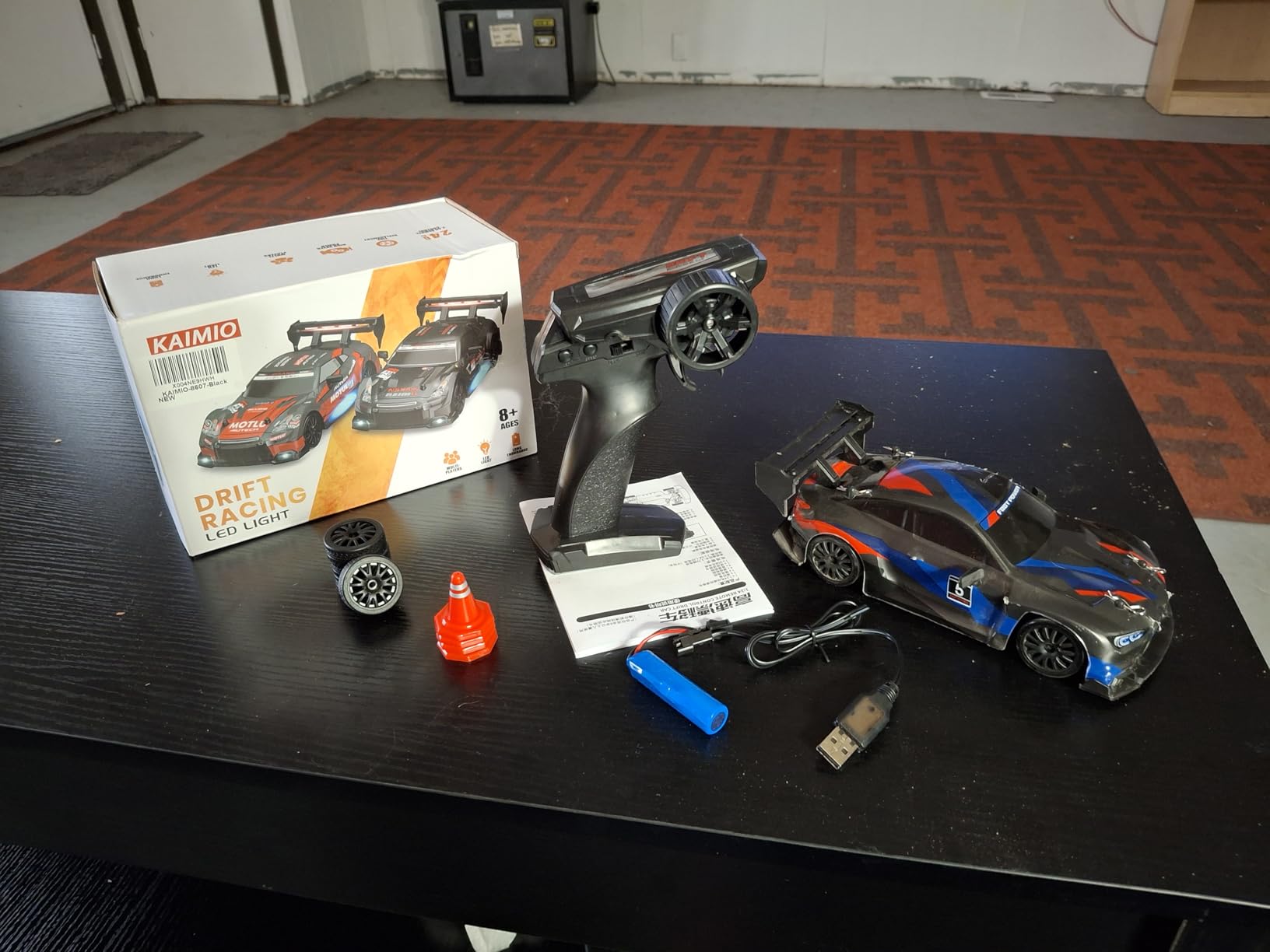
The remotes arrive pre-bound, so if you buy two in different colors you can run them simultaneously without any pairing step. The same chassis is offered in many body styles, which makes multi-car racing easy to set up with friends or siblings.
Lighting is the other attraction: LED headlights, tail lights, body LEDs and ground-effect lighting. It sits at 4.4 out of 5 across 440 reviews, and reviewers consistently call it the best value per unit of speed in this category.
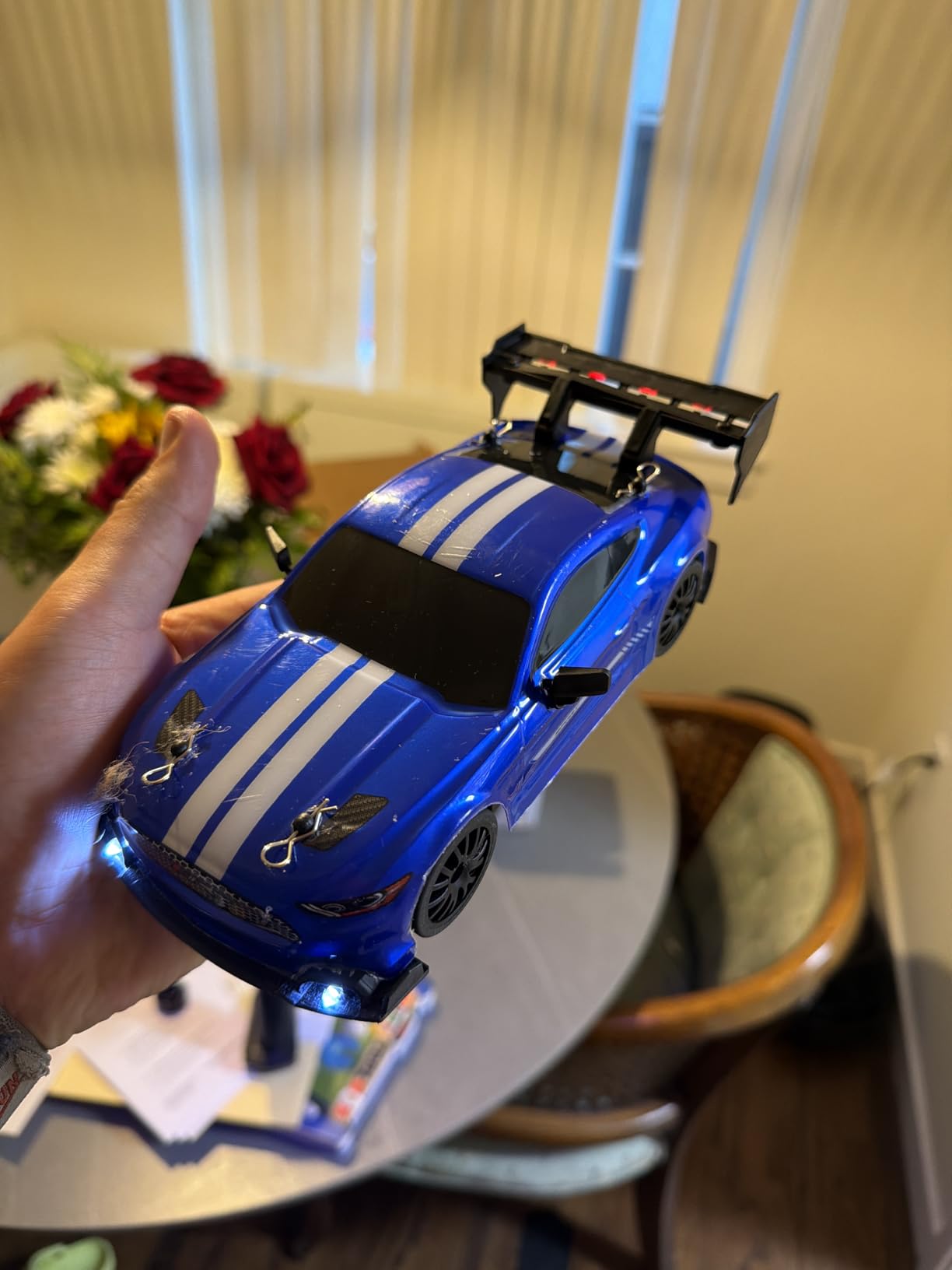
Why the pre-bound remotes matter
Most 2.4GHz cars need a pairing step before the first run. If you are buying for a child or running a two-car race, a car that works the moment it comes out of the box removes a support call and a source of frustration.
That practical detail is worth more to a beginner than any spec on the box.
What we would change before recommending it more widely
The steering is a toggle switch, which makes fine corrections hard at any speed. At 30 KM/H that limitation matters more than it does on a slow car.
The non-standard battery pack is the bigger practical problem. It runs about 10 minutes per charge, and when the pack wears out, replacement is difficult. Owners also report occasional units arriving with reversed throttle.
6. Sakeye 1:16 4WD: More Footprint for Bigger Indoor Spaces
Sakeye RC Drift Car 2.4GHz 1:16 Scale 4WD High Speed Remote Control Cars Vehicle with LED Lights Two Batteries and Drifting Tires Racing Sport Toy Cars for Adults Boys Girls Kids
1:16 scale 4WD at 18 KM/H
145-inch 2.4GHz control range
Two 7.4V 500mAh batteries
LED lights and water-mist effect
Pros
- Largest footprint of the entry cars so it drifts more convincingly
- 145-inch range covers a garage or driveway comfortably
- Two batteries give roughly 40 minutes total runtime
- Interchangeable drift and racing tires
- LED lights and a rear water-mist spray effect
Cons
- 18 KM/H top speed is modest against faster 1:24 models
- Drifting only works properly on smooth boards
- tiles and tracks
- Wheel axles and tires are consumable high-wear parts
Scale changes how a drift car feels more than any other single factor. At 1:16 this car has roughly double the footprint of a 1:24, so it carries more momentum through a slide and looks like a proper car rather than a toy. If your indoor space is a garage floor rather than a tabletop, that matters.
It holds a 4.5 rating across 893 owner reviews, with 75 percent of those reviewers giving it five stars. Proportional control for forward, backward, left and right is standard here, and owners single it out as easy to pick up.
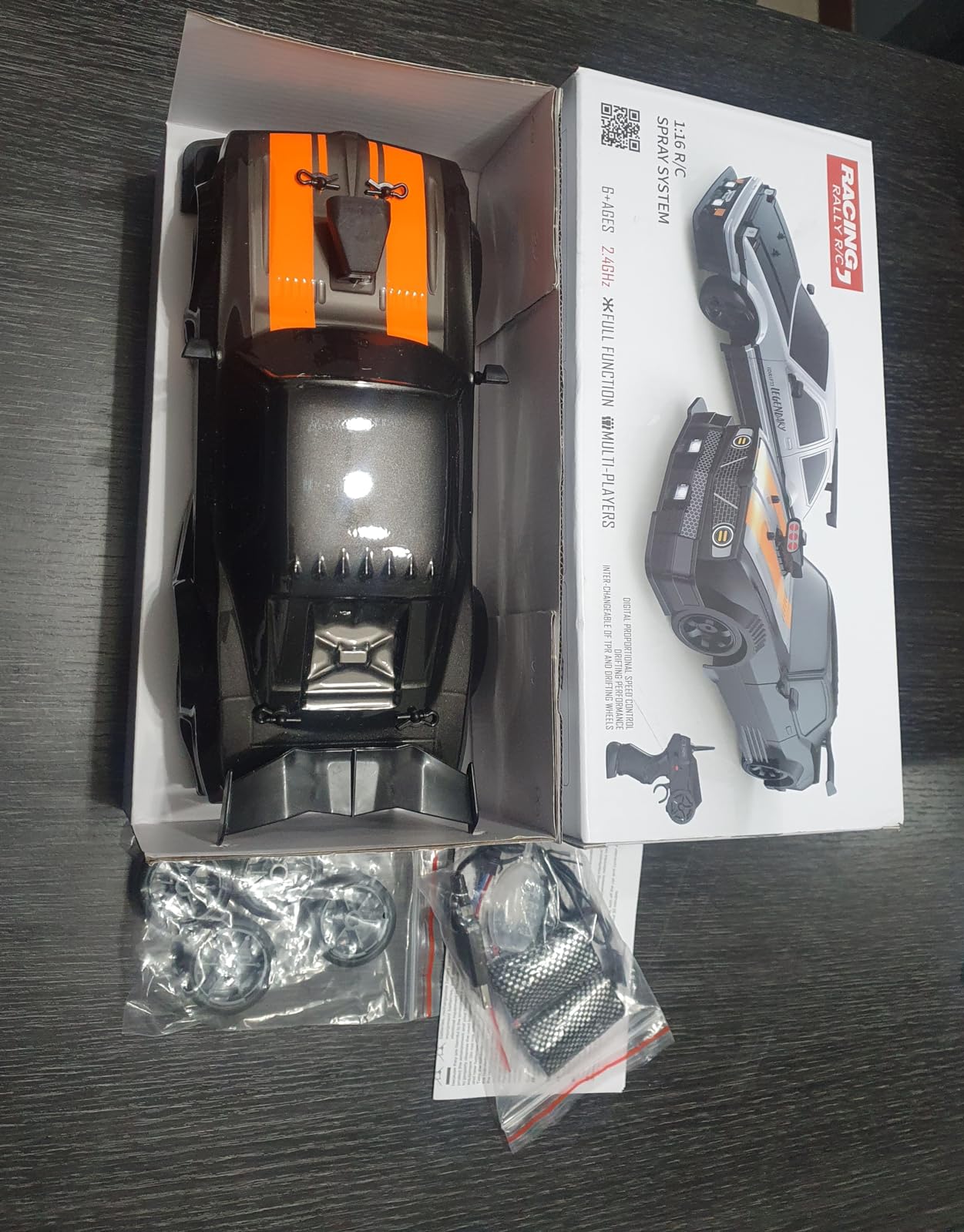
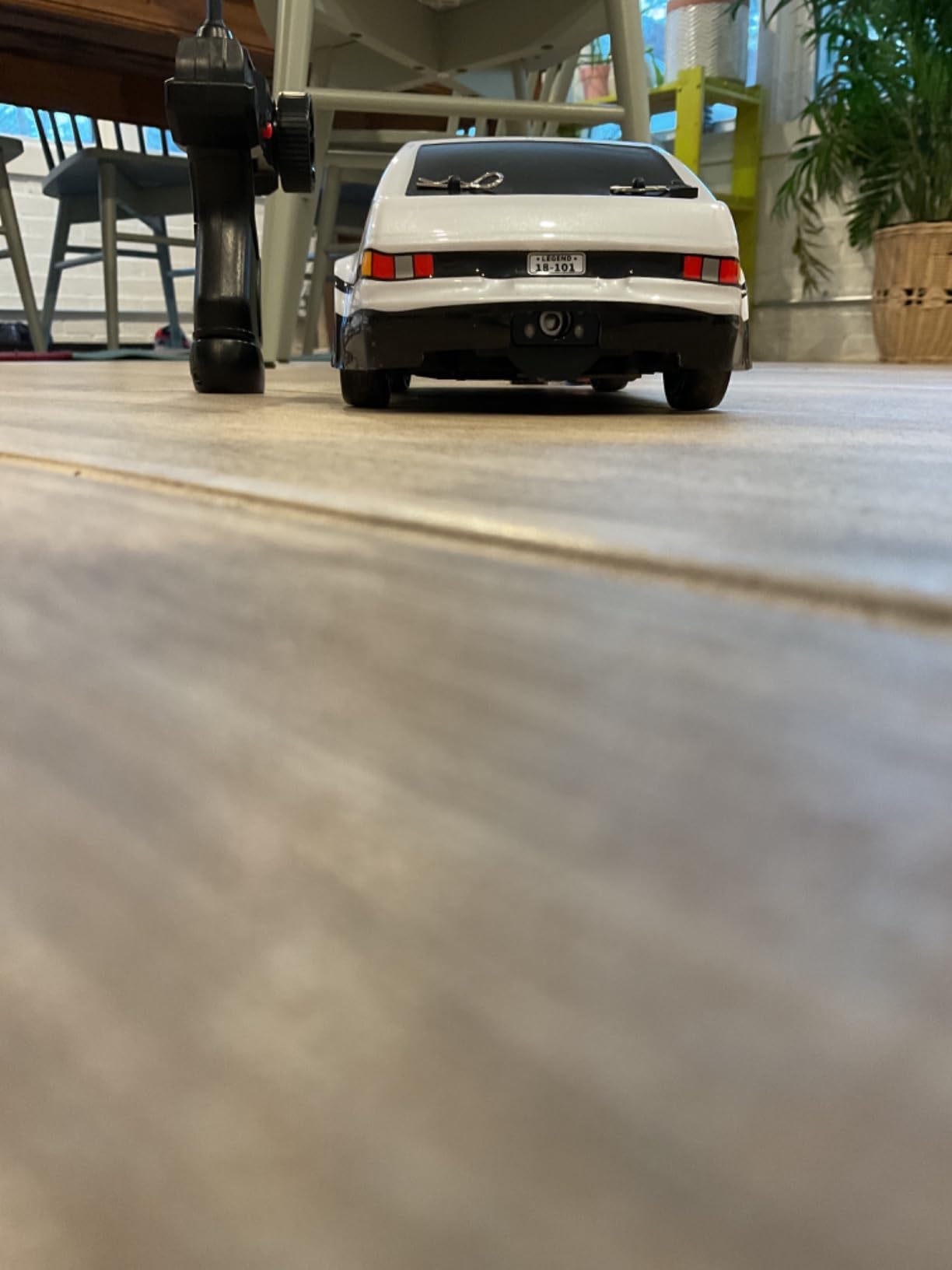
The 2.4GHz radio has a stated 145-inch range, which is more than double the indoor reach of most cars in this roundup and is enough to drive out of a room and into a hallway. Multiple cars can run at once without interference.
Two 7.4V 500mAh rechargeable batteries give 20 minutes each, roughly 40 minutes total. The car also includes four speed racing tires and four drift tires, plus LED lights and a rear water-mist spray effect that adds some spectacle to a slide.
When a bigger footprint is the right call
A larger car needs more room to complete a slide without hitting something. On a hallway or a carpet-free living room floor, the 1:16 scale gives you enough space to build a proper drift line instead of a single flick-and-catch.
It is also the entry-tier car that most resembles the proportions of a real drift car, which matters for adults who want the hobby to look right.
Where the extra size costs you
At 18 KM/H it is not the fastest car here, and the KAIMIO at 1:24 is quicker on a smaller footprint. Speed and scale trade against each other at this budget.
Owners also note that drifting only performs well on smooth boards, tiles and tracks, and that the wheel axles and tires wear quickly because the car is heavier. Budget for a spare tire set.
If you want the fastest entry-tier option rather than the most realistic one, our faster RC cars for drift and speed guide covers the quicker end of this tier.
7. FLYCOLOR Turbo Racing C64 1:76: Proportional Control at Desk Scale
FLYCOLOR Turbo Racing C64 1:76 RC Drift Car, Full Proportional RTR (Blue)
1:76 micro drift car with full proportional control
SVC gyro with adjustable trim
55mAh LiPo, up to 30 minutes
Type-C charging in 40 minutes
Pros
- Genuinely full proportional steering and throttle at this tiny scale
- Working headlights
- brake lights and controllable chassis LEDs
- Two spare unpainted shells you can paint yourself
- Type-C charging with a 40 minute top-up
Cons
- Very small and light
- which makes it hard for newcomers to drive
- Gyro needs careful tuning and the steering trim is sensitive
- About 30 minutes of runtime per charge
- Several reports of an inconsistent remote
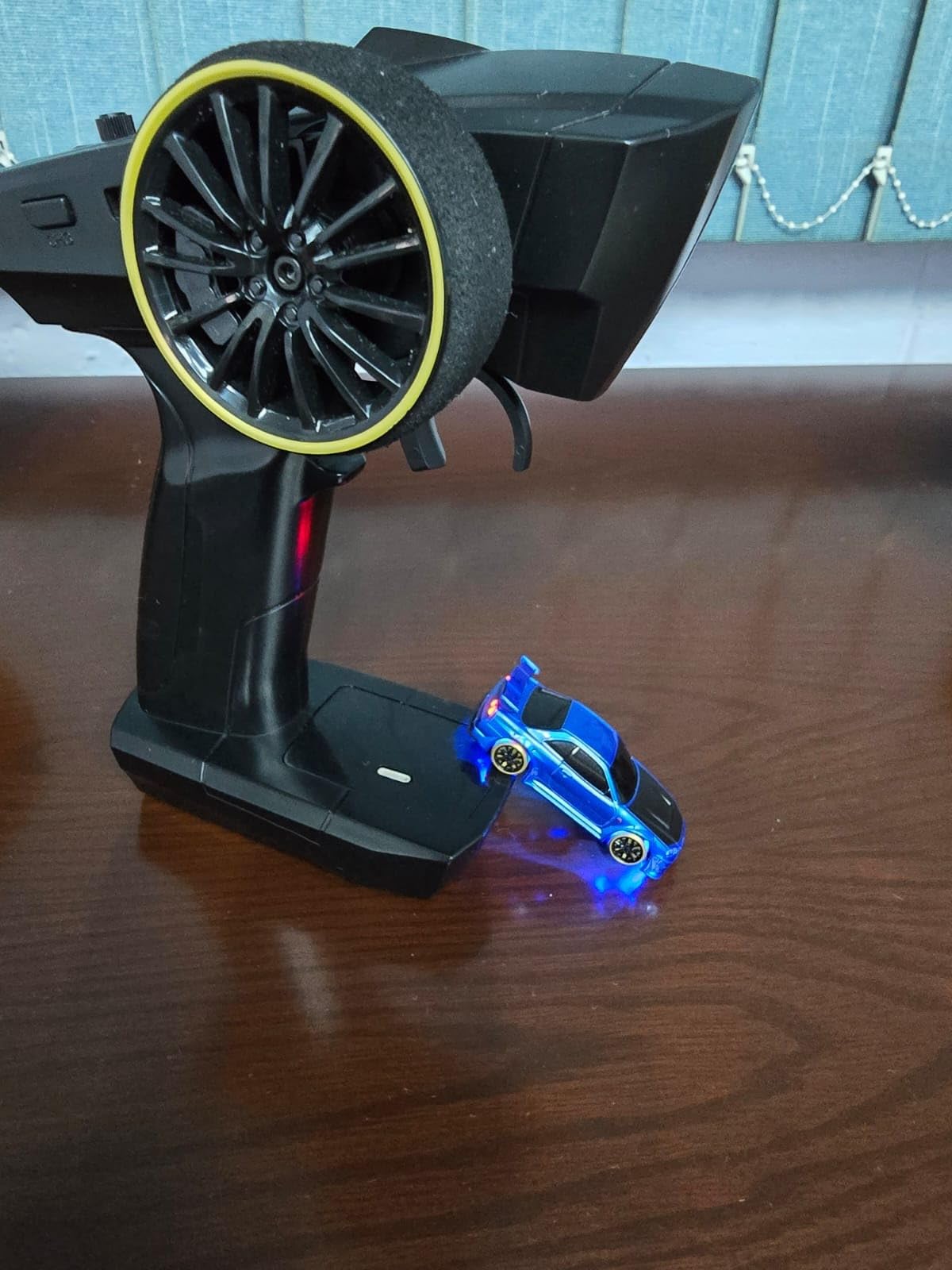
This car is roughly Hot Wheels sized and drives on a desk or a small tabletop, which makes it the only pick here you can use in a shared office or a small flat without clearing furniture. The 1:76 scale also happens to be the one most associated with hobby micro drifting.
More importantly, it has full proportional steering and throttle, plus an SVC gyro with adjustable steering trim. Proportional control at this scale and this configuration is genuinely unusual, and it is what separates this car from the on/off toys further up the page.
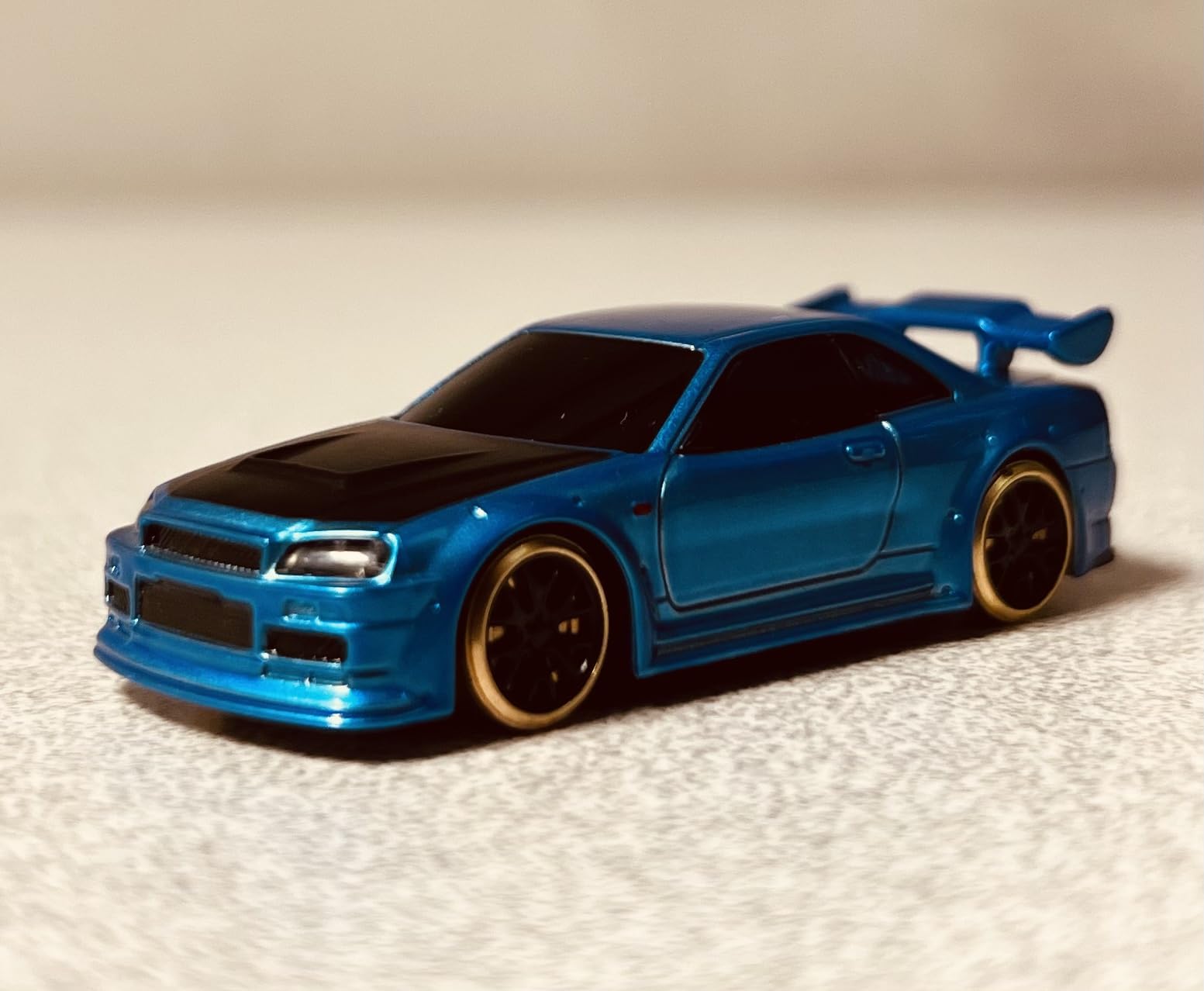
The lighting package is unusually complete for a micro car: spotlight-effect headlights with a double flash, working brake taillights, and chassis LEDs controlled from a third channel on the transmitter. There is also a progressive throttle curve that gives gentle power over the first half of the trigger and stronger pull over the second half, which helps a beginner modulate entry speed.
The 55mAh battery gives up to 30 minutes of runtime and recharges over Type-C in about 40 minutes. You get a removable body shell plus two extra unpainted shells for painting, which is the single most popular feature with owners.
Why proportional control matters more than speed
A micro car has almost no momentum, so catching a slide depends entirely on how precisely you can move the steering and throttle sticks. On/off controls are useless at this scale because there is no time to react to a full-lock input.
The gyro assist here also smooths out corrections, though it needs tuning before it feels natural rather than fighting you.
Where it will frustrate you
Owners consistently describe the gyro as fiddly and the steering trim as very sensitive. Several also report inconsistent remotes, and the runtime is short enough that you will charge it between practice sessions.
It sits at 4.2 out of 5 from 410 reviews, and a number of reviewers consider it expensive relative to what it does. We agree it is a collector and desk-scale choice rather than a first car.
8. DIKAVEY 1:12 Brushless: The Step-Up, Framed Honestly
DIKAVEY 1:12 RC Rally Car Fast Max 50 MPH,Drift Adults RC Car
1:12 brushless rally car reaching 80 km/h
35A ESC with cooling fans and metal heatsinks
3S 2200mAh LiPo included
Gyro-assisted drifting and full lighting
Pros
- Genuinely hobby-grade metal drivetrain and chassis
- Wide parts availability makes repairs and tuning straightforward
- Gyro-assisted drifting keeps the car stable at speed
- No assembly needed and quick out of the box
- Full LED lighting with brake and turn signals
Cons
- Stock tires wear out within a handful of runs
- Tends to flip over at full throttle without slowing down
- About 4 hours of charging for roughly 20 minutes of high-speed run
- Tiny body clips make quick body-off access awkward
This is the one pick here that is not cheap, and we have included it deliberately. It answers the question every beginner eventually asks: what does the next tier actually buy? The answer is metal, speed, runtime control and repairability, not better drifting technique.
Underneath is a 35A brushless ESC with a Rocket 2845 3600KV brushless motor, cooling fans and metal heatsinks, driving a full-metal drivetrain: a CNC 59TC steel differential, oil-damped suspension, steel CVDs, a 6061 aluminium chassis and powder-metallurgy gears. That is a hobby-grade platform by any honest definition.
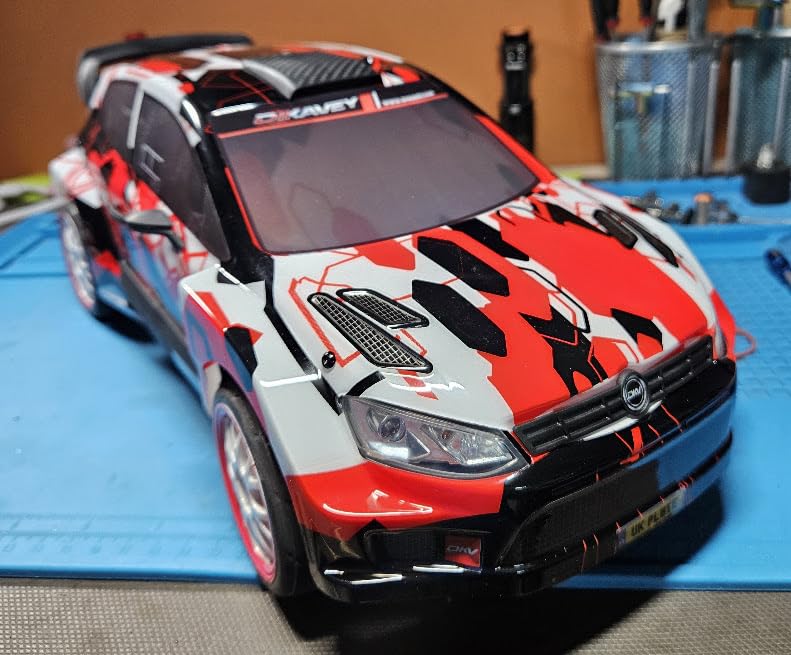
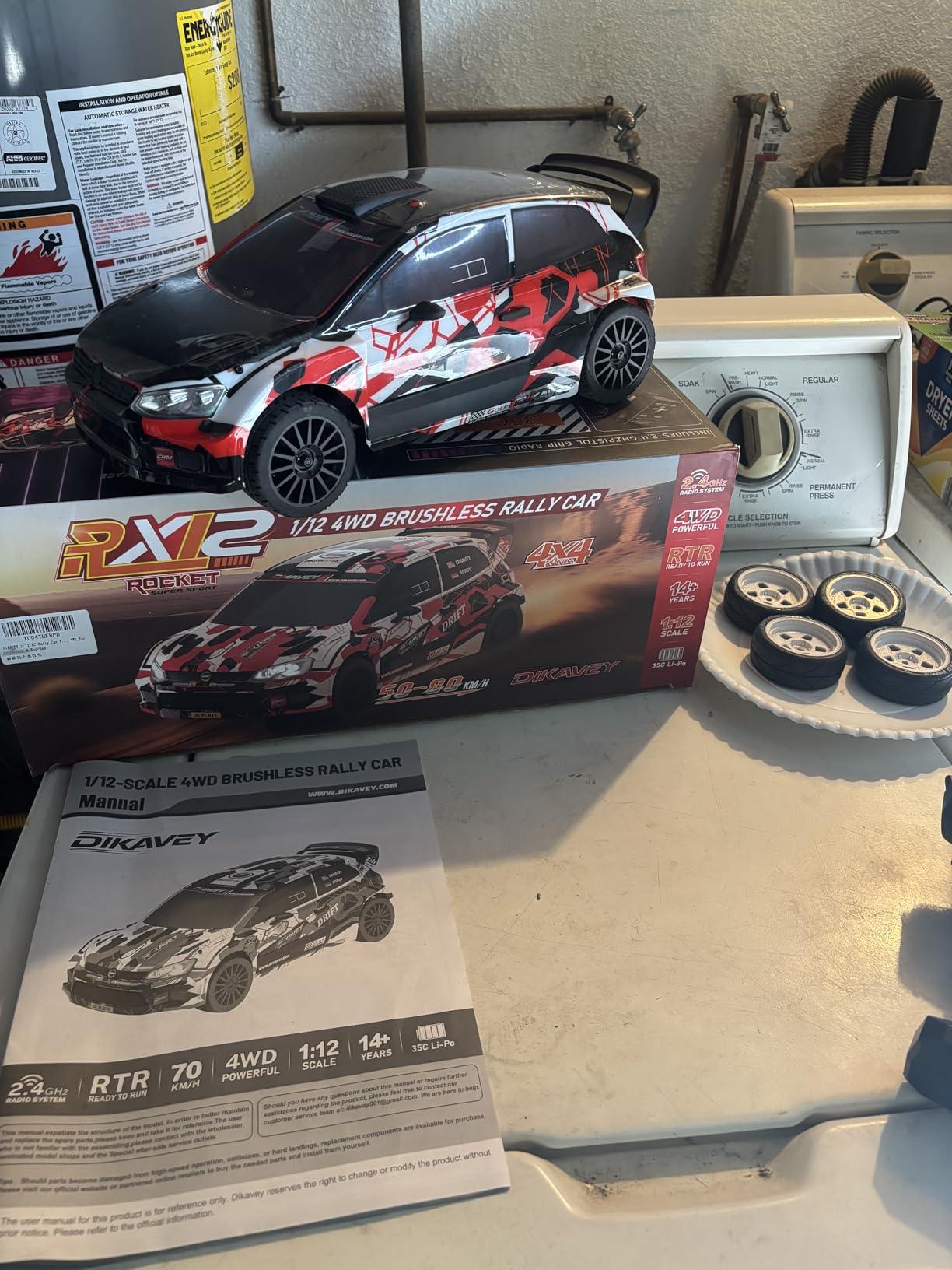
The included 3S 2200mAh LiPo drives it to 80 km/h, or about 50 mph. The 2.4GHz transmitter offers a 350 meter range, three speed modes, steering and throttle end point adjustment, light controls and gyro-assisted drifting, which is the closest thing to an electronic stability aid on a car at this price.
Owners rate it 4.5 out of 5 from 286 reviews, with 78 percent giving five stars, the highest five-star share in the roundup. Several describe the value as comparable to platforms costing considerably more.
What the extra spend really buys
Two things. First, parts availability: metal drivetrain components and standard sizing mean a crash is a repair rather than a write-off. Second, the 350 meter range and the three speed modes, which mean you can drive it outdoors rather than only on a smooth floor.
The center slipper clutch and sealed differentials are designed to support stable drifting with less rollover risk, and the ESC includes overheating warning, low-voltage cutoff and over-current protection.
Why it is not on the recommendation list yet
It is fast. At 80 km/h with a rollover tendency at full throttle, it is not a car to hand to a nervous beginner, and the gyro-assisted drifting needs setup time before it helps rather than fights.
Buy replacement tires up front, because owners report stock tires wearing out within a handful of runs, and budget for a 4-hour charge cycle for roughly 20 minutes of high-speed running. If you want more hobby-grade background, our beginner brushless RC car guide sets out what that tier involves.
For the wider hobby context around this step-up, see our hobby RC car roundup.
What to Look for in a Cheap Drift RC Car
These seven criteria are the ones that actually change your experience as a beginner. Everything else on a product page is decoration.
- Proportional steering and throttle. If the transmitter only offers full lock or straight, you cannot catch a slide. This single feature separates the cars worth learning on from the ones you will outgrow in a week.
- Interchangeable drift and racing tires. Hard slick tires slide, grippy tires do not. A car that ships both sets lets you understand tire choice without spending anything extra.
- Two batteries included. One battery means waiting mid-session. Rotating two packs roughly doubles your practice time, which is the resource you are actually short of.
- Battery and charger availability. Check whether the pack is a standard size you can replace. Proprietary packs are the number one reason cheap RC cars end up in a cupboard.
- Surface requirements. Cars that drift on carpet or rug will chew through tires quickly and hide what drifting actually feels like. Smooth tile, hardwood or a garage floor is the realistic beginner surface.
- Speed range or speed modes. A slow mode is worth more than a fast one. Being able to practise at walking pace and then build up is how you learn control instead of memorising luck.
- Spare parts availability. Cheap cars with named brands and documented model numbers have tires, axles and shells you can buy later. No-name chassis with no documentation do not, and a broken one is then finished.
RWD vs 4WD: Which Layout Actually Drifts
Almost every car in this roundup is four-wheel drive, and almost every dedicated hobby drift platform is rear-wheel drive. That difference confuses more beginners than anything else in this hobby, so it is worth explaining plainly.
Drifting works by breaking traction on the driven wheels and holding the resulting slide with counter-steer. On a four-wheel-drive car, all four tires are being asked to grip at once. Give it enough throttle to slide the rear and the fronts lose bite too, so the car pushes wide instead of rotating. That is why so many cheap RC cars will spin on a smooth floor rather than hold a neat sideways line.
Rear-wheel drive solves it by concentrating slip at one axle. The front tires keep gripping and pointing where you steer, which is exactly what counter-steering needs. It is the reason nearly every competitive drift platform is rear-drive, and the reason a 4WD toy drifting on a hallway floor is a compromise rather than a mistake.
The common claim that a Tamiya chassis is all-wheel drive and therefore useless for drifting is worth correcting. The drift-spec Tamiya platforms are rear-wheel drive configurations, and Tamiya has a long-standing named beginner drift line-up. A car being bad at drifting is a layout or setup question, not a brand question.
What this means for a first car: a four-wheel-drive toy drifter is genuinely fine for learning throttle feel and slide direction on a small scale. If your ambition is sustained sideways driving at speed, you will eventually want rear-wheel drive and the drivetrain upgrades that come with it. Our limited-slip differential guide covers the part most beginners meet first on that journey.
Scale Ladder: 1/76 to 1/12 and What Each Size Needs
Scale is the decision that most affects price, speed, space and upgrade path. Pick the wrong rung and you either outgrow the car or never get it out of the house.
- 1:76 is desk scale. It runs on a 55mAh cell, needs about half a metre of surface and is the only tier that fits on a tabletop. Proportional control is achievable here and worth insisting on.
- 1:24 is the beginner sweet spot and the tier most of this roundup occupies. It drifts on a hard floor or a garage, needs about a metre of space, and costs less than a takeaway meal. Two AA-sized cells or a small lithium pack are normal.
- 1:16 roughly doubles the footprint of a 1/24. It carries more momentum through a slide and looks more like a real car, but needs more clear floor and eats tires faster.
- 1:12 is where hobby-grade hardware begins. Metal drivetrains, oil-damped suspension and brushless power appear at this scale, along with charging times measured in hours.
The pattern is simple: bigger scale means more speed, more space, more cost and more repairability. Smaller scale means more forgiving crashes and cheaper mistakes. Start at the smallest scale that gives you room to complete a slide, and only move up when you have run out of floor.
What a Cheap Drift RC Car Really Costs to Run
The car is the smallest part of the cost, which is the point almost every buying guide misses. Budget for the running costs before you commit, because they are what decide whether the hobby keeps going.
- Spare batteries. Every car here runs two at a time, so you already have a full set. When those wear out, the standard-size cells are far cheaper than a proprietary pack.
- A charger you trust. The included USB cable is adequate for the toy tier. If you move up to LiPo packs, a balance charger becomes the first sensible accessory purchase.
- Replacement tires. Drift tires are consumables. Every car in this roundup has tires that wear, and the Sakeye at 1:16 wears them fastest because it is heavier. Two spare sets is not excessive.
- Crash repairs. Toy-grade cars lose axles, wheels and body clips. Budget for a replacement wheel set in the first few months rather than treating a broken car as the end of the hobby.
- Your time. The real cost is the twenty minutes needed to charge between sessions. Plan practice around charging rather than assuming continuous runtime.
Where to Practise Drifting at Home
Surface choice decides whether you learn to drift or merely spin. This is the single most common beginner mistake and it makes a good car look bad.
- Smooth indoor floor. Hardwood, tile or a smooth laminate is the best beginner surface. Mark a circuit with tape or use the cones that several of these cars include.
- Low-pile carpet. The HTURCCOP is the one car here whose owners report it drifting on carpet. Anything else will drag and wear tires quickly.
- Garage floor. Concrete is smooth, flat and forgiving. It suits the 1:16 and larger cars, and the 145-inch range on the Sakeye covers a typical garage.
- Driveway or pavement. Fine for straight-line speed and wide arcs. Expect more grip, so you will need more speed and more space to hold a slide.
- A club track. The correct surface for sustained drifting, and the natural next step once indoor practice stops being enough.
Two practical rules. Never drift on carpet with hard slick tires, because you will shred them in minutes and the car will barely slide. And if several people are driving at once, keep your distance, since 2.4GHz signals drop when cars are close together.
Frequently Asked Questions
What is the cheapest car to drift?
The cheapest car to drift is a ready-to-run 1/24 scale 4WD model with hard drift tires, proportional steering and a 2.4GHz radio. Liberty Imports at 1/24 is the lowest-cost entry in our roundup, running on three AA batteries with interchangeable slick drift tires. It slides readily on hardwood, tile or pavement and costs less than most takeaway meals.
What is the best budget RC drift car for beginners?
The best budget drift RC car for beginners is the ACAMMZAR 1:24 4WD. It combines full proportional throttle and steering with two selectable speed modes, ships with two batteries and two tire sets, and holds a 4.5 rating across 1,332 owner reviews. The speed modes let a new driver practise slow slides before adding speed.
What is the best first drift car for a complete beginner?
For a complete beginner, a 1/24 scale car with proportional steering is the right first step, not a hobby-grade 1/10 platform. Start with a car that ships two tire sets and two batteries, so you can practise on a smooth floor and keep playing while a pack charges. Move up in scale only when you run out of indoor space.
What cheap cars make good drift cars?
Cheap cars make good drift cars when they have three things: proportional steering and throttle so you can catch a slide, interchangeable hard drift tires so the rear breaks traction predictably, and a drivetrain that can rotate the car rather than push it wide. Most four-wheel-drive toys meet the tire and radio test but understeer once you add speed.
Should a beginner buy RWD or 4WD for drifting?
A beginner can learn on four-wheel drive at small scale, but rear-wheel drive is what holds a sustained sideways slide. Four-wheel drive concentrates slip on all four tires, so the car tends to push wide. Rear-wheel drive keeps the front tires gripping so counter-steer actually works, which is why dedicated drift platforms are rear-drive.
Conclusion: Which Cheap Drift RC Car Should You Buy
For most beginners, the ACAMMZAR 1:24 4WD is the right first car in 2026. Proportional steering, two speed modes, two batteries and two tire sets give you everything you need to learn on a smooth floor without a large outlay. If you want to spend as little as possible, the Liberty Imports runs on three AA batteries and takes the same beating.
Buy the Desdoni if you want the most owner feedback behind your choice, the HTURCCOP for a child learning to drive, the KAIMIO for speed, the Sakeye if you need a bigger footprint, and the FLYCOLOR C64 if your practice surface is a desk. The DIKAVEY 1:12 is a hobby-grade platform to grow into, not a cheap first car.