
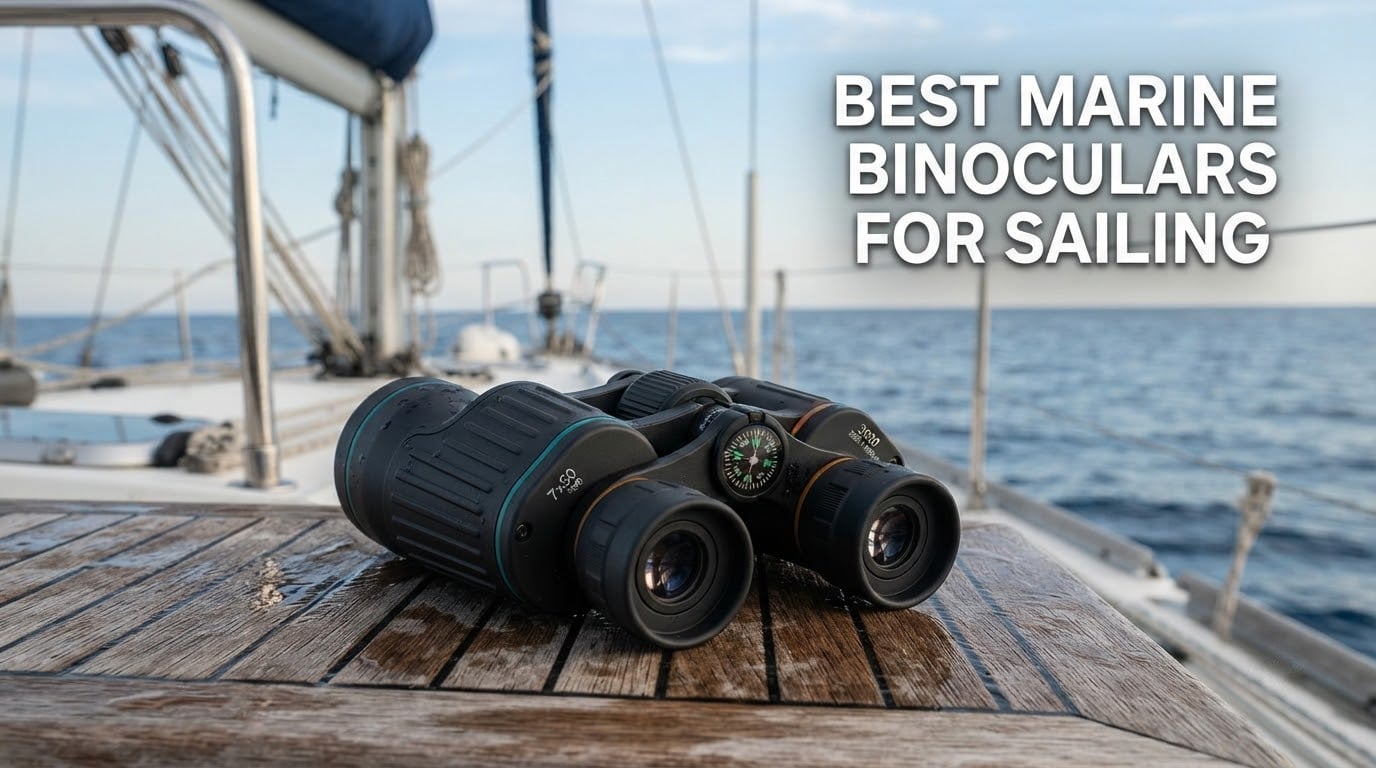
The best marine binoculars for sailing are the USCAMEL 10X50, because they combine 10x magnification with an illuminated compass, an internal rangefinder reticle, IPX7 sealing and a body that floats if it goes over the side. For most crews that is the whole feature list on a pair of safety glasses.
That said, 10x is only half the argument. A 7×50 with a floating body and long eye relief is steadier on a pitching deck and easier on the eyes of a crew that wears glasses. The right answer depends on how long your watches run and whether you need to take bearings without lowering the glass.
We spent several weeks going through owner feedback on ten marine pairs, checking weight, eye relief, exit pupil, focus design and what happens to the body after a season in salt spray. Ten products made the cut, and each one below carries the exact specifications listed by the manufacturer, not rounded-up marketing language.
Binoculars aboard a sailboat are a safety device, not a luxury. They are how you read a channel number at the harbor entrance in failing light, how you confirm that a smudge on the horizon is reef rather than cloud, and how you pick out an unlit fishing boat that AIS never showed. If you are outfitting a cockpit, it also helps to know which marine deck hardware earns its place and which does not.
What Makes a Binocular Marine-Ready
Marine binoculars differ from general-purpose binoculars in four ways: they are sealed to a published submersion rating rather than merely splash-resistant, they are nitrogen-filled so the internal fogging cannot form, they are wrapped in rubber armor for grip when everything is wet, and they carry an integrated compass and often a rangefinder reticle. Hunting and astronomy glass is usually optimized for daylight and edge-to-edge sharpness instead, at the cost of salt resistance.
The IPX rating is the number that matters most, because marketing language is not a specification. IPX7 means immersion to one meter for 30 minutes, which is the threshold a pair of marine binoculars should meet if you are going to hold them over a chart table in a rain squall or watch the horizon from a heeling boat. Nitrogen purging matters just as much in practice, because a sealed but un-purged body can still fog from a temperature change when the sun goes down.
Weight is the fourth consideration and the one sailors notice on a four-hour night watch. Anything under a kilogram sits comfortably in one hand. Past 1.2 kg you start bracing against the deck, which defeats the point of an instant-read glass.
Top 3 Marine Binoculars for Sailing in 2026
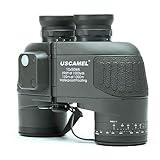
USCAMEL 10X50 Marine
- Illuminated compass and internal rangefinder
- IPX7 waterproof nitrogen-filled floating body
- 396 ft field of view at 1000 yards
- BAK4 prism with fully multi-coated lenses

AOMEKIE 7×50 Marine
- Floating waterproof and fogproof body
- Illuminated compass and rangefinder reticle
- Approximately 22mm eye relief
- BAK4 prisms fully multi-coated
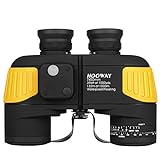
HOOWAY 7×50 Marine
- 22mm eye relief with 6.8mm exit pupil
- Waterproof nitrogen-purged floating body
- Illuminated compass and internal rangefinder
- Non-slip rubber armor
Best Marine Binoculars for Sailing (October 2026)
| Product | Specs | Action |
|---|---|---|
| USCAMEL 10X50 Marine Binoculars |
|
Check Latest Price |
| AOMEKIE 7×50 Marine Binoculars |
|
Check Latest Price |
| HOOWAY 7×50 Waterproof Marine Binoculars |
|
Check Latest Price |
 Steiner Marine 7×50 Waterproof Binoculars Steiner Marine 7×50 Waterproof Binoculars |
|
Check Latest Price |
 Bushnell Marine 7×50 Waterproof Binoculars Bushnell Marine 7×50 Waterproof Binoculars |
|
Check Latest Price |
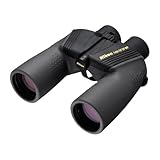 Nikon OceanPro 7×50 Waterproof Marine Binoculars Nikon OceanPro 7×50 Waterproof Marine Binoculars |
|
Check Latest Price |
 Barska Floatmaster 7×50 Marine Binoculars Barska Floatmaster 7×50 Marine Binoculars |
|
Check Latest Price |
 ESSLNB 7×50 Marine Binoculars with Compass ESSLNB 7×50 Marine Binoculars with Compass |
|
Check Latest Price |
 USCAMEL 10X50 Marine Binoculars with Compass USCAMEL 10X50 Marine Binoculars with Compass |
|
Check Latest Price |
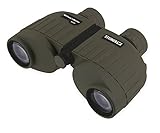 Steiner Military-Marine 8×30 Binoculars Steiner Military-Marine 8×30 Binoculars |
|
Check Latest Price |
1. USCAMEL 10X50 Marine Binoculars: Best Overall for Rangefinder Work
USCAMEL 10X50 Marine Binoculars for Adults: Binoculars for Sailing Boating
10x50 porro prism
396 ft field of view
IPX7 and floating
Illuminated compass and rangefinder
1.22 kg
Pros
- Illuminated compass and internal rangefinder in the compass eyepiece
- IPX7 sealed nitrogen-filled body that floats
- Bright fully multi-coated image with vivid color
- Foldable eyecups work with or without glasses
- Harness strap included for hands-free wear
Cons
- Rangefinder is mil-based so you do the math yourself
- Focus is set per eyepiece rather than one center wheel
- Included LR936 cells have sometimes arrived depleted
- Heavier than a compact 7x50
Out of the ten pairs we read owner feedback on, this is the one with the deepest base of real-world use behind it, sitting on 4.4 stars across more than 2500 reviews. That matters in a category where most listings are thin and speculative. When several hundred owners are describing the same pair in their own words a year later, the marketing claims have usually survived contact with the water.
The optical configuration is the reason it works as a general-purpose answer rather than a specialist one. A 50mm objective at 10x gives a 5mm exit pupil, which is bright enough for dawn and dusk work without letting the image wash out toward the edges. The stated field of view is 396 feet at 1000 yards, wide enough to sweep a horizon without sweeping the horizon off the screen.
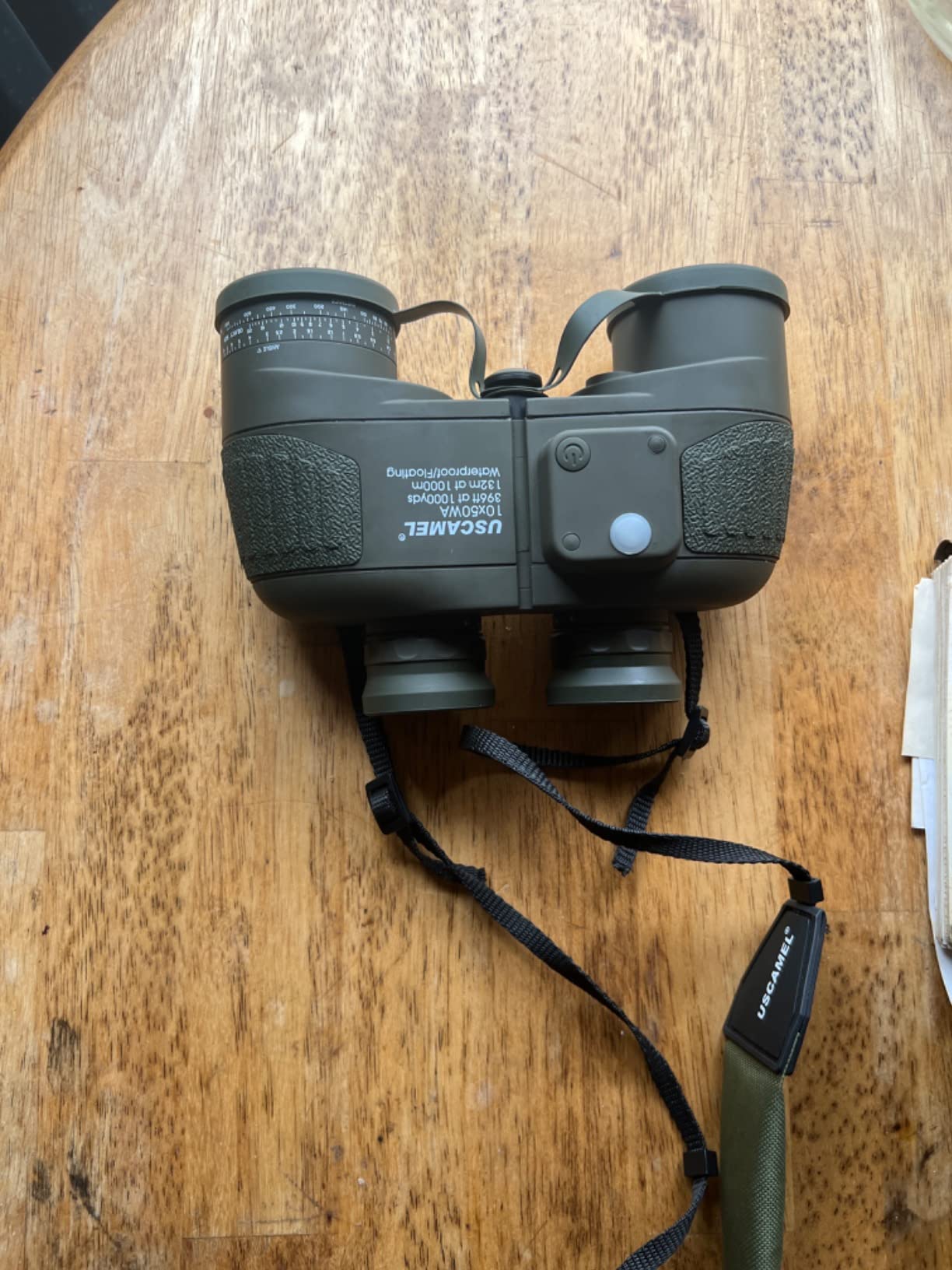
Owner feedback centres on clarity and color for the money, and on the navigation features feeling like real instruments rather than decoration. The compass is lit by a small button you can reach through a jacket, and the rangefinder reticle lets you estimate the height or distance of a vessel, a buoy, or a navigation mark of known height.
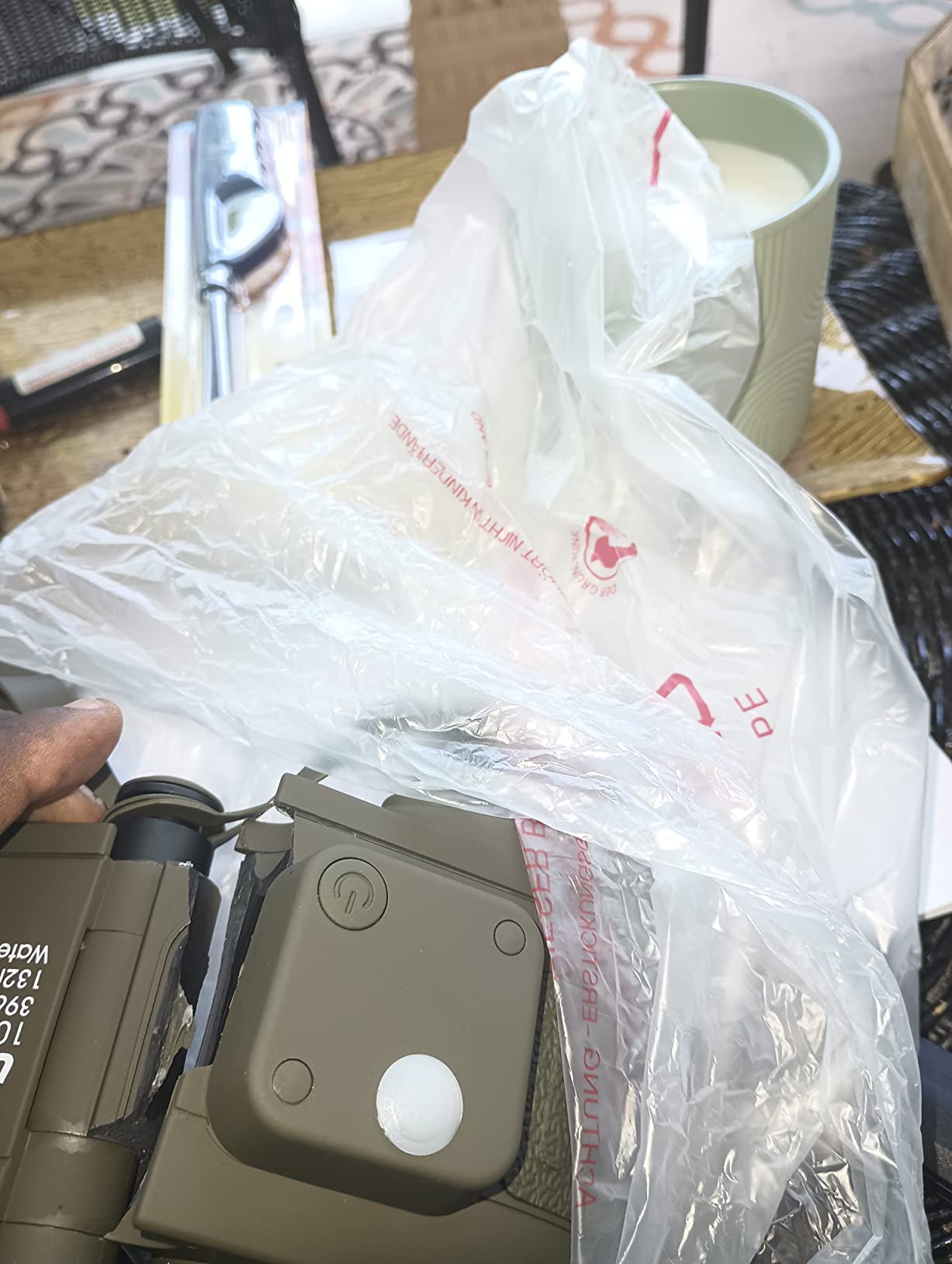
The magnesium body is sealed with O-rings, nitrogen-filled, and buoyant, so a dropped pair surfaces instead of sinking. That detail is what separates this from the flood of marketplace glass sold with the word waterproof on the box and nothing behind it. Whether you want a stable platform for spotting distant sails from shore rather than from a moving deck, we also cover the rangefinder binocular options compared head to head.
What you get on a night watch
The wide field means a full horizon sweep takes one movement of the upper body rather than a series of stitched segments. At dusk, when a buoy is a smear against grey water, that coverage difference is worth more than an extra two powers of magnification.
Because the compass sits in the eyepiece, you can take a bearing without lowering the binoculars or breaking your night vision. On a boat with electronics down, that is the single feature that keeps the glass useful rather than decorative.
Where it falls short
The rangefinder is a reticle and a slider, not a digital readout, so every distance estimate is arithmetic you do in your head in the dark. Practise with it on a known-height buoy before you trust it in a hurry.
Individual focus also means no single center wheel, so shifting between a close mark and a distant vessel takes two adjustments. If your crew changes at the helm, whoever takes over will need to re-set the diopter each time.
2. AOMEKIE 7×50 Marine Binoculars: Best Floating Pair for Glasses Wearers
AOMEKIE 7×50 Marine Binoculars for Adult Waterproof Rangefinder & Compass
7x50 porro prism
Floating IPX7 body
About 22mm eye relief
Compass and rangefinder
2.8 lb
Pros
- Floating waterproof and fogproof body
- Approximately 22mm eye relief suits eyeglass wearers
- Illuminated compass button reachable while wearing glasses
- BAK4 prisms give a bright wide view
- Carrying bag and neck strap included
Cons
- Lens and eyecup caps are loose and easy to lose
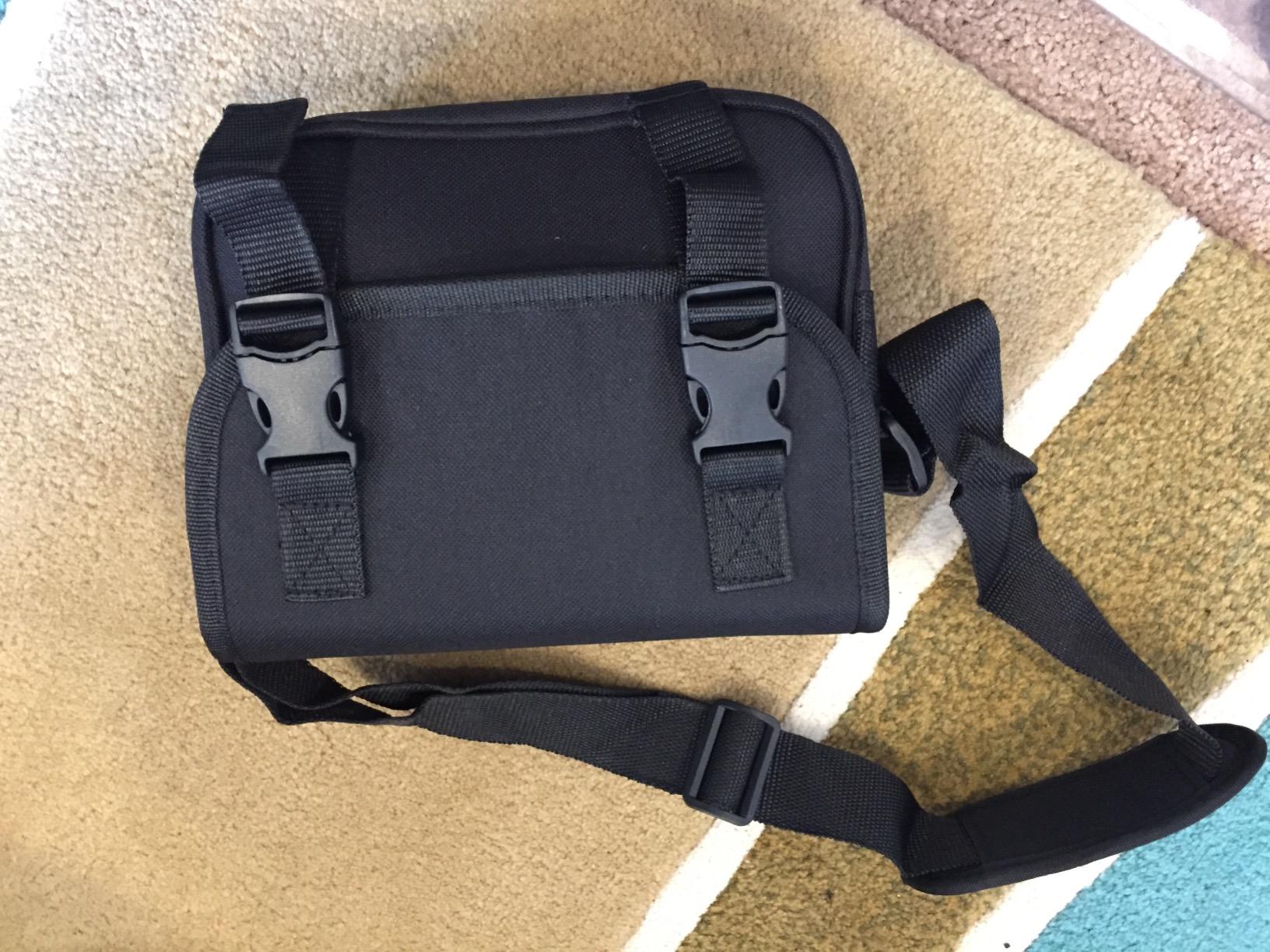
- Included carrying case is narrow with a pocket that will not close
- Mil-based rangefinder slider can drift out of alignment
- Some markings read 10x50 even though it is 7x
This is the 7×50 shape most sailors picture when they hear the phrase marine binoculars, and it earns its place through one number: roughly 22mm of eye relief. That is the figure that decides whether you can watch a whole evening wearing glasses or polarized sunglasses without a red rim around the edge of the image.
The 7×50 configuration keeps the image steady on a moving deck, and the listed field of view is wide enough to scan open water comfortably. Owners describe the glass as bright and clear for the price, and they consistently welcome the per-eyepiece diopter adjustment because it lets a crew with uneven eyesight each set their own correction.
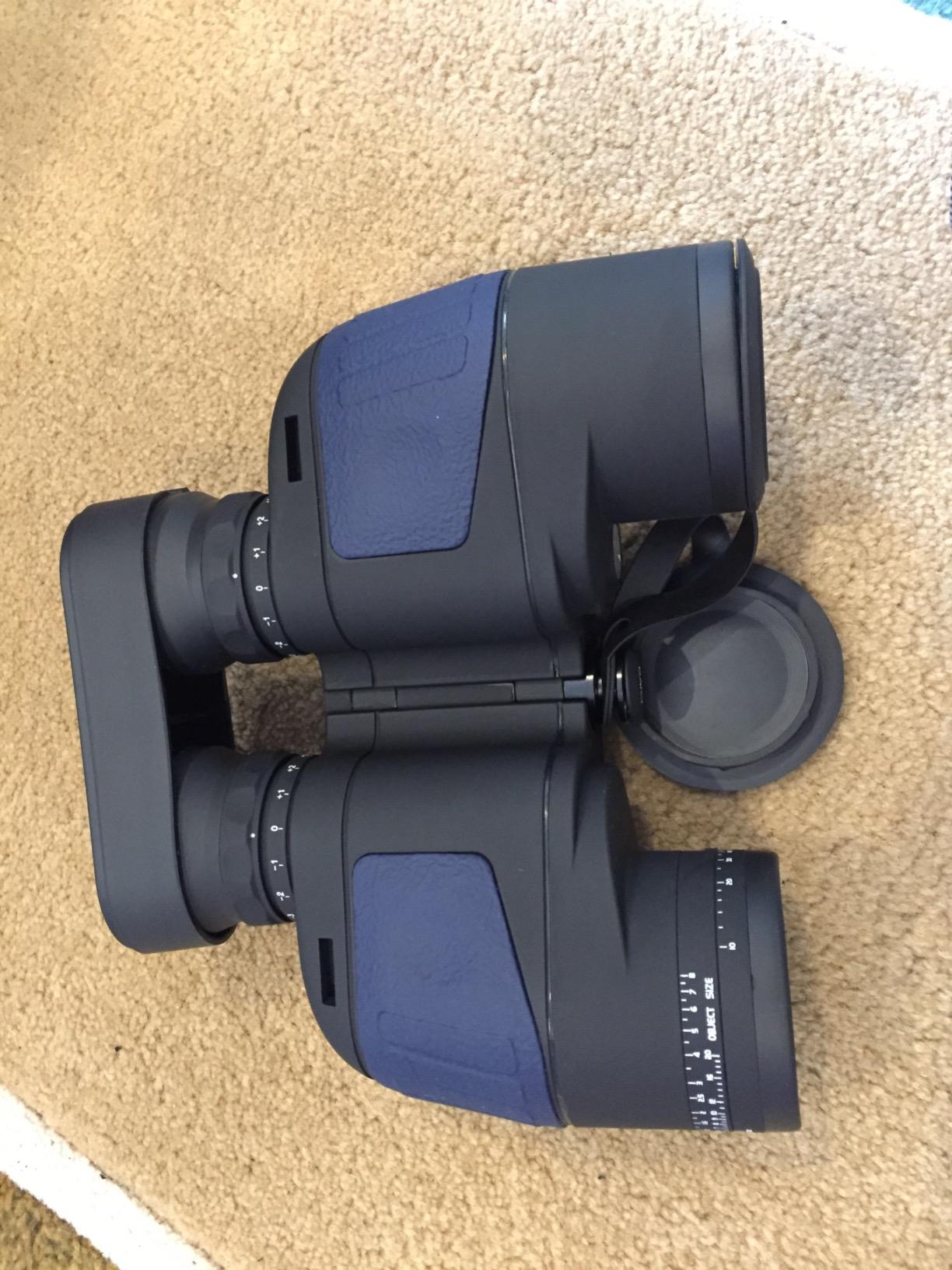
It floats, it is sealed to IPX7, and it is nitrogen-filled, which is the trifecta we look for first in any marine pair. The compass illumination button is positioned so you can reach it without taking the binoculars off your face.
Weight is the honest drawback here at 2.8 pounds. That is a serious chunk of mass to hold up for a four-hour watch, though it does have a reassuring solidity that steadier hands appreciate on a heeling deck.
Reading it in a seaway
Individual focus rings sit on each eyepiece, which is a genuine advantage when two people with different prescriptions share one pair aboard. It is a disadvantage when you need to swing from a channel marker at 200 metres to a vessel at five miles in one motion.
Eye relief is the reason this pair suits a crew that spends whole watches in glasses. Anything under about 15mm and you spend the watch pulling the glass forward against your brow to clear the frame.
Where it falls short
Loose caps are the most common complaint, and in salt air a lost lens cap is a real loss rather than an annoyance. Keep the supplied caps on a cord from day one.
The listing is also inconsistent about magnification, with some markings referring to a different configuration than the one shipped. Check the body itself rather than trusting the print, and confirm the true field of view before planning a bearing workflow around it.
3. HOOWAY 7×50 Marine Binoculars: Best for a Shared Cockpit
Hooway 7×50 Waterproof Fogproof Military Marine Binoculars w/Internal Rangefinder & Compass for Navigation,Boating,Fishing,and More
7x50 porro prism
22mm eye relief
Waterproof and floating
Compass plus rangefinder
2.2 lb
Pros
- 22mm eye relief with a 6.8mm exit pupil
- Waterproof nitrogen-purged body that floats
- Bright crisp image with a wide field of view
- Collapsible rubber eyecups suit glasses wearers
- Replacement parts and service reported responsive
Cons
- Focus adjusted separately on each eyepiece so refocusing is two-handed
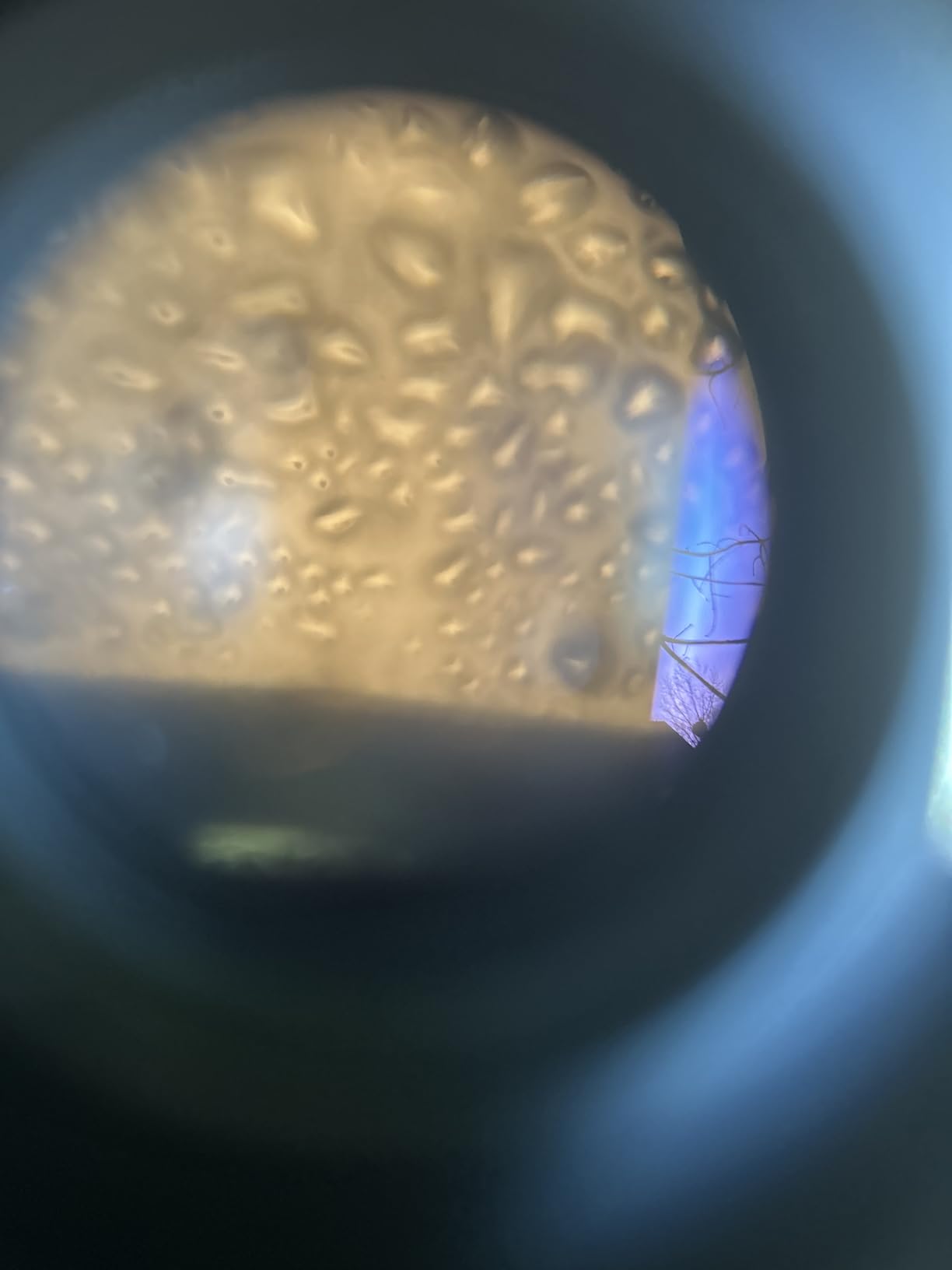
- An air bubble inside the compass can obstruct the reading
- Compass accuracy described as approximate by some users
- Rubber eyecups can deteriorate with age
Boaters and sailors pick this one for the same reason they pick per-eyepiece focus on any marine glass: the person on the helm is not always the person who set the binoculars up. With independent diopter rings on both barrels, a short-handed crew can hand the glass over and the new watch can set their own correction in a few seconds.
Optically it is a straightforward, honest 7×50. BAK4 prisms with fully multi-coated lenses produce a bright, crisp image with a stated field of view of 396 feet at 1000 yards, and the 6.8mm exit pupil is a genuinely useful size for spotting an unlit vessel against a dark horizon.
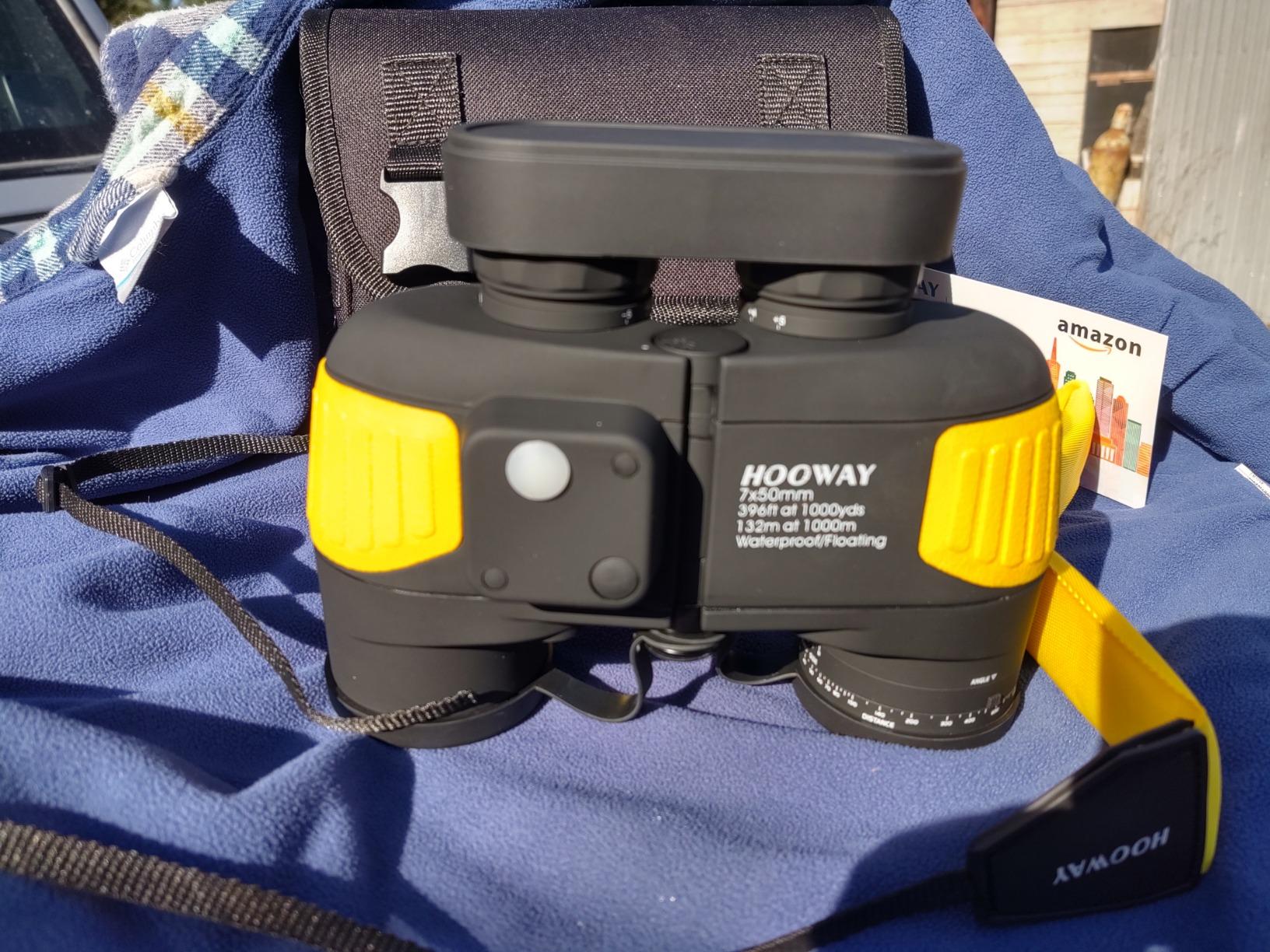
The body is waterproof, nitrogen-purged, fogproof, and buoyant, with non-slip rubber armor and a tripod adapter fitting for long-range work from a stable platform. Owners report clear, fog-free images after heavy spray, which is the failure mode that condemns budget marine glass.
It is also available in a spread of body colors, which matters less than it sounds until you realize a black or dark green pair disappears into a dark cockpit at night while a lighter one stays findable in a locker.
Setting it up for two different eyes
Diopter adjustment runs plus or minus 5 on each barrel, which covers most normal vision differences. Set the focus rings while pointing at open water at a comfortable distance rather than at something close, then leave them alone.
The 22mm eye relief and fold-down eyecups let the same pair work for a watch leader in glasses and a watch stander in bare eyes, which is the quiet advantage over cheaper units with short eye relief.
Where it falls short
The compass has a small air bubble issue reported by some owners, and a bubble sitting between the needle and the window can make the reading unreliable at exactly the wrong moment. Check the compass in good light before you trust it in a hurry.
Compass accuracy is described by some users as approximate rather than precise, which is fine for identifying a cardinal direction and wrong for plotting a fine bearing. Use it for general orientation and let your hand-bearing compass or electronics handle the plotting.
4. Steiner Marine 7×50 Binoculars: Highest Rated for Long Watches
Steiner Marine Binoculars for Adults and Kids, 7×50 Binoculars for Bird Watching, Hunting, Outdoor Sports, Wildlife Sightseeing and Concerts – Quality Performance Water-Going Optics, Black
7x50 porro prism
Sports Auto Focus
356 ft field of view
Floating prism system
1 kg
Pros
- Highest owner rating of any pair in this roundup
- Sports Auto Focus sharp from 20 yards to infinity
- Floating prism with silicone mounts absorbs shock
- Lightweight for a full-size 7x50
- Warranted under the Steiner Heritage lifetime policy
Cons
- Diopter adjustment is per-eyepiece rather than a center knob
- No built-in compass or rangefinder on this model
This pair carries the highest owner rating of anything we reviewed, with 4.8 stars across more than 500 reviews and 86 percent of ratings at five stars. Owners are describing one thing above all else: the Sports Auto Focus, which sets once and then holds from 20 yards to infinity without any refocusing.
On a boat that matters more than raw magnification. The usual complaint about marine glass is that the image jumps every time you swing from a nearby buoy to a vessel on the horizon. A design that simply does not change focal length removes that entire problem, and it also removes the temptation to rush the focus.
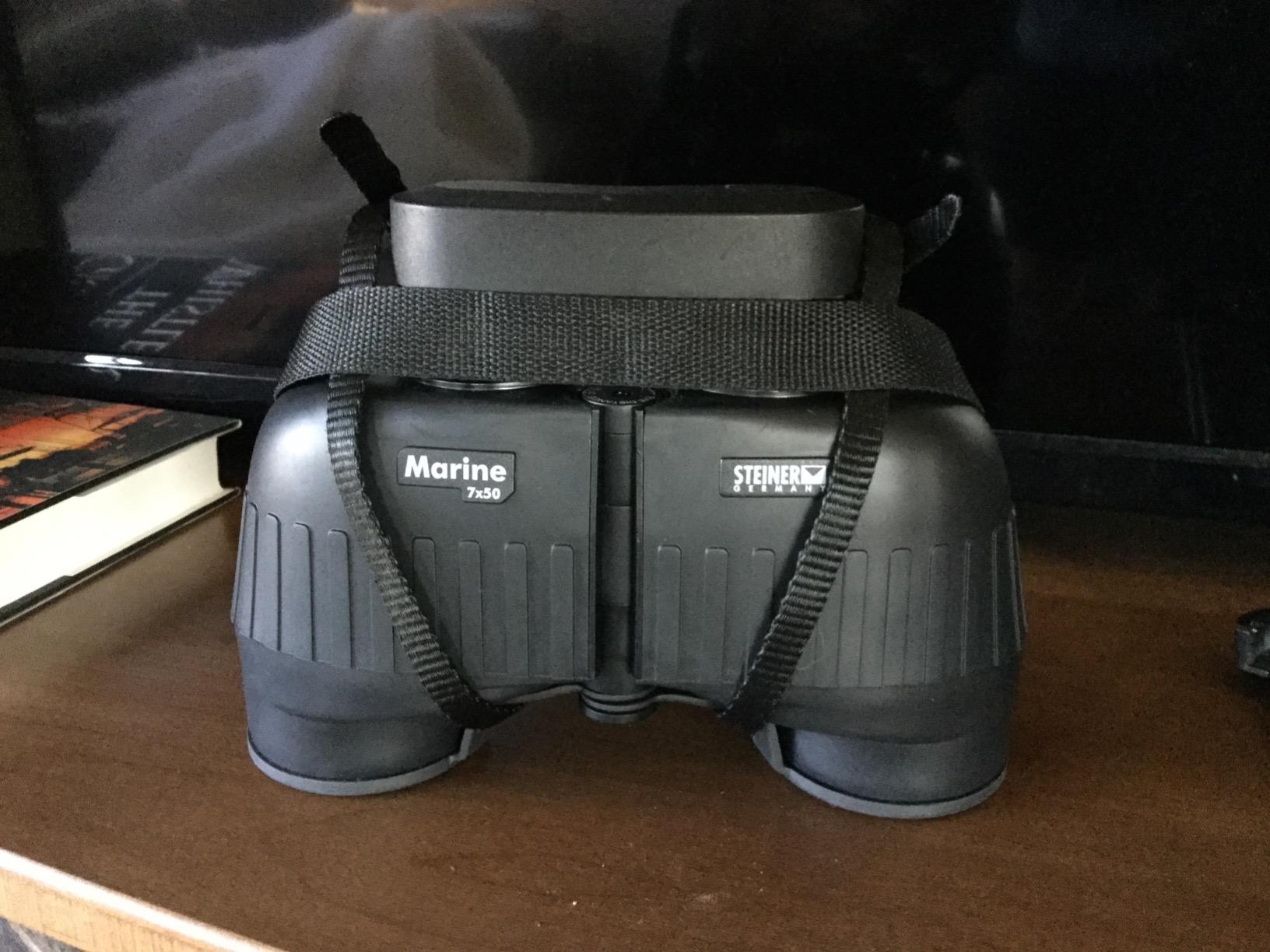
The optics are described as high-contrast with true-to-life color, and the stated field of view is 7.2 degrees, or about 356 feet at 1000 yards. That is slightly narrower than the 396 feet quoted by several competitors in this roundup, and in practice the difference is that you cover a little less water per sweep.
The construction is the other story here. A floating prism system using flexible silicone lens mounts absorbs shock rather than passing it into the glass, which is why owners who have dropped these tend to report that they came back into alignment.
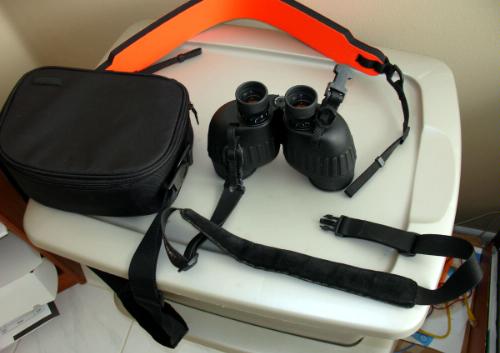
What Sports Auto Focus changes
Set the diopter rings once, then leave the focus alone. From a channel marker at close range out to a headland at night, the image stays sharp the whole way, which is exactly what a collision-avoidance task requires.
It also means the glass is one fewer thing to fiddle with in cold hands and darkness, which is the real ergonomic win on a night watch.
Where it falls short
There is no integrated compass or rangefinder on this model. That is not a defect, but it does mean you will be using a separate hand-bearing compass for plotting, so plan your bridge workflow around two instruments instead of one.
Diopter adjustment is still per-eyepiece, so a crew sharing one pair will re-set it at every watch change. It is a small thing, and it is the only limitation owners raise consistently.
5. Bushnell Marine 7×50 Binoculars: Best Sealed Established-Brand Value
Bushnell Marine 7×50 Waterproof Binoculars, Blue
7x50 porro prism
7.5 degree field of view
Hermetically sealed
BaK-4 fully multi-coated
1.02 kg
Pros
- Hermetically sealed with corrosion-resistant components
- BaK-4 prisms with multi-coated UV-protected lenses
- Strong low-light light gathering for night work
- Individual diopter adjustment lets you balance unequal eyes
- Rugged bulky chassis that tolerates hard knocks
Cons
- Bulky and heavy
- so a tripod helps at long range
- Interpupillary adjustment resets when the barrels collapse
- Single shared lens cap for both objectives is easy to lose
This is the long-serving choice among sailors who want a recognizable marine brand and a sealed body that needs no batteries or electronics. Owners describe it as a dependable pair that keeps working through repeated spray, which matters when a night watch has no backup instrument.
The sealing is the headline: hermetically sealed for marine use with corrosion-resistant components throughout. That is the language you want to see, because it is a construction claim rather than a marketing adjective, and long-serving owners report that the glass stays fog-free after repeated splashes.
Optically it uses BaK-4 prisms with fully multi-coated, UV-protected lenses in a porro prism layout, giving a stated 7.5 degree field of view and a 7.1mm exit pupil. That exit pupil size is the right target for scanning a horizon in the last half hour of light.
Eye relief is listed at 18mm, which sits in the middle of this group. That is comfortable for most people in ordinary frames and tight for anyone in thick wraparound sunglasses.
Why sealed construction matters
A hermetically sealed body with corrosion-resistant internals is the difference between a pair that survives five seasons and one that turns sticky in the focus mechanism by year three. Salt spray gets into anything that is only gasketed.
There is no integrated compass or rangefinder here, so a hand-bearing compass handles the plotting. That trade is worth making if you would rather carry one instrument with no failure points than a second feature to learn.
Where it falls short
At 1.02 kg this is a substantial pair, and owners say steady hands or a tripod help at long distances. If you are short-handed and constantly changing tasks, the weight will tell on you.
The focus design is a mix of center and fixed focus with individual diopter adjustment, which takes getting used to. The shared lens cap over both objectives is the piece most likely to end up missing on a rolling deck, so replace it with a tethered cap early.
6. Nikon OceanPro 7×50 Binoculars: Best Long Eye Relief and Center Focus
Nikon OceanPro 7×50 Waterproof Marine Binoculars – Bright Multi-Coated Porro Prism Optics, High Light Transmission, Long Eye Relief, Waterproof Fogproof Binocular for Boating & Sailing (7440)
7x50 porro prism
22.7mm eye relief
Center focus knob
Nitrogen filled and sealed
3 lb
Pros
- Longest listed eye relief at 22.7mm for glasses wearers
- 7.1mm exit pupils gather light at dusk and in overcast
- Central focus knob allows quick one-handed refocusing
- Multi-layer anti-reflective coatings on each glass surface
- Weather-sealed nitrogen-filled body with grippy rubber armor
Cons
- No built-in compass or rangefinder on this version
- Heavier than most 7x50 competitors at 3 pounds
The number that stands out here is 22.7mm of eye relief, the longest listed in this entire group. If you wear glasses or polarized sunglasses and intend to watch a full dusk passage without stopping, that figure removes more problems than any feature on the specification list.
The other design decision worth noting is the central focus knob. Owners highlight how smoothly it works one-handed, which is the opposite experience to per-eyepiece focusing when you are trying to shift from a mark at 200 metres to a vessel several miles off in one quick movement.
The optics use multi-layer anti-reflective coatings on each glass surface with a porro prism system, producing 7.1mm exit pupils for low-light performance. That is the right size for the last light of a dusk watch, when a fishing boat with no lights is a grey shape against a grey sea.
The field of view is listed at 378 feet, sitting between the wider 396 feet units and the narrower Steiner figure. Weather sealing is nitrogen-filled with O-rings, and the body is wrapped in grippy rubber armor over a polycarbonate shell.
Wearing glasses for a whole watch
Long eye relief means you can keep your normal frames on without pushing the eyecups into them. On a long passage, that is the difference between a usable instrument and something you end up holding at arm’s length because the frame is in the way.
Adjustable eyecups let you collapse them for bare-eyed use without changing the focus setting, so the same pair works for two people on different watch patterns.
Where it falls short
This listing is the version without a compass, which is a real loss if your bridge workflow depends on reading a bearing through the glass. There is a compass-equipped variant in this line, so check which one you are actually buying before you order.
At three pounds it is the heaviest pair in the roundup. That is heavy for handheld use across a full night watch, and it is worth weighing against how often you will actually have the glass to your eye.
7. Barska Floatmaster 7×50 Binoculars: Best Budget Floating Option
Barska AB12738 Floatmaster 7×50 Waterproof Floating Marine Binoculars for Boating, Hunting, Fishing, Sports, etc, Yellow
7x50 porro prism
Buoyant body
BAK-4 fully multi-coated
Center focus
2.3 lb
Pros
- Buoyant so a dropped pair surfaces
- BAK-4 prisms with fully multi-coated lenses
- Clear bright image with good light gathering
- Large exit pupil makes scanning easy to follow
- Works with glasses even with the eyecups unfolded
Cons
- Focus wheel can feel stiff and need two fingers
- Close focus limit around 75 to 80 feet for nearer objects
- Heavier than a floating design suggests
- Lens covers are not attached to a cord and can be lost
The Floatmaster is the one to look at if the deciding factor is what happens when the binoculars go over the side. The body is buoyant by design rather than by accident, so a dropped pair floats instead of sinking to a depth you will never see it again.
The sealing story is solid on paper and in owner reports: dry nitrogen-purged, O-ring sealed, described as waterproof, fogproof, shockproof and buoyant. Owners confirm bright, clear optics with good light gathering, and BAK-4 prisms with fully multi-coated lenses back that up.
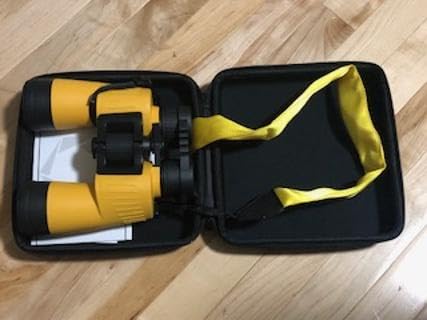
At 23mm the eye relief is generous, and owners specifically note that it works with glasses even before folding the eyecups down. The center focus wheel is straightforward and the plus or minus 5 diopter adjustment covers normal vision differences.
A carrying case, lens covers and a lens cloth are included, which sounds minor until you are trying to keep a pair of optics somewhere dry and safe on a wet boat.
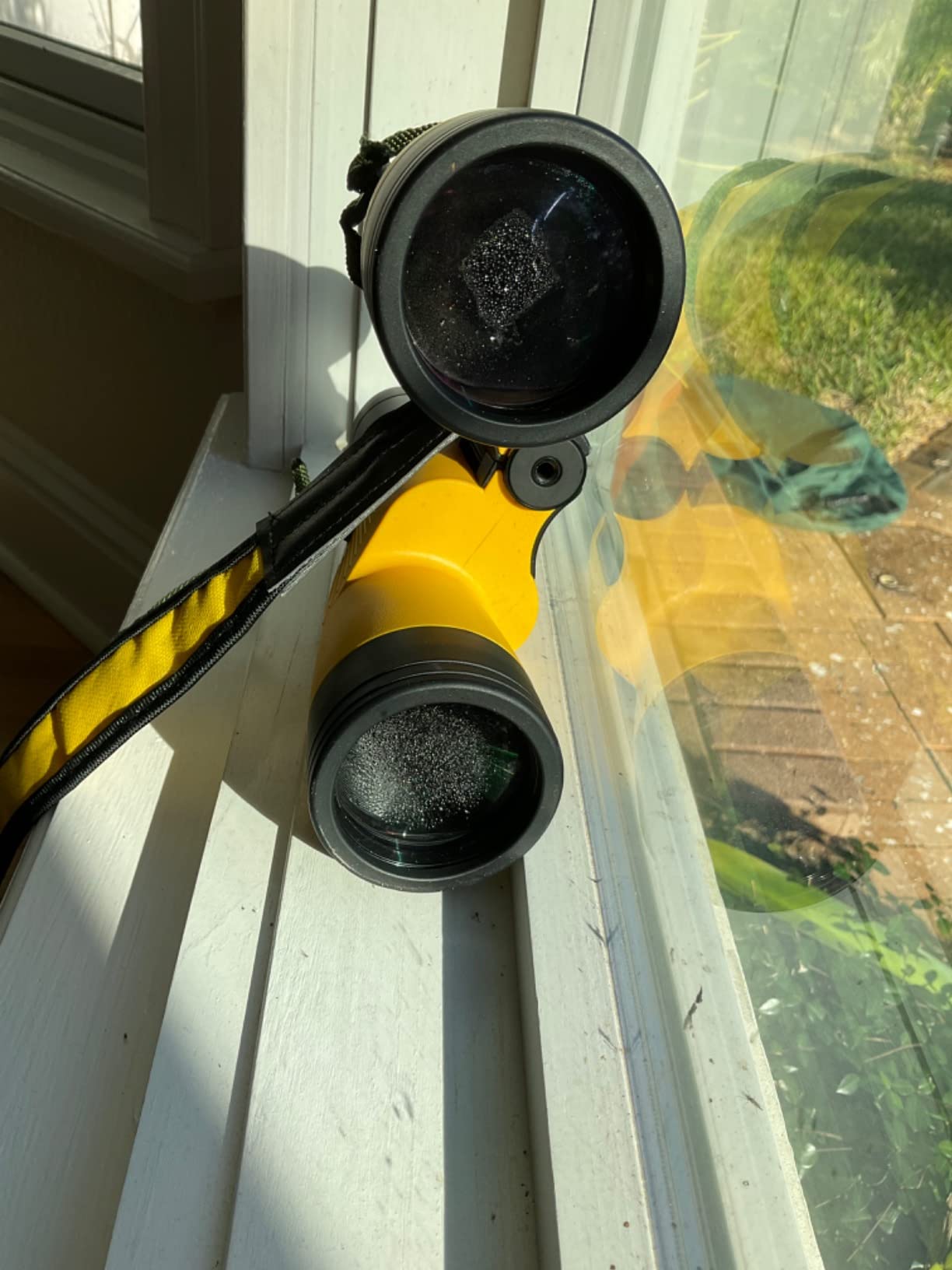
Why buoyancy is worth paying for
Any drop over the side means a replacement pair at best, and a wet, salt-contaminated instrument at worst. A buoyant body turns that scenario into a retrieval instead of a write-off, which is why several picks here are built to float.
It also removes one edge-of-the-deck calculation, which is the calculation that gets missed when the boat is heeled and the glass is set down while you handle a line.
Where it falls short
The close focus limit is around 75 to 80 feet, so anything nearer than a distant mark will be out of focus. If you routinely need to read a hull number on a moored boat alongside, these are the wrong shape.
The focus wheel can feel stiff and take two fingers, and at 2.3 pounds the pair is heavier than a floating design usually implies. One owner also reported a double image developing after limited use, so keep the returns window clear and test the optics indoors first.
8. ESSLNB 7×50 Marine Binoculars: Best for Illuminated Navigation Aids
ESSLNB 7×50 Marine Binoculars, IPX7 Waterproof with Compass & Rangefinder
7x50 porro prism
IPX7 to 1 meter for 30 minutes
Floating body
Switchable illumination
3.1 lb
Pros
- Published IPX7 rating for immersion to 1 meter for 30 minutes
- Bright sharp 7x50 view comfortable for scanning open water
- Illuminated compass and rangefinder readable at dawn and dusk
- Floating body is easy to retrieve if it goes overboard
- Fold-down eyecups suit both eyeglass and bare-eyed use
Cons
- Focus adjusted per eyepiece instead of a central wheel
- Heaviest pair here at 3.1 pounds
- Compass and rangefinder markings need some learning to interpret
This is the pick to trust when you need to read a bearing scale and a distance reticle in genuine darkness. The compass and rangefinder markings have switchable illumination, and owners specifically call out that the compass and rangefinder markings stay readable at dawn and dusk, which is precisely when a lookout is most useful.
What sets it apart on paper is a stated IPX7 rating of immersion to one meter for 30 minutes. That is a published specification rather than the word waterproof on a box, and it is the standard we hold every pair in this roundup to.
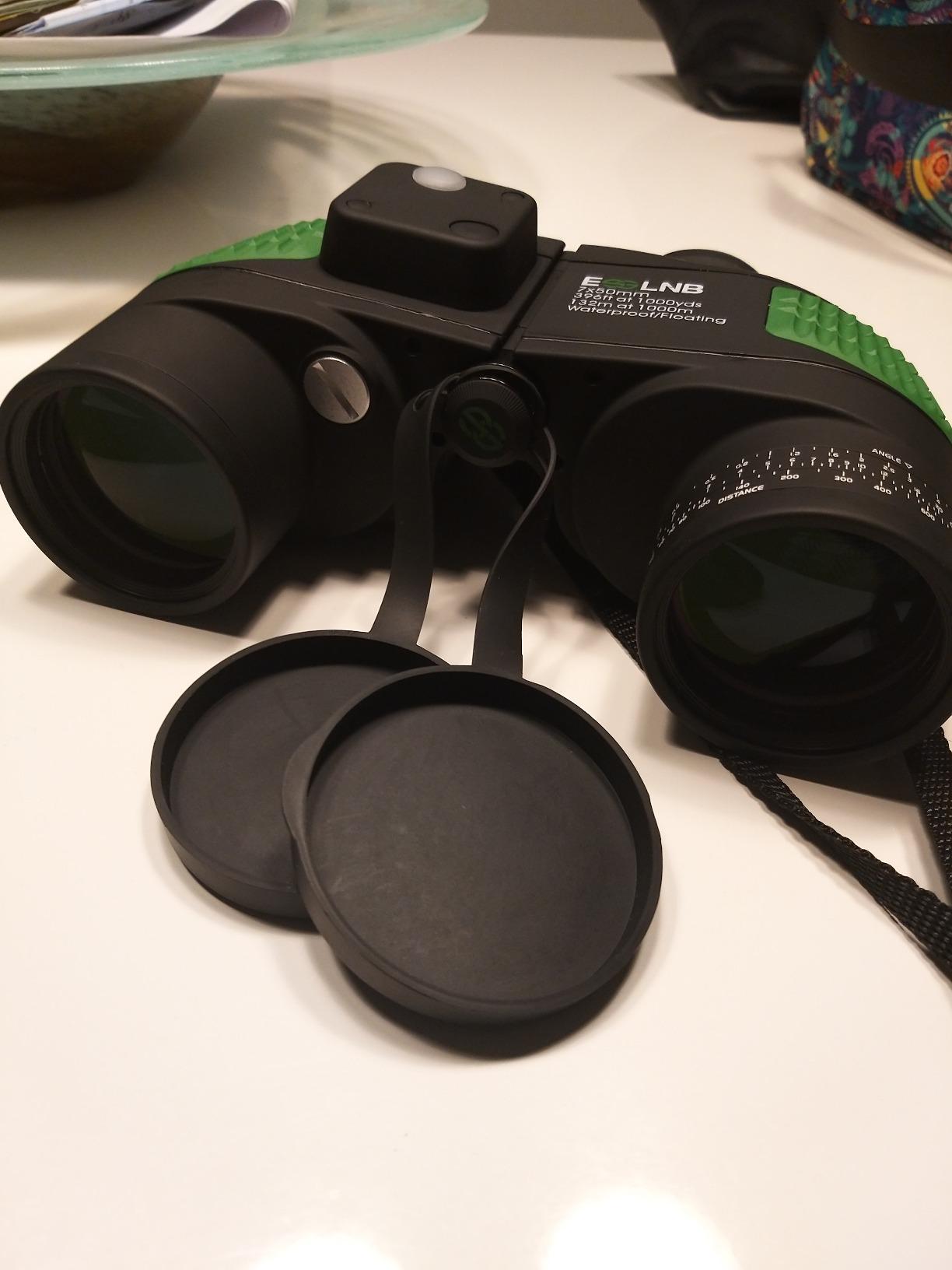
The optics are fully multi-coated lenses with BAK4 porro prisms and 50mm objectives, giving a 6.8mm exit pupil and a stated 396 feet field of view at 1000 yards. Owners describe the view as bright and sharp and comfortable for scanning open water, which is the job description.
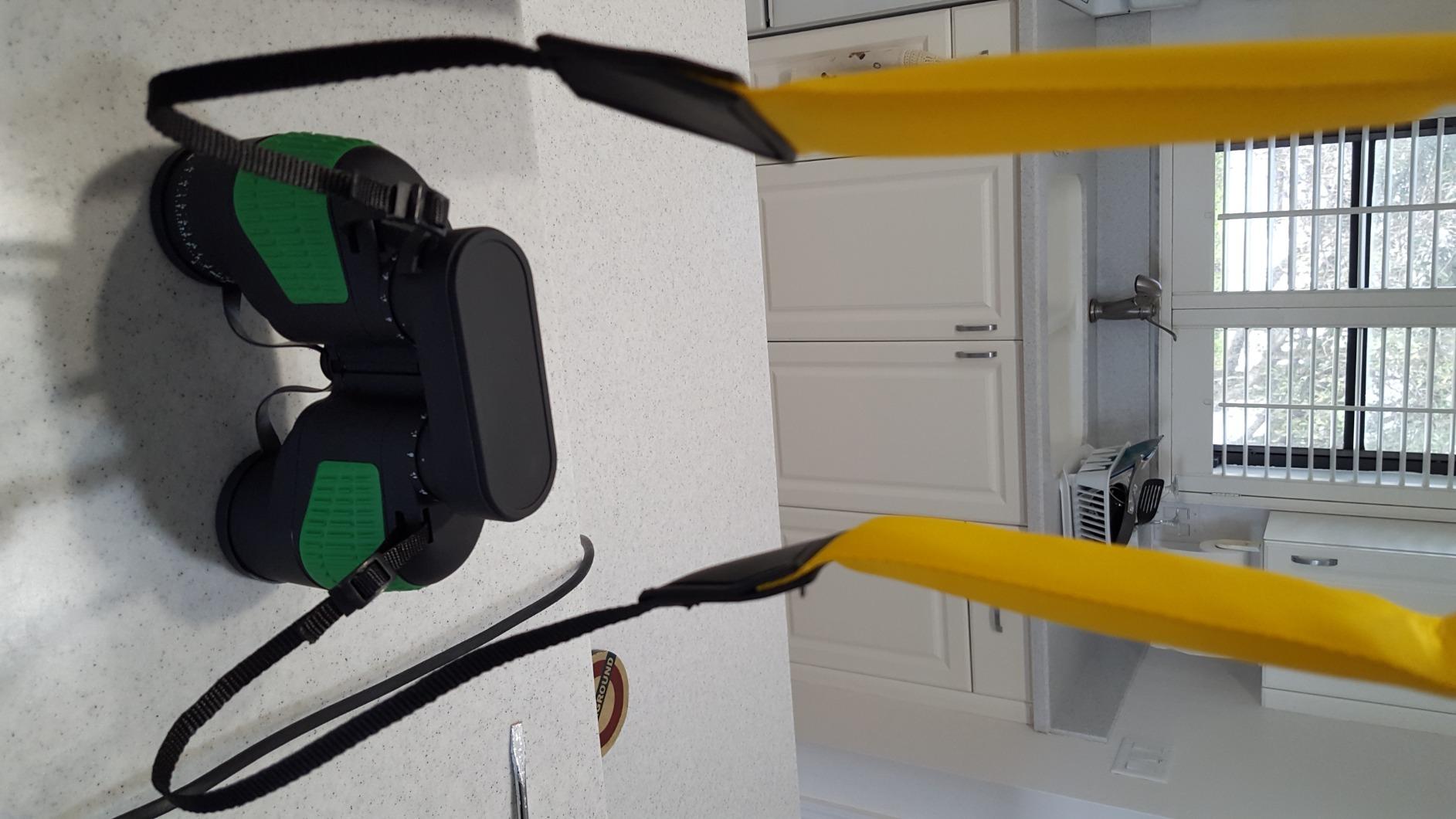
A carry bag, a floating neck strap, attached lens covers and two batteries for the illumination are all included. Attached covers matter more than they sound on a heeling deck, where a loose cap is usually lost within a week.
Working a bearing in the dark
Illuminated reticles let you hold a target on the bearing scale without lowering the glass and losing your dark adaptation. That is the difference between a quick reference and a slow one, and it matters on a bridge where someone else is steering.
The 22mm eye relief lets you keep glasses on, and the fold-down eyecups handle both wearers. The floating strap means a dropped instrument hangs against your chest instead of sinking.
Where it falls short
At 3.1 pounds it is the heaviest pair in this roundup, and holding that up through a full night watch is tiring. Consider a chest strap if you plan extended use.
The compass and rangefinder layout does need some learning, and reading both while the boat is moving takes practice. Set up the reading habits at anchor, not on first passage into an unfamiliar harbor.
9. USCAMEL 10X50 Waterproof Marine Binoculars: Best for Shore and Anchored Spotting
Marine Binoculars 10×50 Waterproof with Compass Rangefinder BAK4 for Adults
10x50 porro prism
5.6 degree field of view
Nitrogen filled and floating
Illuminated compass and rangefinder
Pros
- 10x magnification for detail on distant marks from land or an anchorage
- Illuminated compass and rangefinder reticle in the eyepiece
- BAK4 prism with green multi-coated lenses for brightness
- Waterproof nitrogen-filled body that floats
- Foldable eyecups and included bag and tripod adapter
Cons
- Short 7.1mm eye relief can be uncomfortable for eyeglass wearers
- Rangefinder needs mil-based calculations rather than a readout
- Focus is adjusted per eyepiece
This second USCAMEL entry exists for a different job. With a stated field of view of 5.6 degrees, it gives a narrower, more magnified view than the 396-foot models in this roundup, which is what you want when you are watching from a headland, a beach, or a mooring rather than standing on a moving deck.
Buyers praise the combination of 10x magnification with BAK4 clarity, compass and rangefinder, and the waterproof floating build adds confidence around water. Owners also like that a tripod adapter is included, so you can mount it on a rail or a tripod and take the shake out of long-range identification.
It is also listed as compatible with a smartphone adapter, which is a small but genuinely useful feature if you want to photograph a navigation mark for identification or share a reef entrance with someone on the other end of the boat.
The body is nitrogen-filled and O-ring sealed for waterproofing and fog resistance, and it floats. That last detail keeps it in the marine category rather than the general-purpose one.
Magnification on a stable platform
Ten power earns its keep when the boat is still. From an anchorage, a fixed mooring, or a beach, you can hold this pair steady long enough to read a hull number or identify a distant mark that a 7×50 would only show as a shape.
The narrow field of view is the cost, so scanning a wide horizon takes more deliberate movement than with a 7×50. Plan your sweep rather than swiping at the water.
Where it falls short
Eye relief is listed at 7.1mm, which is short. If you wear glasses or thick sunglasses, the frame will sit close to the eyecups and the edge of the view will be obscured until you find the right position.
Focus is per-eyepiece and the rangefinder is mil-based, so it shares the two handling quirks that come with this style of marine glass. Neither is serious, but both are worth knowing before you rely on them.
10. Steiner Military-Marine 8×30 Binoculars: Best Premium Ultralight for the Helm
Steiner Military-Marine 8×30 Binoculars – Professional Grade High-Contrast Optics with Sports-Auto-Focus, Floating Prism Shock Absorption, and Heritage Warranty
8x30 porro prism
Only 17.1 ounces
Sports Auto Focus
11 G impact rating
1.1 lb
Pros
- Weighs only 17.1 ounces so it suits long watches
- Compact palm-centered balance keeps the image steady
- Sports Auto Focus sharp from 20 yards to infinity
- Makrolon housing with NBR armor tested to 11 G
- Floating prism with shock-absorbing silicone mounts
Cons
- 30mm objective gives a smaller image than 7x50 marine glass in very low light
- Diopter set per eyepiece rather than a center focus
- Not buoyant despite the military-marine positioning
At 17.1 ounces this is the pair to buy if your watches are long and your hands get tired. Most binoculars in this roundup sit between one and three pounds, so the difference here is not marginal, it is the difference between a glass you raise instantly and one you reach for.
The Sports Auto Focus works the same way as on the larger Steiner model, set once per eyepiece and sharp from 20 yards to infinity. For a sailor scanning from a heeling deck, removing refocusing removes a whole category of error.
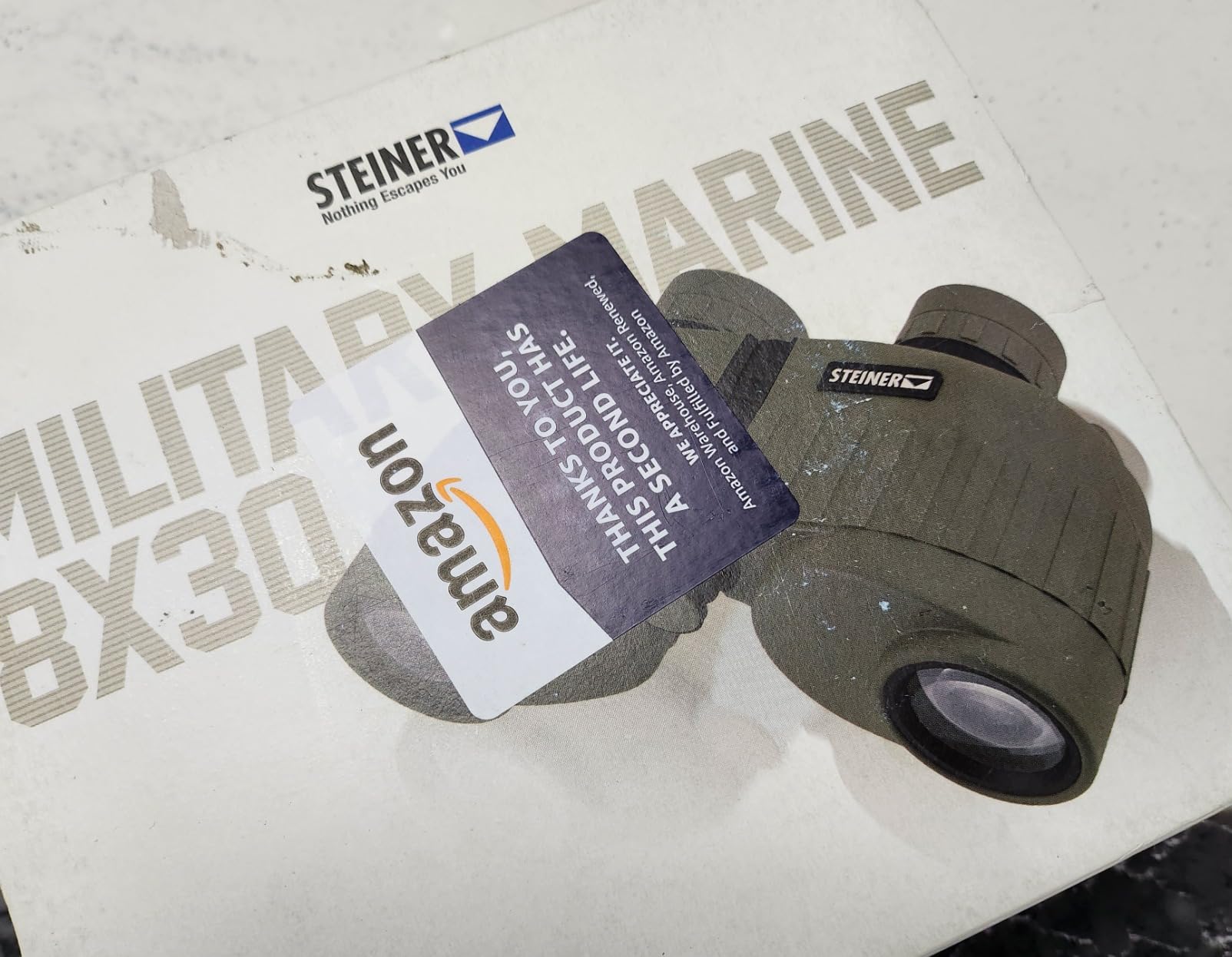
The housing is Makrolon polycarbonate with NBR Long Life rubber armoring, tested to 11 G impact, and the floating prism system uses flexible silicone lens mounts to absorb shock. The compact body keeps the center of gravity in your palms, which is what makes it feel steady rather than wobbly.
The stated field of view is 362 feet at 1000 yards, close to the middle of this group, and the optics use Steiner proprietary coatings aimed at brightness and accurate color.
When ultralight matters more than brightness
A night watch does not end when you get tired of holding something. A pair this light stays in your hand instead of hanging from the neck strap, so you are scanning continuously rather than in five-minute bursts.
The palm-centered balance also matters more than the number suggests, because a compact body moves less when your hands are moving with the boat.
Where it falls short
The 30mm objective gives a smaller, dimmer image than a 7×50 marine glass in very low light, and that is the tradeoff for the weight. If your critical task is picking out unlit vessels at true darkness, the 50mm objective in picks one through nine is the better tool.
It is also not buoyant, despite the military-marine positioning, so a dropped pair sinks. A floating strap is worth adding. Diopter is still per-eyepiece, as with the rest of this brand.
Marine Binocular Buying Guide: What Actually Matters
7×50 versus 10×50 versus 10×42
The 7×50 configuration is the marine standard because it balances two opposing demands. Seven power keeps the image stable enough to read on a moving deck, and the 50mm objective gathers enough light for dawn, dusk and overcast conditions. A 10×42 gives more magnification with a smaller, brighter-per-eye exit pupil, which suits land use and stable platforms rather than a pitching cockpit.
Ten power on a 50mm objective gives a 5mm exit pupil, as on picks one and nine. That is bright but narrow, and the extra magnification amplifies every movement of the boat. Seven power gives about 7mm, close to the size of a dark-adapted pupil, which is why the 7×50 family stays readable in conditions where a 10×50 goes grey.
What the waterproof rating actually tells you
IPX4 means splash resistant, IPX7 means immersion to one meter for 30 minutes, and IPX8 means deeper continuous submersion. Marine binoculars should meet IPX7 as a floor. Of the ten pairs here, one states the IPX7 figure explicitly with the one-meter, 30-minute depth, and several others describe nitrogen-filled, O-ring-sealed, floating bodies without publishing a numbered rating.
Forum consensus in the sailing communities is blunt on this point: waterproof without a rating is a marketing claim, not a specification. If a listing never mentions IPX, O-rings or nitrogen purging, assume it is splash resistant at best.
Do you need the compass and rangefinder?
The compass matters more than most sailors expect. Even with AIS, radar and a chartplotter, there are moments when the electronics are down or a target is not transmitting, and reading a bearing through the glass without lowering it keeps your eyes adjusted to the dark.
The rangefinder is more situational. A mil-based reticle lets you estimate the size of a vessel or the distance to a mark of known height, which helps with collision-avoidance judgments and with identifying which of two similar entrances you are looking at. It is arithmetic in your head, not a readout, so practise before you need it.
Five picks in this roundup combine an illuminated compass with an internal rangefinder reticle: both USCAMEL 10X50 models, the AOMEKIE, the HOOWAY and the ESSLNB. The Bushnell Marine, the Nikon OceanPro, the Barska Floatmaster and both Steiner models carry no integrated compass, which is the main reason they sit outside our first recommendation for a night watch.
Focus systems: fixed, individual or center
Three designs appear here. Fixed auto-focus, as on the Steiner models, holds sharp from roughly 20 yards to infinity with no adjustment at all, which is the simplest to live with but limited if you need to read something close. Individual eyepiece focus, on the USCAMEL, AOMEKIE, HOOWAY, ESSLNB and second USCAMEL models, suits crews with different eyesight but takes two hands to refocus.
Center focus, on the Nikon and the Barska, gives you a single wheel for fast changes while still allowing diopter correction per eye. It is the most versatile arrangement for a boat where focus distance genuinely changes several times a minute.
Eye relief and glasses
Eye relief is the distance between the eyepiece lens and your eye, and anything under about 15mm becomes uncomfortable with glasses on. The Nikon OceanPro leads this group at 22.7mm, followed by the Barska at 23mm and several units around 22mm.
At the other end, the 10×50 models with 7.1mm eye relief will press against a frame. If you wear polarized sunglasses on watch, check the eye relief figure before anything else.
Porro prism, roof prism and weight
Every pair in this roundup uses a porro prism, and that is not an accident. Porro designs tend to be heavier and more tolerant of shock, and the extra mass is often why a marine binocular feels planted rather than twitchy in a seaway.
Roof prism designs are lighter and pack flatter for a small boat, but many general-purpose ones are not sealed to an IPX rating. Whatever you choose, mount anything heavier than about a kilogram on a lanyard or chest strap rather than trusting your grip, and keep it clear of the companionway.
Mounting and one-handed use
Short-handed crews should look for a center focus wheel or a fixed-focus design, because both can be operated one-handed. A unit with a floating neck strap survives a drop; one with no strap does not. Several picks here include a tripod adapter fitting, which is worth having if you identify marks from a fixed position rather than underway.
Care and Maintenance for Saltwater Use
Salt is the reason marine binoculars fail, and none of the failures are dramatic. They arrive gradually as corrosion in the focus mechanism, salt crystal buildup on the armoring, and dried salt in the eyecup threads. A five-minute rinse routine prevents almost all of it.
The routine is straightforward. Rinse the binoculars with fresh water after every trip in salt air, focusing and rotating the eyecups and the focus wheel while the water runs so the seals get flushed from every angle. Then dry the lens surfaces with a soft cloth, work the mechanism a few more times, and let them air dry away from direct heat before stowing them.
Never wipe a lens with a dry cloth, because grit on the salt film will scratch the coating. If the compass is illuminated, replace the cells before a long passage rather than after a dark watch, and carry a spare set. Check that the compass window is still clear of condensation, since internal fogging usually appears there first.
A collimation check once a year is worth doing. Look at a distant straight edge, preferably a building corner, and confirm the two images merge into one when you bring the binoculars into focus. If they stay doubled at all distances, the instrument needs service rather than adjustment, and no amount of cleaning will fix it.
Mounting matters as much as rinsing. A chest strap or a binnacle bracket keeps the glass off the deck sole where salt water collects, and it frees both hands for lines. While you are outfitting the rest of the boat, marine autopilot systems and marine fuse panels are worth getting right for the same reason: the night watch is not the time to discover a problem.
Used and Vintage Marine Binoculars, and What to Avoid
The used market for marine glass is genuinely good, because these things were built to survive. A pair that has spent twenty years in a flybridge locker is often in better optical condition than a new unit that has spent a year in a car. What you are really buying on the used market is the sealing, which cannot be replaced cheaply.
Check for internal fungus and haze before anything else, ideally by holding the objective up to a bright light and looking for a haze that does not wipe off. Check the rubber armoring for hardening and cracks, and check that the prism mount has not separated. Then confirm that the compass, if fitted, still swings and damps rather than sticking.
What to avoid is the flood of marketplace marine glass with no verifiable rating. Forum discussion in the sailing communities is unanimous on this: no-name units sold with a waterproof claim, no IPX figure, and no nitrogen purging will fog internally within a season, and their compasses tend to be the first thing to become useless. The right instinct is to treat binoculars the way sailors treat a personal flotation device, as a safety item that either works or does not.
Our advice is simple. If you can get a named brand with a published specification and a transferable warranty, the premium over an unrated clone is the cheapest insurance on the boat.
Frequently Asked Questions
What is the difference between marine binoculars and regular binoculars?
Marine binoculars are built to a higher standard than general-purpose glass. They carry a published waterproof submersion rating rather than mere splash resistance, are nitrogen-filled so they cannot fog internally, are wrapped in rubber armor for grip when wet, and almost always include an integrated bearing compass and often a rangefinder reticle. General-purpose, hunting, and astronomy binoculars optimize for daylight sharpness and edge-to-edge clarity instead, and many are not sealed for salt water at all.
What are the best binoculars for using at sea?
The three picks we rate highest for use at sea are the USCAMEL 10X50 Marine for its combination of illuminated compass, internal rangefinder, IPX7 sealing and a floating body; the AOMEKIE 7×50 Marine for its floating construction and roughly 22mm of eye relief; and the Steiner Marine 7×50 for its Sports Auto Focus and the highest owner rating of any pair we reviewed at 4.8 stars.
What are 7×50 binoculars good for?
Seven power keeps the image steady enough to read on a moving boat, a 50mm objective gathers enough light for dawn and dusk navigation, and the large exit pupil is close to the size of a dark-adapted eye. That combination makes 7×50 the marine standard for spotting unlit vessels, reading buoy and channel numbers, and taking bearings on lighthouses and headlands from a heeling deck.
Which is better, 10×42 or 7×50 binoculars?
For sailing underway, 7×50 wins, because seven power stays readable on a moving deck and the 50mm objective gives an exit pupil of about 7mm for low-light use. A 10×42 gives more magnification with a smaller 4.2mm exit pupil, which is a better tool when you are stationary on land, anchored, or watching wildlife from shore rather than working a bridge watch.
Are Steiner binoculars a good brand?
Steiner has an excellent reputation among sailors for durability, sealing and mechanical design, and its floating prism systems use flexible silicone lens mounts that absorb shock instead of passing it into the glass. The debate is optical performance per dollar, where owners often argue Fujinon-style alternatives match or beat Steiner for less. Both Steiner picks in this roundup rated highly, at 4.8 and 4.7 stars.
What are the best waterproof marine binoculars?
Look for a published IPX rating rather than the word waterproof on a box. The ESSLNB 7×50 states an IPX7 rating for immersion to one meter for 30 minutes, and the USCAMEL, AOMEKIE, HOOWAY, Barska, and Nikon picks are described as nitrogen-filled, O-ring sealed and fogproof. Any listing that never mentions IPX, O-rings, or nitrogen purging should be treated as splash resistant only.
Conclusion: The Best Marine Binoculars for Sailing in 2026
The best marine binoculars for sailing in 2026 are the USCAMEL 10X50 Marine, which pair a floating, IPX7-sealed body with an illuminated compass and an internal rangefinder on the deepest owner record we found. If you wear glasses, pick the AOMEKIE 7×50 Marine for its floating body and roughly 22mm of eye relief.
If your watches are long and your hands tire, the Steiner Marine 7×50 is the highest-rated pair we reviewed and its Sports Auto Focus removes refocusing entirely. For the lightest premium option at the helm, the Steiner Military-Marine 8×30 at 17.1 ounces wins on comfort and loses only the brightness of a 50mm objective in the darkest hours.
Whichever you choose, buy it with a stated IPX rating, rinse it with fresh water after every trip in salt air, and give it a floating strap before it ever leaves the shop.