
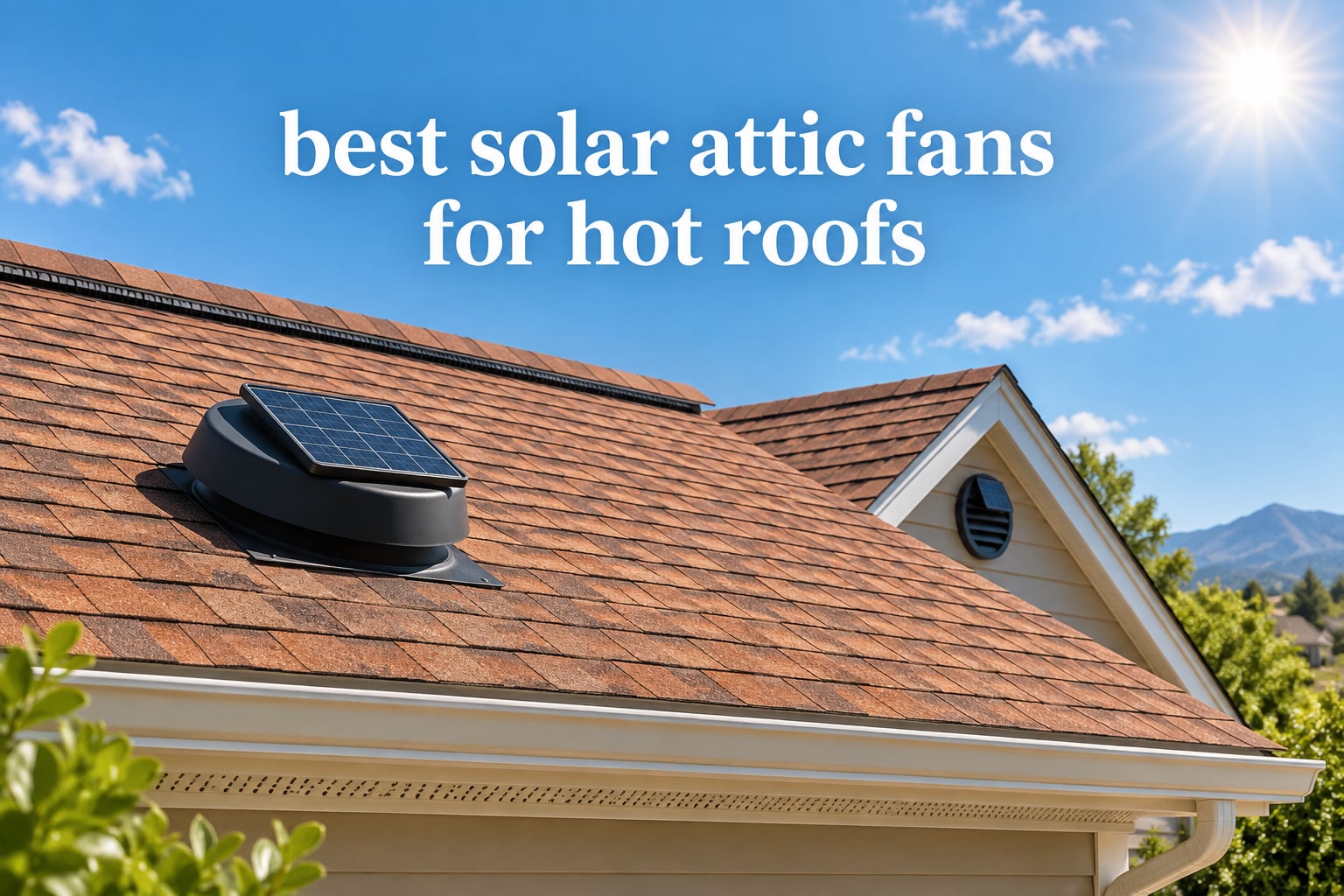
A solar attic fan is worth the money on a hot roof if three things are true: your attic is sealed from the living space, your soffit vents are clear, and you already have adequate roof or ridge vents. Miss any one of those and the fan becomes an expensive box that moves air in a circle. Get all three right and the same fan can pull 120-150F attic air out of your house during the hottest part of the day, easing the load on your air conditioner at zero operating cost.
That is the honest version of the verdict, and it matters because the loudest claims in this category come from sellers, not from people who live with the result. Forum threads on r/SolarDIY and r/solar keep returning to the same disappointment: the attic cools beautifully at 2pm and then the unit does nothing for the six hours after sunset. That is physics, not a defect. A solar attic fan harvests energy from a panel, and there is no panel output after dark unless a fan ships with a household-power adapter.
So this roundup of the best solar attic fans for hot roofs in 2026 is built around the two questions that actually decide the purchase: how much air does your attic actually need, and what happens to that air when the sun goes down. We compared 10 solar attic exhaust fans on airflow rating, panel wattage, motor type, noise, controls, warranty length and what happens after dark, using only manufacturer and retail specification data plus the patterns that show up repeatedly in buyer reviews.
Two things this article does differently from the ones ranking above it. First, every product below is a real, orderable model with a published airflow rating, and we say plainly which numbers we could not verify. Second, we spend as much time on the fans that are wrong for your attic as on the ones that are right, because a fan pulling 2800 CFM through a 900 sq ft attic with blocked soffits will pull your conditioned indoor air up into the attic and make the house warmer. More air is not automatically better.
If you are still deciding between venting approaches, our guide to attic exhaust fans for cooling covers the wired options side by side, and solar generators cover the other place homeowners put solar hardware on the property.
Top 3 Solar Attic Fans for Hot Roofs in 2026
These are the three we would put on a hot roof, in the order we would put them there. The iLIVING HYBRID takes the top slot because it combines the highest review volume in this group with a 40W panel, a 1150 CFM rating and an adjustable panel angle that lets you chase the sun on a steep slope. The Remington 30W earns the value slot on the strength of 1550 CFM from a smaller panel, a built-in humidistat and thermostat, and a brushless motor rated at 0.08 sones. The Remington 40W Builder Series takes the premium slot because it ships with the 110V hybrid adapter in the box, which is the only way to solve the after-dark problem without a second purchase.
iLIVING HYBRID Smart Thermostat Fan
- 1150 CFM airflow
- 40W panel
- Adjustable panel angle
- 15-year warranty

Remington Solar 30W Roof Mount
- 1550 CFM airflow
- 30W panel
- Built-in humidistat and thermostat
- 0.08 sones
Remington Solar 40W Builder Series
- Hybrid 110V adapter included
- 40W panel
- 22.5 inch steel flashing
- Lifetime warranty
10 Best Solar Attic Fans for Hot Roofs (October 2026)
Every model below appears once, in this table and in its own section. Airflow is the published CFM rating, wattage is the panel output, and the last column tells you the single job we would assign to that fan. Where a manufacturer does not publish a CFM figure, we say so rather than estimating one.
| Product | Specs | Action |
|---|---|---|
| iLIVING HYBRID Smart Thermostat Fan |
|
Check Latest Price |
 Amtrak Solar 12-Inch 50W Fan Amtrak Solar 12-Inch 50W Fan |
|
Check Latest Price |
| Remington Solar 40W Builder Series |
|
Check Latest Price |
| Remington Solar 30W Roof Mount |
|
Check Latest Price |
 4SEASONS 400 CFM Solar Vent Fan 4SEASONS 400 CFM Solar Vent Fan |
|
Check Latest Price |
 QuietCool AFR SLR-40 QuietCool AFR SLR-40 |
|
Check Latest Price |
 VEVOR 42W Smart Roof Vent Fan VEVOR 42W Smart Roof Vent Fan |
|
Check Latest Price |
 VEVOR 14-Inch Gable Mount Fan VEVOR 14-Inch Gable Mount Fan |
|
Check Latest Price |
 OmniPV 40W Hybrid Attic Fan OmniPV 40W Hybrid Attic Fan |
|
Check Latest Price |
 Remington Solar 20W Round Series Remington Solar 20W Round Series |
|
Check Latest Price |
1. iLIVING HYBRID Smart Thermostat Solar Roof Attic Fan – Best Overall for Hot Roofs
iLIVING HYBRID Ready Smart Thermostat Solar Roof Attic Exhaust Fan, 14″, 40-Watt, 1150 CFM, Cools up to 2900 Sq.Ft. Coverage Area, Black
1150 CFM
40W panel
14 inch blade
Roof mount
65 dB
Pros
- Most reviews in the group at 1665
- 1150 CFM from a 40W panel
- Adjustable panel at 0/15/30/45 degrees
- IP68 brushless motor with 15-year warranty
- No wiring and fits existing housings
Cons
- Nighttime running needs a separate adapter kit
- 65 dB is audible from directly underneath
- Some blades arrive loose on the collar
This is the fan I would put on a hot roof first, and the reason is not the headline airflow number. It is that iLIVING publishes the details most competitors bury: a 14-inch nylon-fiber-aluminum blade, an IP68-rated brushless motor, a 15-year warranty and a panel that tilts to 0, 15, 30 or 45 degrees. That panel adjustment is the feature that matters on a hot roof, because it lets you set the panel square to the midday sun on a shallow pitch and flatter on a steep one instead of accepting whatever the installer bolted down.
The thermostat is the other differentiator. It runs from 50F to 122F with an enable and disable setting, which means you can set a real attic temperature threshold and let the fan decide when to work rather than running whenever the sun is out. For a hot roof that is the difference between a fan that helps and a fan that runs all afternoon making noise for no gain.
Owners report attic temperatures dropping roughly 15-20F in hot climates, and that figure lines up with what reviewers of other 40W units describe. Installation is genuinely tool-light: no electrician, no wiring run, and it fits into existing fan housings with support poles. Several buyers specifically mention that the fan is not audible from inside the house.
Coverage is stated as up to 2900 sq ft, which is a marketing-style number that assumes generous vent area. Applying the 1 CFM per 2 sq ft sizing rule, 1150 CFM covers roughly 2300 sq ft of attic floor. That is a big attic, and it is more than enough for the majority of houses with a 120F peak.
The hybrid-ready design is the part to plan around. Non-stop day and night running requires the separate ILG8SF304 AC/DC adapter, which is not included. If your attic holds moisture overnight or you live somewhere with frequent cloud cover, budget for that adapter or accept that this fan runs only when the sun is up.
Two complaints repeat in reviews. Some units arrive with the blade spinning loose on the collar and need manual crimping before first use, and the 65 dB rating means it is clearly audible from directly beneath the unit while it runs. Neither is a dealbreaker in an unconditioned attic, but both matter if you plan to work up there in the afternoon.
What the iLIVING HYBRID does well on a hot roof
The panel angle adjustment is the hot-roof feature. A fixed panel on a 45-degree south slope can lose a meaningful share of its harvest at midday, and the ability to move through four angles lets you compensate without rewiring anything. Combined with the 50-122F thermostat, that is a genuinely well-matched package for a sun-facing roof.
At 1150 CFM and 2900 sq ft of stated coverage, it is also large enough that one fan can handle a full two-story attic rather than being a token unit. The 15-year motor warranty and IP68 sealing are the durability numbers you want on something mounted in a rain zone.
Where it falls short
The missing adapter is the real gap. Of the three top picks, it is the only one where hybrid operation requires a separate purchase, so a hot-roof owner who also cares about overnight moisture control ends up buying twice. If night and cloudy-day venting matters to you, the Remington 40W Builder Series solves the same problem with the hardware in the box.
It is also the highest published noise figure among the top three at 65 dB, while the two Remingtons are rated at 0.08 sones, a near-inaudible specification. If the attic sits directly over a bedroom you will hear the difference.
2. Amtrak Solar 12-Inch 50W Gable Vent Fan – Best for Greenhouses, Sheds and Garages
Amtrak Solar 12-Inch 50W Solar Attic Fan with Thermostat, Made in USA – Quiet Gable Vent Fan for Attic, Garage, Shed, Greenhouse – Plug and Play
50W panel
12 inch galvanized housing
10 inch blade
12V DC
Pros
- Highest panel wattage here at 50W
- All-galvanized steel housing
- 15 feet of cable for panel placement
- Quick-connect wiring for fast install
Cons
- Louder than the 14-inch Amtrak model
- Recurring factory wiring and polarity faults
- Needs full sun for full output
This one is different from the rest of the list in a useful way. It is not a roof-mount unit. It is a 12-inch galvanized steel fan designed to open a gable louver, with 15 feet of cable so you can put the 50W panel wherever the sun actually is. That makes it the pick for a greenhouse, shed, garage or cabin where there is no ridge vent to exhaust through and no intent to cut a hole in a roof.
At 50W it carries the highest panel output in this group, and the manufacturer rates it for areas up to 2250 sq ft. The panel itself is rated for 25 years of power production, which is longer than any fan warranty we found. No airflow figure in CFM is published, so if you need a hard number for sizing, this is not the fan to size from.
Buyers like the metal. The all-galvanized housing is a step up in perceived durability from the polycarbonate and plastic housings used by several competitors, and the sealed ball-bearing, thermally protected high-torque motor is the kind of motor spec you rarely see at this level. Installation is quick-connect wiring with mounting brackets included, and manufacturer support is reported as responsive when units do fail.
Where it falls short is quality control at the factory. Several reviews describe units arriving with polarity errors in the wiring or unstripped wire ends, and others describe an imperfect motor bushing and bent blades that produce a wobble or a ticking sound once running. The supplied cable with crimp connectors at the panel end is also described as thin and not very weather-resistant, which matters for a unit meant to sit outdoors in a greenhouse or shed all summer.
It is also noticeably louder than the 14-inch model from the same brand, and it needs full sun to hit its rated output. Budget for sealing and protecting the panel-end connections yourself.
Where this fan earns its place
Off the roof and onto a gable, a shed or a greenhouse, this is a strong unit. The 50W panel and the 15 feet of cable mean you can chase the sun rather than accept a fixed position, and the galvanized housing tolerates a damp shed far better than a polycarbonate unit would.
It is also one of two units here built around a louver-style opening, which means you are working with what is already installed rather than adding a roof penetration and a flashing system.
Where it falls short
It is not the right fan for a sealed residential attic, mainly because you cannot verify its airflow. Sizing a 2000 sq ft attic properly requires a CFM number, and this one does not publish one.
The recurring wiring and blade defects are worth weighing. In a greenhouse or shed, a fan that ticks or hums is tolerable. Mounted in a house, those same defects get noticed every single night.
3. Remington Solar 40W Builder Series – Best for Humid Climates
Remington Solar Builder Series 40 Watt Solar Attic Fan – Includes 110V Adapter for auto-Run Night time Operation
40W panel
Hybrid 110V adapter
22.5 inch flashing
0.08 sones
Pros
- 110V hybrid adapter included in the box
- Built-in humidistat and thermostat
- 0.08 sones brushless motor
- 22.5 inch steel flashing
- Limited lifetime warranty
Cons
- Highest price in the category
- Business-hours-only support
- App does not show current fan state
The Builder Series solves the problem that stops most people buying a solar attic fan, which is what happens after sunset. The 110V hybrid adapter is in the box, so this unit runs on solar during the day and switches to household power automatically at night and in cloud. For a humid climate, that matters more than raw CFM, because the moisture load in an attic is usually highest overnight when the temperature differential between inside and outside inverts.
It is also one of only a few fans here with a genuine humidistat alongside the thermostat. A thermostat responds to heat, a humidistat responds to moisture, and in the Southeast the second one is what keeps mold off the deck. Owners also report the fan being so quiet they have to look up to confirm it is running, which matches the 0.08-sone brushless motor specification.
The build is among the sturdiest in this roundup. A 22.5 by 22.5 inch heavy steel flashing is a genuinely large roof penetration cover, and buyers report it installing cleanly with no leaks. It typically fits an existing turbine vent opening, which shortens the install considerably. The motor carries Texas Windstorm certification, which is a meaningful hail-resistance credential in the southern states where this fan is most popular.
Remington publishes a limited lifetime warranty on the fan and a 30-day money-back satisfaction guarantee. In a category where a 15-year motor warranty is common, a lifetime warranty on the fan body is a real differentiator, and the 22.5 inch flashing plus lifetime warranty combination is the leak-risk answer for anyone nervous about cutting a roof hole.
What you give up is money and hands-on support. This is the most expensive fan in the group, and reviewers note that support is business-hours only despite advertising 24/7 email support. The app also does not show whether the fan is currently running, which is a small thing that gets annoying when you are trying to confirm the humidistat is doing its job.
One warranty detail worth reading carefully: keeping the hybrid adapter warranty valid requires a surge protector, and some buyers report that warranty replacements require them to diagnose the failed part themselves. Read the terms before you rely on the claim.
What makes this the humid-climate pick
Humidistat plus included AC power is the combination nothing else in this roundup matches. During the day the solar panel handles the heat load for free, and at night the adapter keeps air moving so condensation does not form on the underside of the deck. In a Gulf Coast or lower Southeast attic, that is the difference between a fan that helps in summer and a fan that also protects you in the off-season.
The 0.08-sone motor and the lifetime warranty make it the fan to buy when the attic sits directly over a bedroom or over a home office and noise is the constraint that decides the purchase.
Where it falls short
The price is the first honest objection. It is the most expensive unit here, and you are partly paying for the adapter that competitors sell separately.
Because no CFM rating is published for this model, you are sizing it by the accompanying roof vents rather than by airflow. If your attic is large and poorly vented, the OmniPV at 2100 CFM or the Remington 30W at 1550 CFM are easier to size with confidence.
4. Remington Solar 30W Roof Mount Fan – Best Value for Large Attics
Remington Solar 30 Watt Roof Mount Solar Attic Fan
1550 CFM
30W panel
13 inch blade
Humidistat and thermostat
Pros
- 1550 CFM from a smaller 30W panel
- Built-in humidistat and thermostat
- 0.08 sones brushless motor
- Texas Windstorm certified
- One-hour surface-mounted DIY install
Cons
- Nighttime running needs a separate adapter
- Higher price than most competing solar fans
This is the efficiency standout of the roundup. A 30W panel driving 1550 CFM means more moving air per watt of harvest than the 40W units here, and 1550 CFM covers roughly 3100 sq ft of attic floor under the 1 CFM per 2 sq ft rule. For a big attic, that is one fan instead of two, and one roof penetration instead of two.
It shares the Remington feature set that makes these fans distinctive: a built-in humidistat and thermostat for automatic airflow adjustment, a brushless motor rated at 0.08 sones, and Texas Windstorm certification for hail and weather resistance. The 22.5 by 22.5 inch steel flashing and the surface-mounted design that installs in about an hour make it a realistic weekend project.
Review data backs the spec sheet well. Roughly 74% of reviews are five star, with owners consistently citing airflow, near-silent running and simple installation. The reduced cooling load on the HVAC system and the furnace is the benefit that owners mention most in practical terms.
The obvious gap is the same one as the iLIVING: night and cloudy-day operation requires a hybrid adapter sold separately. In a dry climate where the goal is purely summer heat, that is a perfectly reasonable trade for 1550 CFM at a 30W panel. In a humid one, it is the reason to step up to the 40W Builder Series instead.
Price is the second objection. It sits above several competing solar fans in this roundup, so the value case rests entirely on airflow per watt and on owning a roof vent, not a gable wall.
Why the 30W beats the 40W for most attics
Hot-roof performance is about harvested watts per unit of roof area, and 1550 CFM from 30W is the best ratio here. If your attic is 2000 sq ft or larger, this single unit can handle the job where two smaller fans would mean two penetrations and two control boxes.
The humidistat also earns its place. Even without a night adapter, moisture-triggered operation means the fan runs when damp even on a mild day, which helps prevent the mold that shows up in shaded north-slope attics.
Where it falls short
The separate adapter purchase is the main one. Owners who wanted 24/7 venting ended up buying the hybrid kit after the fact, so plan for it in your budget if your attic holds moisture.
The 13-inch plastic blade is smaller than the 22-inch blade on the VEVOR 42W, which is one reason that unit’s CFM figure is so much higher. If you need to move very large volumes, this is not the ceiling of the category.
5. 4SEASONS Solar Attic Vent Fan – Best for Small Attics and Sheds
4SEASONS Solar Attic Vent Fan – 400 CFM Airflow, Up to 500 sq. ft., 12W Solar Panel, CSA A93 Certified, Polycarbonate Housing, Quiet Roof Ventilation
400 CFM
12W panel
Up to 500 sq ft
5.6 lb
CSA A93
Pros
- No wiring and drops straight in
- Inaudible from inside the house
- Only 5.6 lb so it is easy to handle
- Brushless motor for low vibration
Cons
- 400 CFM only suits attics up to 500 sq ft
- No on/off switch so it runs in cold weather
- Some units leaked in wind-driven rain
This is the small-attic and outbuilding option, and it is honest about its size. 400 CFM against the 1 CFM per 2 sq ft rule covers an attic of about 800 sq ft, and the manufacturer states coverage up to 500 sq ft. Do not put this on a 1500 sq ft attic and expect a result.
What it does well is installation and quietness. It is a fully assembled unit with integrated flashing, no wiring at all, and at 5.6 pounds it is the only fan in this roundup you can comfortably carry up a ladder one-handed. Owners describe it as inaudible from inside the house even in the room directly below, and it ramps its output up and down automatically as cloud cover changes, so you never touch it after installation.
The certifications are a genuine plus for a cheap unit. TDI and CSA A93 independent certification for safety and performance is not universal in this category, and the impact-resistant polycarbonate housing carries a waterproof rating. Several owners report multi-year durability and measurable upstairs temperature drops on small attics.
The limitations are equally clear. The instructions specify a larger cut-out than actually required, which pushes installers toward a bigger hole than necessary, and the documentation does not explain how to balance the fan, so blades can rub the housing after mounting. There is no on/off switch, meaning it also runs in cold weather and keeps moving dry winter air.
The most serious complaint is wind-driven water intrusion through the fan opening on some units. If your roof pitch is shallow or your region gets driving rain, a larger flashed unit is the safer bet.
When this is the right fan
Small attics, sheds, workshops, goosenecks and anything under roughly 800 sq ft. It is also the easiest unit here to install solo, because at 5.6 pounds with integrated flashing and no wiring, one person on the roof is realistic.
If you have ever wanted attic venting but not wanted to run power or hire anyone, this is the lowest-friction version of the product.
When it is not
On a genuinely hot roof over 1000 sq ft, 400 CFM is underpowered and no amount of sun will change the arithmetic. Buyers who expected it to cool a main house report disappointment, and the specs support them.
It is also the weakest choice in heavy rain or on a low-pitch roof, and the lack of any on/off control means it runs in winter when you may want the heat to stay put.
6. QuietCool AFR SLR-40 – Best for Steep Roofs and Adjustable Panel Placement
QuietCool AFR SLR-40 Roof Mount Solar Attic Fan – 40 Watt Adjustable Panel – Included AC/DC Inverter for 24/7 Runtime – Thermostat Controlled
1104 CFM
40W panel
24/7 inverter
60 degree tilt
Thermostat
Pros
- Panel tilts 60 degrees and rotates 180 degrees
- AC/DC inverter included for 24/7 runtime
- 15-year panel and warranty plus 5-year motor
- 20 foot power cord included
Cons
- 1104 CFM is modest for a large attic
- Thermostat trigger fixed at 88F
- Three-blade plastic blade is noisier
The QuietCool is the most flexible panel in the roundup, and on a hot roof that is the feature to shop for. The panel tilts up to 60 degrees and rotates 180 degrees, which means you can set it square to the sun on a steep south pitch, flatten it for a low-slope roof, or swing it around a chimney or dormer. Every other roof-mount here offers a fixed panel or a limited set of detents.
The AC/DC inverter is also included, giving genuine 24/7 runtime without a separate purchase. A preset thermostat switches the fan on at 88F, which is a sensible default for a hot attic, and the warranty structure is the clearest in the group: 15 years on the panel, 15 years on the unit, 5 years on the motor.
Airflow is 1104 CFM, which covers roughly 2200 sq ft of attic floor. That is respectable but not class-leading, and it is the reason this is not the top pick. On a 2000 sq ft attic it is adequate; on anything larger you would be adding a second fan.
Two constraints to know before buying. The thermostat trigger is preset and cannot be adjusted, so if your attic runs cooler than 88F on the days you care about, the fan will not respond. And the three-blade plastic blade produces noticeably more noise than the multi-blade brushless designs elsewhere in this list, which undercuts the QuietCool name in practice.
The heavy-duty steel housing and 20-foot power cord do make installation straightforward, and the brand has a long track record in the category, which is worth something on a component you will not want to replace.
Why the adjustable panel matters on a hot roof
Panel angle is the single biggest lever on a hot roof that most buyers ignore. A fixed panel installed for aesthetics may sit at a poor angle to the midday sun, and on a steep slope that costs you a meaningful share of the harvest exactly when the attic is hottest. Sixty degrees of tilt plus full rotation is the widest range available here.
The included inverter also makes this one of the four units here that can run after sunset out of the box, alongside the Remington Builder Series, the VEVOR 42W and the OmniPV.
Where it falls short
1104 CFM is a modest number, and at that airflow you are paying a premium against the 30W Remington that moves 1550 CFM. If your attic is large, the airflow-per-dollar argument points elsewhere.
The fixed 88F trigger and the three-blade plastic design are the two compromises. Neither is serious, but both are things you notice every summer afternoon.
7. VEVOR 42W Smart Roof Vent Fan – Best Airflow for the Largest Attics
VEVOR 42W Solar Attic Fan, 2800 CFM Smart Roof Vent Built-in Temperature Sensors with Remote Control, Low-Noise & Weatherproof for Attic, Garage, RV Ventilation
2800 CFM
42W MPPT panel
22 inch blade
60 dB
Remote
Pros
- Highest airflow here at 2800 CFM
- 42W MPPT regulator harvests more sunlight
- Switches from solar to electric at sunset
- Remote control and humidity plus smoke auto-off
Cons
- Solar panel failure reported in under four months
- Trigger temperature fixed at 26C
- Hard to service once roof-mounted
At 2800 CFM this is the most powerful fan in the roundup by a wide margin, and it gets there with the largest blade here at 22 inches driving a brushless DC motor. Under the 1 CFM per 2 sq ft rule that covers roughly 5600 sq ft of attic floor, which makes it the right unit for a very large attic, a garage, an RV or a workshop where one fan has to do the work of three.
The power electronics are the strongest part of the specification. A 42W MPPT solar regulator harvests sunlight more efficiently than a plain PWM controller, and the unit switches from solar to household power at sunset for 24/7 operation including cloudy days. That solves the after-dark problem without any extra purchase, same as the QuietCool and the Remington Builder Series.
Control is the most feature-rich here. The integrated intelligent controller handles both temperature and humidity, and it includes a smoke detection auto-off function, which is a genuinely thoughtful safety feature for a unit sitting above living space. The remote works from up to 9.75 metres away, and all mounting hardware and flashing are included. Reviewers report attic drops of 20F or more within hours of installation, which is consistent with the airflow claim.
Two things give us pause. The 22-inch blade is rated at 60 dB, which is the noisiest specification among the brushless motors in this roundup, and the on temperature is fixed at 26C, so you cannot raise the threshold for a cooler attic without changing the unit.
More seriously, there is a reported case of the solar panel failing in under four months, and once the panel is roof-mounted it is awkward to service. For a fan you may keep for a decade, panel longevity is a real question, and it is the single most important thing to check with the manufacturer before committing.
What the 2800 CFM figure actually gets you
Large airflow is not a bragging number if your vent area cannot support it. The rule of thumb is that total exhaust should roughly match total intake through soffits, and 2800 CFM exhaust with soffits rated for 1000 CFM will pull your conditioned indoor air into the attic. Confirm your intake capacity before choosing the biggest fan on the page.
Assuming the vents support it, this is the fan for attics over 2000 sq ft, for garages and shops, and for anyone who would rather install one unit than two. It is also the only one here rated as compatible with both metal and masonry roofs.
Where it falls short
Review volume is thin at 124 reviews, so the long-term data is thinner than the other picks. For a permanent roof installation, that is worth weighing against the Remington units with hundreds of reviews and lifetime warranties.
60 dB, a fixed 26C trigger and a reported panel failure inside four months are the three reservations. None is disqualifying, but all three are reasons to confirm panel warranty terms in writing.
8. VEVOR 14-Inch Gable Mount Fan – Budget Pick for Gable Vents
Pros
- Quiet 45 dB brushless motor
- 1300 CFM for a gable or wall mount
- Includes 14 inch bracket and needs no professional tools
- Adjustable thermostat cycles the fan automatically
Cons
- Gable mount rather than a flashed roof unit
- 1300 CFM covers only up to 1850 sq ft
This is the pick when you want no roof penetration at all. It is a 14-inch wall and gable mount fan with a 1300 CFM brushless motor rated at 45 dB, among the quietest published ratings in this roundup. It comes with a 14-inch mounting bracket and installs with basic tools, which makes it the least intimidating unit on the page.
1300 CFM covers roughly 2600 sq ft by the sizing rule, though the manufacturer states coverage up to 1850 sq ft. The adjustable thermostat cycles the fan on and off with ambient temperature, and the outer mesh keeps birds, leaves and debris out of the housing, which matters on a gable where the fan is exposed.
The materials hold up well. A high-strength Q235A steel housing with 1060 aluminum alloy blades resists corrosion, and the motor is rated to 1600 rpm. It also carries the highest average rating in this group at 4.6 stars, with roughly 85% of reviews at five stars.
The limitation is structural rather than mechanical. There is no integrated flashing, so it depends entirely on a sound gable or wall opening and on the quality of your exterior seal. If your existing gable vent opening is aged, the leak risk moves from the flashing into the siding and trim work around it, which is its own repair.
It is also a gable-mounted fan, so it exhausts at the gable rather than at the ridge. That is a lower stack effect than a ridge or high-roof exhaust, so you will get less of the buoyant pull that makes high venting effective. On a hot roof, that is the trade you are making to avoid cutting a hole.
Why this is the sensible gable option
It pairs a real airflow number with a genuinely quiet motor, which most gable-mount options in this category do not. 45 dB at 1300 CFM means you can mount it on an upstairs gable without it becoming a sleep disturbance, and the thermostat means it is not running all afternoon producing noise for no thermal gain.
It is also the right choice for a house with skylights or a metal roof, where every homeowner we would advise is nervous about cutting a hole. Nothing gets cut.
Where it falls short
Coverage tops out at 1850 sq ft, so it is a small-to-medium attic solution. Below that ceiling, the 2800 CFM VEVOR roof mount moves more than twice the air through a properly flashed roof penetration.
Low gable exhaust means less stack-driven draft than a ridge vent, and a mesh-covered opening can partially restrict free area. Both are acceptable, but expect a smaller measured temperature drop than a roof-mounted unit on the same attic.
9. OmniPV 40W Hybrid Attic Fan – Best for Cloudy and Coastal Areas
OmniPV Solar Hybrid Attic Fan, 40 W 2100 CFM Roof Mount Exhaust Fan With AC Adapter, 75°F Thermostat Auto On/Off, Low Noise and Weatherproof for Home, Shop, RV, Garage & Shed
2100 CFM
40W panel
11.8 inch blade
45 dB
AC adapter
Pros
- 2100 CFM at a quiet 45 dB
- AC adapter included for backup and night use
- Flexible flashing molds to shingle ridges
- Anti-UV aluminum body suits coastal air
Cons
- Installation instructions are poor
- Flashing lip is under 1 inch
- Power cable ships disconnected
- Thermostat fixed at 75F
The OmniPV pairs 2100 CFM with a 45 dB brushless DC motor, which combines high airflow with a low published noise figure. At 2100 CFM it covers roughly 4200 sq ft of attic floor, so it is a genuine large-attic unit that does not sound like a leaf blower running overhead.
Like the Remington Builder Series, it ships with an AC adapter for backup and night-time running, so cloudy regions and humid coastal air are handled without a second purchase. The aluminum alloy body carries anti-UV, anti-oxidation and corrosion resistance claims that make it a reasonable coastal choice, and the included flexible flashing, rafter and batten straps let it sit on a house roof, a gable vent or an extractor position.
Owners report noticeably reduced air conditioner run time after installation, which is the outcome that matters for a hot roof. Most also completed the install themselves and liked the way the flexible flashing molded flat to shingle ridges for a clean look.
Documentation is the weak point, and it is a real one. Reviews describe the installation instructions as very poor or effectively absent, especially for shingle roofs and wiring, and several note the power cable arrives disconnected, which confuses first-time installers. The cable detail is trivial; the missing flashing instructions are not.
There is also a complaint that the flashing lip is under an inch, raising a long-term water intrusion concern in heavy storms. And the thermostat threshold is fixed at 75F with no adjustment, so the fan will not back off on a mild day. Some units also arrive with side damage from poor packaging, which is worth inspecting on arrival.
What the 45 dB rating buys you
Noise is the deciding factor when the fan is directly over a bedroom, a bonus room or a home office. At 45 dB with 2100 CFM, this moves nearly twice the air of the QuietCool while being listed at the same decibel figure.
The included AC adapter also makes it one of only four units in this roundup that can run after sunset out of the box, which is what makes it the pick for cloudy regions rather than just dry ones.
Where it falls short
The flashing is the weak link. A sub-1-inch flashing lip on a roof-mounted fan is a long-term leak exposure, and the documentation does not help you mitigate it. In a heavy-rain region, the Remington units with 22.5 inch steel flashing are a better bet for the same money range.
At 72 reviews the long-term picture is also thinner than the Remington or iLIVING data, and the fixed 75F trigger means no seasonal tuning.
10. Remington Solar 20W Round Series – Lightest Install for Moderate Attics
Remington Solar 20 Watt Roof Mount Solar Attic Fan – Round Series
20W panel
17V DC
Round Builder housing
15 lb
Humidistat
Pros
- Lightest Remington here at 15 lb
- Quiet round housing design
- Built-in humidistat and thermostat
- 22.5 inch steel flashing
- MC4 connectors and inverter compatible
Cons
- Smallest panel and lowest airflow in the Remington range
- Night operation needs a separate 110V adapter
The Round Series is the Remington answer to a specific problem: getting a well-built flashed unit onto a roof without wrestling 32 pounds of hardware up a ladder. At 15 pounds it is roughly half the weight of the square Builder Series, and the round housing is reported as quieter and lighter than the original square versions.
You keep the parts that make the Remington line worth buying. A 22.5 by 22.5 inch steel flashing, a brushless motor rated near-inaudible with Texas Windstorm documentation, and the built-in humidistat and thermostat pair. MC4 connectors and inverter compatibility mean you can add a 110V adapter for night operation later without replacing the fan.
Review data is strong, with roughly 75% of reviews at five stars. Owners consistently single out the quiet, lightweight round design and the thermostat and humidistat automation, and the 15-year limited warranty plus 100% satisfaction guarantee is a reasonable durability position.
The 20W panel and 17V DC maximum output are the smallest in the Remington range on this page, and no CFM rating is published. That makes it a harder unit to size with confidence, and on a genuinely hot roof over 2000 sq ft the 30W or 40W models are the safer bet for airflow.
As with the other solar-only Remingons, night operation requires a separately sold 110V adapter. If moisture control at night is your priority, step up to the 40W Builder Series.
When the round design is the deciding factor
If you are installing this yourself, on an older roof, without a helper, weight is a genuine safety and practicality variable. Half the weight of the square models, a large flashing and a straightforward install make this the Remington we would choose for a solo roof job.
The humidistat also keeps the moisture-control benefit of the range, which matters if the attic sits above a bathroom or kitchen exhaust run.
Where it falls short
Airflow is the gap. With the smallest panel in the range and no published CFM, it is the model to skip for a large attic on a hot roof. It suits a moderate attic where the vent area is modest and you want a better-installed unit rather than a bigger one.
How to Choose a Solar Attic Fan for a Hot Roof in 2026
Three preconditions before you buy anything
Check these three before you pick a model, because each one can make any fan on this page a disappointment.
First, the attic must be air-sealed from the living space. Bypassed ducts, a bathroom or kitchen exhaust run, a recessed light, a stairwell or a large gap around a hatch will all pull conditioned air into the attic. Forum consensus on r/buildingscience is skeptical of powered attic fans generally and insists on passive ventilation sizing first, and that caution is well placed. Seal the boundary first with foam and baffles, then measure.
Second, the soffit vents must actually be open. Insulation is frequently pushed back against the soffits during a re-insulation job and blocks them without anyone noticing. This is the single most common complaint we found among owners who felt their fan underperformed, and most of them only discovered it after installing the fan.
Third, you need adequate roof or ridge vents for the fan to exhaust through. A 2800 CFM fan exhausting into a roof with 1000 CFM of ridge vent does not move 2800 CFM. It moves 1000 CFM and puts the rest of the capacity to work pulling your indoor air upward.
How much CFM does your attic need?
The sizing rule most builders use is 1 CFM of airflow per 2 sq ft of attic floor area. Measure the floor of the attic, multiply by 0.5, and that is your target CFM. A 1200 sq ft attic needs about 600 CFM, a 2000 sq ft attic needs about 1000 CFM, and a 3000 sq ft attic needs about 1500 CFM.
Worked example: a 1800 sq ft attic requires 900 CFM. The iLIVING HYBRID at 1150 CFM covers it with headroom, the QuietCool at 1104 CFM covers it, and the 4SEASONS at 400 CFM does not. For a 2600 sq ft attic, the target is 1300 CFM, which the VEVOR gable mount and the Remington 30W at 1550 CFM both meet. Above 4000 sq ft, only the OmniPV at 2100 CFM and the VEVOR 42W at 2800 CFM are close, and even those want a second unit.
Do not size up past the requirement. Oversized airflow creates negative pressure, and negative pressure pulls your conditioned air from the house into the attic, which makes the house warmer and the bill higher. This is the failure mode that fuels forum complaints about marketing CFM numbers, and it is entirely avoidable by sizing to your vent area instead of to the biggest number on a page.
Panel wattage and what temperature drop to expect
Panel wattage determines harvest, and harvest determines airflow, but the relationship is not linear. The 12W 4SEASONS moves 400 CFM and the 42W VEVOR moves 2800 CFM, so roughly three and a half times the panel produced seven times the air, helped by a much larger blade and an MPPT regulator.
On realistic temperature drop, buyer reports across this roundup cluster in the 15-20F range for 40W units, and above 20F for the highest-output models, measured on a properly sealed and vented attic. Attics in hot climates regularly peak between 120F and 150F, so a 20F drop is a meaningful improvement in working conditions even if your upstairs thermostat does not move. Solar fans are widely described as improving attic comfort rather than measurably cooling living space, and that is the honest expectation to buy with.
A fan cannot remove radiant heat passing through the roof decking itself. That is conduction through the roof assembly, and no amount of airflow touches it. Insulation and an air barrier are what stop radiant heat, and the fan’s job is only to remove the hot air that accumulates under the deck.
Panel placement on a hot roof
Panel orientation is the hot-roof decision nobody in this category talks about properly. Four steps decide it.
First, pick the sunniest slope available and check it at midday, not at installation convenience. A south slope is the traditional answer, but on a house whose worst heat arrives in the late afternoon, a west slope can beat a south one. The panel should face the direction your heat actually comes from.
Second, confirm nothing shades it. Trees, a neighbouring roof, a chimney and dormers can all knock out a large share of the day’s harvest, and a shaded panel is a permanently underperforming fan.
Third, choose tilt to match your roof pitch and your peak sun angle rather than leaving it flat. A fixed panel on a steep slope bleeds harvest at exactly the wrong time of day.
Fourth, buy an adjustable panel if you can. The iLIVING HYBRID steps through 0, 15, 30 and 45 degrees, and the QuietCool offers 60 degrees of tilt with 180 degrees of rotation. That range is worth more on a hot roof than an extra 200 CFM, because you can retune the unit in a season without climbing back up.
Roof mount or gable mount?
A roof mount penetrates the roof and needs a flashing system. A gable mount uses an existing opening and needs none of that, but it exhausts lower on the roof and moves less air for the same fan.
Choose a roof mount when the attic is large, the existing gable is already occupied or too small, or you want the maximum stack effect from a high exhaust point. Choose a gable mount when the existing opening is sound, when your roof is metal or tiled and you want to avoid a penetration, or when roof leak anxiety is the thing stopping you. If you have skylights, a gable mount is the lower-risk answer.
On leak risk, the flashing size is what matters most. The Remington units use 22.5 by 22.5 inch steel flashing, which is the most generous penetration cover here. The units with integrated or flexible flashing are lighter to install, and reviews of the OmniPV specifically question the depth of the flashing lip. Texas Windstorm certification on the Remington and iLIVING units is the credential to look for if you live in a hail region.
Thermostat, humidistat, or both?
A thermostat turns the fan on when the attic gets hot. A humidistat turns it on when the air gets damp. In a dry, hot, sunny climate, a thermostat alone is enough. In a humid one, the humidistat is the control that prevents mold, and the three Remington models here are the only ones that combine both.
Pay attention to whether the trigger is adjustable. The QuietCool’s thermostat is preset at 88F with no adjustment, the OmniPV is fixed at 75F, and the VEVOR 42W controller is fixed at 26C. The iLIVING is the one roof mount here with a genuinely adjustable range from 50F to 122F.
Solar, wired, or hybrid?
Solar costs nothing to run and needs no wiring. Its weakness is that output follows sunlight, so it does nothing at night and slows in cloud. A wired fan runs whenever you tell it to, draws a small but continuous amount of electricity, and gives you a thermostat you fully control.
Hybrid units, in practice the four fans here that ship with an AC adapter or inverter, are the answer to a climate with heavy overnight humidity or frequent cloud. In a hot, dry, sunny climate, plain solar is the right call and the hybrid hardware is money you did not need to spend.
Against a wired fan, the honest comparison is total cost of ownership. A solar fan’s energy cost is zero forever; a wired fan’s running cost is small but real. Forum debate on this point tends to end with the same conclusion: most people who feel they wasted money on a solar fan did not waste money, they bought the wrong fan for a roof that was not sealed or a vent area that could not move the air.
When not to buy one
Do not buy a solar attic fan if the attic is not sealed from the living space, because you will be exhausting your own conditioned air and paying to do it. Do not buy one if your soffit vents are blocked, because the fan has nothing to draw from and will pull from the house instead. Do not buy one on an attic where natural convection through well-sized soffit and ridge vents is already adequate, because a powered fan adds a roof penetration and a failure point for no measurable gain.
Do not buy one on a very tight new-build attic where the roof structure and the conditioned envelope are integrated, since there is little air volume to move and the enclosed framing does not benefit. And if your real problem is ducts or a heat pump installed in the attic, no fan substitutes for relocating that equipment, although attic heat is genuinely a threat to equipment longevity and a fan helps the rest of the space too.
Frequently Asked Questions
Are solar attic fans a good investment?
Yes, on a hot roof with a sealed attic, clear soffit vents and adequate roof vents, and no if any of those three are missing. A properly installed solar attic fan can drop attic temperatures 15-20F or more during peak sun at zero operating cost, which eases the load on your air conditioner and makes the attic usable. Without air sealing, it exhausts your conditioned air and makes the house warmer. The honest test is whether you can measure a cooler attic, not whether you feel a cooler second floor.
How many CFM for an attic fan?
Use 1 CFM per 2 sq ft of attic floor area, so a 1200 sq ft attic needs about 600 CFM, a 2000 sq ft attic needs about 1000 CFM, and a 3000 sq ft attic needs about 1500 CFM. Do not exceed your soffit intake capacity, because oversized airflow creates negative pressure and pulls conditioned air from your house into the attic.
What are the disadvantages of a solar fan?
The main disadvantage is that output follows sunlight, so the fan does nothing at night and slows in cloudy weather unless it includes an AC adapter or inverter. Other drawbacks are the roof penetration and leak risk on roof-mounted models, the fixed temperature triggers on many models, limited serviceability once a panel is mounted, and the fact that a fan cannot remove radiant heat passing through the roof decking. It also does not cool living space measurably in most homes.
What are the best roof fans?
Among the roof-mounted solar units we compared, the iLIVING HYBRID leads for hot roofs at 1150 CFM from an adjustable 40W panel, the Remington 30W delivers the best airflow per watt at 1550 CFM, the VEVOR 42W moves the most air at 2800 CFM for very large attics, and the Remington 40W Builder Series is the best for humid climates because it includes a 110V hybrid adapter and a humidistat.
Do solar attic fans leak roofs?
Roof-mounted solar fans can leak, but the risk is manageable. Flashing size is the variable that matters most, and units with 22.5 inch steel flashing, such as the Remington models, present a much larger cover than lighter integrated-flashing designs. Installation quality, sealant and roof age matter as much as the product. If you have skylights, a metal or tiled roof, or real anxiety about penetrations, a gable mount such as the VEVOR 14-inch unit avoids the roof entirely.
What is the best solar-powered fan for a greenhouse?
For a greenhouse the Amtrak Solar 12-inch 50W is the better fit than any roof-mount unit in this roundup, because it is built to open a gable louver and comes with 15 feet of cable so you can place the 50W panel wherever the sun is best. Greenhouses need higher panel wattage and daytime airflow rather than overnight heat removal, and they never need a roof penetration. Seal and protect the panel-end connectors, which are the weak point on that unit.
Our Verdict on the Best Solar Attic Fans for Hot Roofs in 2026
The iLIVING HYBRID is our pick for a hot roof, and the reason is the combination of published airflow, an adjustable panel and the largest body of owner feedback in this roundup. The Remington 30W is the smarter money if your attic is large, because 1550 CFM from 30W is the best airflow per watt here. If you live somewhere humid or cloudy, the Remington 40W Builder Series is worth the premium because the hybrid adapter and the humidistat solve the two problems that make people regret solar fans.
Before any of them go on a roof, seal the attic from the living space, confirm the soffits are open and match your fan’s CFM to the intake you actually have. Get those three things right and the best solar attic fans for hot roofs are among the easiest home upgrades you can make. Get them wrong and no fan on any page will help. Use the table above to compare airflow, wattage and mount type side by side, then check the current listing for the model that matches your attic.