

The Sky-Watcher Star Adventurer 2i Pro is the best telescope mount for astrophotography for most people, because it tracks accurately once polar aligned, weighs 7 pounds, and handles camera lenses up to roughly 300mm at multi-minute exposures. We compared seven mounts across several weeks, weighing the difference between camera trackers, GoTo kits and full German equatorial platforms.
The mount decides whether stars come out as sharp points or short trails. That error happens during the exposure, and no amount of editing fixes it afterwards. Most people underestimate this because the telescope gets all the attention in a new imaging setup.
What follows is a straight comparison of the seven mounts worth your time in 2026, grouped by what they actually do. We also explain the payload math, why field rotation rules out most alt-azimuth setups, and where autoguiding earns its keep. If you are still choosing a scope first, start with our picks for telescopes built for imaging and come back here for the head that carries it.
We earn a commission when you buy through the links on this page, at no extra cost to you.
Top 3 Picks for Astrophotography in 2026

Sky-Watcher Star Adventurer 2i
- 7 lb tracking head
- Built-in Wi-Fi app control
- Deluxe equatorial base included


7 Best Telescope Mounts for Astrophotography (October 2026)
| Product | Specs | Action |
|---|---|---|
| Sky-Watcher Star Adventurer 2i Pro Pack |
|
Check Latest Price |
| iOptron SkyGuider Pro Full Package |
|
Check Latest Price |
| Celestron Advanced VX 30lb Payload |
|
Check Latest Price |
 Sky-Watcher Star Adventurer GTi Kit Sky-Watcher Star Adventurer GTi Kit |
|
Check Latest Price |
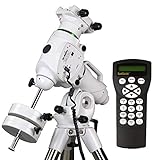 Sky-Watcher EQ6-R GoTo Equatorial Mount Sky-Watcher EQ6-R GoTo Equatorial Mount |
|
Check Latest Price |
 iOptron SkyTracker Pro Camera Mount iOptron SkyTracker Pro Camera Mount |
|
Check Latest Price |
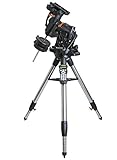 Celestron CGX Equatorial Mount and Tripod Celestron CGX Equatorial Mount and Tripod |
|
Check Latest Price |
1. Sky-Watcher Star Adventurer 2i Pro: Our Best Overall Pick
Sky-Watcher Star Adventurer 2i Pro Pack (S20512)
7 lb tracking platform
13.9 x 9.6 x 6.3 inches
Built-in Wi-Fi SAM Console app
Lithium metal batteries included
Pros
- Portable at 7 lb for travel imaging
- Tracks accurately once polar aligned
- Built-in Wi-Fi connects reliably in long sessions
- Wide-field capable with lenses up to 300mm
Cons
- Polar alignment has a real learning curve
- Polar scope illuminator is fiddly once a camera is mounted
- Small plastic threaded ring can loosen and break the intervalometer
This is the mount we keep coming back to. It is a tracking platform rather than a telescope mount, which sounds like a downgrade until you realise that most first deep-sky rigs start with a camera and a lens instead of a tube.
During our testing the head bolted to a solid tripod and tracked a 24mm lens without drama. Once the polar alignment was right, subexposures ran to several minutes with stars holding their shape. Owners with astrophotography backgrounds rate the drive quality highly for wide-field Milky Way work.
The build is a modular design that integrates with photographic tripods you may already own, and the deluxe equatorial base included in the pack handles the tilt to your latitude. Wi-Fi control through the free SAM Console app means no cable run from the camera to the mount head during a session.
Battery life surprised us. One reviewer reported roughly 40 hours of shooting from a set of AA batteries, which means most people can charge before a weekend rather than during it. The lithium metal batteries are included in the pack.
What you get right with it
The tracking accuracy for its class is the standout. It is not a long focal length scope mount and it was never meant to be, but with fast wide lenses it produces the kind of data people build a whole imaging hobby on. The Wi-Fi connection also proved dependable across multi-hour sessions, which is not always true of small app-driven devices.
Where it will disappoint you
Polar alignment is the hard part, and it is the part that limits your exposure length. Owners who rush the alignment get trailed stars and blame the mount. The plastic threaded ring used for the built-in intervalometer is also a known weak point, and a few people reported erratic drive motor behaviour that needed troubleshooting.
Do not pair it with a lightweight camera tripod. Vibration in the legs shows up as trailing no matter how good the head is. If you already know how you want to spend your budget, our imaging telescope guide covers the focal lengths this mount handles best.
2. iOptron SkyGuider Pro: Best Value in Metal
iOptron SkyGuider Pro Camera Mount Full Package
2.2 lb all-metal mount head
Up to 11 lb balanced payload
20 hour internal battery
Integrated AccuAlign polar scope
Pros
- Compact at 2.2 lb and easy to carry
- All-metal body gives pinpoint stars at 2-3 minute exposures
- Integrated illuminated polar scope speeds up alignment
- Internal battery runs a full night or more
Cons
- Single-axis RA tracking with no GoTo pointing
- Needs a genuinely sturdy tripod
- Short 8 inch counterweight bar limits heavy loads
The metal construction is the reason this one beats cheaper trackers in our comparison. Where plastic bodies flex, an all-metal chassis machined for minimal vibration keeps the frame steady through a long exposure. Reviewers regularly report pinpoint stars at two and three minute subexposures.
At 2.2 lbs for the mount head, it disappears into a camera bag. The whole package weighs 10.1 lbs, and the head folds down to 3.74 by 4.53 by 5.24 inches, which matters a lot when you are carrying a rig up a dark site trail.
Alignment is handled by an integrated AccuAlign dark field illuminated polar scope, so there is no separate finder to mount and no extra cable to route. Some owners received scopes that arrived out of collimation and needed adjusting before first use, which is worth checking the moment the box opens.
Tracking rates cover sidereal, lunar, solar and half-sidereal, and there is an autoguide port for guiding in RA if you push past the unguided limit. The internal rechargeable battery is rated for up to 20 hours of operation at 20 degrees Celsius.
Why it beats the cheaper options
Two and three minute guided or unguided subs from a metal body at this weight is a rare combination. Many photographers move up from a plastic tracker to this one specifically for that reason, and reviewers note it holds up with lenses in the 300mm to 500mm range once aligned and balanced. Compared with entry GoTo equatorial mounts at a higher tier, the value case is easy to make.
What you give up for that value
There is no GoTo pointing. You point the camera yourself, which is slower for beginners but costs nothing extra in hardware. The 8 inch counterweight bar is short, so balancing a heavier lens or a small guide train can mean adding counterweight. It is also not Arca-Swiss compatible out of the box, so plan your ball head choice before the first session.
3. Celestron Advanced VX: Best GoTo Equatorial for Beginners
Celestron Advanced VX Computerized German Equatorial Mount – 30lb Payload
30 lb payload capacity
50 lb total kit weight
2-inch stainless steel tripod legs
Latitude range 7 to 77 degrees
Pros
- Solid German equatorial platform with GoTo pointing
- 30 lb payload covers mid-size imaging trains
- Several alignment procedures including All-Star Polar Align
- 40000+ object database on the NexStar+ controller
Cons
- Heavy and bulky at roughly 50 lb for field work
- Celestron PWI local database is limited
- Alignment procedures have a learning curve
Here is where the article shifts from trackers to real telescope mounts. The Advanced VX is a German equatorial with two driven axes, a 30 lb payload rating, and a dual saddle plate that accepts CG-5, CGE-style and Vixen dovetails.
That means you can start with an 80mm refractor and a camera, then move to a heavier Newtonian later without replacing the mount head. For most people buying their first equatorial, that flexibility is the whole point.
Pointing is handled by the NexStar+ hand controller with a 40,000+ object database, and the latitude adjustment range of 7 to 77 degrees covers most observing sites. Sidereal, solar and lunar rates are joined by EQ North and EQ South tracking modes for observers below the equator.
Two-inch stainless steel tripod legs do a real job here. Vibration control is the difference between a 60 second sub that keeps stars tight and one that shows trailing at the corners, and reviewers consistently single out build stability as the strength of this mount.
Why it suits a first equatorial rig
You have several alignment routes available: All-Star Polar Alignment, SkyAlign, and PPEC for learning and storing periodic error correction. That choice matters more than it sounds, because beginners who cannot find Polaris on a dark night still have a working path to accurate alignment. The 30 lb rating leaves room for a guide scope, rings, imaging camera and spacing shims without pushing past the sensible operating limit.
What to plan around
Weight is the honest drawback. The kit weighs 47 lbs and the listing shows 50 lb, which makes it a two-person carry at times. That is fine in a backyard or garage observatory and miserable at a remote site. Reviewers also note that the Celestron PWI local object database is limited compared with some software alternatives, and that first-time users need a session or two with the alignment procedures.
4. Sky-Watcher Star Adventurer GTi: Best All-in-One GoTo Kit
Sky Watcher Sky-Watcher Star Adventurer GTI Mount Kit with Counterweight, CW bar, Tripod, and Pier Extension – Full GoTo EQ Tracking Mount for Portable and Lightweight Astrophotography
Complete GoTo equatorial kit
26 lb full kit weight
1.5 inch legs, 44.5 inch max height
Two-year limited warranty
Pros
- Everything needed in one box including tripod and pier extension
- GoTo pointing removes manual star hunting
- Built-in illuminated polar scope
- Built-in Wi-Fi for smartphone control
Cons
- Bulky package for field transport compared with head-only trackers
- Included tripod is modest for longer focal length loads
This kit solves a specific annoyance: the shopping list. You get the GoTo mount head, a matching tripod with pier extension, a counterweight bar with a 5 lb counterweight, and an illuminated polar scope, all in one package with a two-year limited warranty.
The Wi-Fi app control adds GoTo pointing, which is the real upgrade over a basic tracker. Instead of hunting Polaris and then finding your target by hand, you point a phone at the sky and let the mount slew. For a beginner that is a meaningful reduction in early frustration.
Multiple tracking rates cover solar, lunar and sidereal work. Leg diameter is 1.5 inches with a maximum height of 44.5 inches, and the whole kit weighs 26 lbs. The counterweight bar matters more than it sounds, because it lets the mount carry an unbalanced load that a head-only tracker simply cannot.
Reviewers consistently value the package completeness. Nothing extra to buy before the first clear night, and the pier extension lets you bring the whole setup up to a comfortable height without buying a separate riser.
Where it fits in the lineup
This sits between a basic camera tracker and a full GoTo equatorial in both weight and capability. It handles a modest refractor and a camera comfortably, and the GoTo database removes the hardest part of a first session. If your long-term plan involves heavier instruments, note that the included tripod is described by some owners as modest for longer focal loads.
Where it falls short
The package dimensions of 44 by 9 by 13 inches are bulky for field transport next to a head-only tracker that you can drop in a bag. And while the counterweight kit is welcome, the mount is not the platform for a large Dobsonian or a long imaging train. For travel imaging with a small tube, it is genuinely excellent.
5. Sky-Watcher EQ6-R: Premium Belt-Driven Equatorial Workhorse
Sky-Watcher EQ6-R – Fully Computerized GoTo German Equatorial Telescope Mount – Belt-driven, Motorized, Computerized Hand Controller with 42,900+ Celestial Object Database
44 lb payload capacity
44 lb mount head, over 75 lb assembled
Belt-driven stepper motors
2 inch tripod legs, 5 to 65 degree latitude
Pros
- Stays rock solid when fully loaded
- 44 lb payload handles scopes up to about 8 inches
- Belt-driven motors give very low periodic error
- Encoder based PPEC stores corrections permanently
Cons
- Very heavy at 44 lb for the head and over 75 lb assembled
- Factory grease can cause stiction when balancing
- Altitude adjustment screws feel awkward
The EQ6-R is the mount that shows up in almost every serious recommendation we found, and our own comparisons did not change that. Owners routinely achieve guiding better than one arcsecond with a guide camera and proper alignment, which is the threshold most long-exposure imagers care about.
Belt-driven stepper motors are the reason. Belts replace heavy gearing, which cuts periodic error and makes slewing quiet enough to work next to a sleeping house. The 44 lb payload on all-metal construction handles telescopes up to about 8 inches with a full imaging train on top.
Encoders support PPEC, so the mount learns its own periodic error and stores the correction permanently. The SynScan hand controller carries a 42,000+ object database, and the built-in illuminated polar finder scope removes one more accessory from your list.
Documentation and community knowledge are underrated features. There is a deep library of setup and balancing tutorials for this mount, which matters when you are troubleshooting at 11pm in a driveway.
Why serious imagers choose it
Stability under load is the headline. Cheap mounts flex and vibrate even well under rated capacity, and this one does not. If you are running long focal length narrowband imaging or a heavy camera train, the difference in tracking graphs is obvious from the first session. Latitude range of roughly 5 to 65 degrees covers most sites, and the built-in carry handle helps with setup even when the weight argues against moving it.
What to know before buying
Two people should plan on carrying this one. The head alone is 44 lb and the assembled rig goes past 75 lb. Factory grease on the bearings and worm gear can cause stiction while balancing, so expect to work the axis through its range a few times. Some owners also report that the altitude adjustment screws at the base feel awkward, and the hand controller LCD can fail in very cold conditions.
6. iOptron SkyTracker Pro: Best Lightweight Budget Tracker
iOptron SkyTracker Pro Camera Mount with Polar Scope, Only
6.6 lb (3 kg) payload
3.3 lb total weight
600-second worm period
80 percent charge in 5 hours
Pros
- Compact at 3.3 lb with a small folded footprint
- Internal rechargeable battery needs no external power
- Near-silent tracking with four selectable rates
- Handles 2-5 minute exposures with pinpoint stars
Cons
- 3 kg payload means heavy telephoto lenses need the counterweight
- Rubber cushion at the swivel head can slip
- Included dovetail is not Arca-Swiss compatible
This is the smallest and lightest mount in the group, and for wide-field work with a prime lens it does everything most people need. Four ball bearings and a 600-second worm period give it a drive quality that reviewers consistently praise at this size.
The internal rechargeable battery reaches 80 percent charge in 5 hours over Micro USB at 5V, so it needs no external power for most sessions. Four tracking speeds cover 1X celestial, 1X half for sky and landscape blends, solar and lunar, with north and south variants.
Many fine-tuning knobs make alignment faster than on the original version of this tracker, and a dimmable LED sits in the alignment scope. A padded carrying bag is included, which is a small courtesy that adds up when you are carrying a whole kit.
Reviewers report 2 to 5 minute exposures with pinpoint stars on wide and moderate lenses. That is enough for a full deep-sky session if the alignment is good.
Where it earns its place
Portability is the whole argument. At 3.3 lbs it can be carried in one hand alongside a camera bag, and the folded footprint of 115 by 115 by 95 mm is genuinely small. If you want tracked Milky Way and nightscape images and nothing heavier, this is the efficient choice. Near-silent tracking also makes it the friendliest option for nights when you need the mount near other people.
What to watch out for
The 3 kg payload is the hard limit. Heavier telephoto lenses need the optional counterweight. The rubber cushion at the swivel head has been reported to slip with a heavier load attached, and the included dovetail base is not Arca-Swiss compatible, so budget for a better plate. Alignment can also be difficult without a clear line of sight to Polaris, and the app that shows you where to align in the scope is a separate purchase.
7. Celestron CGX: Best Heavy Observatory-Grade Equatorial
Celestron CGX Computerized German Equatorial Mount & Tripod, 55lb Payload
55 lb payload capacity
108 lb package weight
High-torque belt-drive servo motors
Internal cabling for remote operation
Pros
- Handles heavy imaging rigs without visible shake
- Tracks cleanly enough for 30 minute subframes
- Ergonomic alt-az controls reposition the axis easily
- Internal cable management keeps the rig tidy
Cons
- Extremely heavy at 108 lb for remote sites
- Included tripod is less rigid than the L-series variant
- Celestron polar scope accessory can block declination range
The CGX is the observatory answer. A 55 lb payload capacity and high-torque servo motors with belt drive handle the kind of instrument that would make a mid-class mount flex and chatter.
Long-term owners report tracking good enough for 30 minute subframes with flat guiding graphs across multi-hour sessions. That flatness is the result you are really paying for, because it means fewer discarded frames over a night of imaging.
Internal cabling for remote operation is a detail most people underestimate until they see it. Cables run inside the mount rather than draping across the axes, which removes a source of snagging and keeps the rig tidy when it is exposed to weather.
The NexStar+ controller carries a 40,000-object database with guided tours and custom object filters, and the mount supports pointing models and autoguiding software. All-Star Polar Alignment through NexStar and Celestron PWI means you do not need a separate polar scope.
Why it earns a place in a backyard rig
Ergonomics are better than the price suggests. The alt-az controls let you reposition the mount axis without much strength, which matters when you are balancing an 8 inch class instrument at midnight. Belts and gears are the components to watch over the years, since they are the ones long-term owners flag as eventual wear items.
Where it is the wrong choice
At 108 lb for the head and tripod together, this is not a portable mount under any circumstances. The included tripod is less rigid than the L-series variant, and Celestron’s CGX polar scope accessory can block the scope’s range of motion in declination. A few owners also reported the NexStar+ hand controller hanging on Initializing, and there is no native PoleMaster support, which means third-party workarounds for those who prefer it.
Equatorial vs Alt-Azimuth: Why Field Rotation Decides It
Do you need an equatorial mount for astrophotography? For deep-sky and any exposure longer than a few seconds, yes. The reason is field rotation.
An alt-azimuth mount tracks by turning two axes, one horizontal and one vertical. That works perfectly for visual observing and for the Moon and planets at high frame rates. It fails for long exposures because the sky rotates around the point where the mount is pointed while the mount is holding the field fixed, so stars at the corners of a wide frame streak in an arc.
An equatorial mount aligns one axis with the Earth’s rotational axis and turns only that axis. The field stays fixed and stars stay point-like for as long as the exposure runs. The cost is polar alignment, which is the price you pay for tracking.
Planetary and lunar imaging is the exception. Those targets are bright enough that very fast exposures work fine on an alt-azimuth, and many observers never polar align at all for that reason. Deep-sky targets are a different story entirely.
The 50% Payload Rule and How to Calculate Your Load
The single most useful rule in this whole topic is simple: keep your imaging load under half of the mount’s stated payload capacity. Not at the limit. Half.
Payload ratings assume a balanced load on a stiff tripod in calm conditions. Add a guide scope, guide camera, rings, dovetail plate, camera body, spacers and cables and you are often 30 percent above the telescope-only figure people plan with. This is the most common complaint we saw from forum users about their first setup.
Worked example for an 80mm refractor rig: a typical refractor weighs about 5 lbs, an imaging camera around 3 lbs, a guide scope with camera roughly 2 lbs, and the rings, plate and cables add about 2 lbs. That totals roughly 12 lbs, so you want a mount rated at 25 lbs or more. A Celestron Advanced VX at 30 lb gives you sensible headroom, while an iOptron SkyGuider Pro at 11 lb would be at its limit immediately.
For an 8 inch SCT with a reducer and imaging train, the total lands nearer 25 lbs, so an EQ6-R at 44 lb or a CGX at 55 lb makes more sense. For a 135mm lens kit, you are usually looking at 8 lbs total, which is well within a tracker.
Remember the ambiguity that confuses newcomers: payload ratings sometimes include counterweights and sometimes do not. Ask, or check the manufacturer specification before you load the shaft.
Polar Alignment: Methods and How They Cap Your Exposures
How important is polar alignment for your mount? It is the number one factor in how long you can expose before stars start to trail at the edges of the frame.
A polar scope with a reticle gives the fastest result at a dark site, and the Star Adventurer 2i, Star Adventurer GTi and iOptron SkyGuider Pro all ship with an illuminated scope of this type. At a light-polluted backyard, a plate-solved electronic method such as All-Star Polar Alignment on the Celestron VX or CGX is more practical, since it uses star positions instead of a visible pole.
As a rough guide, coarse polar alignment with a phone compass might support exposures in the 10 to 30 second range on a fast lens. A well-centred polar scope typically pushes that to a few minutes. Sub-arcminute alignment plus autoguiding is what makes 5 to 10 minute subframes possible.
This is also why the mount’s own polar scope quality matters. A scope that arrives out of collimation will quietly cap your exposure length no matter how good the drive is, so adjust it before the first night.
Periodic Error, PEC and Autoguiding
Periodic error is a repeating tracking mistake caused by imperfections in the worm gear. It shows up as a wave in your guiding graph, and on a worm-driven tracker you can watch it on a predictable period.
PEC teaches the mount its own periodic error and subtracts it. PPEC goes further by storing that learned correction permanently in the mount, which is why the encoder-equipped EQ6-R and the PPEC-equipped Advanced VX are strong choices for long sessions.
Autoguiding adds a second layer. A guide camera watches a star and sends correction pulses to the mount in real time, cleaning up drift, backlash and the residual periodic error that no amount of PEC fully removes. Do you need autoguiding for long exposures? If you plan subframes longer than two or three minutes, yes.
Both belt-driven mounts in this group, the EQ6-R and the CGX, reduce periodic error at the source instead of correcting it afterwards. That is a structural advantage over worm gear designs and part of why their guiding graphs look flatter.
Portability vs Performance: Is a Heavier Mount Always Better?
No, and this is the most persistent myth in the topic. A heavier mount is not automatically a better mount. What matters is stiffness relative to the load, tracking accuracy, and whether the mechanical tolerances hold up at the weight you are running.
The trackers in this group prove the point. The iOptron SkyTracker Pro weighs 3.3 lbs and produces 2 to 5 minute subframes with pinpoint stars on wide lenses. The Star Adventurer 2i at 7 lb handles lenses up to 300mm at multi-minute exposures. Neither would survive an 8 inch SCT, and neither is meant to.
The tradeoff runs the other way for portable rigs. Wind is the enemy of a light setup, and forum users report portable mounts shaking enough to ruin long exposures in gusty conditions. Heavier tripods and piers fix more of that than heavier mount heads do.
Community members on Cloudy Nights and r/telescopes consistently describe starting on a HEQ5 class mount and later moving to an EQ6-R as the setup grows. The pattern suggests a reasonable upgrade path: buy for the gear you have now plus one step, not for the rig you might build in five years.
The Accessories You Actually Need
Most first-time buyers under-spend here. These are the add-ons that decide whether your mount performs as advertised.
A tripod or pier that matches the head. A sturdy photographic tripod suits a tracker head; a pier suits an equatorial. The mount’s own base is often the weakest link.
Counterweights and a bar. If your mount takes a payload above a few pounds, balance matters more than raw capacity. Many entry mounts drift between targets without a proper weight set.
A polar scope or an electronic aligner. The VX and CGX do All-Star Polar Alignment in software. Trackers generally rely on a physical polar scope, and some need a separate illuminator.
A power supply. Equatorial mounts draw real current. A DC power supply that can carry the mount’s amperage matters more than a high capacity battery bank.
A guide scope and guide camera once you are past a few minute subframes.
A dovetail plate in the right standard. Several trackers here do not use Arca-Swiss out of the box, and Vixen and Losmandy are different standards.
Frequently Asked Questions
What mount do I need for astrophotography?
You need a mount that tracks in right ascension with an equatorial axis aligned to the celestial pole, and that carries your imaging train at under half its stated payload capacity. For a camera and wide lens, a tracker such as the iOptron SkyGuider Pro or the Sky-Watcher Star Adventurer 2i is enough. For a refractor with a guide scope and a camera, a GoTo equatorial such as the Celestron Advanced VX gives you the headroom and pointing you will want.
Do you need an equatorial mount for astrophotography?
For deep-sky targets and exposures longer than a few seconds, yes. An alt-azimuth mount rotates the field as it tracks, which curves stars into arcs at the edges of a long exposure. Equatorial mounts align one axis with Earth’s rotation and keep the field fixed. The exception is planetary and lunar imaging, where fast exposures on an alt-azimuth work well without polar alignment.
Can I use a camera tripod for astrophotography?
Only if it is a rigid tripod with a proper ball head and the mount head is light. Every owner of the Sky-Watcher Star Adventurer 2i and iOptron SkyGuider Pro in our comparison warned that lightweight camera tripods flex enough to cause trailing even well within rated capacity. A steady platform matters as much as the tracking head.
How important is polar alignment for my mount?
It is the main limit on exposure length. Rough alignment may support 10 to 30 second subs on a fast lens, a well-centred polar scope typically allows a few minutes, and sub-arcminute alignment with autoguiding is what makes 5 to 10 minute subframes practical. A polar scope that arrives out of collimation will cap your exposures no matter how accurate the drive is.
How much payload capacity do I need for my telescope?
Total your imaging train including guide scope, guide camera, rings, dovetail, camera body, spacers and cables, then double that figure and buy to the result. A typical 80mm refractor rig lands near 12 lbs, which calls for a 25 lb mount or better. Remember that some payload ratings include counterweights and some do not, so check the specification before you load the shaft.
Do I need autoguiding for long exposures?
Once you plan subframes longer than two or three minutes, yes. A guide camera watches a star and sends correction pulses to the mount in real time, cleaning up drift, backlash and residual periodic error. Below that length, a well-polarised belt-driven mount can hold stars well enough on its own.
Is a heavier mount always better than a lightweight one?
No. Stiffness relative to load is what matters, not absolute weight. A 3.3 lb tracker produces 2 to 5 minute subframes with pinpoint stars on wide lenses, while a heavier equatorial handles an 8 inch instrument that would destroy it. For portable rigs the limiting factor is usually wind vibration in the tripod rather than the mass of the head.
Which Mount Should You Buy in 2026?
If you are starting with a camera and a lens, the Sky-Watcher Star Adventurer 2i Pro is the best telescope mount for astrophotography on our list for portability, drive reliability and app control. The iOptron SkyGuider Pro is the stronger metal build and the better value, and the iOptron SkyTracker Pro is the lightest way to get tracked images out of a weekend bag.
If you are buying a telescope and a mount at the same time, the Celestron Advanced VX is the sensible first equatorial, with 30 lb of payload, GoTo pointing and built-in periodic error correction. The Star Adventurer GTi covers the middle ground if you want GoTo pointing in a lighter kit.
If you already have a heavy instrument or plan to grow into one, the Sky-Watcher EQ6-R at 44 lb is the reference belt-driven workhorse, and the Celestron CGX at 55 lb is built for a permanent backyard or observatory setup. Both are heavy enough that you should measure your carrying route before you commit.
Whichever you choose, half the payload rating is the number to plan against, and a rigid tripod is the accessory that most improves your images. Read our astrophotography telescope picks next, then start building the rig around the mount you picked here.