
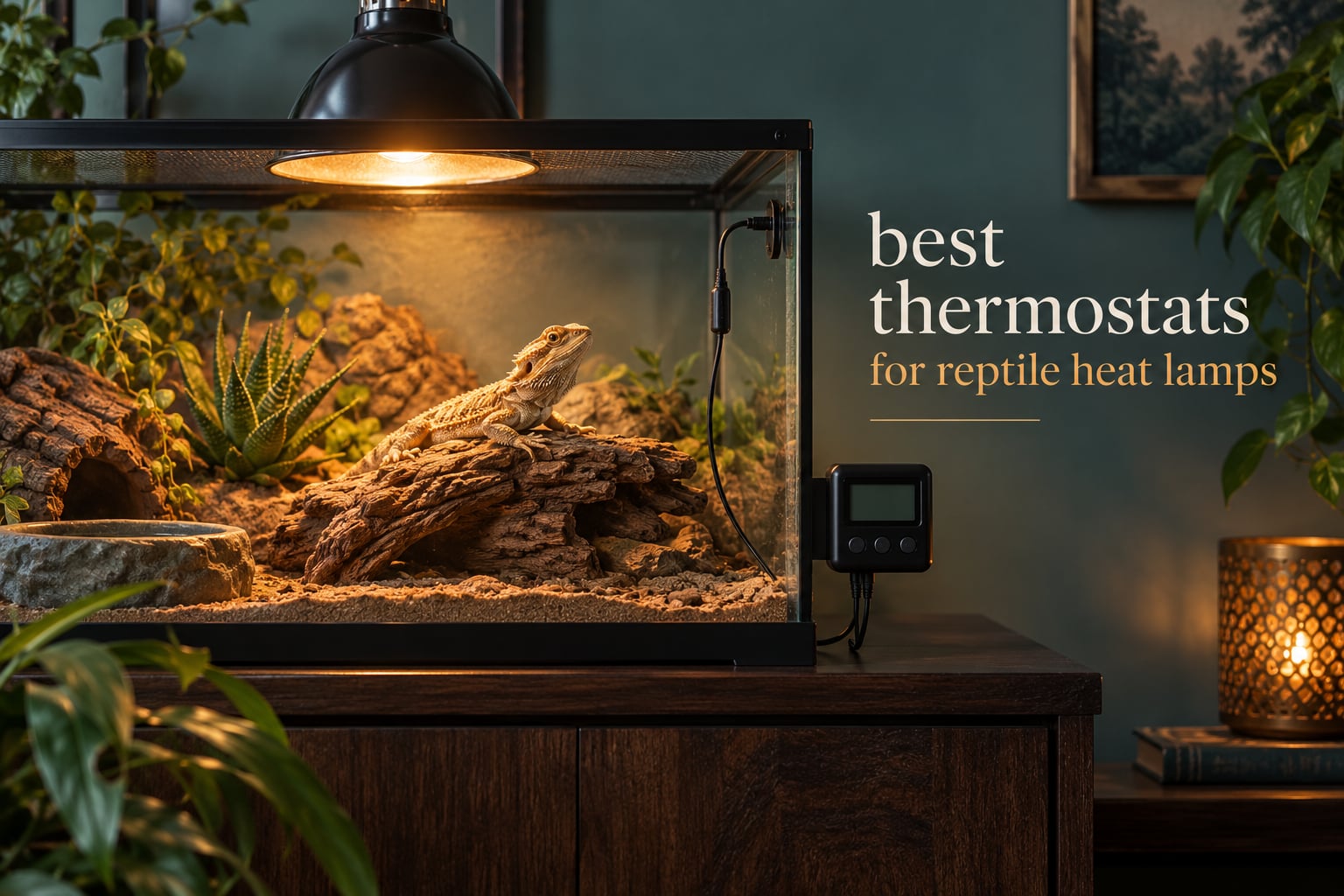
The search for the best thermostats for reptile heat lamps gets confusing fast, because most of what sits at the top of the results is built for heat mats, not bulbs. A reptile is an ectotherm, so the enclosure does not regulate itself, and a lamp left on a timer or a plug will run the basking spot well past what the animal can tolerate.
We spent weeks reading the controller types, wattage ratings, probe placements and failure reports behind the units below, then sorted them by what they actually do to a lamp. Three of the ten are true dimming or pulse proportional controllers, which is the part most roundups leave out entirely even when the query is about heat lamps.
Our rule for every pick: the thermostat has to match the heat source, hold temperature without wrecking bulb life, and shut down safely when something goes wrong. Every number below comes from the manufacturer listing or from aggregated owner reviews, and we flag the units where reliability reports are thin.
Our broader guides cover reptile heat lamp choices and a longer look at reptile thermostat basics.
Does a basking bulb need a thermostat?
Yes, and for an incandescent, halogen or deep heat projector basking bulb you want a dimming or pulse proportional controller rather than an on/off unit. An on/off thermostat cuts all the power and then restores it, which swings the basking spot in cycles and burns through filament bulbs faster. Dimming holds a steadier temperature and lets the bulb run cooler.
Matching rule of thumb: on/off units are fine for heat mats, heat cable, ceramic heat emitters and radiant heat panels because those parts tolerate hard switching. Dimming or pulse proportional control is the better match for anything that emits light.
Heat source to controller type, at a glance:
Halogen basking bulb – dimming or pulse proportional. Visible light doubles as heat, so brightness control is real temperature control.
Incandescent basking bulb – dimming or pulse proportional. On/off cycling is the main reason these bulbs fail early.
Deep heat projector – dimming or pulse proportional preferred, on/off workable. DHPs run hot and tolerate switching, but steady output tracks ambient drift better.
Ceramic heat emitter – on/off acceptable, dimming better in a cold room where the relay would short-cycle.
Radiant heat panel – on/off is standard. Panels are low-wattage resistive elements that handle cycling well.
Under-tank heat mat or heat cable – on/off only. Do not put a mat on a dimmer.
UVB lamp – no thermostat. UVB tubes and compact fluorescent lamps need a timer, not temperature regulation.
On the other hand, if you run a UVB fixture and a basking lamp from the same enclosure, you need two separate devices: a timer for the UVB and a thermostat for the heat. The REPTITRIP below does both in one box.
Top 3 thermostat picks for reptile heat lamps in 2026

Best Thermostats for Reptile Heat Lamps (October 2026)
Control type is the column that matters most here. Anything listed as on/off will cycle your lamp, which shortens bulb life and makes the basking spot swing.
| Product | Specs | Action |
|---|---|---|
| BN-LINK Reptile Thermostat |
|
Check Latest Price |
 Zoo Med ReptiTemp RT-600 Zoo Med ReptiTemp RT-600 |
|
Check Latest Price |
| Inkbird IPT-2CH WiFi |
|
Check Latest Price |
 REPTIZOO Dimming Thermostat TC02 REPTIZOO Dimming Thermostat TC02 |
|
Check Latest Price |
 Exo Terra Day and Night Timer Thermostat Exo Terra Day and Night Timer Thermostat |
|
Check Latest Price |
 Zilla Digital Temperature Controller Zilla Digital Temperature Controller |
|
Check Latest Price |
 REPTITRIP Day-Night Timer Thermostat REPTITRIP Day-Night Timer Thermostat |
|
Check Latest Price |
 Exo Terra On/Off Thermostat 100W Exo Terra On/Off Thermostat 100W |
|
Check Latest Price |
 REPTI ZOO Digital Timer Thermostat THC16 REPTI ZOO Digital Timer Thermostat THC16 |
|
Check Latest Price |
 CAVACHEW Dimming Thermostat 300W CAVACHEW Dimming Thermostat 300W |
|
Check Latest Price |
1. BN-LINK Reptile Thermostat – the most proven controller in the roundup
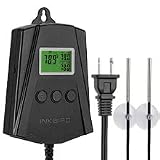
BN-LINK Reptile Thermostat Temperature Controller, Digital Heat Mat Thermostat for Seed Starting, Plant Germination, Greenhouse, Incubator, Brooder, Brewing, Reptiles Tank,40-108°F, 1000W, ETL Listed
On/off heating control
40-108F range
1000W at 120V
ETL listed
4.92 ft probe
Pros
- ETL safety certified
- 1000W capacity covers a lamp plus a mat
- Three-button operation is genuinely simple
- 19k+ reviews document long service life
Cons
- On/off only so bulb life takes a hit
- Click sound when the relay switches
- 120V single voltage only
This is the unit we run when we want something boring and proven. It holds a set point from 40 to 108 degrees F, drives up to 1000W at 120V, and ships with a probe on a 4.92 foot cable, which is long enough to reach the warm side of most enclosures without a splice.
What stands out is the evidence base rather than the feature list. With 19688 reviews averaging 4.6 stars, owners report units still working after three years, and one recurring theme in that feedback is the manufacturer sending free replacements when something did fail.
The honest limitation is the control type. It is a straight on/off relay, so a basking bulb on this controller will switch on and off rather than dim. Keepers running a halogen who care about filament life should look at the REPTIZOO TC02 or the Exo Terra PT2454 instead.
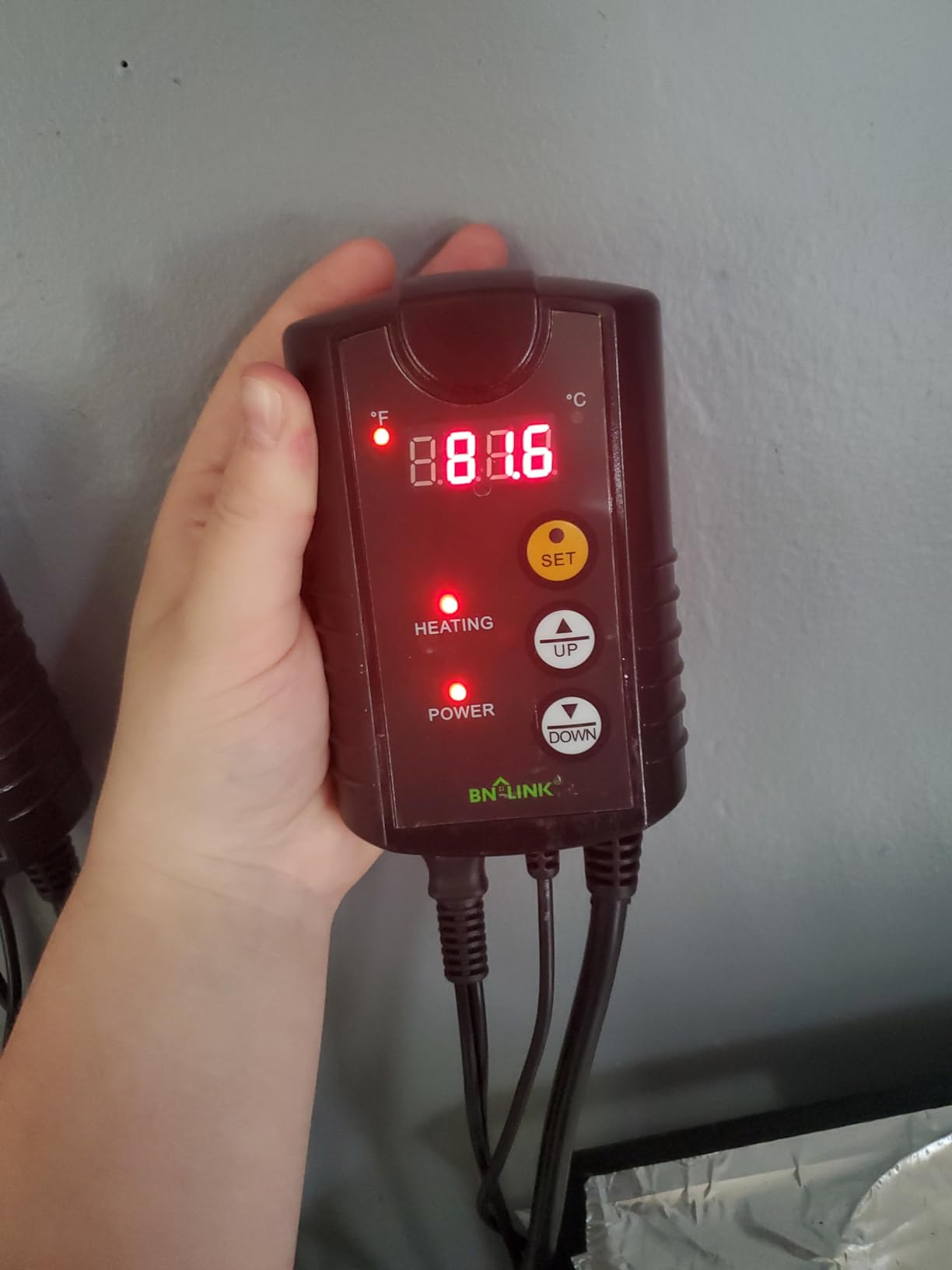
Setup matters more here than with a dimmer. We like to tape the probe to the enclosure wall at animal height on the warm side, with a few inches of slack so the probe tip sits in still air rather than pressed against glass where it would read the substrate temperature.
Owners also flag that the reading updates in steps rather than continuously, so the display does not move in real time. Pair it with an infrared temperature gun and you will catch that easily, which is why we treat the secondary check as non-negotiable for any model on this list.
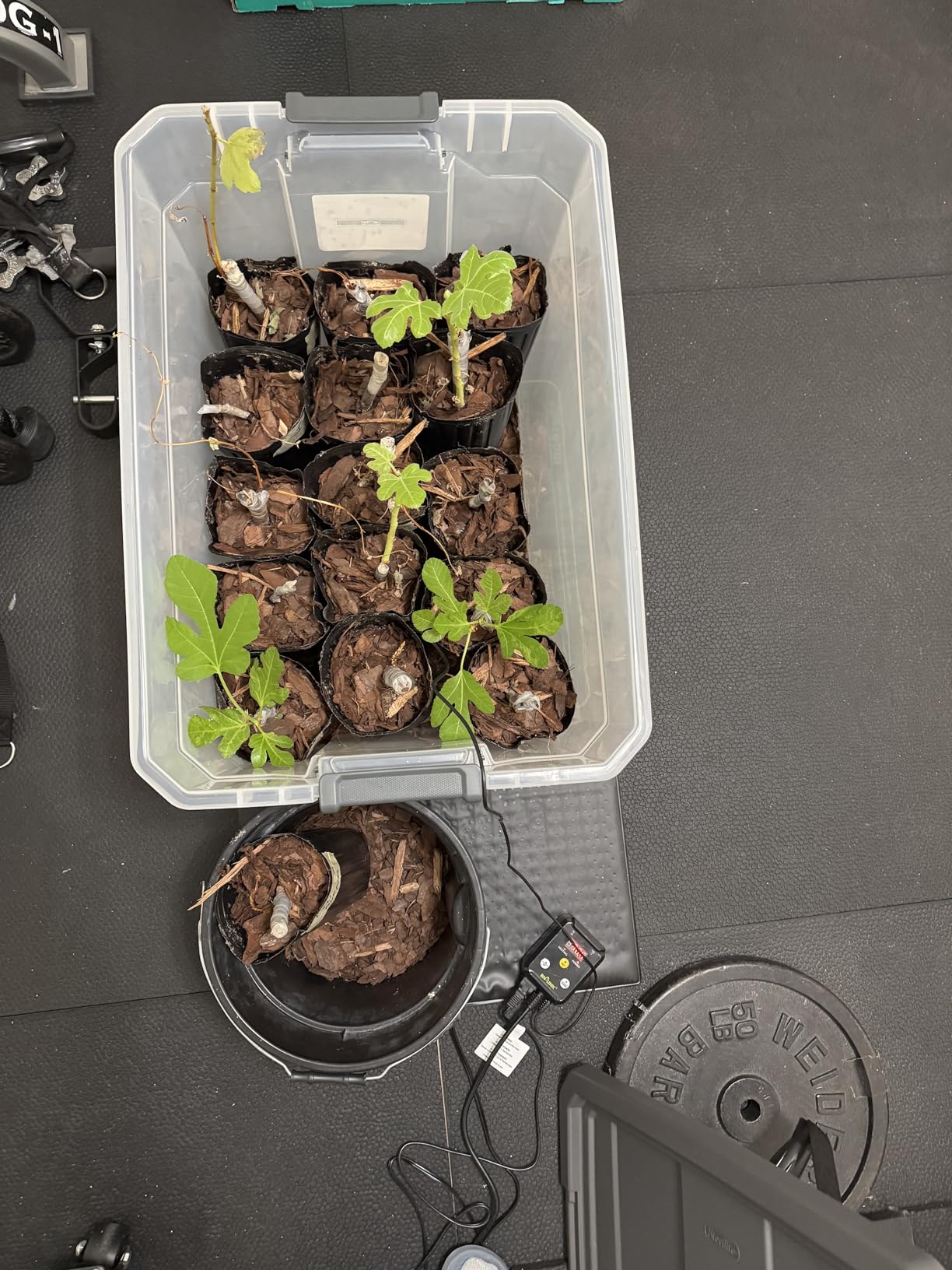
When the BN-LINK makes sense
This is the right call for a beginner, a plant shelf, or a heat mat setup where the controller’s job is simply to stop the mat running all day. The three-button interface takes seconds to learn, and the bright LED with heating and power indicators is readable in a dark reptile room.
For a reptile room running several enclosures, the 1000W ceiling means you can drive a mat and a small lamp from one unit, which saves a wall outlet.
When it is the wrong call
Skip it if your main heat source is a light-emitting bulb and you plan to keep that bulb for months at a time. On/off cycling is the single most common reason basking bulbs burn out early in this hobby, and no amount of probe placement fixes it.
The 40 to 108F ceiling is also worth noting for very warm climates. If your summer nights push past that, you will want a unit with a higher upper range.
2. Zoo Med ReptiTemp RT-600 – the brand-name pick for mixed setups
Zoo Med ReptiTemp Digital Thermostat
50F to 122F control range
600W heating and 150W cooling
HEAT or COOL mode
6 ft remote sensor
Memory after power loss
Pros
- Widest usable range in the roundup
- Switch between heating and cooling mode
- Built-in memory restores settings after a power cut
- High and low alarm
Cons
- Single outlet limits multi-device control
- On/off relay rather than dimming
- Costs more than generic units
The RT-600 is the one we suggest to people who want a known brand name on the box and a controller that handles both heating and cooling. It can switch a connected fan on when the enclosure gets too warm, which matters for desert species in a warm room.
Its 50 to 122F range is wider than most of the field, the sensor cable runs 6 feet, and the load ceiling of 600W for heating plus 150W for cooling covers a single halogen basking bulb with room to spare.
Reviews describe the alarm as the standout feature. It flashes and sounds at extreme high and low readings, which gives you audible warning during the night when nobody is checking the enclosure.
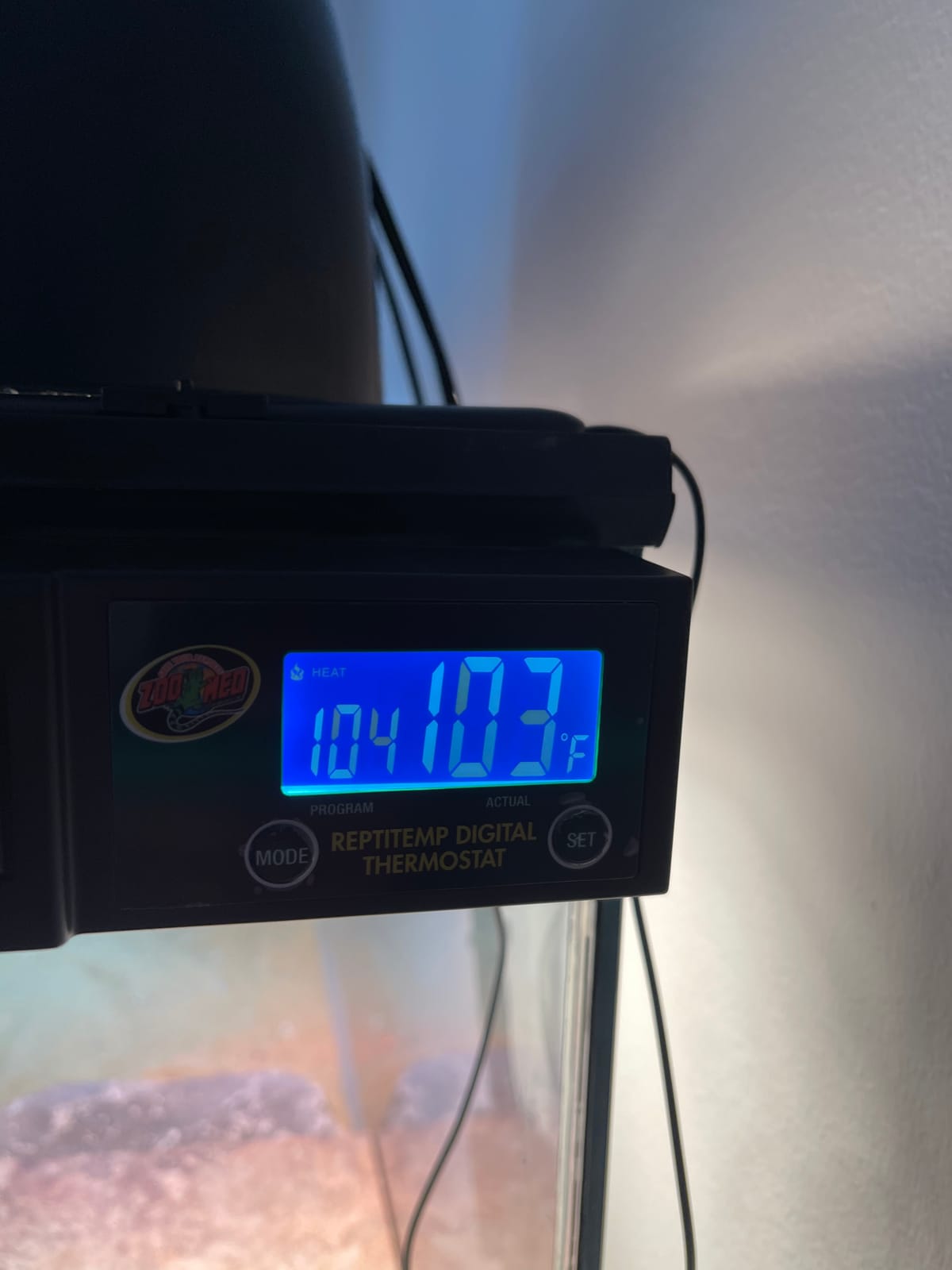
What you give up is dimming. The RT-600 is an on/off controller, so it belongs on a heat mat or a ceramic heat emitter rather than a halogen that you want to keep for a year.
Built-in memory is the detail we appreciate most. A power cut or a scheduled breaker trip no longer means re-entering your target temperature, which removes a common failure mode where a keeper comes home to a cold enclosure and a unit that forgot its set point.
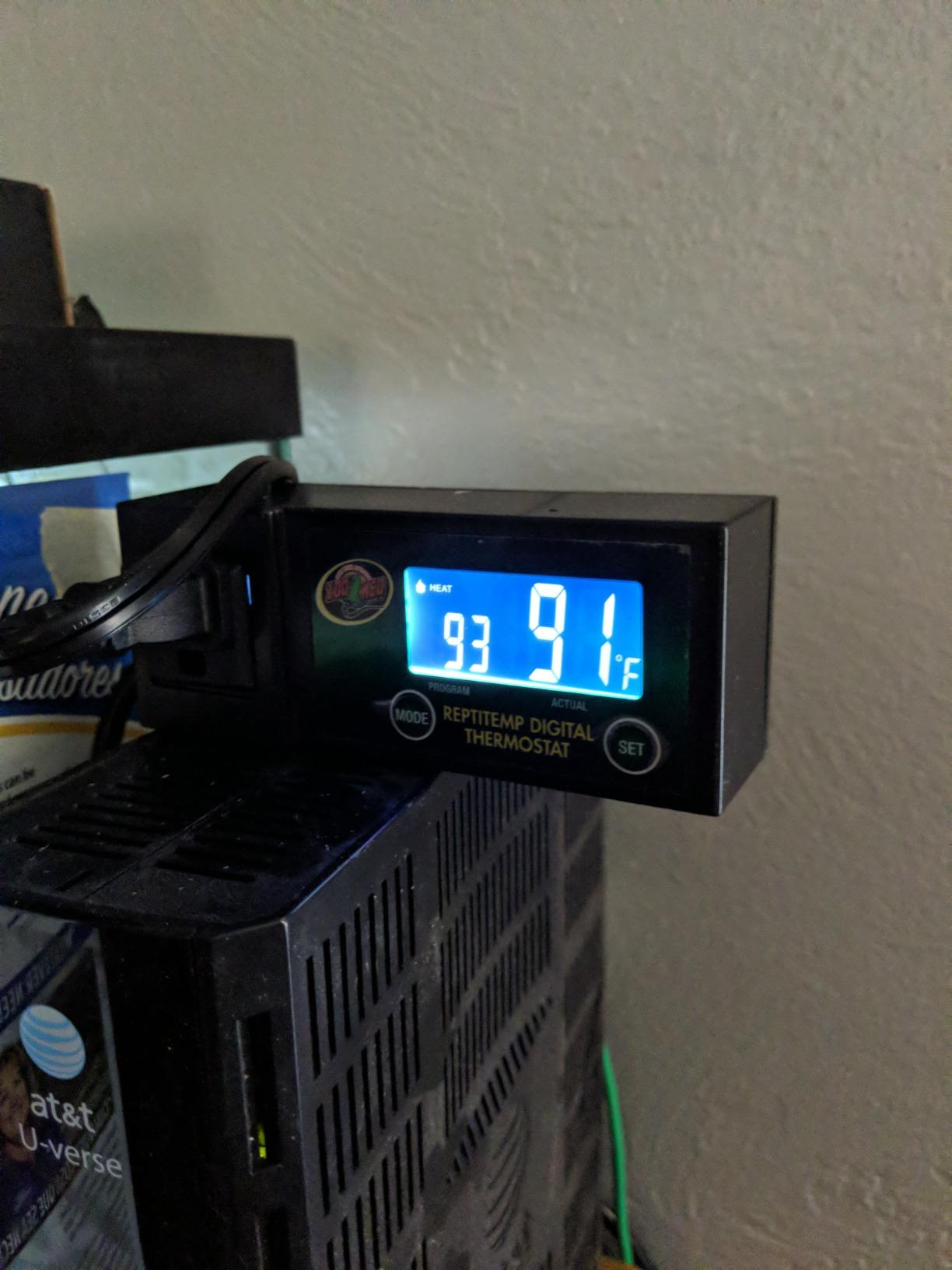
When the ReptiTemp RT-600 makes sense
Choose it for a setup that mixes a mat with a ceramic emitter, or for a desert enclosure where you want a fan assist on hot afternoons. The single outlet keeps wiring simple, and the alarm is genuinely useful for anyone who sleeps while the animal is active.
At 1487 reviews and a 4.6 average, the failure rate reported by owners is low, which is unusual for this category.
When it is the wrong call
It is not the answer for a bulb-first enclosure. If your basking spot runs on a halogen or an incandescent lamp, an on/off controller will cycle that bulb and you will be replacing filaments more often.
One outlet also means you cannot split a warm side and a cool side from a single unit. That setup needs a dual zone controller such as the Inkbird below.
3. Inkbird IPT-2CH WiFi Thermostat – two zones and phone monitoring
Inkbird WiFi Heat Mat Reptile Thermostat Controller Temperature Controller with 2 Probes and 2 Outlets, IPT-2CH Reptiles Heat Mat Thermostat (Max 250W per Outlet)
Two outlets and two probes
250W per outlet,500W total
2.4GHz WiFi app control
Heating only
Replaceable probes
Pros
- Two independent zones from one box
- App charts and data export
- Probe error and high/low alarms
- 1046 reviews at 4.4 stars
Cons
- 2.4GHz WiFi only
- Heating only with no cooling relay
- Some owners report app connection drops
This is the model to look at when one enclosure needs a warm side and a cool side, or when you run a reptile room and want to check every enclosure from your phone. Each of the two outlets has its own probe and its own set point, so the two channels run independently.
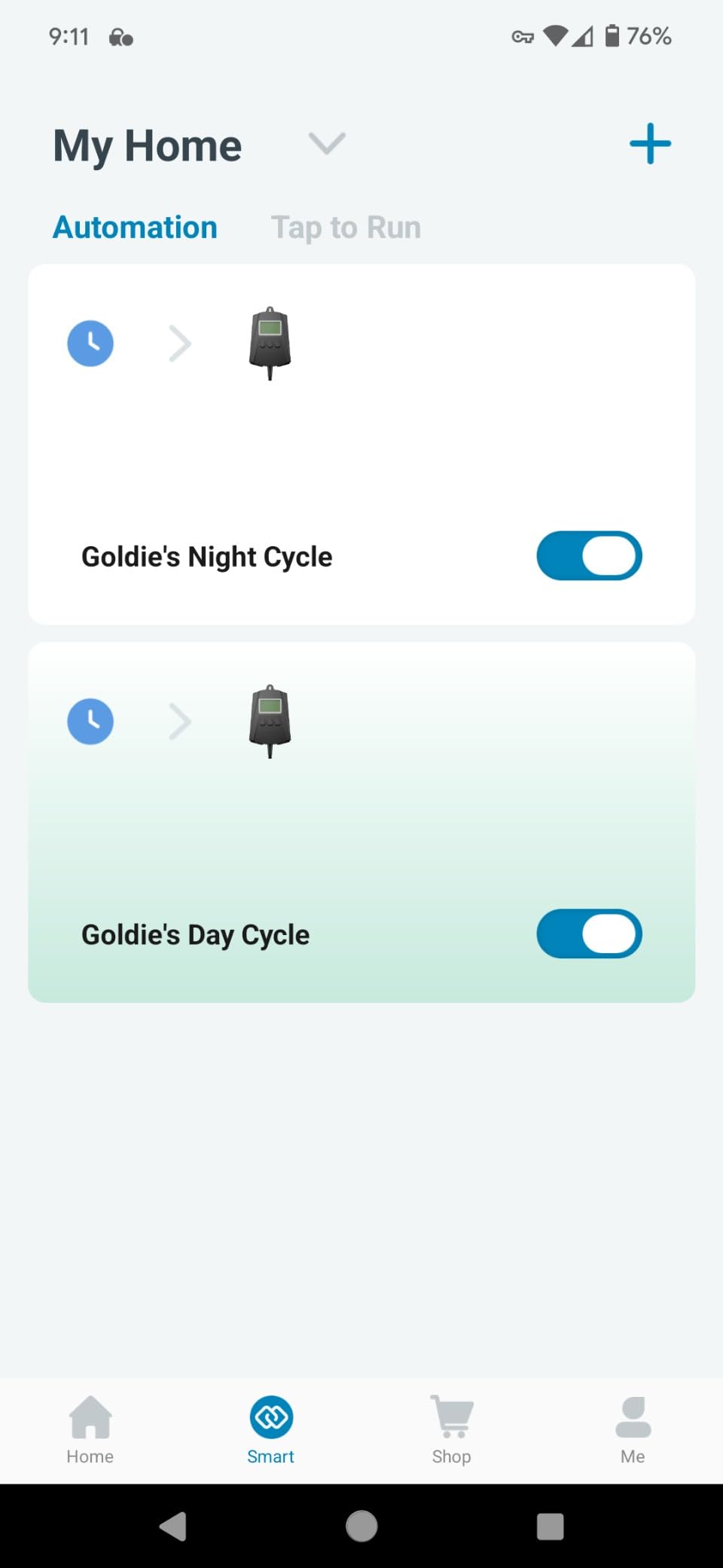
The INKBIRD app adds data charts, exportable logs, high and low temperature alarms and probe error alerts. That last one matters: if a probe stops reporting, the app tells you instead of leaving a heater running on a dead sensor.
At 250W per channel it is not meant for a 300W halogen. Think of it as a dual heat mat controller or a mat plus a small ceramic emitter.
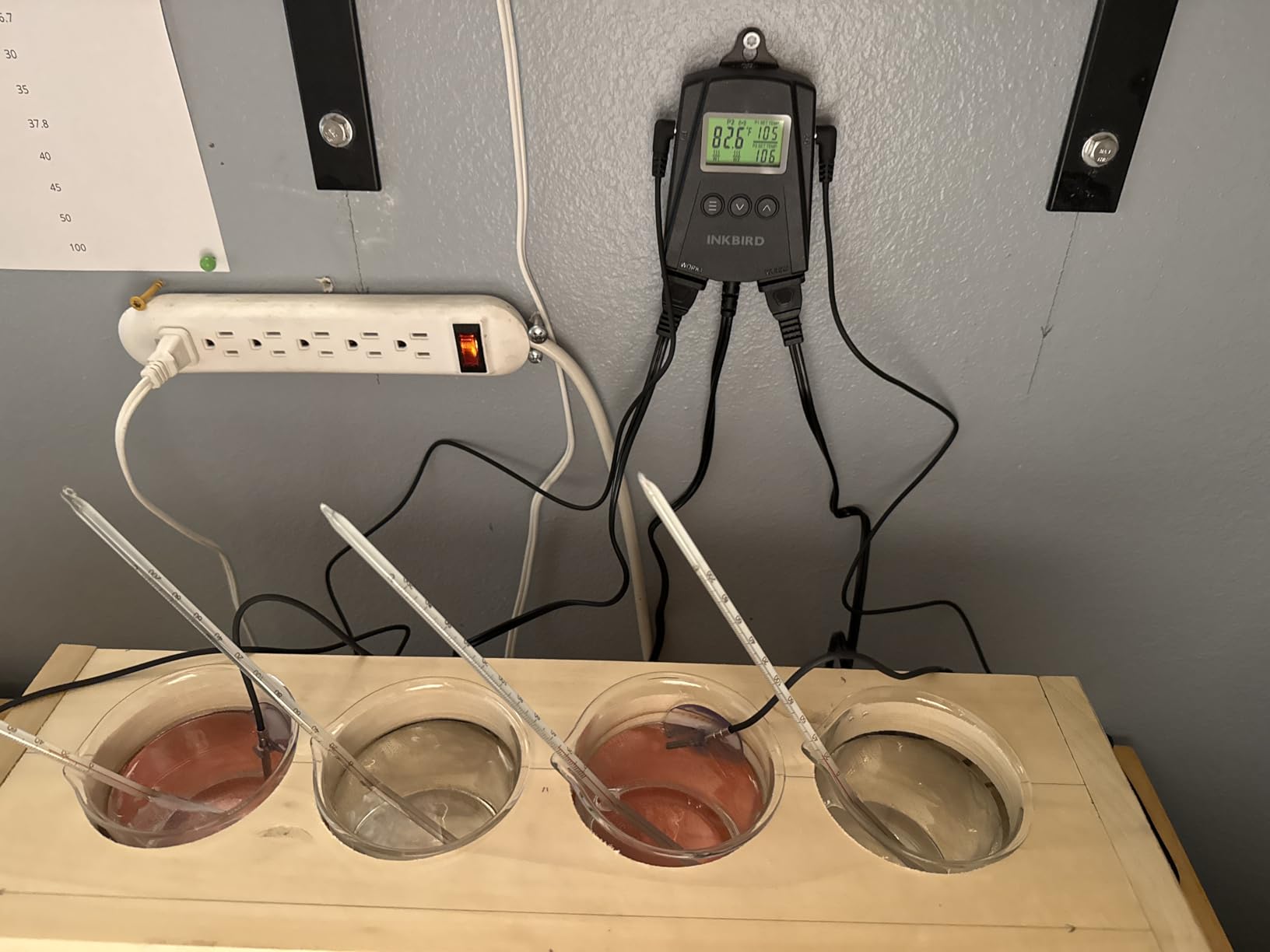
Owners are split on connectivity. The unit only joins 2.4GHz networks, so a router that pushes everything onto 5GHz will not see it, and some reviewers report needing to re-pair the device after a network change.
It is also heating only. There is no cooling relay, so the fan assist you get on the Zoo Med unit is not available here.
When the Inkbird makes sense
It earns its place for two-zone work: a ball python warm side and cool side, a two-tier rack, or any arrangement where one controller per enclosure would mean doubling your wall outlets. The app logging also makes it the easiest pick to audit after a week of operation.
Two included probes remove the guesswork of matching sensors to channels.
When it is the wrong call
Do not put a large halogen basking bulb on it. Two things work against that: the 250W per outlet ceiling, and the fact that on/off control will shorten filament life regardless of the wattage.
If your router is 5GHz only, or you would rather not depend on an app and a cloud account to control a heater, choose a stand-alone controller instead.
4. REPTIZOO TC02 Dimming Thermostat – PID dimming made for bulbs
REPTIZOO Dimming Thermostat, PID Temperature Controller with Memory Function, Reptile Thermostat for Reptile Heat lamp, Specifically Designed for Light Heat Bulbs & Heaters
PID dimming for heat lamps
41F to 140F range
300W maximum output
LED display with C/F toggle
Memory after power loss
Pros
- Purpose-built PID dimming for heat bulbs
- Extends bulb life versus on/off control
- Memory keeps your set point through a power cut
- 780 reviews of real lamp use
Cons
- Not for sunlamps or UVB fixtures
- Probe must sit at least 15cm from the heat source
- Some reports of flickering or shutdowns
This is the first unit we would actually put on a halogen basking lamp if you do not want to spend enthusiast money. It uses PID dimming, which means it reduces power output continuously instead of switching the bulb on and off, and the manufacturer states it is designed specifically for light-emitting heat sources.
The range runs 41 to 140F and the output ceiling is 300W, which covers an 80W or 100W halogen with plenty of headroom. The LED screen toggles between Celsius and Fahrenheit, and the memory function restores your settings after power loss.
At 780 reviews and 4.2 stars it is well used by keepers, and the recurring praise is simple: bulbs last longer and the basking spot stops swinging.
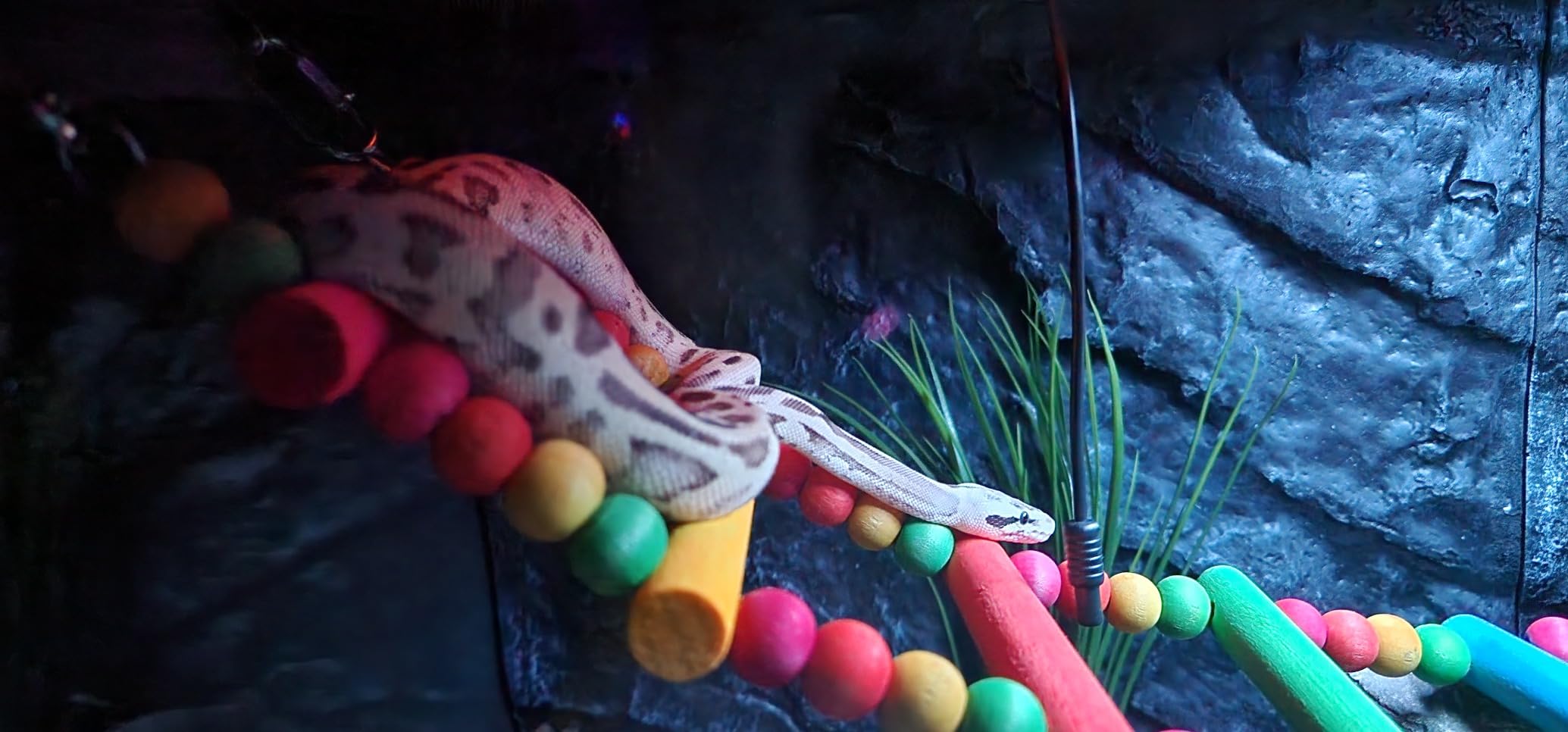
The instruction to keep the probe at least 15cm from the heat source is not boilerplate. With a dimming controller the probe is the only thing limiting output, so park it too close to the bulb and the thermostat will throttle down permanently.
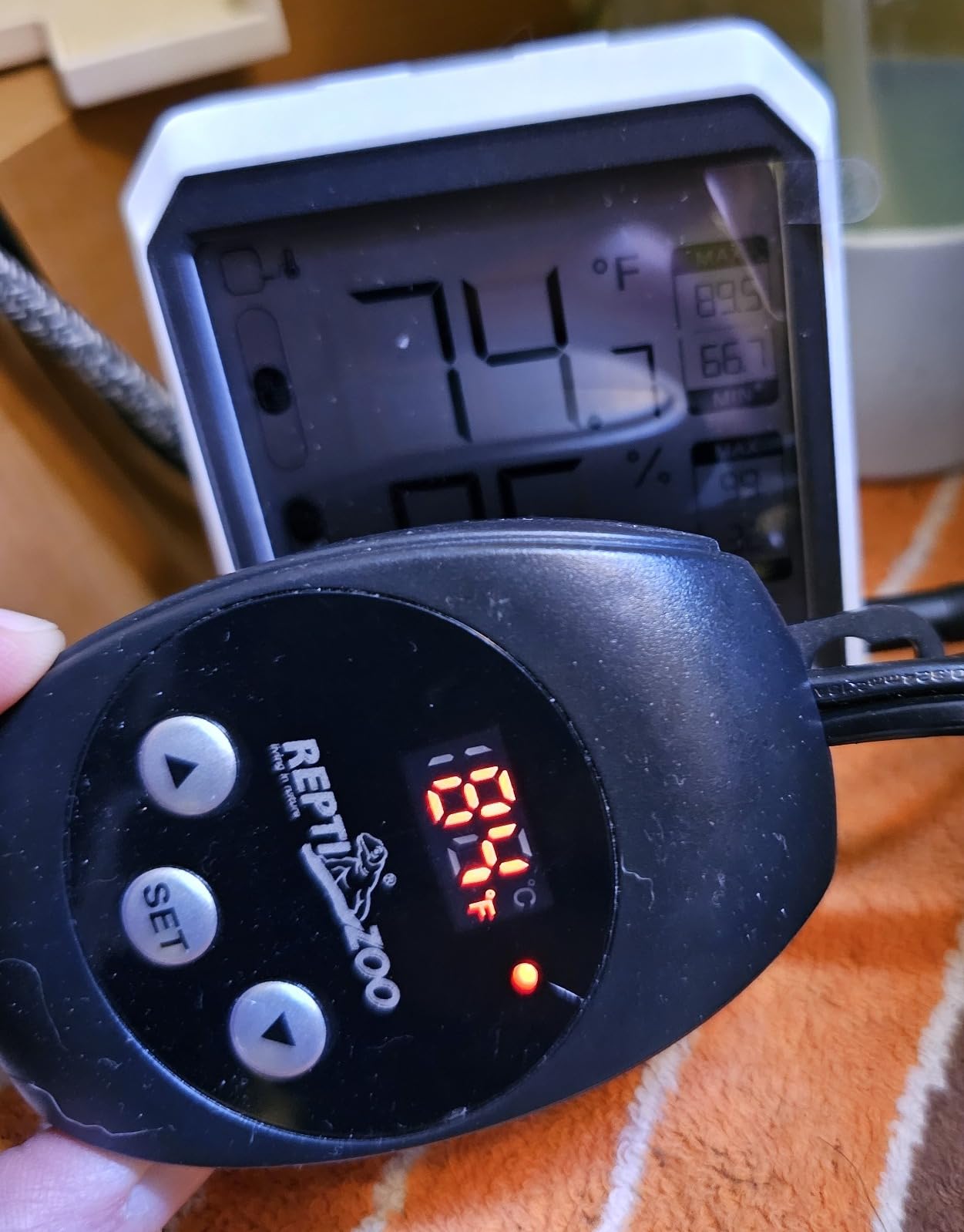
Negative reviews mention flickering and units shutting down early, so treat it as a budget choice rather than a breeding-room component. Verify with an infrared temperature gun during the first week and check the setup again as the seasons change.
When the TC02 makes sense
It is the pick for a single basking lamp in a mid-size enclosure where bulb replacement costs add up. If you have ever thrown away a halogen after three months, the dimming behaviour here is the reason to switch.
The wide 41 to 140F range also makes it workable in warm rooms where a unit topping out at 122F would struggle.
When it is the wrong call
Do not use it with a sunlamp or any UVB fixture. Dimming a UVB lamp is a different problem entirely, and the manufacturer explicitly excludes them.
If you need more than 300W, or you want audible alarms, this is not the unit. Move up to the Exo Terra PT2454 or the Zoo Med RT-600.
5. Exo Terra Day and Night Timer Thermostat – full lamp control with programmable set points
Exo Terra Thermostat with Day and Night Timer for Reptile Terrariums
Dimming and pulse proportional control
Independent day and night set points
50F to 140F
600W maximum
Blue LCD with actual and set temperature
Pros
- Only pick here offering both dimming and pulse proportional
- Moves the enclosure from a day set point to a night set point automatically
- 600W handles a halogen plus a mat
- Works with bulbs
- mats
- cables and ceramic heaters
Cons
- Highest cost of the ten units
- Needs a battery for memory backup
- Programming takes practice for beginners
This is the most capable controller in the roundup. It offers both dimming and pulse proportional control, which means you can drive a light-emitting heat bulb and still hold a very steady temperature rather than a brightness that creeps.
The feature that changes daily husbandry is independent day and night set points from 50 to 140F. Most nocturnal species need the enclosure to drop at night, and this unit makes that drop automatic instead of asking you to remember a timer.
The 600W ceiling is generous for a single enclosure: a 150W halogen plus a small mat or cable fits comfortably.
The blue LCD shows actual and set temperature side by side, with a red LED and a heating symbol when the device is actively driving power. That feedback loop is what you want while you are dialing in a new enclosure.
It runs on a battery for memory backup, which is the same idea as the Zoo Med and REPTI ZOO units: a power cut should not reset your carefully tuned set points.
When the Exo Terra makes sense
It is for keepers running a single animal in a planted or bioactive enclosure where temperature stability matters and you do not want to think about night cycling. Dimming plus pulse proportional gives you the smoothest temperature curve of anything we tested.
It also handles mixed sources, so you can run a halogen basking bulb and a ceramic heat emitter from the same output without worrying about which chemistry is dimmer friendly.
When it is the wrong call
It is the most expensive unit here, and the 4.0 average across 190 reviews is the lowest star rating of the group. A handful of owners report reliability problems over time, so if you have never used a programmable controller before, this is a steep place to start.
One enclosure with one mat does not need this. The Zoo Med RT-600 covers that use for less.
6. Zilla Digital Temperature Controller – the set-and-forget heat tape option
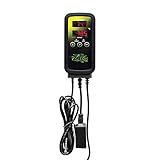
Zilla Digital Temperature Controller, Thermostat for Reptile Terrariums
On/off control for non light-emitting sources
Programmable day and night settings
Probe with automatic overheat shut-off
Temperature probe included
Pros
- Long-term owners report years of service
- Automatic overheat shut-off when the probe reads high
- Programmable day and night settings
- Easy to program
Cons
- On/off only with no dimming
- No alarm for temperature deviations
- Not for light-emitting heat sources
- Relay click is audible in a quiet room
The Zilla is aimed squarely at heat tape, ceramic emitters and under-tank heaters, and it is very good at that job. It holds within about a degree of the setting according to owners, and the probe includes an automatic overheat shut-off as a backstop.
What separates it from generic controllers is the programmable day and night settings. A nocturnal snake or a gecko enclosure can hold a lower target overnight without a separate timer.
With 348 reviews at 4.6 stars, the pattern in long-term feedback is durability. Multiple owners describe years of continuous service, which is the kind of evidence most listings cannot show.
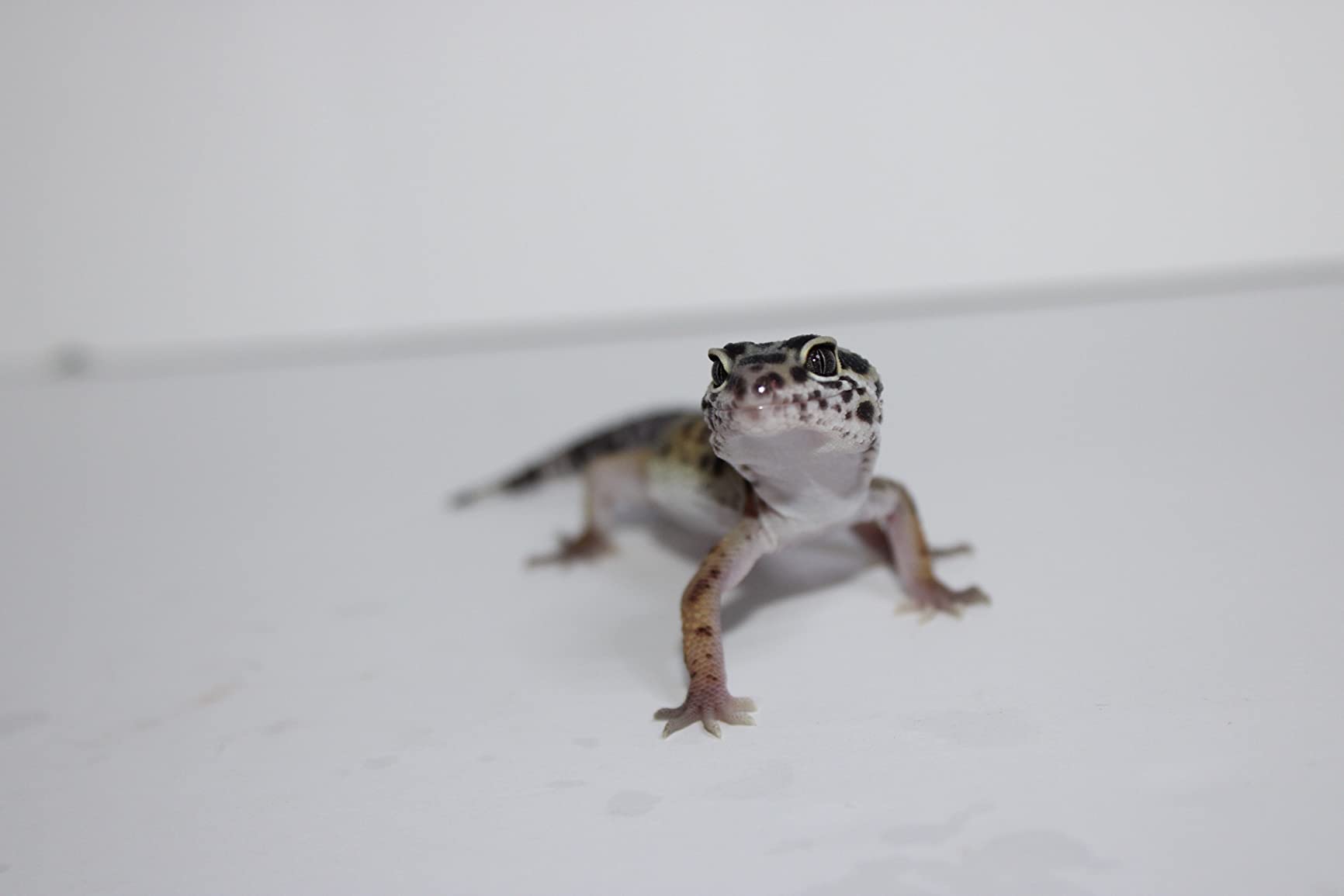
Two things to know before you buy. First, the hysteresis is about 1 to 1.5 degrees, meaning the relay cuts out at your set point and restores power roughly a degree below. That is normal for an on/off controller and not a defect.
Second, there is no audible alarm. If the temperature drifts while you sleep, the controller keeps doing its job quietly and you will not hear about it, so an infrared temperature gun check stays important.
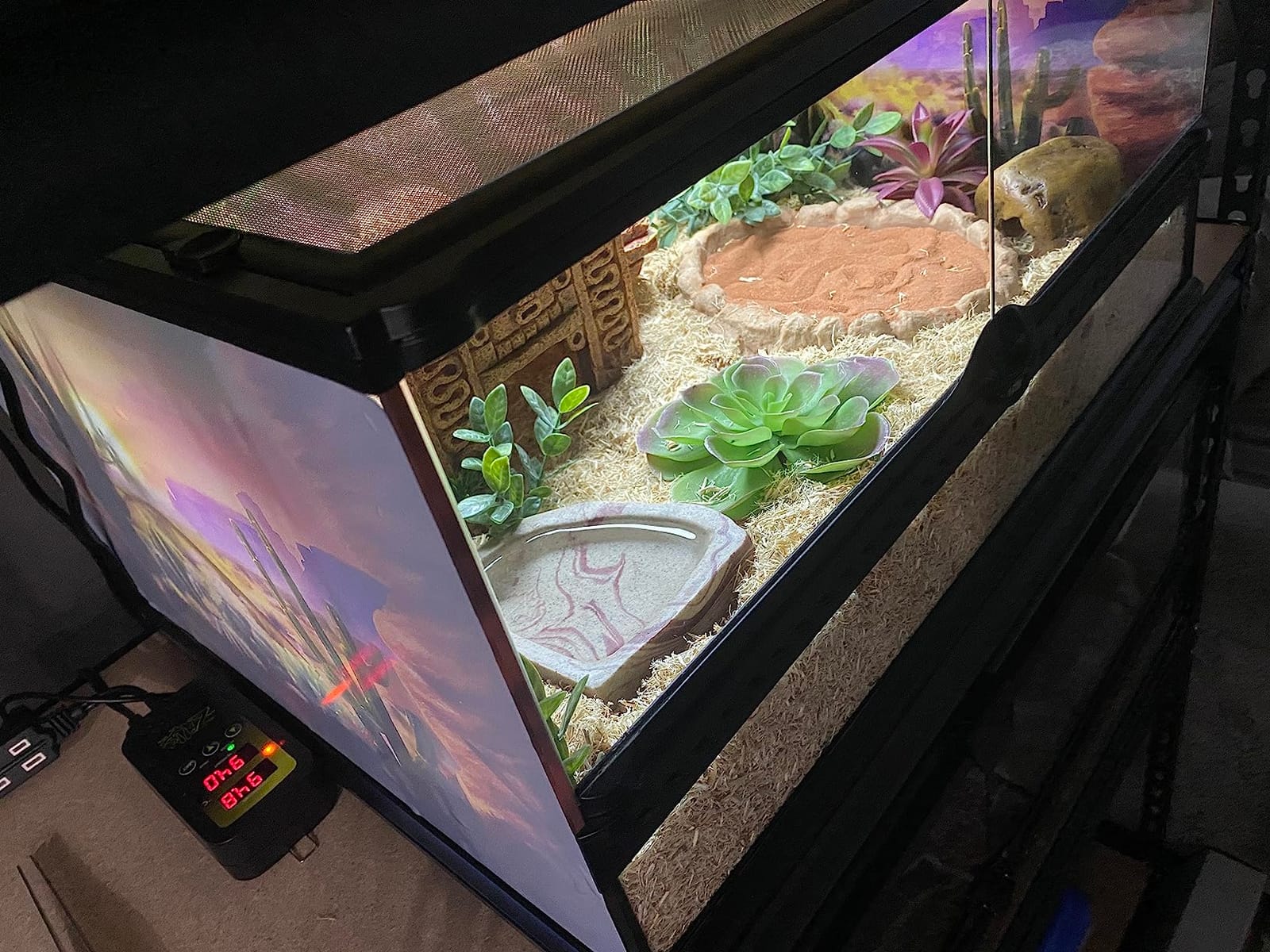
When the Zilla makes sense
It suits anyone running heat tape along the back of a long snake enclosure, or an under-tank heater for a gecko or nocturnal species. The overheat shut-off and the multi-year reliability reports are what we would want next to a heating element.
It also works well as a second controller for the cool side of a two-zone setup, because its probe-based shut-off is the safety net that a bare dimmer lacks.
When it is the wrong call
It is not for any bulb. Non light-emitting means exactly that, and running a halogen through an on/off controller is the cycle-heavy arrangement that kills filaments.
If you sleep through the night and want to be woken by a controller alarm, the Zoo Med RT-600 or the REPTI ZOO THC16 both sound for temperature extremes.
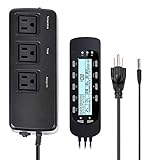
7. REPTITRIP Day-Night Timer Thermostat – one box for UVB plus heat
REPTITRIP Reptile Thermostat, Light Timer for Temperature and Lighting Control, Day-Night Timer Thermostat with Reptile Thermometer for UVB Light, Heat Lamp, Heating Pad, 10A 1250w
Two sockets: one timer, one thermostat
32F to 140F with day and night settings
1250W total on a 10A cable
Sensor accuracy of plus or minus 2F
Replaceable sensor
Pros
- Timer socket runs your UVB on a schedule separately
- 1250W total capacity
- Three custom timing programs
- Replaceable sensor extends service life
Cons
- Temperature socket is non-dimmable
- Setup is complex for a first thermostat
- Heating only with no cooling function
The problem this solves is one most keepers hit in month one: a UVB tube that needs a schedule and a basking lamp that needs temperature regulation, both in the same enclosure. The REPTITRIP has two sockets and separates those jobs.
Socket S1 runs on timer control with three custom programs, and socket S2 handles day and night temperature from 32 to 140F. The stated sensor accuracy is plus or minus 2F with a 500 millisecond refresh rate.
At 1250W total on a 10A cable it has the largest capacity of any unit here, so it can carry a basking bulb on one channel and a mat or cable on the other.
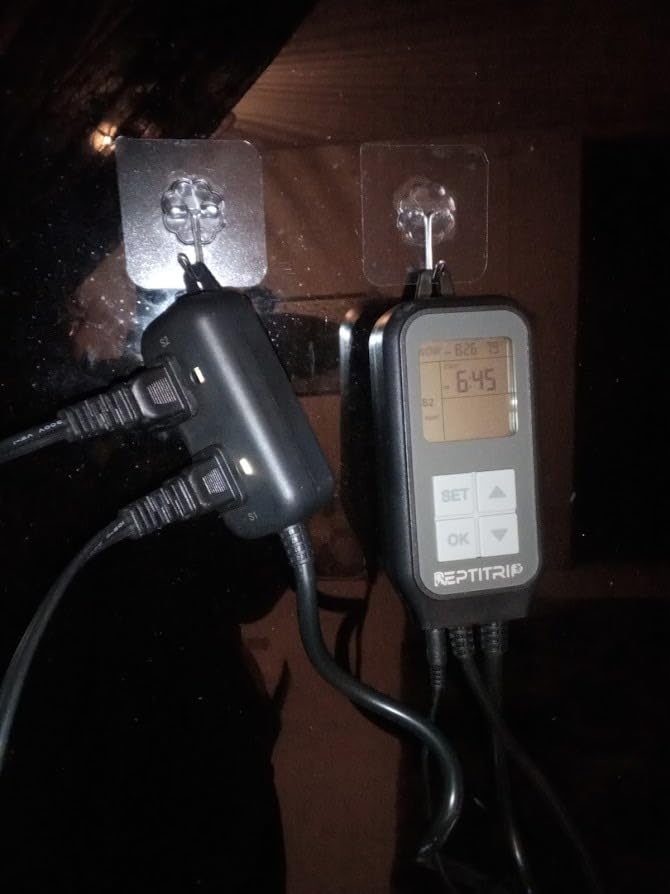
The 0.1F resolution and replaceable sensor are nice touches. If a probe fails later you swap the sensor instead of the whole unit, and the 15 inch body with a ceramic outer shell reads clearly in a rack system.
Programming is the hard part. Owners who have set it up describe a learning curve, and the manual does not walk through every combination of timer logic and day or night temperature.
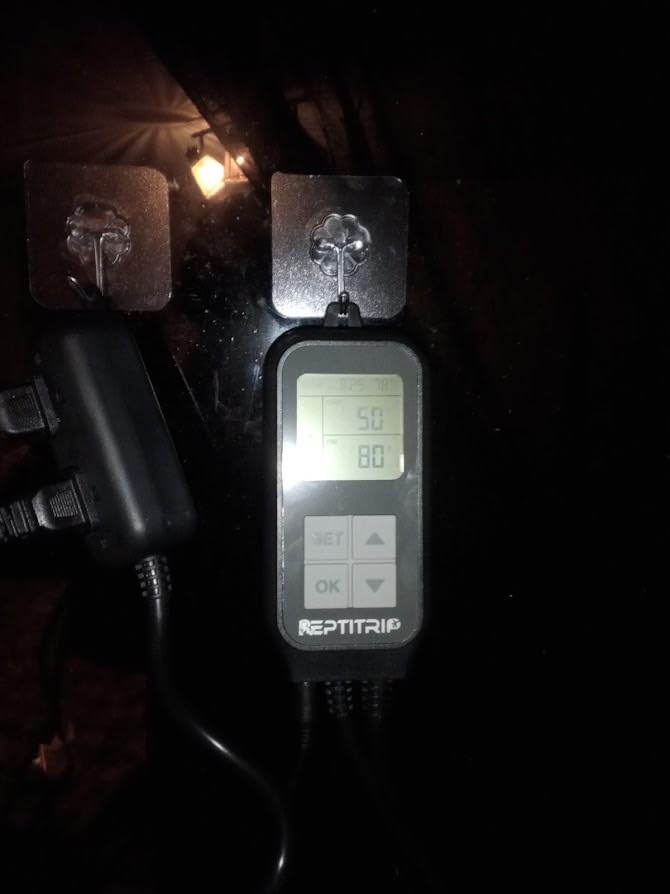
When the REPTITRIP makes sense
It is the answer for a desert or tropical enclosure running a UVB fixture alongside a heat source, because it removes the need for a separate plug-in timer and keeps the two schedules in one place.
For a reptile room with several enclosures, the high total wattage and independent day or night settings make it a good central unit.
When it is the wrong call
The temperature socket is on/off, not dimmable. If your priority is bulb longevity on a halogen, this loses to the REPTIZOO TC02.
There is no cooling function either, so it cannot run a fan on a hot day. And if you like simple three-button controllers, this is the opposite.
8. Exo Terra On/Off Thermostat 100W – a small-enclosure heat mat controller
Exo Terra Reptile Electronic On/Off Thermostat, 100 W
On/off control
100W maximum load
6 ft sensor probe
Red on and off indicator light
Heat mats and ceramic heaters only
Pros
- Explicitly built for mats and ceramic heaters
- Simple single dial operation
- Long 6 ft probe cable
- Established brand with a track record
Cons
- Cannot be used with bulbs of any kind
- 100W ceiling is the lowest in the roundup
- On/off cycling causes visible temperature swings
This unit has one job and states it plainly: heat mats and ceramic heaters, nothing else. The manufacturer copy is explicit that light-emitting heat sources are not supported, which is more honesty than most listings in this category offer.
For a small enclosure, a single ceramic heat emitter, or a simple mat setup, it is a clean answer. The 6 foot probe gives you reach, and the red indicator light shows when the relay is closed.
At 334 reviews and 4.3 stars, roughly 70% of ratings sit at five stars. The complaints in the remainder are mostly about durability and about the temperature swings caused by on/off cycling.
When the Exo Terra 100W makes sense
It works well as a dedicated mat controller for a leopard gecko enclosure, where the mat is the only heat source and the surface temperature is what matters.
Because the 100W limit is low, it also acts as a useful safety stop: you cannot accidentally plug a 150W halogen into it and overload the relay.
When it is the wrong call
Any enclosure where the basking spot is a lamp. This controller cannot drive one, and that is by design rather than a fault.
The 100W ceiling also rules out ceramic heat emitters above 80W or any heat lamp, no matter how the wiring is arranged.
9. REPTI ZOO Digital Timer Thermostat THC16 – three outlets and preset species modes
REPTI ZOO Reptile Thermostat Digital Outlet Temperature Timer Troptical or Desert Mode with Day Night Control for Aquarium Reptiles Terrarium Humidistat Mushroom Fermentation,Easy Setup (THC16)
Tropical and desert presets plus custom programming
4 timer periods to the second
Day and night temperature control
Three outlet types
CR2 battery memory backup
Pros
- Tropical and desert presets make setup fast for beginners
- Temperature
- timer and always-on outlets in one unit
- Waterproof detachable probe
- Backup battery preserves programming
Cons
- Multiple reviews report failure around 60 days
- Alarm cannot be disabled and beeps at large deviations
- Programming instructions are unclear
The three-outlet arrangement is unusual and genuinely useful. One outlet is temperature controlled, one runs on a timer, and one stays always on, which lets you run a basking heat lamp on temperature control while a UVB fixture follows a schedule and a mister or light stays powered.
The preset tropical and desert modes are the fastest path to a working setup for a beginner. Once you outgrow them, the custom programming offers four timer periods accurate to the second and independent day and night temperature control.
The probe is detachable and waterproof, and a CR2 battery keeps your programming through a power cut.
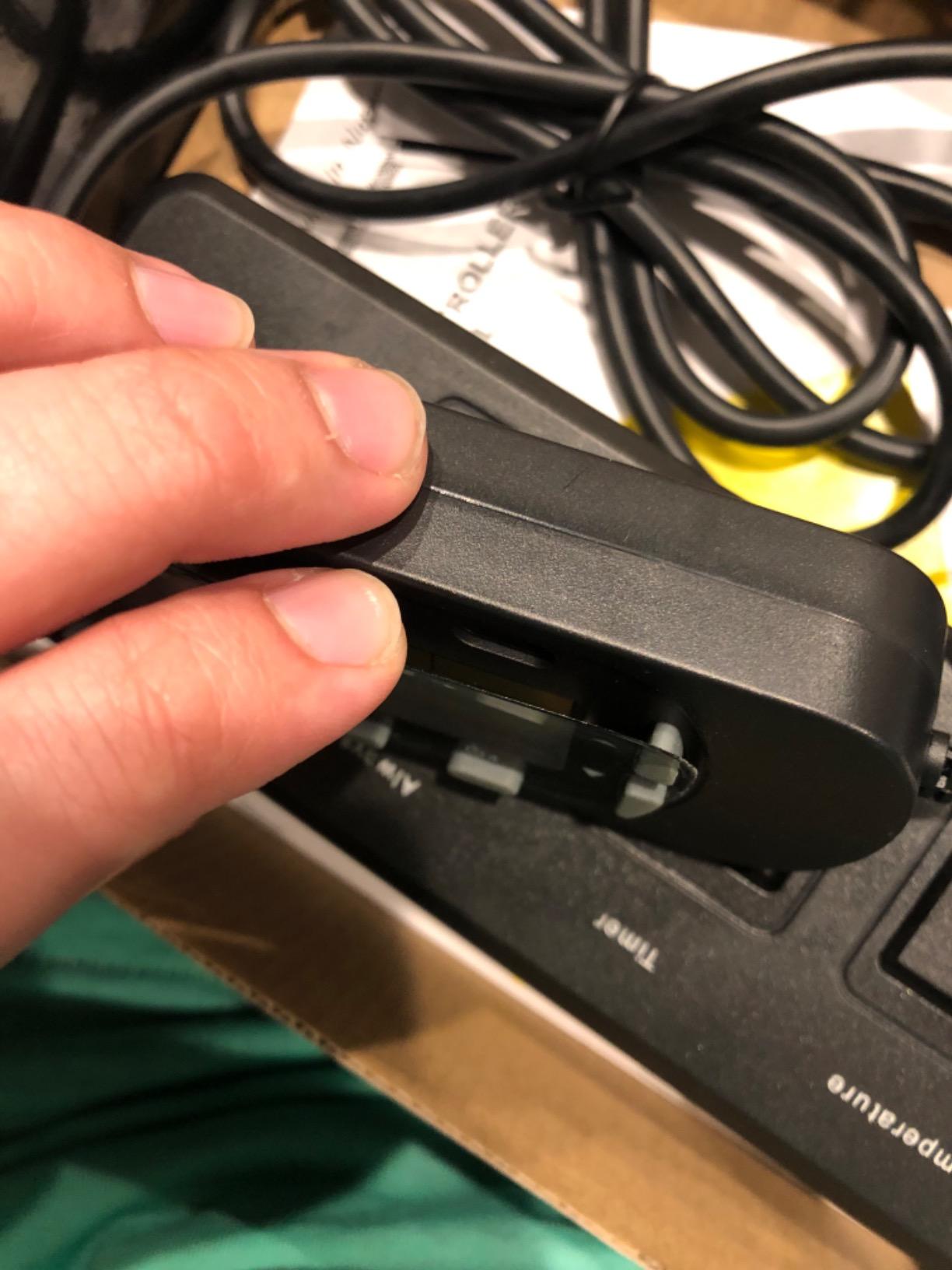
Reliability is the concern here, and we would not skip past it. Across 272 reviews averaging 4.0 stars, several verified owners describe the unit failing at roughly 60 days, often with the alarm misbehaving, and a 62% five-star rate is the second lowest in the group.
The alarm cannot be switched off and sounds at deviations of five degrees or more, which some owners find intrusive. Others report that a connected UVB light flashes when the alarm triggers.
When the THC16 makes sense
The outlet layout suits a mixed enclosure that needs three kinds of power: regulated heat, scheduled light, and continuous supply. Few competing units give you that in one box.
The presets also make it forgiving if you are still learning what temperatures a tropical species actually needs.
When it is the wrong call
If your setup is only a heat lamp, you are paying for outlets you will not use. The Zoo Med RT-600 does the regulated part with an alarm for less.
Given the reported failure pattern, we would not build a breeding rack around this unit or leave an animal unattended behind it without a second thermometer.
10. CAVACHEW Dimming Thermostat 300W – the cheapest way into dimming
CAVACHEW Dimming Thermostat Reptile, Thermostat for Reptile Heat Lamp Mats Bulbs, PID Temperature Controller for Reptile Amphibian Habistat, Memory Function, LED Digital Screen, Sensitive Probe, 300W
PID dimming mode
68F to 122F range
300W output at 110V-240V
LED display with C/F toggle
Wall mountable
Pros
- PID dimming at the lowest cost of any lamp-capable unit here
- Dual voltage accepts 110V and 240V setups
- Memory restores your set point after power loss
- Small and easy to wall mount
Cons
- One verified review reports the unit melting and a fire risk
- Several owners report flickering or failure within weeks
- Ships in Celsius by default
- Build quality is thin at this tier
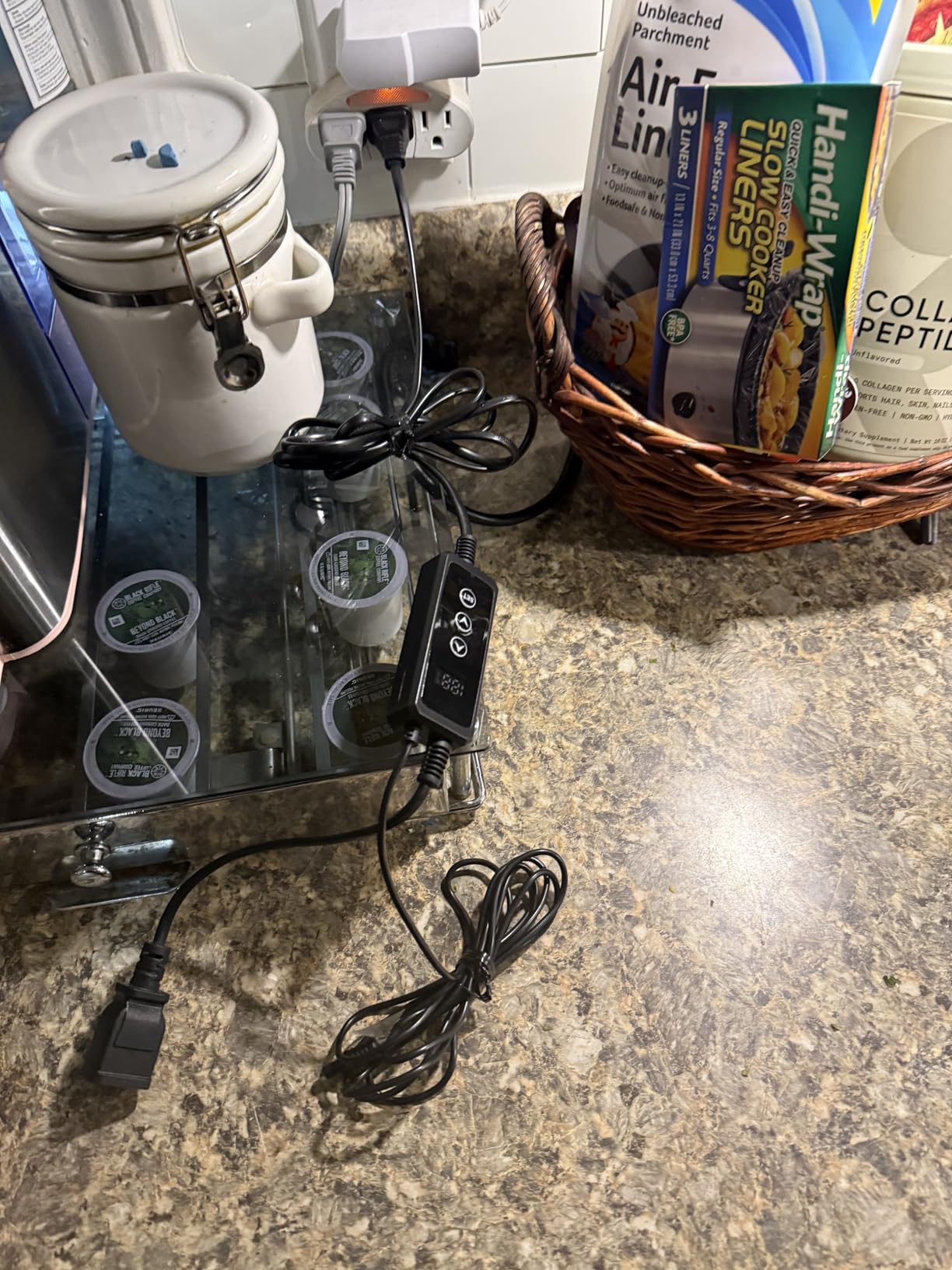
We are including this one because it shows exactly where the entry level of dimming control sits. It uses PID dimming, accepts 110V to 240V, and holds temperatures from 68 to 122F on up to 300W of lamp or heater load.
The dual voltage rating is unusual at this tier, and the memory function restores settings after a power loss. It also mounts flat on a wall, which is useful when rack space is tight.
At 190 reviews and 4.3 stars, most owners report it working well enough for a heat lamp. Our concern is not the concept, it is the enclosure around the plug.
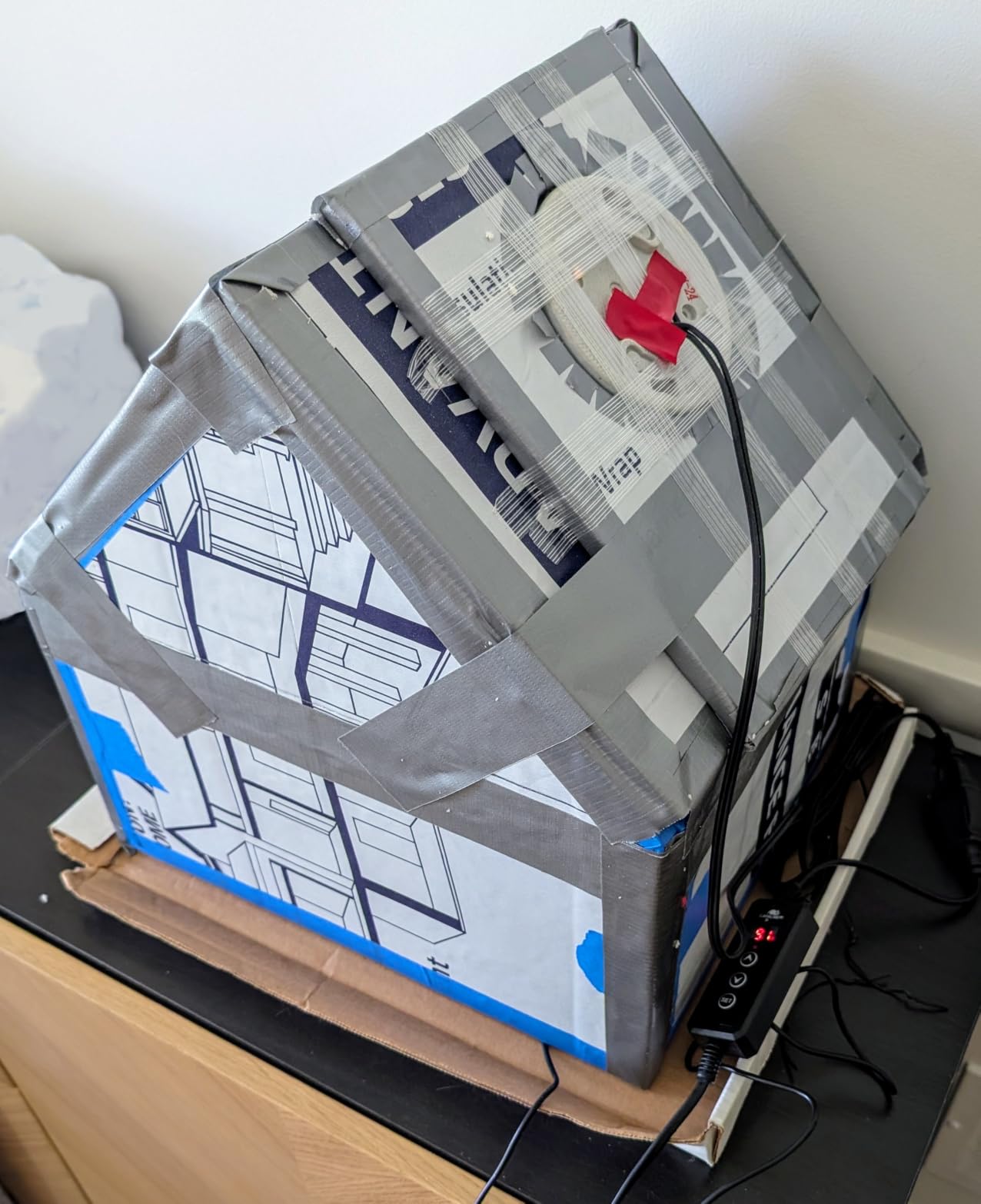
One verified review reports the unit melting with a fire risk. That is a single report, but at this price point the enclosure and relay components are the least engineered part of the design, and a dimming controller is wired directly to a heating element.
Other owners describe flickering or total failure within weeks, and the default unit is Celsius, which catches out first-time buyers.
When the CAVACHEW makes sense
It makes sense for a single small lamp in a low-risk setup, such as a starter enclosure where you already have an independent thermometer watching the animal.
For anyone who wants dimming behaviour without spending more, it demonstrates the difference between cycling a bulb and throttling it, which is a useful lesson before you invest in a better unit.
When it is the wrong call
Do not put a valuable animal behind it. A safety report of that kind is the deciding factor for us, and the reliability pattern does not improve the picture.
It also tops out at 122F and 300W, so it cannot run a larger halogen or handle a hot-climate setup.
How to match a thermostat to your reptile heat source
Pick the control type that fits the bulb chemistry
Dimming works with incandescent, halogen, deep heat projector and mercury vapor lamps, and with HO fluorescent fixtures. It is the wrong choice for under-tank heat mats and heat cable, which are low-wattage resistive elements that should run on simple on/off control.
Never dim a UVB fixture. UVB output depends on the tube running at its intended intensity, and cycling or throttling it changes the ultraviolet output your animal relies on for vitamin D synthesis. If you are still deciding which bulb type to run, our reptile heat lamp guide breaks down the options side by side.
Check the wattage ceiling against your actual load
Add up the wattage of everything the controller will drive and compare it to the rating. The BN-LINK at 1000W and the REPTITRIP at 1250W have the most headroom, while the Exo Terra PT2456 caps at 100W, which limits it to small mats and low-wattage emitters.
Running close to the ceiling reduces margin for inrush current when a bulb filament is cold. Staying roughly a quarter below the rating is a sensible habit.
Get the probe placement right for lamp setups
Do not put the probe inside the basking spot. The probe reads the temperature you want the enclosure air to hold, not the surface temperature of the rock under the lamp.
Secure it at animal height on the warm side wall with a small amount of slack, away from glass and away from the direct line of the bulb. REPTIZOO specifies at least 15cm of clearance between the probe and the heat source, and that clearance prevents the controller from throttling output permanently.
Let the setup stabilise for 30 to 60 minutes after you set the target before you judge whether the reading is right.
Look for alarms and probe failure shut-off
High and low alarms are the cheapest safety upgrade available. The Zoo Med RT-600 and the REPTI ZOO THC16 both sound at extreme readings, and the Inkbird sends probe error alerts to the app.
Probe failure behaviour splits into two categories. A fail-closed controller stops driving the heater when the sensor dies, which is the safer outcome. A fail-open controller keeps running the last commanded state, which for a heating element means it stays on. Know which behaviour your unit has before you rely on it overnight.
Decide how you will handle night drop
Most species benefit from a cooler night. Three mechanisms exist: a built-in day and night set point, as on the Exo Terra PT2454 and the REPTITRIP; a separate timer that interrupts power; or a programmable controller that drops the set point automatically.
The REPTI ZOO preset modes and the Zilla day and night programming cover the budget end, while the Exo Terra handles it automatically without extra hardware.
Decide between one zone per enclosure or a dual zone controller
One thermostat per enclosure is the safer default because each animal gets its own set point. Dual zone controllers such as the Inkbird make sense when you are running a warm side and a cool side in the same enclosure, or a rack where two enclosures can share similar targets.
Budget for one probe and one controller per zone. Sharing a controller across separate enclosures means one animal sets the temperature for another.
Verify with a second thermometer, every time
Every thermostat on this list depends on one probe in one location, and none of them reads the surface temperature an animal actually rests on. An infrared temperature gun pointed at the basking rock, the cool side and the animal itself is the only way to close that gap.
Check once a day for the first week, then at least weekly. Forum long-term owners consistently report that accuracy drift on budget units is real and that a second reading catches it before the animal does.
Target temperatures to aim for
Most keepers work toward a warm side in the high 70s to low 80s Fahrenheit for a leopard gecko, around 100 to 105F for a bearded dragon basking spot, and roughly 88 to 92F on the warm side of a ball python enclosure, with ambient air several degrees lower and a night drop of 5 to 10 degrees.
A crested gecko is the common exception. Many keepers run those without a basking lamp at all, using ambient room heat plus a low-wattage source, which is why a lamp thermostat is not always the right purchase.
For a broader walkthrough of controller categories and probe placement, our full reptile thermostat guide covers the options that do not fit a lamp setup.
Frequently Asked Questions
Does a basking bulb need a thermostat?
Yes. A basking bulb needs temperature regulation because a reptile cannot regulate itself, and an unregulated lamp can push the basking spot far past safe levels. For an incandescent, halogen or deep heat projector bulb, choose a dimming or pulse proportional controller rather than an on/off unit, because hard switching swings the temperature and shortens filament life. On/off control is reserved for heat mats, heat cable, ceramic heat emitters and radiant heat panels.
What is the best thermostat for reptile heating elements?
It depends entirely on the heating element. On/off controllers such as the BN-LINK and the Zilla suit heat mats, heat tape and ceramic emitters. Dimming or pulse proportional controllers such as the REPTIZOO TC02 and the Exo Terra PT2454 suit light-emitting bulbs. Always confirm the wattage rating covers your load and that the probe can reach the warm side of the enclosure.
What is the best thermostat for a reptile heat pad?
The BN-LINK is the proven choice for heat mats and pads, holding 40 to 108F and driving up to 1000W at 120V with ETL certification. The Zoo Med RT-600 is the alternative when you also want heating and cooling and an audible alarm. For a pad setup, the probe must sit between the mat and the substrate or in the warm layer above it, not buried deep or pressed against the glass.
Should you turn off the heat lamp at night?
Most species want a cooler night, and turning the lamp off entirely is rarely the best way to get one. A thermostat with programmable day and night set points, such as the Exo Terra PT2454 or the REPTITRIP, lowers the target automatically while keeping control active. A separate timer that cuts power is a workable alternative, but it leaves the enclosure without any regulation during the dark period.
What is the difference between a dimming and pulse proportional thermostat?
A dimming thermostat reduces the power delivered to the heat source continuously, usually by varying brightness or output, which extends bulb life but can still drift with room temperature. A pulse proportional controller fires very rapid pulses of full power and averages them out, producing the steadiest curve with the least fluctuation. Dimming is the practical choice for most lamp setups; pulse proportional suits breeding and precision setups.
Can I use an on off thermostat with a basking lamp?
It will physically work, but it is not recommended for light-emitting bulbs. On/off control cuts all power and then restores it, so the basking spot swings several degrees with each cycle and the filament bulb wears out faster. Non light-emitting sources such as heat mats, heat cable and ceramic heat emitters handle switching well and are the correct pairing for an on/off controller.
The best thermostats for reptile heat lamps in 2026
The best thermostats for reptile heat lamps come down to one question: what is driving the heat. For a halogen or incandescent basking bulb, start with a dimming controller such as the REPTIZOO TC02, or step up to the Exo Terra PT2454 if you want pulse proportional control and automatic night drop.
For mats, heat tape and ceramic emitters, the BN-LINK is our editor’s choice on the strength of its rating, its review volume and the multi-year service owners report, with the Zoo Med RT-600 behind it when you want cooling control and an audible alarm. The Inkbird handles two zones from one box when a warm side and a cool side have to coexist.
Whichever you pick, verify the basking surface with an infrared temperature gun before you trust the reading, and re-check it as the room temperature changes through the year.