
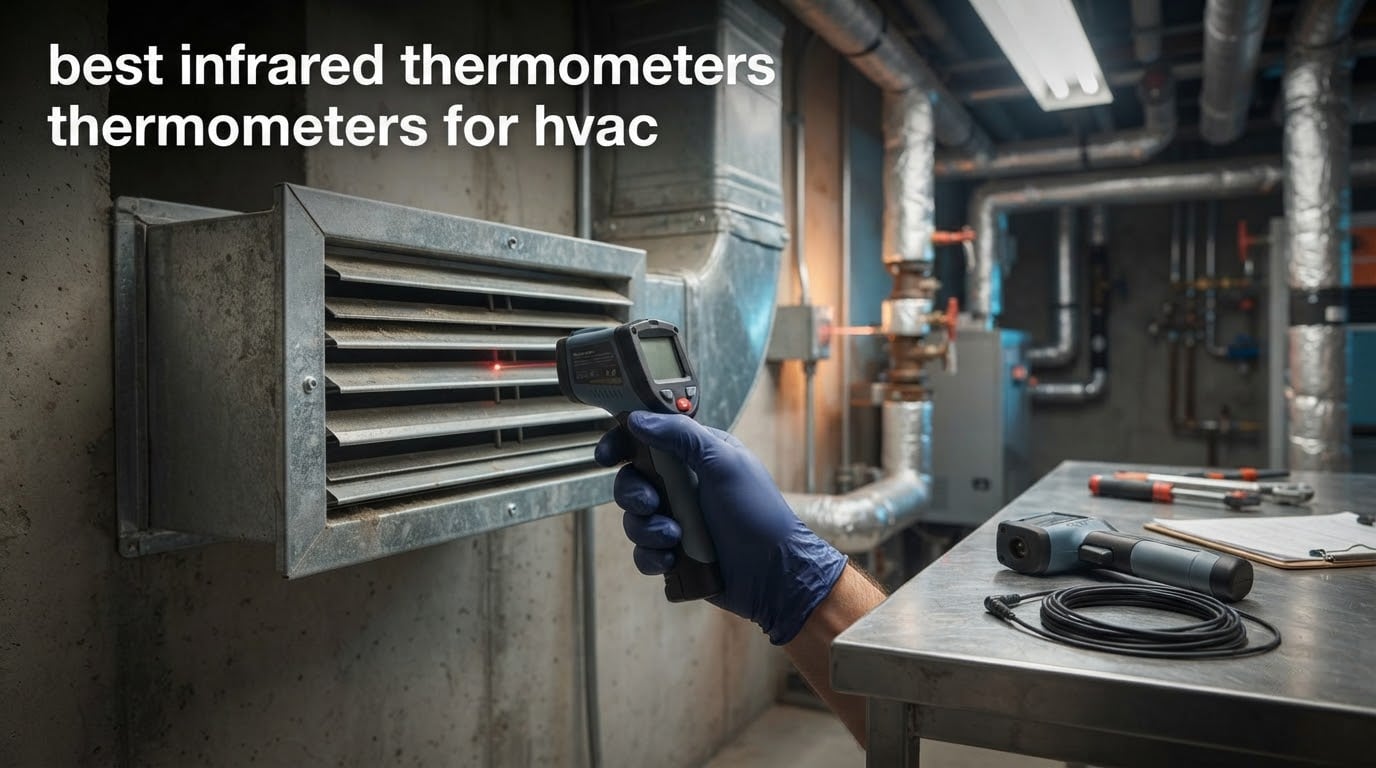
An infrared thermometer for HVAC is a handheld, non-contact temperature gun that senses the infrared radiation a surface radiates and converts it into a surface temperature reading. That lets a technician check ducts, registers, refrigerant lines, insulation, motors and furnace components instantly, from a ladder, without touching hot or moving equipment.
One thing to settle before any of it: an IR gun measures surface temperature only. It does not measure air temperature, and it cannot measure the internal temperature of a refrigerant line. When someone asks what thermometer HVAC technicians use, the honest answer is an IR gun for scanning and a contact probe for the numbers that go on a service ticket. Mixing those two up is where a lot of bad diagnoses start.
Our best overall pick is the Fluke 62 Max, because adjustable emissivity, a 10:1 distance-to-spot ratio and an IP54 housing cover almost every job a field tech meets. Below that we have ranked ten thermometers by the HVAC job they do best, from a pocket dial for a homeowner to a 3632 degree high-heat specialist. If you also need contact-probe readings to go with them, our guide to the best digital thermometers covers that side. Updated for 2026.
Top 3 Picks for HVAC Field Work in 2026

The Fluke sits first because technicians on r/HVAC and hvac-talk keep naming it as the model they stop shopping around for, specifically for dual or single laser pinpointing and adjustable emissivity. The Etekcity is the one most people in those threads already own, and the Klein IR07 is the only tool here that pairs a laser with a real contact probe.
Best Infrared Thermometers for HVAC in 2026
| Product | Specs | Action |
|---|---|---|
 Fluke 62 Max Fluke 62 Max |
|
Check Latest Price |
 Fluke 59 Max+ Fluke 59 Max+ |
|
Check Latest Price |
| Etekcity Lasergrip 1025D |
|
Check Latest Price |
 TempPro TempScan TP30 TempPro TempScan TP30 |
|
Check Latest Price |
 Klein Tools IR1 Klein Tools IR1 |
|
Check Latest Price |
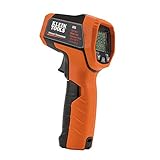 Klein Tools IR5 Klein Tools IR5 |
|
Check Latest Price |
| Klein Tools IR07 |
|
Check Latest Price |
 ennoLogic eT650D ennoLogic eT650D |
|
Check Latest Price |
 Temirup IR05B-RED Temirup IR05B-RED |
|
Check Latest Price |
 CEILSTES Laser and K-Probe Gun CEILSTES Laser and K-Probe Gun |
|
Check Latest Price |
1. Fluke 62 Max: the professional default for duct and component work
Fluke 62 Max Industrial Infrared Thermometer, -22 to +932 Degree F Range, Single Laser Targeting, 10:1 Distance to Spot Ratio, IP54 Rating, Includes 3 Year Warranty, (Not for Human Temp)
Range -22 to 932 F
10:1 D:S with single laser
IP54 and 3 year warranty
Backlit LCD with delta-T
Pros
- Repeatable readings once emissivity is set
- Compact 0.26 kg body clips to a tool belt
- Large backlit display for dark mechanical rooms
- IP54 sealed and 3 meter drop rated
- Shows minimum maximum delta and average
Cons
- Emissivity must be set by hand on shiny metal
- Manual is mostly unannotated cartoons
- Adjustment menus are not explained in the docs
This is the gun I keep in my own truck. It is the one that came up most often when I read technician threads on hvac-talk and r/HVAC about superheat work, and the reason people name it is specific: you can set the emissivity yourself and you can see the spot you are aiming at.
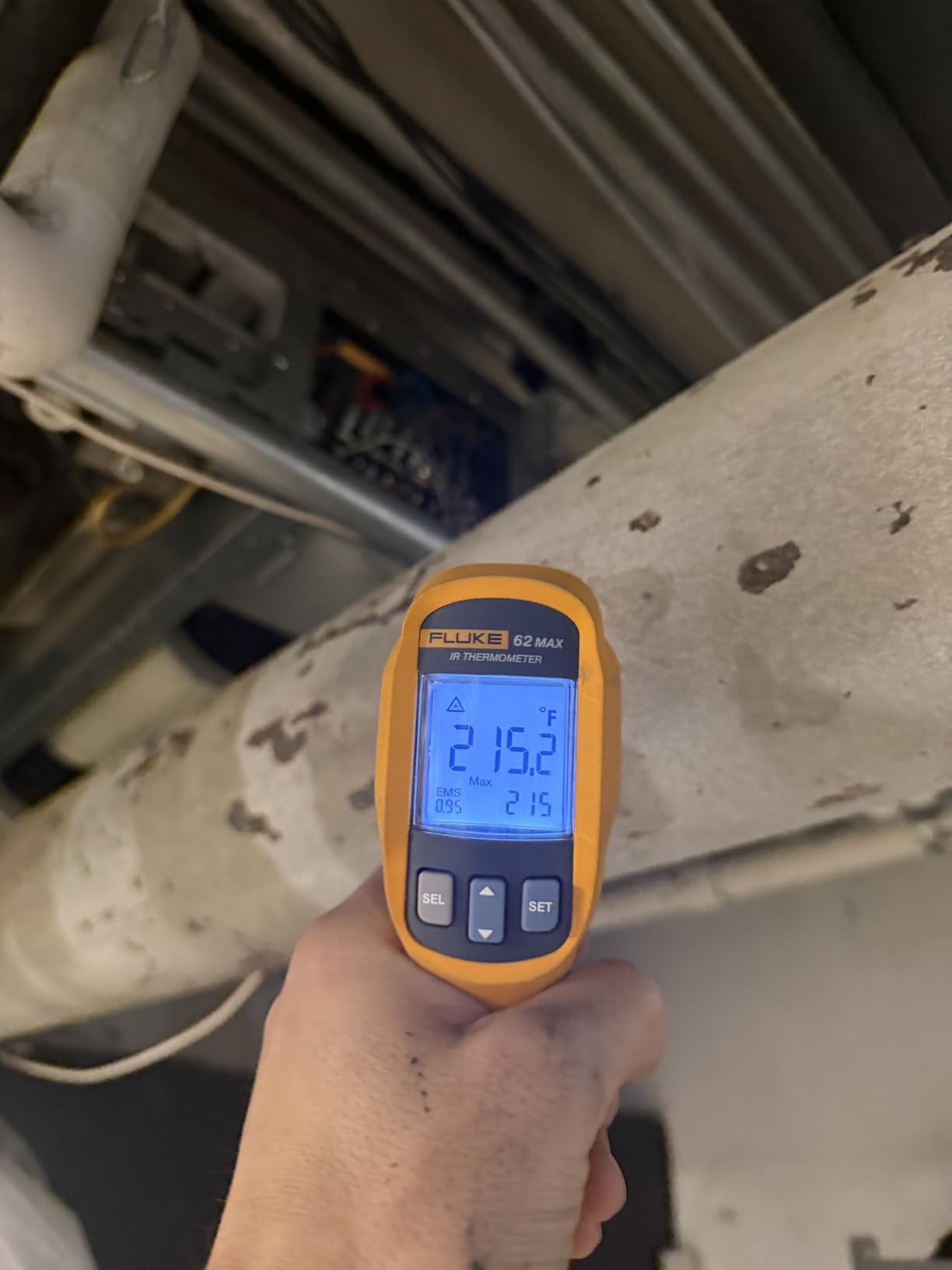
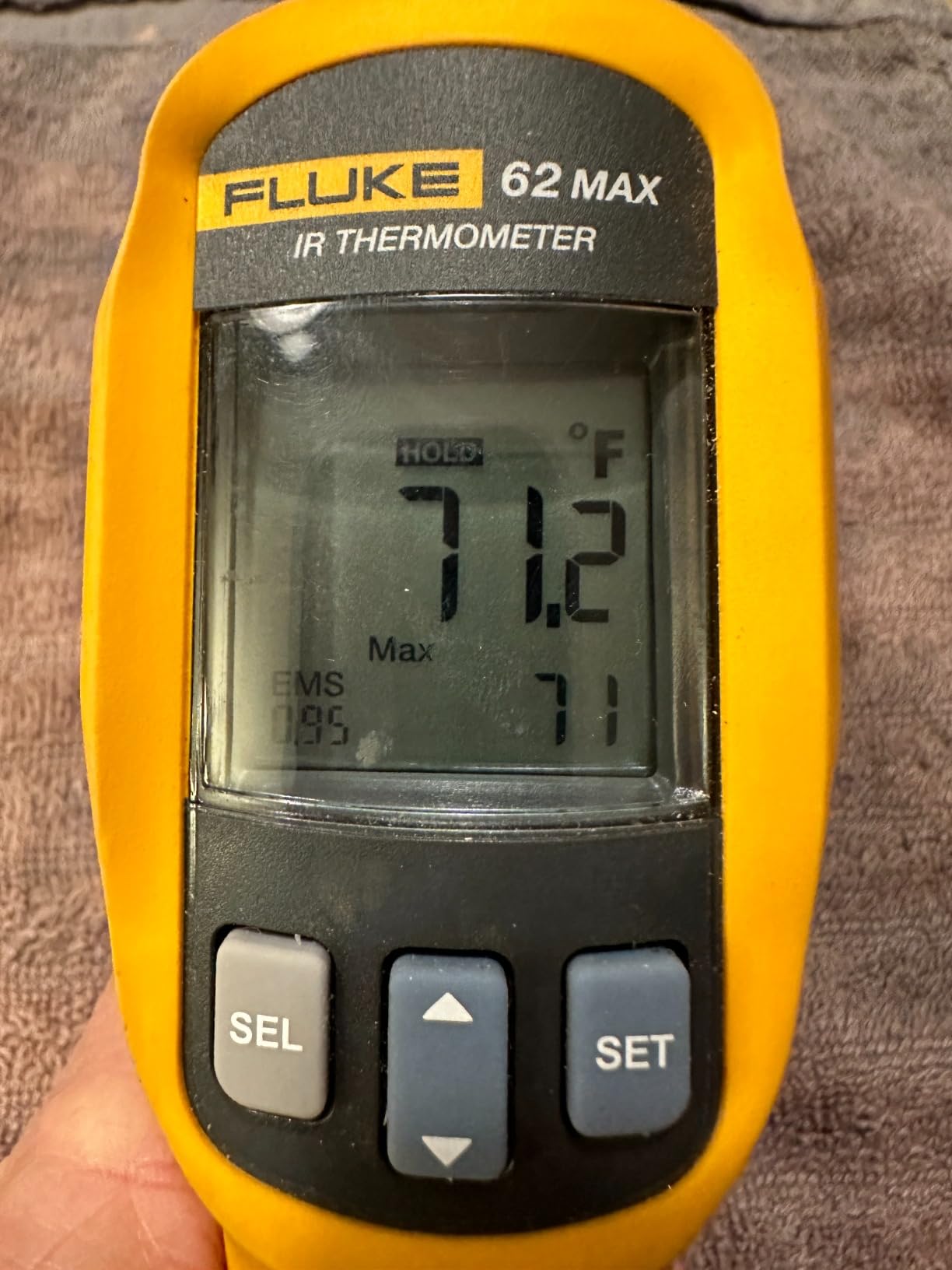
Specs that matter in the field: minus 22 to 932 degrees F, 10:1 distance-to-spot, IP54 for dust and splash, and a three year warranty with NIST as the specification standard. It shows minimum, maximum, delta-T and average, which is exactly what you need when scanning a duct run to find where the temperature falls off. Battery life is listed at 10 hours on a single AA, and the whole thing weighs 0.26 kg.
The honest weakness is documentation. Owners complain the manual is largely unannotated cartoons and that nobody explains the menu needed to change units, alarms or emissivity. You will set that emissivity menu up once, on your bench, and then it becomes muscle memory. The other recurring complaint is simply human error: an unset emissivity on foil-backed duct or bare sheet metal produces a wrong number, and the gun will not warn you.
When the Fluke 62 Max is the right call
Reach for it on a duct temperature survey, a rooftop unit inspection, or any attic or crawlspace job where dust and humidity are part of the environment. The IP54 seal and the drop rating are the reasons it survives contact with real job sites rather than the reasons to buy it for accuracy alone.
When you should pick something else
If your work is mostly furnace temperature rise, a fixed-emissivity pocket gun will not cut it, and if you routinely check flue drafts above 932 degrees F you need a higher range tool. The 10:1 optics also mean you have to stand fairly close to isolate a small supply register, so a wider ratio saves steps on a big grille.
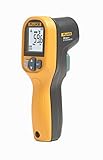
2. Fluke 59 Max+: simpler, smaller, and the pick for boilers and radiators
Fluke 59 Max+ Infrared Thermometer, Yellow, 59 max Plus, 10:1 DTS Ratio, FLUKE-59 MAX+ NA
Range 22 to 932 F
10:1 D:S
IP40 rated
Single AA for 12 hours
Pros
- Consistent readings on boilers radiators and A/C vents
- Large backlit LCD for dark spaces
- Compact enough for a multimeter case
- Backed by a Fluke warranty
- Runs for 12 hours on one AA
Cons
- Battery door needs a screwdriver
- Emissivity table is not built into the unit
- Display shows whole numbers only
The 59 Max+ is the same idea as the 62 Max with less on the spec sheet, and for a lot of hydronic work that is all you need. Energy auditors and installers report dependable readings on boilers, radiators, compressors and A/C vents, and the backlit screen is the reason it works in a dark plant room.
Range is 22 to 932 degrees F, distance-to-spot is 10:1, response is half a second, and it runs for a listed 12 hours on one AA. It is 5 inches long and lighter in the hand than it looks on paper. IP40 covers airborne contaminants rather than splashing water, so I would not leave it in a wet crawlspace.
What I do not like is the small stuff adding up. The battery door is secured with a screw, so if you store the gun without the battery installed, swapping cells is an awkward job. The display rounds to whole numbers, and the emissivity reference list that the manual promises is not actually built into the unit, so you carry your own table or your own memory.
What this one wins
Choose it when your work is heat-side rather than cold-side: boilers, hydronic loops, radiators, flue-adjacent components. Anything in that 22 to 932 degree band reads reliably without ceremony, and the single-AA power means you are not hunting for batteries mid-call.
What you give up
You lose the delta-T and average readouts, the wider temperature floor, and the better sealing. If you are doing insulation audits from a crawlspace you will want the IP54 body instead, and if your diagnostics depend on spotting a 2 degree drop across a coil, whole-number resolution makes that harder.
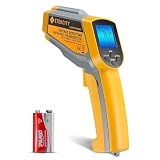
3. Etekcity Lasergrip 1025D: the feature-rich pick pros reach for
Etekcity Dual Laser Infrared Thermometer Temperature Gun, -58°F ~1022°F
Range -58 to 1022 F
12:1 D:S with dual laser
Emissivity 0.1 to 1.0
50 hours on a nine volt
Pros
- Sub second readings that match probe thermometers
- Adjustable emissivity for duct and register surfaces
- Dual lasers and a backlit LCD for dark work
- Handles sub zero and high temperature targets
- Two year Etekcity warranty
Cons
- Build feels cheap with a spongy trigger
- Readings shift if distance changes
- Aiming dot does not match the true spot size
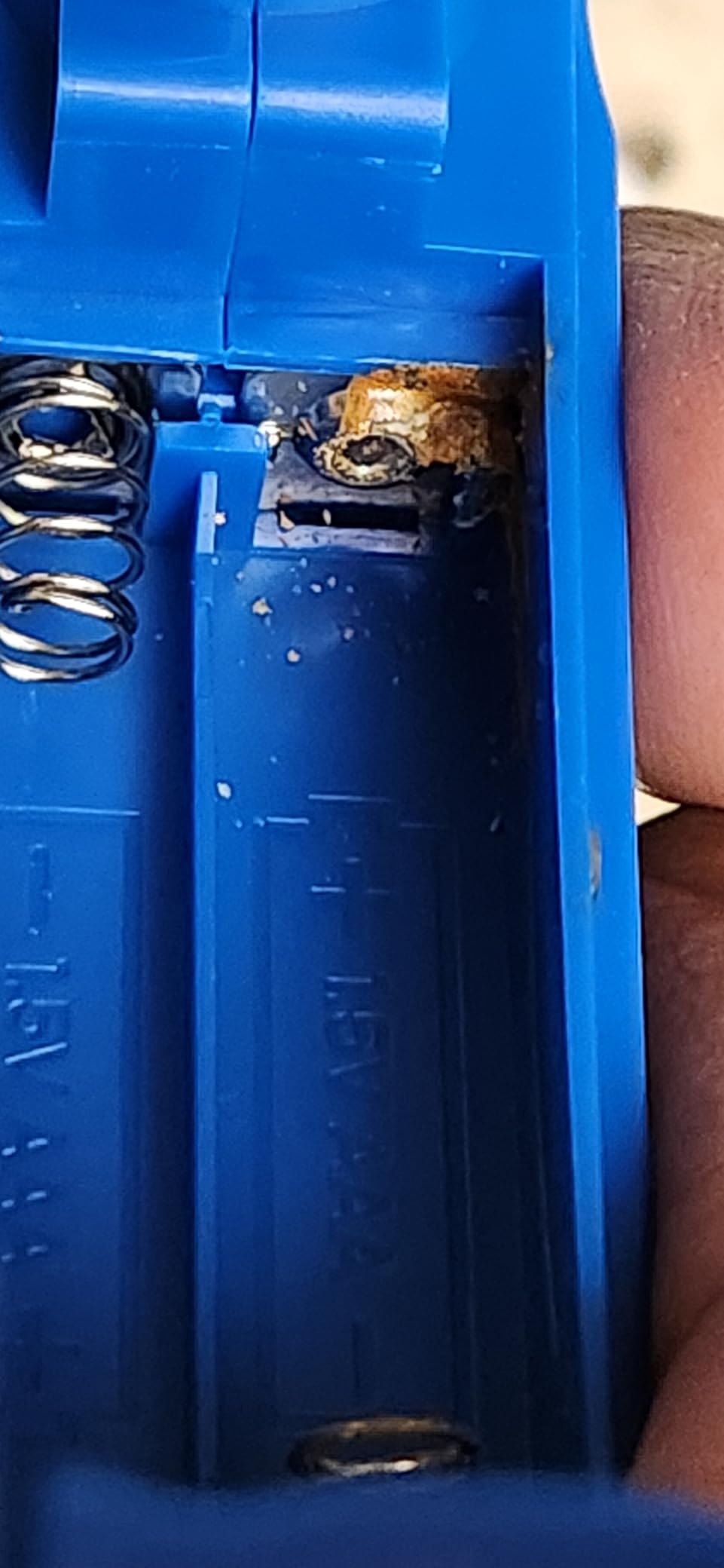
With close to 48k reviews, this is the most-used infrared thermometer on the planet, and for HVAC basics it earns that. People regularly point it at AC return vents and basement cold spots, and the thing that makes those readings usable is the emissivity wheel, adjustable from 0.1 to 1.0.
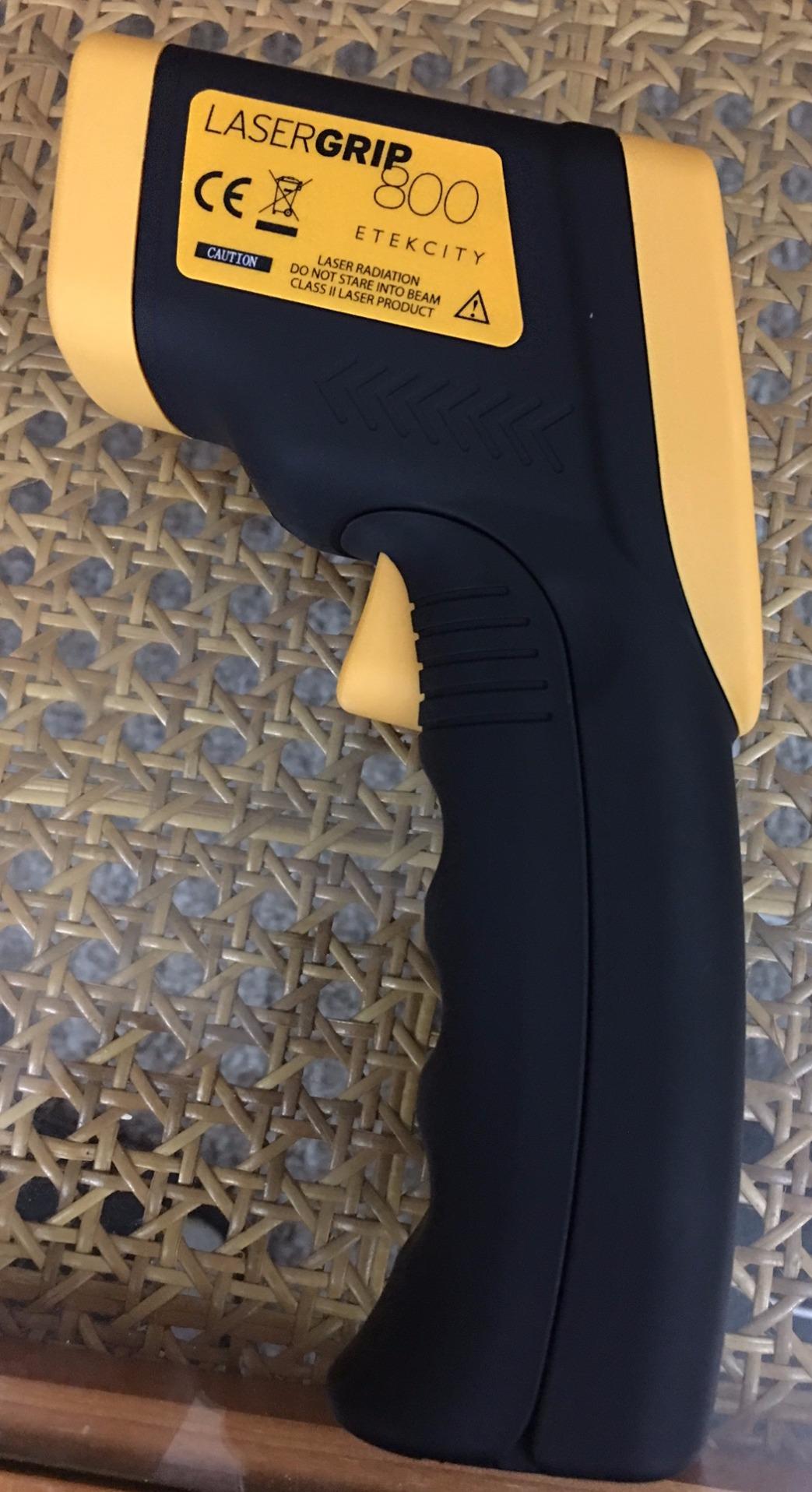
It covers minus 58 to 1022 degrees F, has a 12:1 distance-to-spot ratio with dual lasers, resolves to 0.1 degrees, and responds in half a second. There is a max hold and data hold, a low battery indicator and auto-off, plus a non-contact voltage detection mode that is genuinely handy around a live disconnect. It runs for a listed 50 hours on a 9V battery.
The complaints are consistent and fair: the housing feels cheap, the trigger is short and soft, and readings can shift if you vary your distance. One more that matters on a job site: the single visible aiming dot does not visually match the real sensing spot, so on a mixed surface you can average two temperatures without realising it. If you are new to IR work, pair it with the tape trick below.
Where the Etekcity earns its place
Return-air scanning, insulation spot checks, attic surveys and condenser screening. It is the pick for a growing apprentice or a homeowner who wants adjustable emissivity and dual lasers without stepping up a tier. The 12:1 ratio also reaches a bit further than the 10:1 professional guns.
Where it will frustrate you
It is not a logging instrument: no memory, no alarms, no trend data for a survey. On bare or foil-backed duct it will give you a number you cannot fully correct if you are guessing at emissivity, and the plastic body does not belong in a wet crawlspace. For documentation-heavy work, the ennoLogic further down handles that better.
4. TempPro TempScan TP30: the best value pick for DIY vent checks
TempPro TempScan Infrared Thermometer Gun for Pizza Oven Griddle HVAC
Range -58 to 1022 F
Thermopile sensor at 1.5 percent
12:1 D:S
Backlit LCD
Pros
- Readings match probe thermometers on ice and boiling water
- Max min and average tracking spots hot areas
- Very fast trigger for quick spot checks
- Light 128 g body with a large backlit display
- Adjustable emissivity from 0.1 to 1.0
Cons
- Battery compartment is tight on first use
- Max min average readout cannot be switched off
- Accuracy drops if you change distance
TempPro covers an unusual slice of the market: a real 12:1 ratio and adjustable emissivity on a tool most homeowners buy without thinking twice. When I read reviews comparing it against probe thermometers on boiling water and ice water, the agreement is good enough to trust for a vent check.
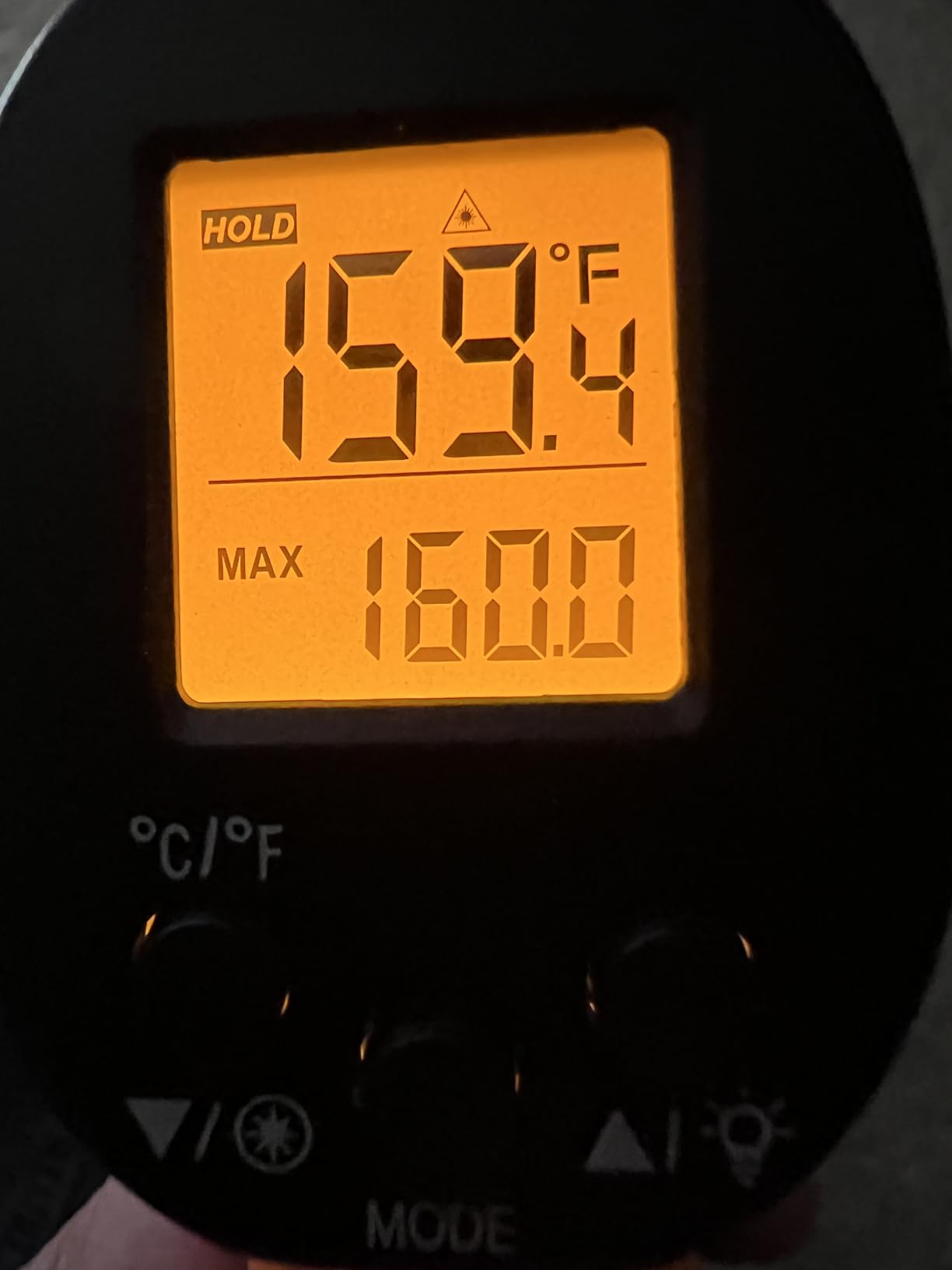
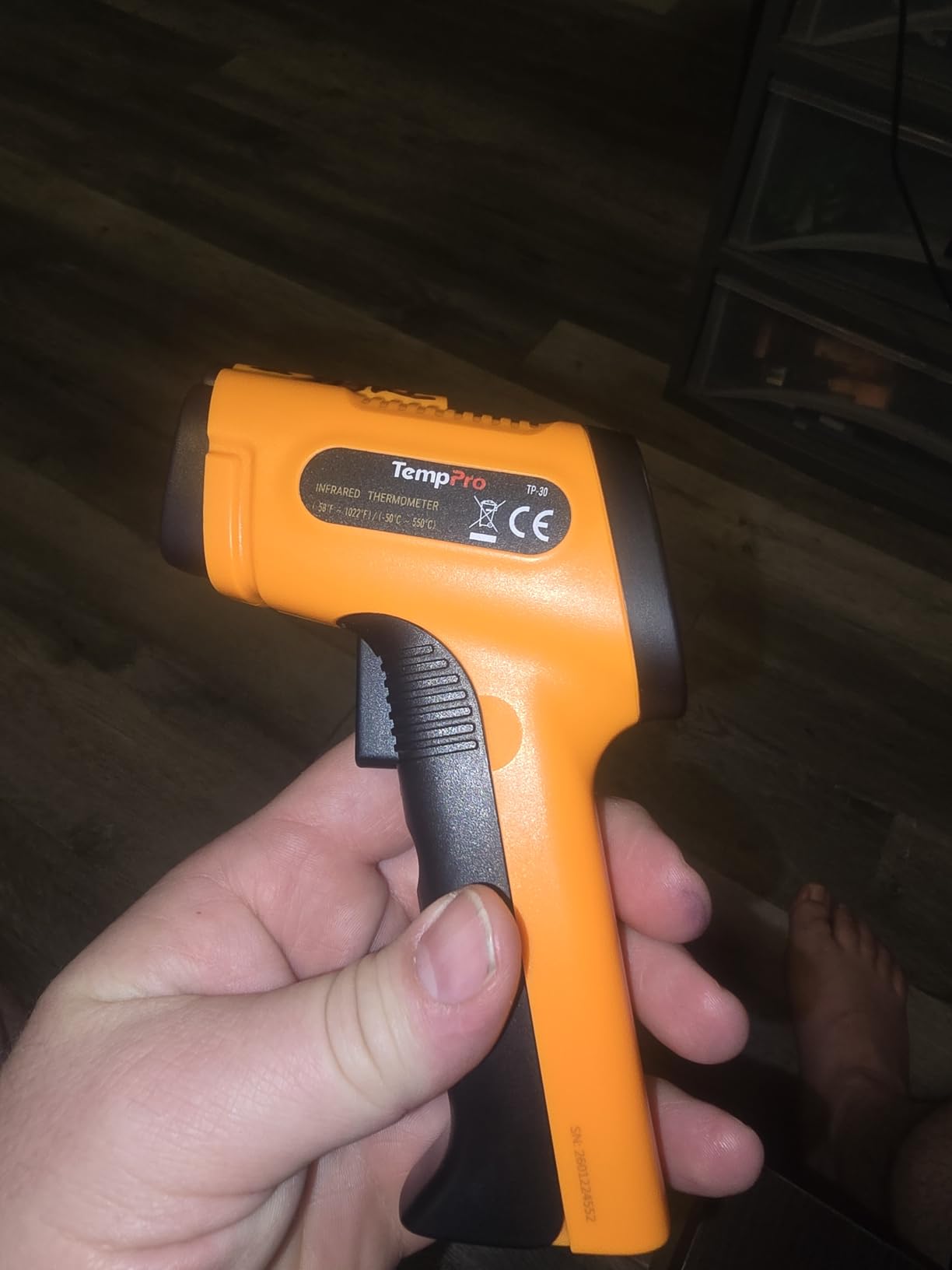
The thermopile sensor is specced at plus or minus 1.5 percent, range is minus 58 to 1022 degrees F, response is half a second, and the display shows maximum, minimum and average of the last scan. It runs on two AA batteries with a 90 second auto shutoff, weighs 128 g and is only 3.74 inches long, which makes it the easiest of this group to live in a pocket.
Two design choices will get under your skin. The battery compartment is extremely tight the first time you open it, and the max/min/avg secondary display cannot be switched off, so two sets of numbers sit on screen at once. Like most 12:1 guns, accuracy degrades if you change your distance mid-reading, and remember it reads surface only, not water temperature.
Why a homeowner should buy this one
It answers the question most people search for: what kind of thermometer can I use to check the temperature of my AC vents. Hold the vents at system start-up, note supply and return, and the max/average recall keeps the numbers on screen long enough to write them down. It is also fine for an oven or a garage griddle later.
What it is not for
There is no probe input, so it cannot confirm what your IR gun reports. There is no IP rating for wet spaces and no calibration traceability on the datasheet, which matters if you intend to write readings into a report. For a professional survey, that lack of documentation is the deciding factor.
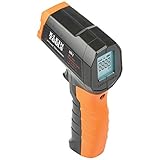
5. Klein Tools IR1: the lightweight pick for home inspectors
Klein Tools IR1 Infrared Thermometer with Targeting Laser, Auto-Hold, More
Range -4 to 752 F
10:1 D:S
Single targeting laser
100 g with pouch
Pros
- Quick accurate readings with a bright display
- Laser pointer simplifies targeting vents and outlets
- Durable housing with 6.6 ft drop protection
- Storage pouch fits a service tool bag
- Instant-on trigger response
Cons
- Fixed 0.95 emissivity
- Shiny metal can read low
- Celsius and Fahrenheit switching is awkward
The IR1 is the tool I hand to someone doing home inspections rather than service calls. At 100 g and just over 6 inches long, with a laser pointer and a custom pouch, it disappears into a bag and does not get in the way on a ladder.
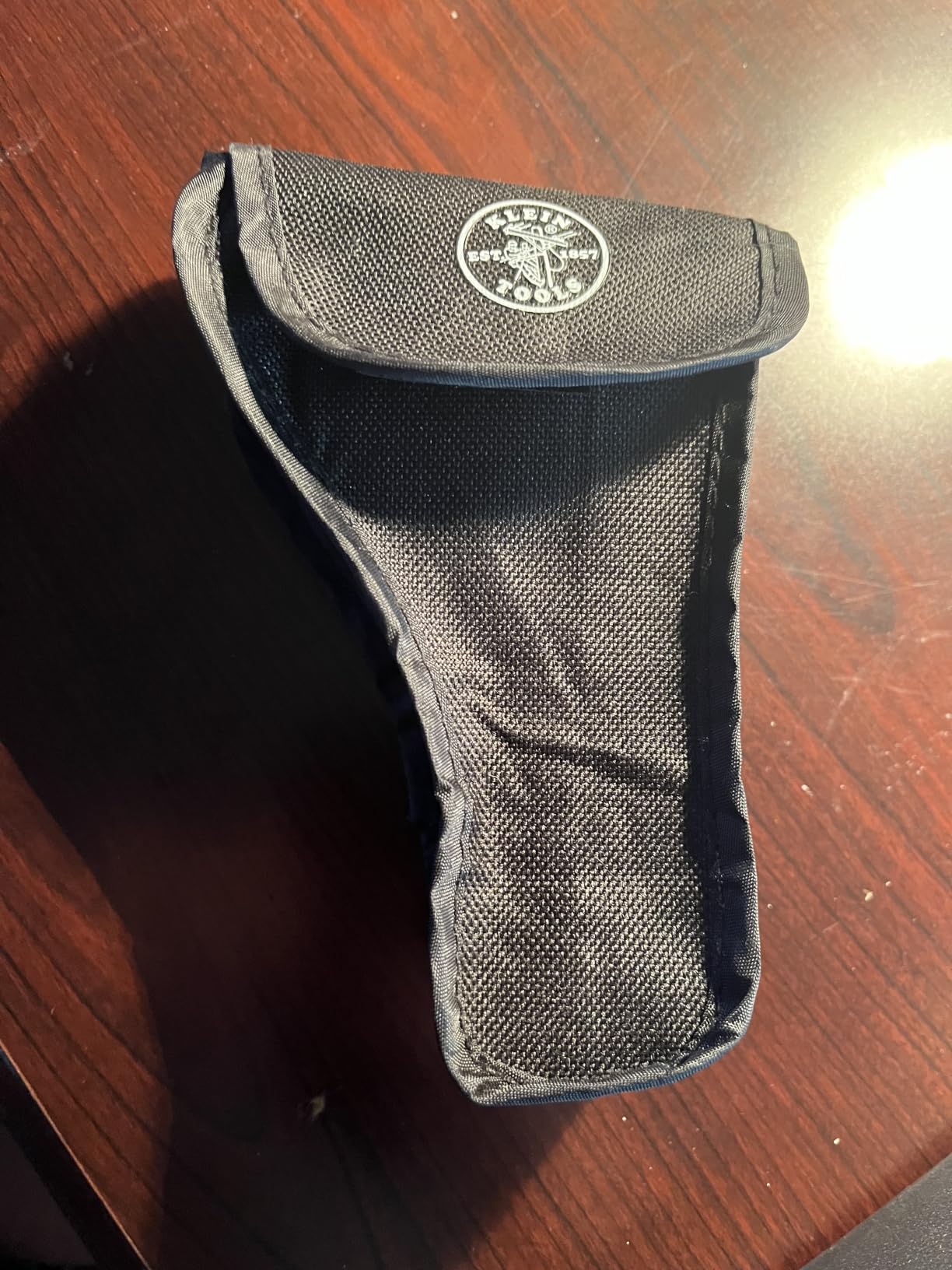
Range is minus 4 to 752 degrees F, optical resolution is 10:1, response is half a second, and it takes two AA batteries. The listing includes 6.6 ft drop protection, which is honest for a tool that will be knocked around in an attic, and the backlit display reads clearly in a dark space. Reviewers specifically cite verifying AC vent output, condenser performance and attic or garage temperatures with it.
The fixed 0.95 emissivity is the whole story here. Painted ductboard and black insulation read fine, but bare metal and foil-backed duct do not, and you cannot correct the error in software. Switching between Celsius and Fahrenheit is also a clumsy two-button operation. If your diagnostic depends on a metal surface, a fixed-emissivity gun will quietly lie to you.
Best fit for quick whole-home checks
Vent output comparison, attic and garage temperature mapping, spotting a hot component on a board, and general comfort complaints. It is also the most comfortable of this group to use one-handed, which matters when you are holding a flashlight with the other.
The limit to plan around
No adjustable emissivity, no probe, no alarms, and no stated accuracy tolerance in the listing beyond implied good behaviour. If your work includes refrigerant lines or bare sheet metal, spend the step up. If it is mostly painted ductboard and air, this is enough and you will notice the price gap less than you think.
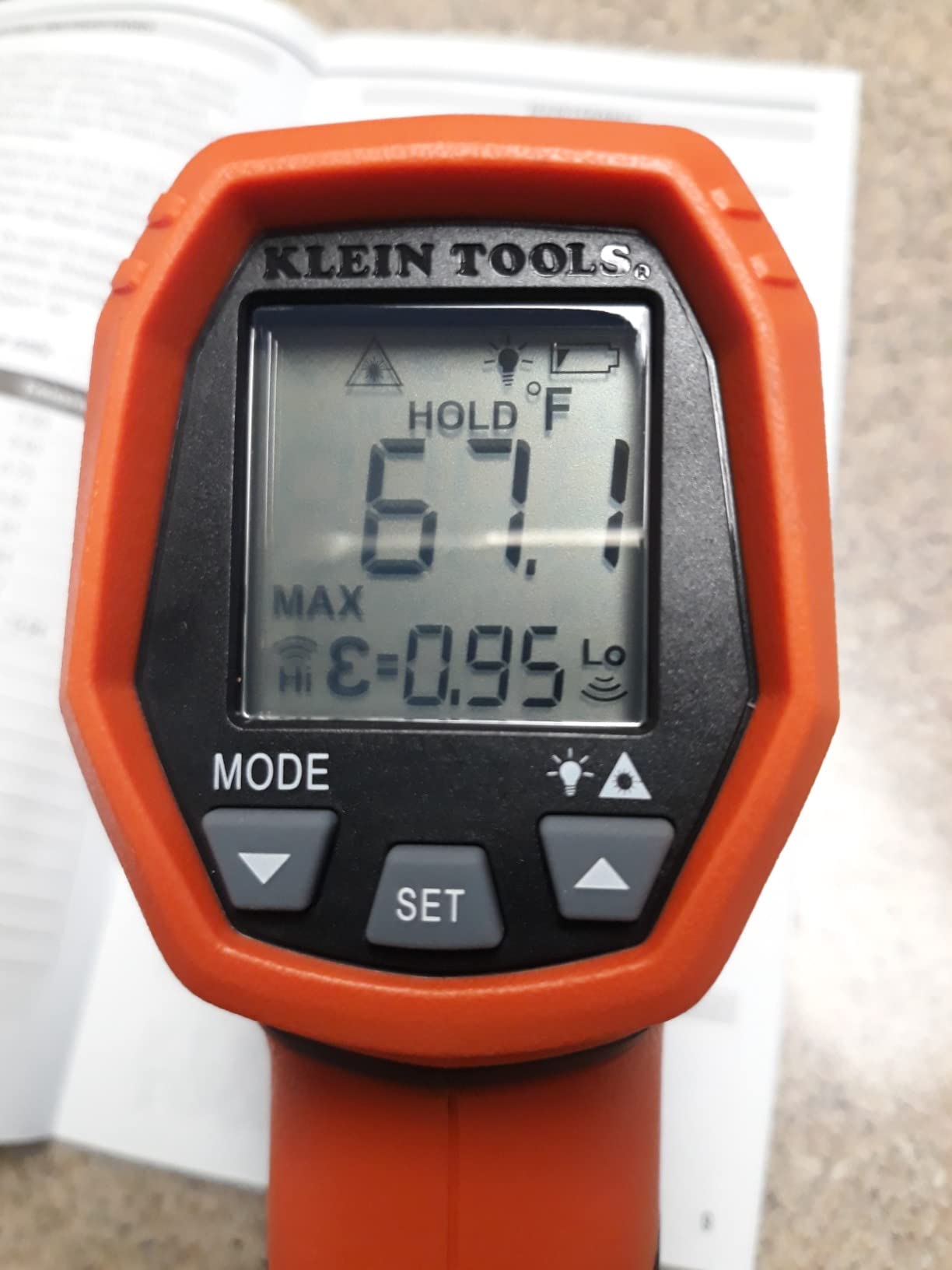
6. Klein Tools IR5: the alarm-driven scan tool for multi-zone checks
Klein Tools IR5 Dual Laser 12:1 Infrared Thermometer, Digital Thermometer Gun with Backlit Display, Dual Laser Targeting and Auto Scan, Wide Temperature Range
Range -22 to 752 F
12:1 D:S with dual laser
High and low audible alarms
Adjustable emissivity
Pros
- Dual lasers mark the exact spot being measured
- Adjustable emissivity works on cast iron and stainless
- Solid heavy build with a protective pouch
- Max min avg diff plus high and low alarms
- Often compared favourably with the Fluke 62
Cons
- Laser spacing is wider than the true 1 inch spot at 12 inches
- Can read a few degrees low against a Fluke 62
- Auto shuts after about 15 seconds with no on/off switch
The IR5 is the version of the Klein pistol I would put in a van for a whole-building scan, because the audible high and low alarms let you sweep a room of registers without watching the display the entire time. You set the thresholds, you sweep, and it beeps at the outlier.
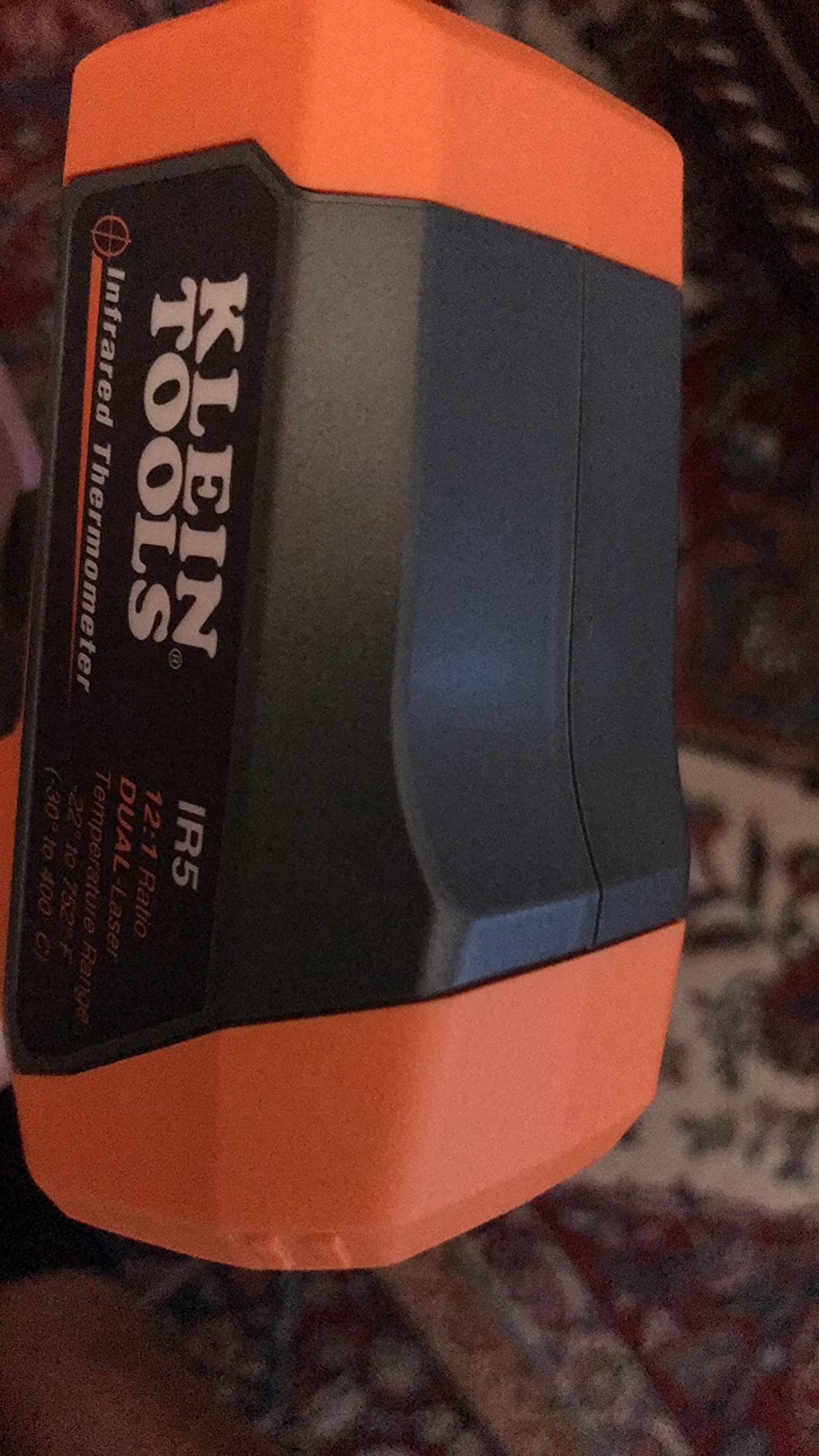
It runs minus 22 to 752 degrees F at 12:1 optical resolution with dual laser targeting, auto scan, max/min/avg/difference modes and a backlit display. Emissivity is adjustable from 0.1 to 1.0, which is what makes it usable on stainless and cast iron. The 6.82 inch body is heavier than the IR1 at 0.3 kg and it ships with a custom pouch and a C cell battery.
The most useful criticism is geometric: at 12:1 the two lasers sit farther apart than the one inch spot they are supposed to bracket, so the frame can be wider than the area being measured. Aim closer than you would think. Some reviewers also found readings a few degrees low next to a Fluke 62, and the unit auto-shuts after roughly 15 seconds with no on/off switch, so a long scan means pressing the trigger.
Where the alarms change the outcome
Multi-zone apartment and office sweeps, supply-air balancing across a floor, and any pass where the technician would rather keep their eyes on the duct run than on an LCD. It also handles cast iron and stainless components where a fixed-emissivity gun fails.
What to watch
Response is listed at one second, slower than most of this list, and the warranty is one year. If you need documented accuracy against a reference instrument, verify on a known surface first. For deep superheat and subcooling work, remember no IR gun of any kind solves that, and a probe input is the real fix.
7. Klein Tools IR07: laser plus contact probe for furnace temperature rise
Klein Tools IR07 Dual Infrared (IR) and Probe Pocket Size LCD Digital Thermometer
Range -40 to 752 F
IR sensor plus contact probe
8:1 D:S
Probe has a hanging hook
Pros
- Only tool here combining a laser with a contact probe
- Very fast response praised in HVACR temperature rise work
- Needs no adjustment for routine vent and duct checks
- Probe hook allows hands free hanging in a register
- Pocket sized at 6.5 inches
Cons
- Screen orientation suits one hand and upsets the other
- Min max and differential modes are confusing to operate
- 8:1 ratio is the widest spot on the list
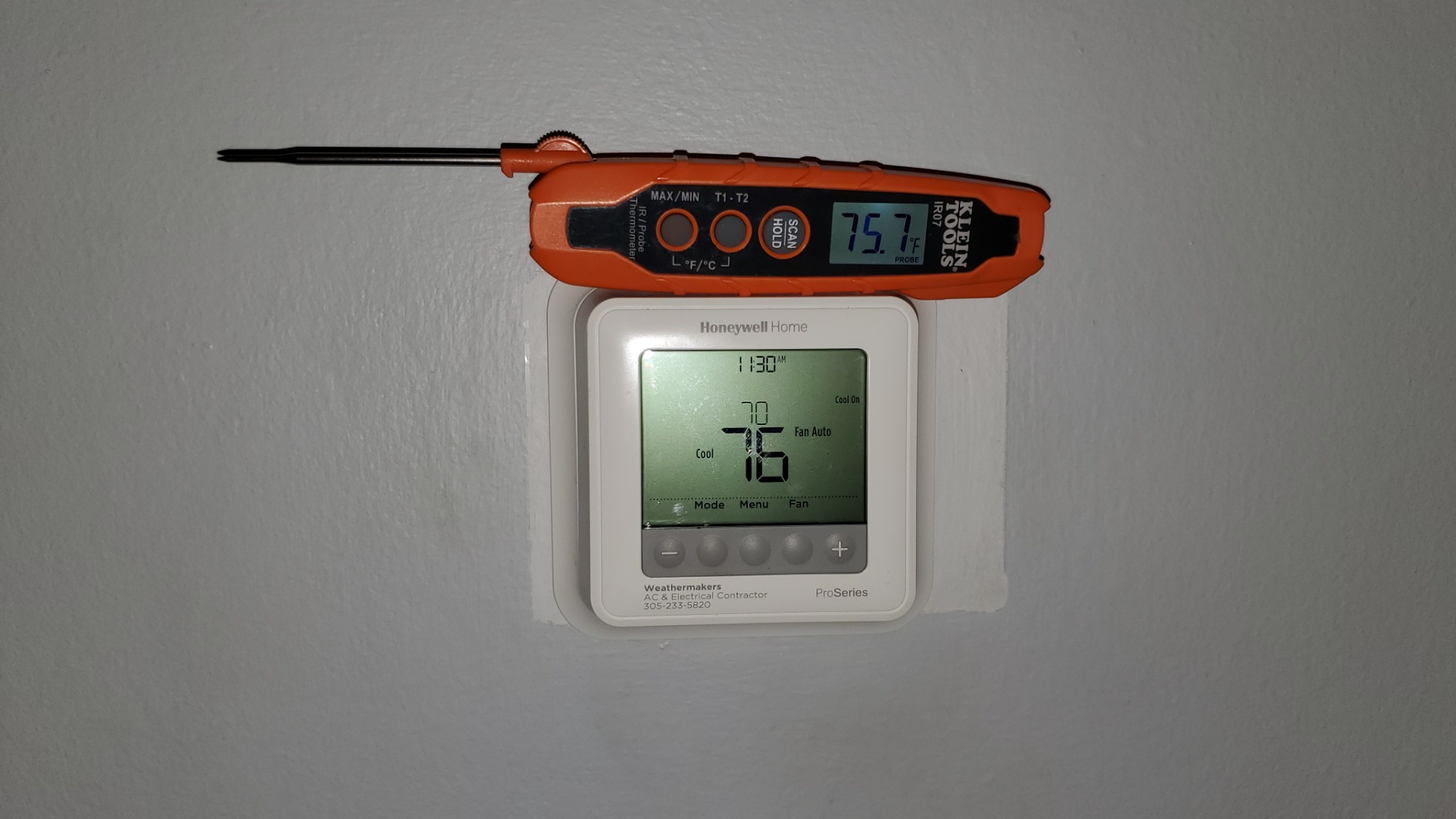
When a question on hvac-talk asks what thermometer to use for superheat calculations, the underlying issue is that you need both a surface reading and a probe reading. The IR07 is the only tool in this roundup that gives you both in one body, which is why I rate it the highest-rated Klein here at 4.7.
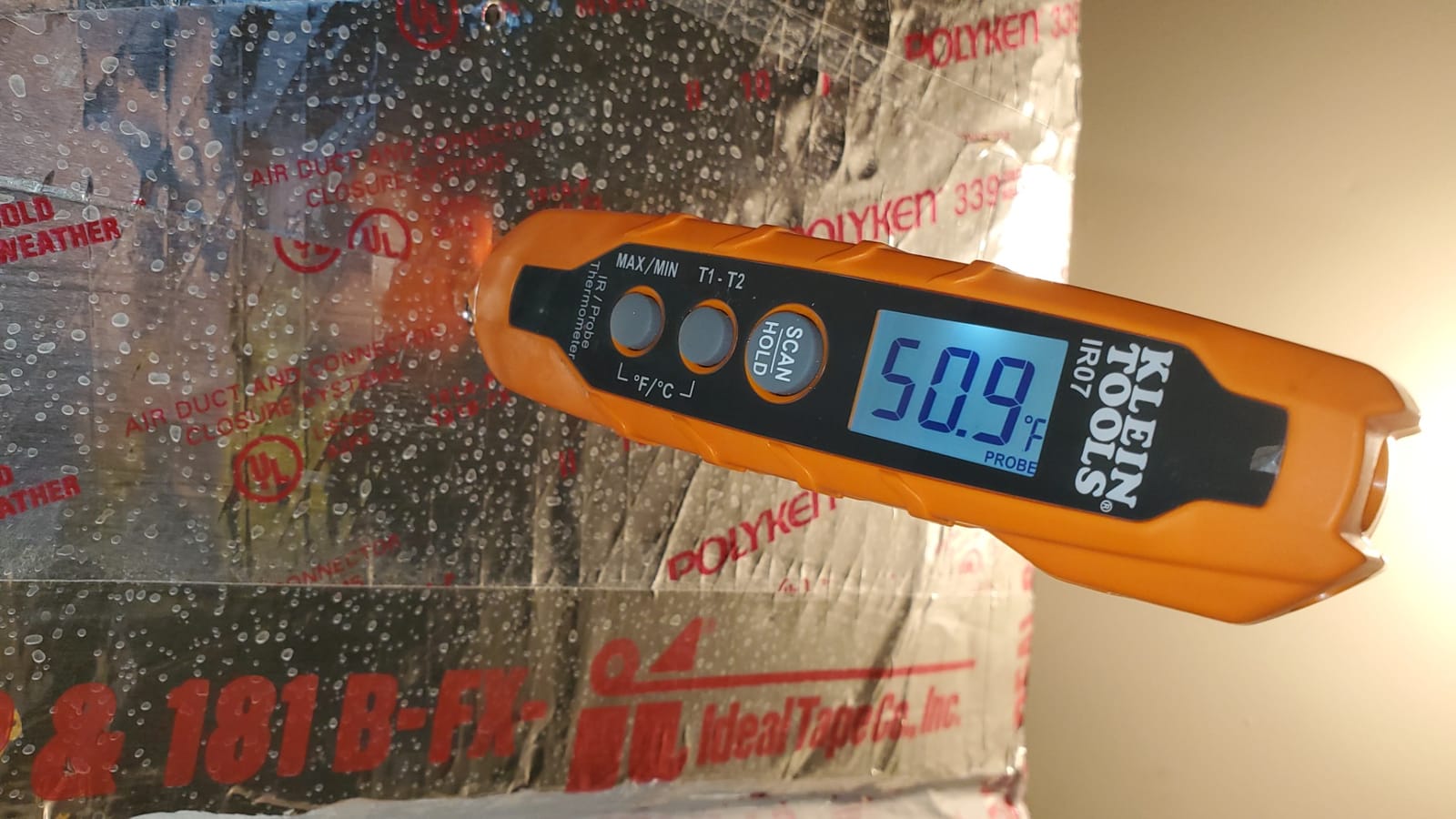
It measures minus 40 to 752 degrees F, combines an 8:1 IR channel with a contact temperature probe, and calculates a differential T1 minus T2 between them. The probe has a hanging hook, so you can leave it suspended in a supply register and read it hands free. Response is half a second, the body is 6.5 inches and 1.44 ounces, and two AA batteries are included with a pouch and manual.
It still cannot measure superheat properly, because superheat needs saturated vapour temperature at the evaporator outlet, not a line surface reading. What it can do is give you the surface number and the internal probe number side by side, which is the comparison a tech actually needs. The two gripes are the screen orientation, which suits one hand only, and min/max and differential modes that are genuinely confusing to operate.
Why the probe hook matters
Hook the probe in a register or duct, leave the gun in your pocket, and take a reading without balancing on a ladder. That single design detail is why this tool shows up in furnace temperature-rise work and why it is also popular in kitchens. The differential mode gives you a delta figure without doing subtraction in your head.
Where the narrow optics bite
Eight to one is the widest spot ratio of any gun here, so on a small refrigerant line or a tight register the spot covers the surface plus its surroundings and the reading softens. Get closer than feels natural, and treat the number as a surface reading rather than a precise one.
8. ennoLogic eT650D: the pick when you need a logged survey
eT650D Temperature Gun by ennoLogic – Dual Laser Non-Contact Infrared Thermometer -58°F to 1202°F – NIST Option Available – Accurate Digital Surface IR Thermometer (Not for Body Temp)
Range -58 to 1202 F
10:1 D:S dual laser
Stores up to 20 readings
10 year warranty
Pros
- Wider range than most rivals
- Memory logging of up to 20 measurements
- Continuous scan plus hands-free mode for surface averaging
- High and low audible alarms with min max avg difference
- 10 year warranty
Cons
- 9V compartment is hard to open and uses dated wiring
- Readings drift if stored cold and may show an error
- Documentation is thin
Memory logging is the feature that separates this from every cheaper gun. You can store up to 20 measurements and walk a rooftop unit or a bank of VAV boxes, then come back to the readings rather than writing numbers on the back of your hand.
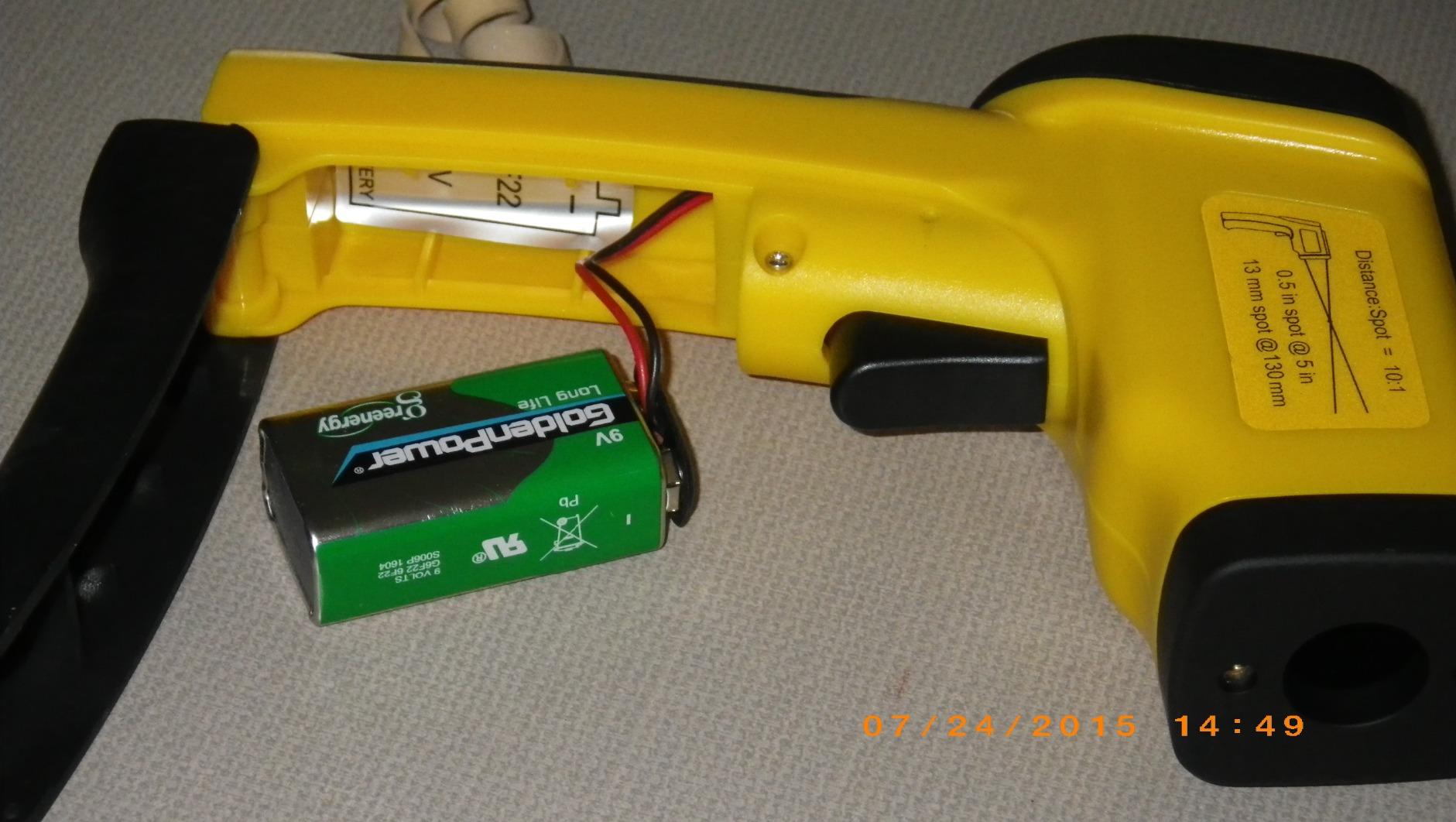
Range runs minus 58 to 1202 degrees F, the widest of the mid-tier units here, with a 10:1 distance-to-spot and dual lasers that can be switched off when you are close. There is scan and hold, a hands-free mode, min/max/average/difference displays and audible high and low alarms. It is 6.25 inches, weighs 5.9 ounces and runs on a 9V battery, with a 10 year warranty behind it.
The 9V compartment is the dominant complaint: hard to open, and the snap connector uses dated wiring. Owners also report drift after the unit has been stored cold, sometimes showing an error until it warms, and slight laser centring variation between units. Buyers verify accuracy against boiling water and an ice slurry and find it holds, which is the reassurance you want before logging data.
When a survey needs a record
Commissioning walkthroughs, RTU inspections, and energy audits where you want a list of readings instead of a memory. The hands-free mode also makes averaging a large surface, like a duct face or a boiler jacket, much easier than a trigger-and-hold approach.
What to verify on arrival
This listing is the non-NIST version, with a certificate variant offered separately, so if traceability matters to your report, buy that option deliberately. Check the 9V door and confirm the batteries are seated, and let the unit reach room temperature before trusting a cold-soaked reading.
9. Temirup IR05B-RED: the high-temperature specialist up to 3632 degrees F
Infrared Thermometer Temperature Gun, -40℉-3632℉, Non Contact Digital Laser Thermometer Pyrometer 50:1 High Temp with Color LCD Display for Industrial HVAC Forge Metal Smelting
Laser range -40 to 3632 F
Type K probe to 932 F
50:1 distance-to-point
Color backlit LCD
Pros
- Far higher maximum temperature than typical HVAC meters
- 50:1 optics reach hot or hard-to-access targets safely
- Type K probe included for contact and internal readings
- Dual laser plus color backlit display captures hot spots in the dark
- High low and difference alarms with data storage
Cons
- Averaging 2 percent accuracy is looser than premium meters
- Probe accuracy of 1.5 percent is typical not lab grade
- Adjustable emissivity must be set correctly on shiny metal
No other gun in this roundup reaches past 1200 degrees F. If you touch forge work, foundry work, high-heat griddles or anything where the target is genuinely too hot to stand near, this is the tool, and the 50:1 optics let you read it from a distance instead of cooking the sensor.
The laser channel covers minus 40 to 3632 degrees F, and the included K-type probe covers 14 to 932 degrees F for internal and contact readings. Optics are 50:1 with dual laser orientation, response is half a second, and there is a large color backlit screen plus min/max/average/difference modes with high, low and delta alarms and data storage. Emissivity is adjustable 0.1 to 1.0, it runs on two AA batteries, and the body is 8 inches long.
Be clear about the accuracy trade: averaging 2 percent on the non-contact side, and 1.5 percent average on the probe. That is fine for spotting a hot spot and not fine for a calibration record. The resin and TPE housing also feels a step below the machined professional bodies, and at 8 inches it is not a pocket tool.
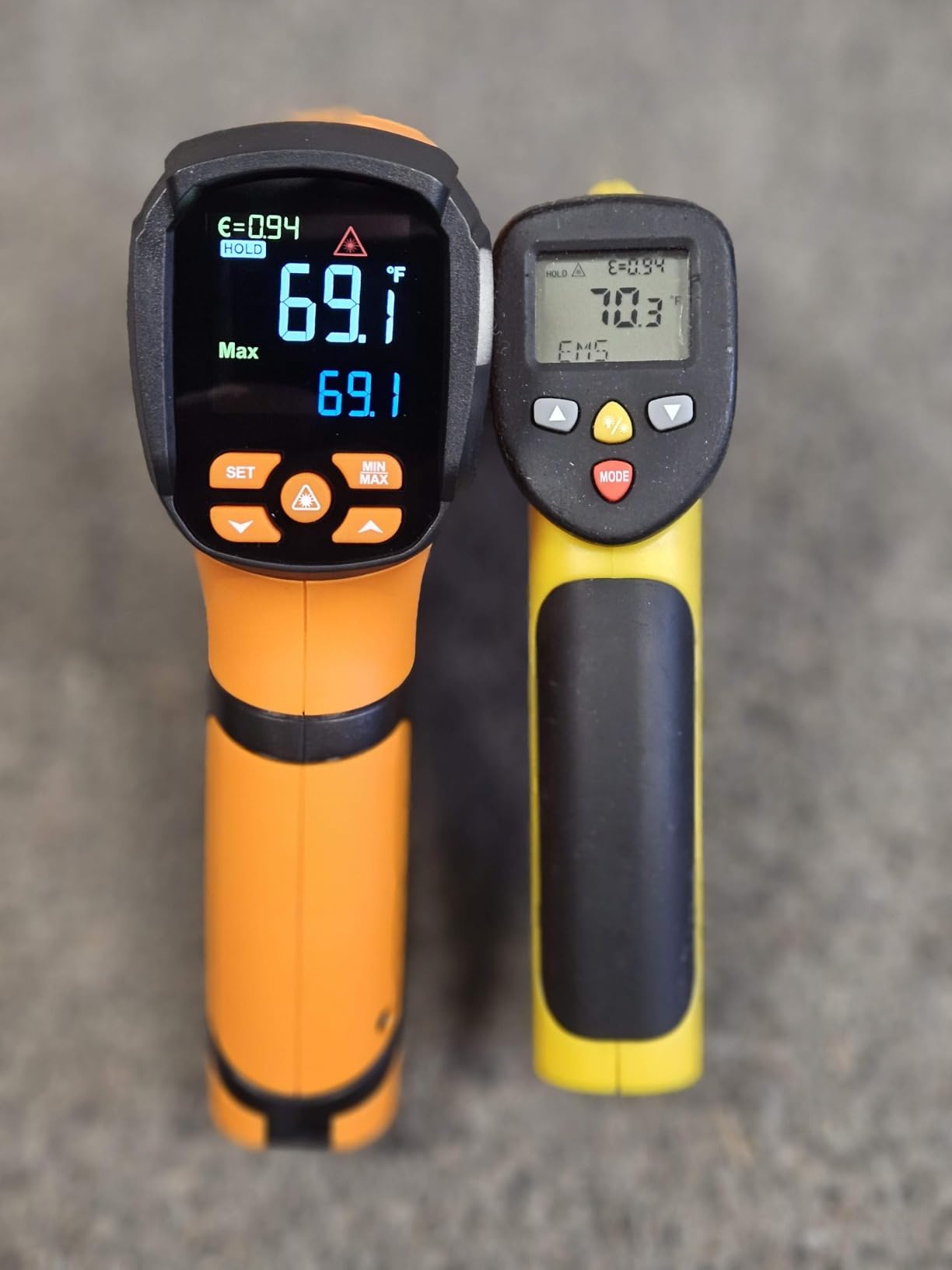
When nothing else reaches the target
Furnace and boiler hot surfaces, high-heat process work, foundry and forging, and any inspection where the target is above 1200 degrees F. The 50:1 ratio is also the most forgiving here for reading a distant surface, and the included K-probe adds a contact channel many rivals in this range lack.
Where precision work belongs elsewhere
If you are chasing a 2 degree difference across a coil, 2 percent average accuracy is too loose to argue about, and the fixed-looking plastic build will not survive a van as well as a sealed professional body. Use this one for range, and use a tighter meter for differential work.
10. CEILSTES Laser and K-Probe Gun: the inexpensive combination
CEILSTES Infrared Thermometer Gun, Non-Contact Digital Laser Temperature Gun, -58°F to 1076°F, Adjustable Emissivity and Max/Min Values for Industrial, Cooking, Griddle,Engine, HVAC (Not for Human)
Laser -58 to 1076 F at 2 percent
K probe to 1562 F at 1.5 percent
13:1 D:S
Adjustable emissivity
Pros
- Non-contact and K-probe in one inexpensive package
- Probe is within about a degree of a reference probe
- Large screen stays readable in bright light
- Comfortable weight and simple operation
- Audible and LED high low alarms flag out of range temps
Cons
- Build quality is basic
- Not rated for body or animal temperature
- 2 percent non-contact accuracy is modest
This is the entry point for someone who has just realised that an IR gun alone cannot answer their question. The included K-type probe runs to 1562 degrees F on the contact side, which is a range most cheap guns cannot touch, and the 13:1 ratio is wider than the 10:1 professional units.
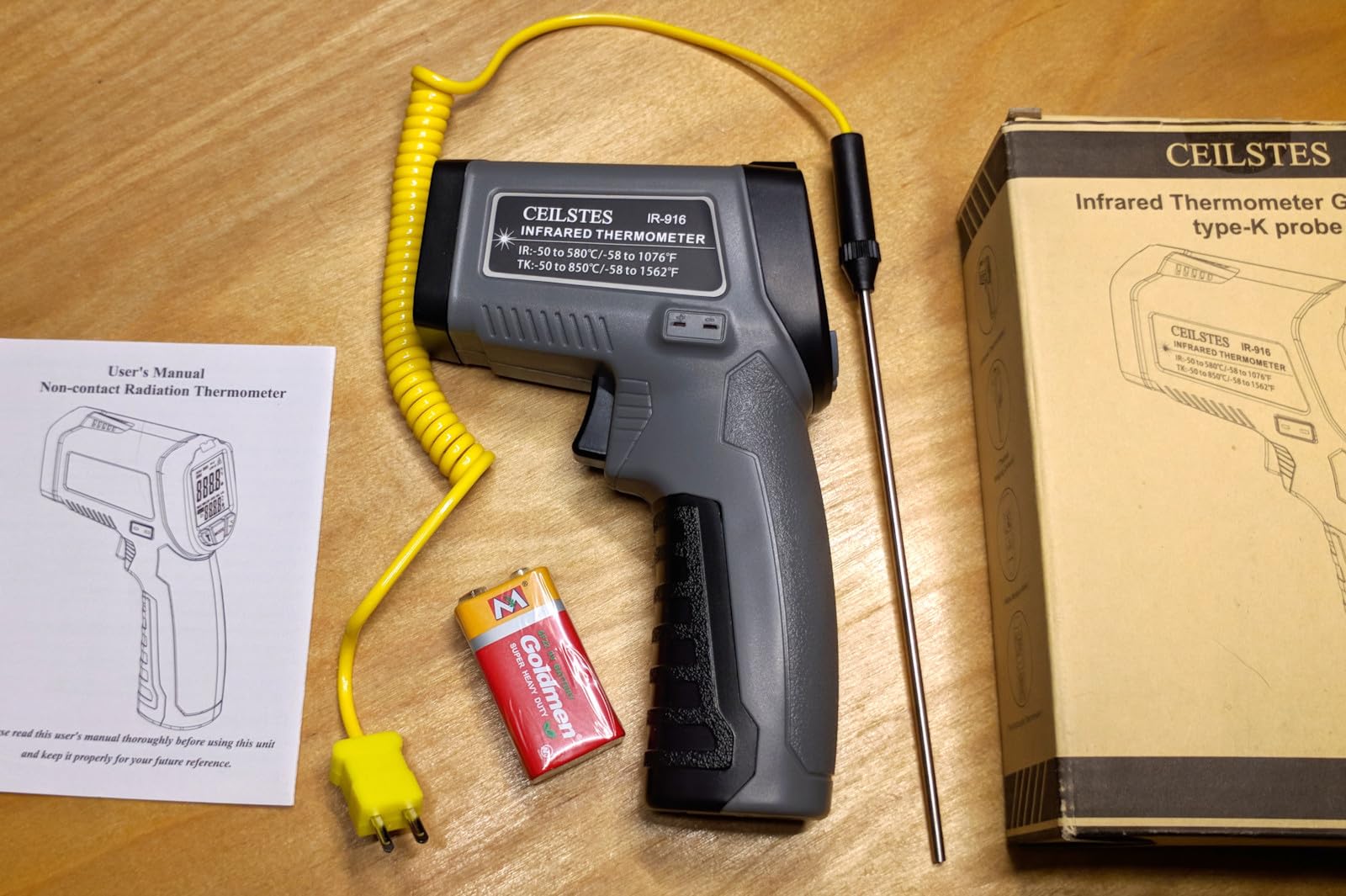
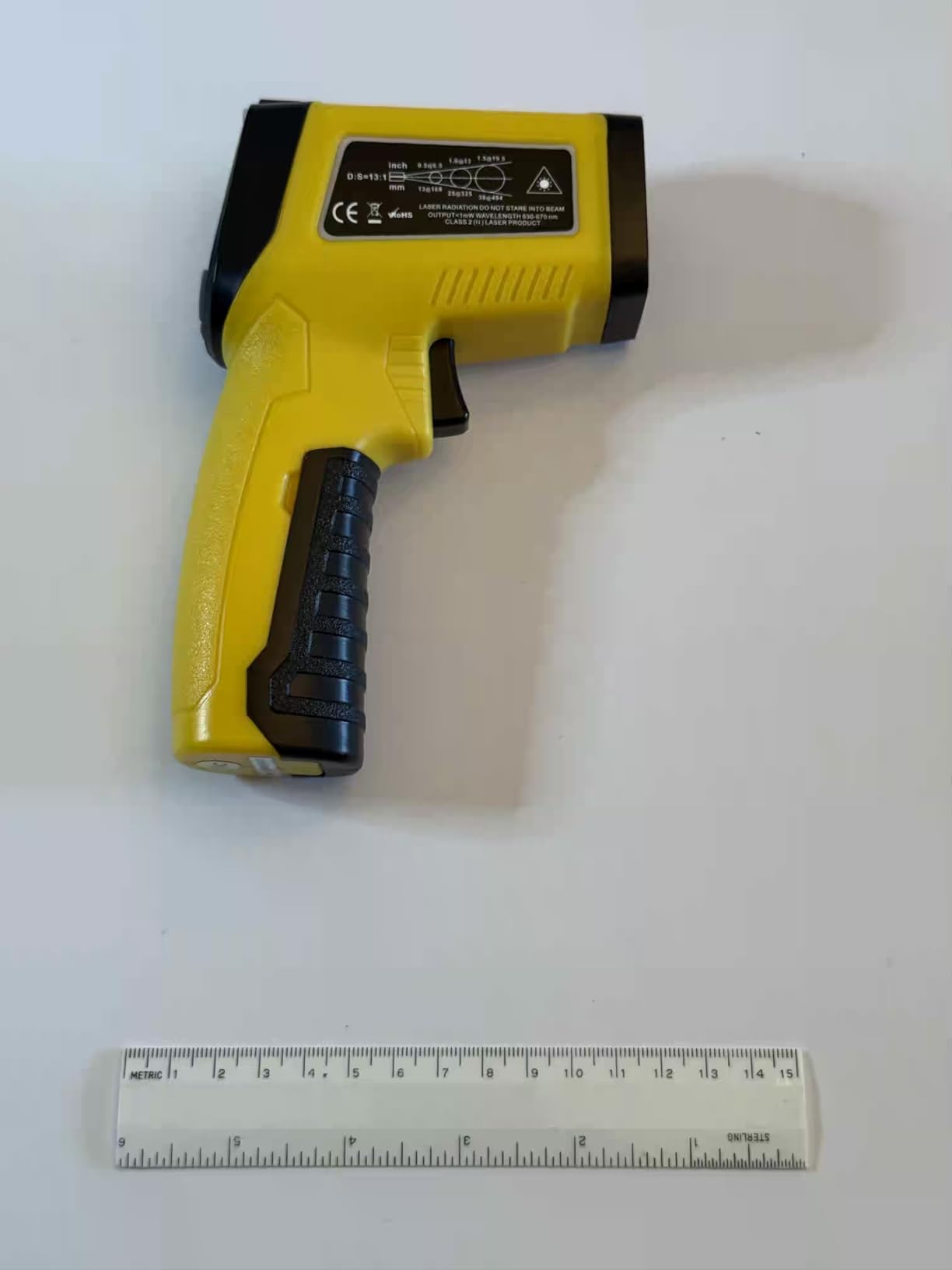
The laser channel measures minus 58 to 1076 degrees F at plus or minus 2.0 percent, and the probe measures minus 58 to 1562 degrees F at plus or minus 1.5 percent, both responding in under half a second. Emissivity adjusts from 0.1 to 1.0, and there are audible and LED high and low alarm thresholds. The body is 6.5 inches and runs on a single 9V battery.
Its review base is small, so treat the feedback as thinner than the others here. The recurring notes are basic build quality, a slightly slower power-up than competing guns, and modest 2 percent non-contact accuracy, which again makes it a spotting instrument rather than a reference one. Mechanics and technicians do like the probe as the standout feature.
The case for it
If your diagnostic needs a surface number and an internal number, this puts both in one case at a fraction of the cost of a professional combination tool. The alarm thresholds are useful on a static running system: set a band, start the equipment, and listen for the beep.
Where you should spend more
There is no stated accuracy traceability, no IP rating, and a build that will not survive being dropped in a van every day. If this is a learning tool or a secondary backup gun, it is a sensible buy. If it is your primary instrument for a paid service call, put the money into a sealed body with a stated warranty and calibration standard instead.
How to Check AC Vent and Duct Temperature Delta With an IR Gun
Temperature delta is supply air temperature minus return air temperature, and on a healthy split system it typically lands between 15 and 22 degrees F. A number well under that points at low airflow, a clogged filter, or undersized ducts; a number well over it usually points at a refrigerant or coil problem. It is the fastest diagnostic a thermostat-based system supports.
Start the cooling system and let it run for at least 15 minutes so temperatures stabilise.
Set your infrared thermometer emissivity for the surface you are reading. Painted ductboard is around 0.95; shiny metal needs the tape method described below.
Stand close enough that the measurement spot fits inside the register or grille. A 10:1 ratio means the spot is about one tenth of your distance, so at 3 feet the spot is roughly 3.6 inches across.
Aim at the air moving across the face of the supply register and record the reading. Aim at the metal grille itself and you are measuring duct metal, which tells you nothing about airflow.
Move to the return grille on the same floor and record that reading the same way.
Subtract return from supply. Note the outdoor humidity and whether the system has run long enough to reach steady state before you decide anything.
One caution: an IR gun aimed into a return grille is reading the air stream only because that air is passing over a surface near the sensor cone. For a true air temperature, use the probe channel of a tool like the Klein IR07 or a proper duct temperature sensor.
IR Thermometer vs. Thermal Imaging Camera: Which One Do You Need?
A thermal imaging camera and an infrared thermometer are not the same thing, despite the interchangeable nicknames. A pyrometer, which is what every gun on this page is, gives you one number for one spot at one instant. A thermal imager builds a picture of thousands of points across a surface and shows you the pattern. An IR camera and a thermal camera are the same device described two ways.
For HVAC, the honest framing is this: the gun is the everyday carry tool and the imager is the upgrade path. Practitioners on r/HVAC increasingly recommend an imager for diagnostics, but the cost puts one out of reach for most techs, and none of the ten guns here will ever show you a heat map.
Is a thermal imaging camera worth it? If you do insulation audits, find failing motor and bearing hot spots, trace duct leakage across a run, or commission equipment repeatedly, an imager pays for itself in time saved. If you mostly answer calls about vent temperatures and short cycling, a gun with adjustable emissivity is the smarter spend. For a broader look at how these tools compare to contact probes, our digital thermometer guide covers the probe side of the decision.
On brand, technicians treat the big instrumentation names as the safe professional answer, and thermal imaging is the area where that matters most because detector quality, thermal resolution and software all affect the result. Whichever you choose, remember the same rule applies to both: a surface with the wrong emissivity produces a wrong picture, not just a wrong number.
What to Look for in an HVAC Infrared Thermometer
Distance-to-spot ratio. D:S describes how much larger the sensing spot is than your target at a given distance. A 10:1 gun has a one inch spot at 10 inches. This is the single most misunderstood spec in the category, and a cheap 8:1 or 12:1 gun physically cannot isolate a three quarter inch suction line or a narrow register from normal working distance. Aim closer than instinct suggests.
Adjustable emissivity. Emissivity is how efficiently a surface radiates infrared energy, and HVAC surfaces vary wildly: painted ductboard reads close to 0.95, while bare sheet metal, foil-backed duct and registers sit far lower. A fixed 0.95 setting means uncorrectable errors on shiny metal, which is why technician forums treat fixed emissivity as a deal breaker. Every gun here except the Klein IR1 has an adjustable range.
Temperature range. Standard HVAC work needs roughly minus 40 to 1000 degrees F. High-heat work around forges, boilers and flues needs far more, and the one gun here that covers it reaches 3632 degrees F. Check the low end too, since attic and crawlspace work in winter happens in genuinely cold conditions.
Probe input. A Type K or contact probe channel is what turns a surface tool into a diagnostic tool. It lets you measure inside a vent or duct, and it is the only way to get the internal refrigerant number that an IR gun cannot reach. Two of the ten units here ship with a probe.
Laser type. A single laser is a pointer only. Dual lasers bracket the actual sensing spot, so you can see the area being averaged rather than guessing. Practitioners repeatedly praise dual lasers for exactly this reason, and on a mixed surface the difference between the two is the difference between a diagnostic and a guess.
Build, sealing and power. For attic and crawlspace work, look for an IP rating and a stated drop rating, and check battery life against a long day of cold-weather reading. A gun that auto-offs too aggressively will interrupt a survey halfway through.
Accuracy specification and traceability. Look for a stated tolerance rather than a marketing claim, and prefer a unit that names NIST as its specification standard. Forums repeatedly complain about no-name meters whose ratings do not survive scrutiny, and a datasheet is the fastest way to tell the two groups apart.
Mistakes That Ruin an IR Reading
Aiming at glass or a mirror. Both are highly reflective and return the temperature of the reflected surface, not their own. Aiming at a window tells you about whatever is behind the camera.
Leaving emissivity at the default. On shiny metal the reading will be wrong, and on a fixed-emissivity gun it will be wrong with no way to correct it.
Standing too far back. Once the spot spills over onto the wall or the duct board, you are averaging two temperatures and getting a number that means nothing.
Mixing ambient and surface readings. Shooting the return grille in an empty room rather than during a running cycle produces a delta that will send you chasing a fault that is not there.
Reading a sun-exposed surface. A south-facing exterior wall in the afternoon can read 40 degrees or more above the air temperature, and that is solar gain, not a loss or gain in the envelope.
Skipping the tape trick. Put a strip of black electrical tape or matte black paint on the surface, let it reach the same temperature as the metal, and aim at the tape. Known high-emissivity surface, reliable number.
Homeowners buying an infrared heater for a garage or a workshop should also know the rule carries over. To see our picks for infrared heaters, and for the difference between heating a room and diagnosing a cooling problem, see the split above.
Frequently Asked Questions
What thermometer do HVAC technicians use?
Most technicians carry a handheld infrared thermometer for surface scanning and pair it with a contact probe or clamp meter for internal readings. The Fluke 62 Max is the most frequently named professional model in technician discussion because of adjustable emissivity and laser pinpointing. No single tool covers every job, so the common kit is an IR gun plus a probe input model like the Klein IR07.
Which brand of infrared thermometer is the best?
For professional HVAC work, Fluke is the most common answer because of build quality, stated accuracy tolerances and long warranties. For value, Etekcity and TempPro cover adjustable emissivity and 12:1 optics at far less money. Klein Tools is the strongest choice when you need a contact probe in the same tool. Choose on range, D:S ratio and emissivity adjustability rather than brand alone.
What is one of the negatives of the infrared thermometer?
The biggest limitation is that it measures surface temperature only. It cannot read air temperature, the internal temperature of a refrigerant line, or superheat and subcooling values, because those need a contact probe or a pressure-temperature calculation. Accuracy also degrades on shiny or low-emissivity surfaces unless you set emissivity correctly.
What kind of thermometer can I use to check the temperature of my AC vents?
A handheld infrared thermometer with adjustable emissivity and a narrow spot, or at least a 10:1 distance-to-spot ratio, is the right tool. Start the cooling system, aim at the air stream crossing the supply register, then measure the return grille on the same floor, and subtract return from supply. A healthy split system typically shows 15 to 22 degrees F of delta.
Why does my infrared thermometer read wrong on metal?
Bare metal, foil-backed duct and registers have low and variable emissivity, so they reflect surrounding infrared energy instead of radiating their own temperature. The gun reports that reflected energy and a low reading. Fix it by setting the correct emissivity value, and for shiny surfaces put black electrical tape or matte paint on the target, let it settle, and measure the tape instead.
Can infrared thermometers measure air temperature?
No. An infrared thermometer senses radiation from a surface, so it reports surface temperature. The reading you get aiming into a vent only approximates air temperature because moving air passes over a surface in the sensor cone. For true air temperature, use a contact probe, a duct temperature sensor, or a properly positioned thermo-anemometer.
The Verdict
The Fluke 62 Max is our best infrared thermometer for HVAC pick in 2026 because it does the three things that matter on a job site: adjustable emissivity, laser pinpointing, and an IP54 body that survives the environment. The Etekcity Lasergrip 1025D covers the same core features for anyone working to a tighter budget, and the Klein IR07 is the pick when a contact probe matters as much as a laser.
Whatever you choose, set the emissivity before you trust the number, and keep a contact probe in the bag for the readings an IR gun cannot make.